
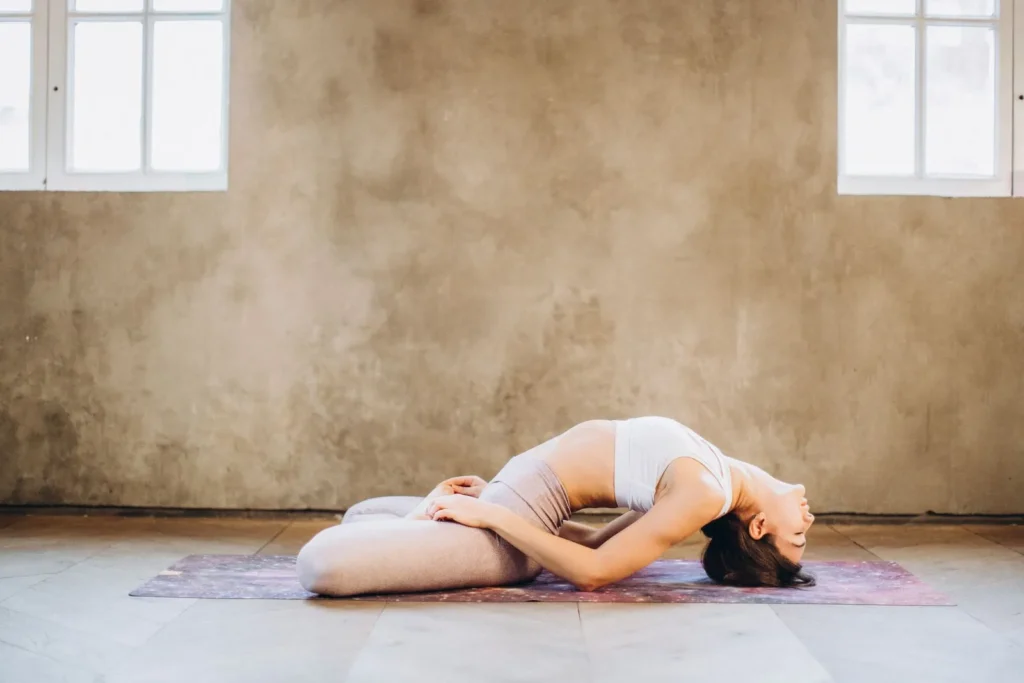
Fish pose, or matsyasana, is a lying backbend that lifts the chest toward the ceiling while the head stays supported behind you. Done well, it opens the front of the chest, the ribs and the hip flexors. Done badly, it dumps your body weight onto the neck. This guide gives you the chest-opening alignment cues, a neck-safe version with the head resting on a block or folded blanket, variation and modification tables, hold times, the counter-pose and a clear list of who should skip it. Treat it as a stretch, not a treatment, and check with your doctor if you have any neck or health concerns.
What is matsyasana and how do you do it step by step?
Matsyasana is done lying on your back. Slide your hands under your hips, press your forearms into the floor to lift the chest, and rest the head lightly behind you. Hold about 5 breaths (roughly 20 to 30 seconds), keeping weight in the forearms rather than the neck, then lift the head first to come out.
The name comes from the Sanskrit words matsya (fish) and asana (pose). It is classed as a beginner-to-intermediate backbend and sits comfortably in a home session once you know the basics from our guide to foundational yoga poses. Here is the sequence in order:
- Lie down. Lie flat with legs together and extended, or with knees bent and feet on the mat if your lower back feels tight.
- Place your hands. Slide both hands, palms down, under your hips. Keep the elbows close to your ribs.
- Press and lift. Press the forearms and elbows into the mat and lift the chest as if a string pulled your breastbone to the ceiling.
- Place the head. Only after the chest is high, lower the back of the head gently onto the floor, a block or a folded blanket.
- Breathe. Keep slow nasal breaths going and soften the jaw.
- Come out. Press the forearms down, lift the head first, lower the chest, then slide the hands out and rest.
How do you keep matsyasana safe for your neck?
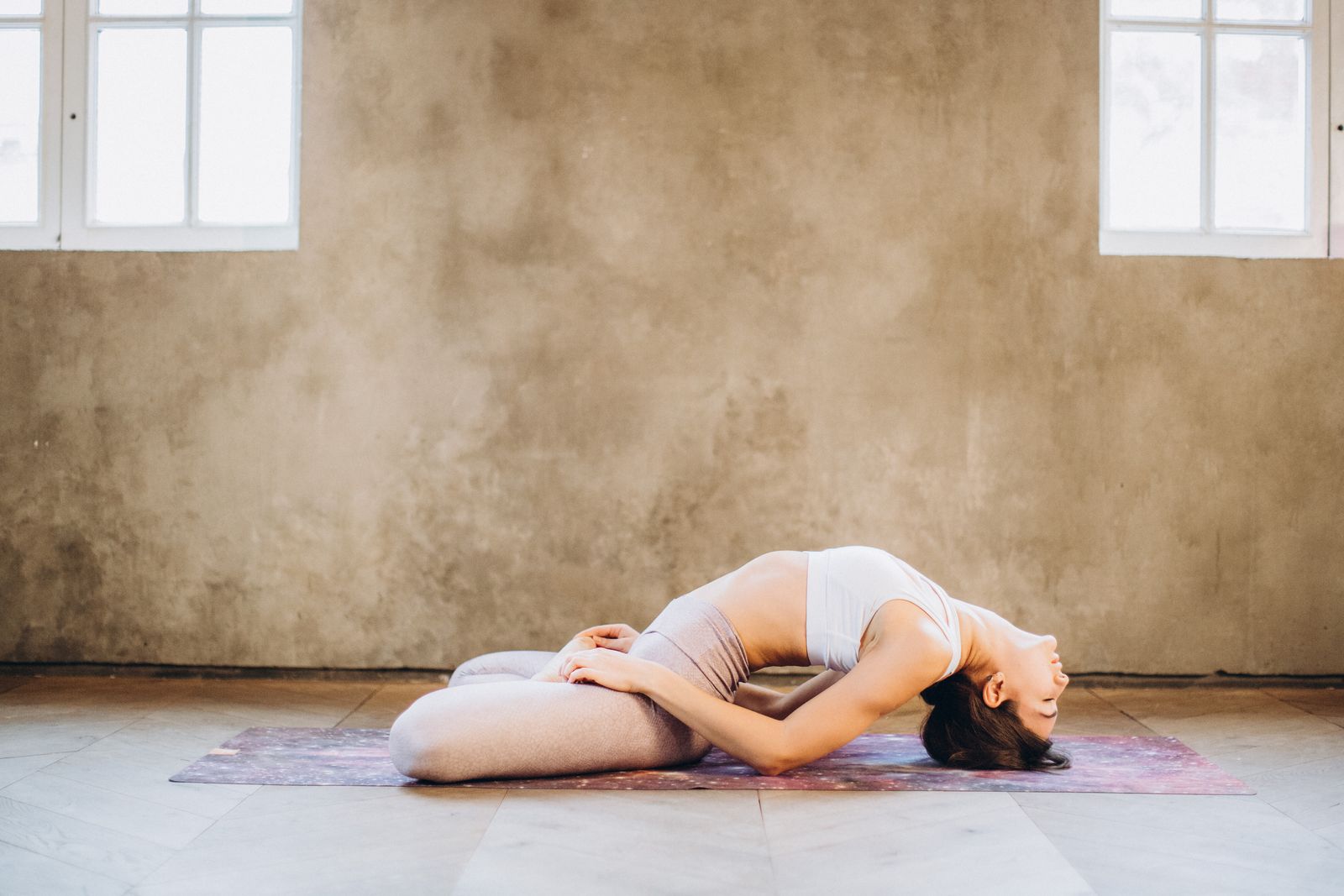
Support the head so it never carries your weight. Lie with the back of your head on a yoga block (on its lowest height) or a thick folded blanket, lift the chest with your forearms, and let the head rest lightly. Never throw the head back or drop it to the floor. If the neck feels pinched, come out.
The classic floor version rests the crown of the head on the mat, which is where most neck strain begins. A support shortens the distance your neck has to travel, so the stretch stays in the chest and upper back. Use this setup:
- Height: choose a support tall enough that the chin stays level, never pulled toward the ceiling.
- Entry: lift the chest first, then slide the support under the head and lower onto it slowly. Do not drop the head back in one motion.
- Load: most weight on the forearms and upper back, with the head only resting. Pressure on the crown means press the forearms harder.
- Exit: lift the head before the chest, every time.
Matsyasana should feel like a stretch across the front of the body, not a squeeze at the back of the neck. Tingling, sharp pain or dizziness means stop.
Chest-opening alignment cues that actually help
Most of the benefit comes from small adjustments, not depth. Use these cues in order:
- Elbows under the shoulders. Wide elbows collapse the lift. Keep them close to your sides and roughly stacked under the shoulder joints.
- Shoulder blades toward the spine. Draw the blades together and down the back, then lift the breastbone. This is what opens the chest.
- Lift from the upper back. Imagine the arch happening between the shoulder blades. If you feel it mainly in the lower back, lower the chest slightly and tuck the tailbone a little.
- Legs awake. Press the heels away and keep the thighs firm. Splayed feet make the shape wobble.
Fish pose variations compared
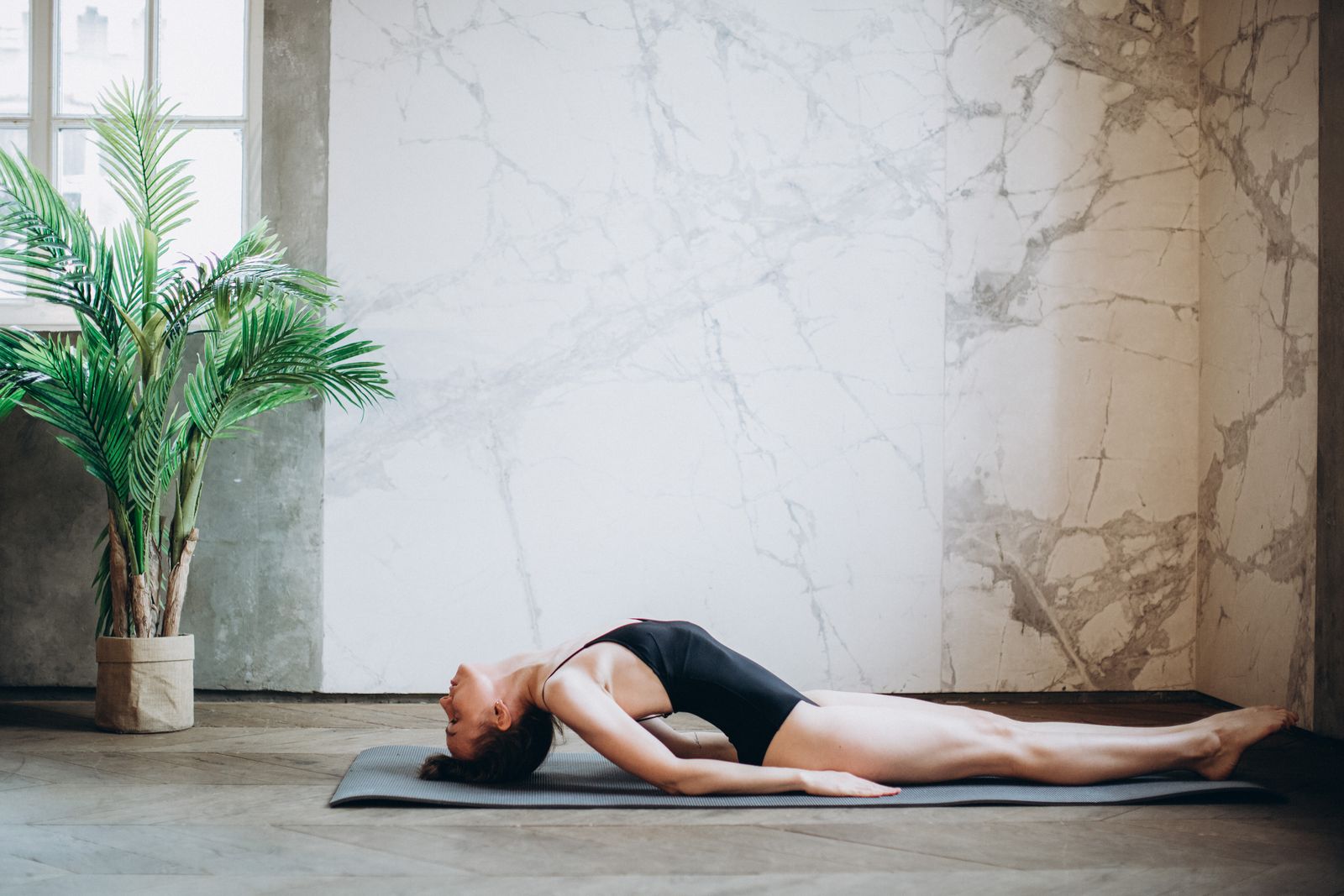
Pick the version that matches your neck, hips and experience, not the one that looks most advanced. Start at the top of the table and move down only when the earlier version feels easy and pain-free.
| Variation | Setup | Best for | Hold |
|---|---|---|---|
| Supported fish (bolster or blankets) | Bolster or two folded blankets lengthwise under the spine, head resting on the floor or a small pad | Beginners, tight shoulders, restorative sessions | 1 to 3 minutes, relaxed breathing |
| Head-on-block fish | Forearm lift with the back of the head resting on a block or folded blanket | Most beginners, anyone with a stiff neck who has been cleared to practise | About 5 breaths |
| Legs-bent fish | Knees bent, feet flat on the mat, same forearm lift | Tight hips or a sensitive lower back | About 5 breaths |
| Classic legs-extended fish | Legs straight and together, forearm lift, crown or back of head lightly down | Practitioners with comfortable necks and shoulders | 5 to 8 breaths |
| Half lotus fish | One foot on the opposite thigh, same lift | Those comfortable with Padmasana (Lotus Pose) shapes | 5 breaths per side |
Modifications: fixing the problem you actually feel
Discomfort in fish pose is usually a signal about one specific thing. Match what you feel to the fix below instead of pushing through.
| What you feel | Likely cause | Modification |
|---|---|---|
| Pressure on the crown or back of the skull | Weight sitting on the head | Lift the chest higher, press the forearms harder, add a block or blanket under the head |
| Pinch at the back of the neck | Head dropped back too far or too fast | Raise the support, keep the chin level, or skip the head-down step and keep the head hovering |
| Ache in the lower back | Arch coming from the lumbar spine | Bend the knees, tuck the tailbone slightly, lift from between the shoulder blades |
| Numb or cranky wrists and hands | Hands pressing hard under the hips | Use a bolster under the spine instead, or keep the hands flat on the floor beside you |
| Tight shoulders, elbows will not tuck | Limited shoulder mobility | Keep the elbows bent and wider, with a smaller chest lift |
How long should you hold fish pose?
Hold fish pose for roughly 15 to 30 seconds, which is about 5 slow breaths, and build toward 8 breaths (around 40 seconds) over a few weeks. Supported versions on a bolster can be held 1 to 3 minutes if they feel comfortable. Practise 3 to 4 times a week, and stop any hold that builds neck pain.
Beginners can start with 3 breaths, about 15 seconds, and do one round. Longer holds do not improve the pose and raise the risk of neck fatigue, so alignment comes before time. If you are working through a stiff back more broadly, our guide to yoga for back pain covers gentler options.
Who should not do matsyasana?
Skip the full pose, or practise only a supported version your doctor has cleared, if you have a neck injury, recent neck surgery, high or low blood pressure, frequent migraines or are pregnant. Backbends that tilt the head can aggravate these conditions, so get personal medical advice before trying fish pose.
| Condition | Why caution matters | What to do |
|---|---|---|
| Neck injury, whiplash or cervical spine problems | Head extension loads the neck | Avoid head-down versions. Ask your doctor or physiotherapist first. |
| Recent neck surgery | Healing tissue should not be stretched or loaded | Skip entirely until your surgeon clears you |
| High blood pressure | Head and neck positions can affect how you feel in the pose | Get medical clearance. Keep the head level and breathe steadily. |
| Low blood pressure | Changing position quickly can cause light-headedness | Move slowly, rise gradually and avoid long holds |
| Migraine | Neck tension and throat compression may trigger an attack | Avoid during an attack or aura. Ask your doctor about safe options. |
| Pregnancy | Lying flat and deep backbends are not advised for many people | Skip the floor version. Practise only with a qualified prenatal teacher and your doctor’s approval. |
See your doctor first if you have any neck, spine, heart, blood pressure or head-related condition, or if you are unsure whether fish pose is suitable. Stop at once if you feel sharp pain, tingling, numbness, dizziness or a headache starting.
Common mistakes in matsyasana, and how to fix them
- Dropping onto the head. Lift the chest first, then rest the head. If your neck is carrying weight, you are too low.
- Cranking the chin up. This crunches the back of the neck. Keep the chin level or slightly lengthened.
- Arching the lower back. The lift should come from the upper back. Bend the knees if the lower back complains.
- Holding the breath. Slow nasal breathing keeps the shoulders and jaw soft.
Does fish pose cure anything? Separating tradition from fact
Older yoga texts make large claims for fish pose, but it should be treated as a stretch and mobility practice, not a treatment for any medical condition. Its realistic benefits are a stretch for the chest, front of the neck and hip flexors, plus an easier upright posture when practised regularly alongside other work.
Do not use it in place of medical care, and do not change any medicine or treatment because of a yoga pose. With steady practice, expect a looser chest, less tightness across the shoulders and slightly easier deep breathing.
Is matsyasana good for desk workers?
Yes, as a short corrective stretch. Long hours at a laptop round the shoulders and push the head forward, and fish pose opens the chest in the opposite direction. It will not fix posture by itself, but 5 breaths once or twice during the day, plus strength work, can help.
A practical version: lie on the floor after work, use a rolled towel or a bolster under the upper back, and rest the head on a pillow. This gives the opening without loading the wrists or neck. Add Tadasana (Mountain Pose) a few times a day to practise stacking the ribs over the hips.
What is the counter-pose and where does fish pose fit in a sequence?
Fish pose follows Sarvangasana (Shoulder Stand) in traditional sequencing because it extends the neck in the opposite direction. Afterward, counter it with a gentle forward bend or knees-to-chest hug, then rest in Shavasana.
In a home session, a sensible order is:
- Warm up with Surya Namaskar (Sun Salutation), then a gentler backbend such as Bhujangasana (Cobra Pose).
- Move into fish pose. It is gentler than kneeling backbends like Ustrasana (Camel Pose), so it works as a warm-up or a closing backbend.
- Counter with a knees-to-chest hug (about 5 breaths), then a few seconds of a gentle chin tuck.
- Open the hips with Baddha Konasana if you like, then lie in Shavasana for a few minutes.
Because the chest is open, matsyasana also makes a good shape for slow breathing. Your pranayama practice will feel easier if you spend a minute here first.
Matsyasana FAQs
Is matsyasana safe for beginners?
Yes, with the right setup. A beginner should use the head-on-block or bolster version, lift the chest with the forearms, hold about 3 to 5 breaths and stop if the neck complains. If you have a neck injury, blood pressure concerns, migraines or are pregnant, check with your doctor first.
What is the difference between matsyasana and setu bandhasana?
Matsyasana is a lying backbend lifted by the forearms, with the head resting behind you. Setu bandhasana (bridge pose) lifts the hips with bent knees and flat feet. Bridge works the glutes and hamstrings more, while fish pose focuses the stretch on the chest, ribs and front of the neck.
Should the head touch the floor in fish pose?
Not necessarily. If you are new, rest the head on a block or folded blanket, or keep it hovering slightly. The goal is a chest lift, not head pressure. Never drop the head back hard, and skip head contact entirely if you have any neck concerns.
How long should I hold matsyasana?
About 15 to 30 seconds, or 5 slow breaths, works for most people. Beginners can start with 3 breaths. Supported bolster versions can last 1 to 3 minutes if comfortable. Stop immediately if you feel neck pain, tingling or dizziness, and avoid holds beyond what feels easy.
What is the counter-pose for matsyasana?
A gentle forward-folding shape such as a knees-to-chest hug, followed by a few seconds of a chin tuck, balances the backbend. If you did fish pose after shoulder stand, finish with rest in Shavasana. Keep every counter-pose slow and pain-free.
Next step: if you want someone to check your alignment and head support in real time, book a session in FitStrot’s online yoga classes and bring fish pose to your next class.


