
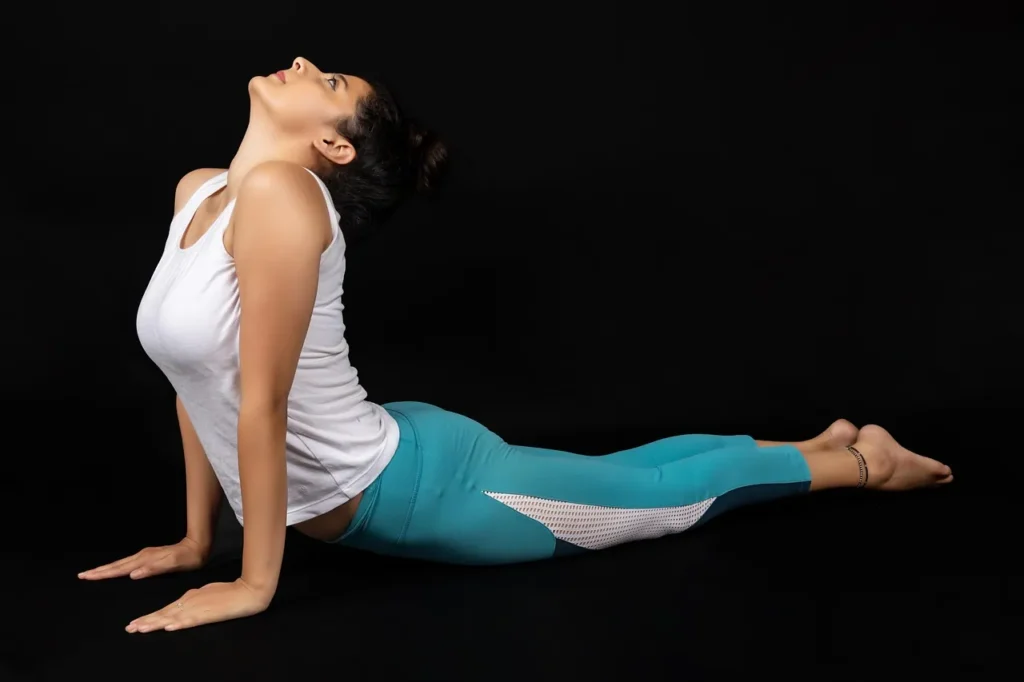
Bhujangasana, or cobra pose, is a gentle backbend done lying face down. You press lightly through your palms and lift your chest while your pelvis and legs stay on the mat. It builds endurance in the back muscles, opens the chest and brings movement back into a spine that sits bent over a laptop all day. It is also pose 7 of the traditional 12-step Surya Namaskar, so most people in India have done it in a school PT class long before they learned the name.
This guide covers what a beginner actually needs: an exact step-by-step table, what the research does and does not show about the benefits, four variations from sphinx to full cobra, who should skip it, the mistakes that cause lower-back pinching, and where the pose fits in a session. In Hindi the pose is भुजंगासन. Bhujanga means serpent, so the name describes a cobra lifting its hood.
What is bhujangasana, and what does it do?
Bhujangasana is a prone (face-down) spinal extension. The spine arches backwards, the chest opens and the hips stay on the floor. A 2020 surface-EMG study of Surya Namaskar found the latissimus dorsi working at 37.4% of maximal effort during bhujangasana. That makes it a moderate back-strengthening pose, not a maximal one.
That study, by Mullerpatan and colleagues at MGM School of Physiotherapy, Navi Mumbai, recorded muscle activity in 8 trained practitioners through all 12 Surya Namaskar poses (International Journal of Yoga, 2020). One finding surprises people. The erector spinae, the long muscles along your spine, worked hardest in Hastapadasana (64.7% of maximum), not in the cobra. So bhujangasana is best treated as a mobility-plus-endurance pose, not a heavy back exercise. If you want real back strength you still need loaded work, like the progressions in our back workout for beginners.
Structurally, the pose belongs to the backbend family with Salabhasana (locust) and Dhanurasana (bow). School syllabi often ask which category bhujangasana comes under. The answer is a prone, backward-bending asana.
Steps of bhujangasana: the full procedure in one table
The bhujangasana procedure below has seven phases, from setup to exit. Read the form cue in each row. It matters more than how high you lift. A short, pain-free lift done well beats a high lift that pinches your lower back.
| Step | What you do | Breath | Form cue |
|---|---|---|---|
| 1. Set up | Lie face down with legs hip-width apart and the tops of your feet flat on the mat. | Normal breathing | Toes point straight back, heels don’t fall outwards. |
| 2. Place hands | Put your palms under your shoulders, fingers spread, and hug your elbows in to your ribs. | Normal | Wrists sit under or slightly ahead of your shoulders, never far forward. |
| 3. Anchor | Press your pubic bone and the tops of your feet gently into the floor. | Exhale | Your thighs switch on. Don’t squeeze your buttocks hard. |
| 4. Lift | Lift your forehead, then your chin, then your chest, peeling up one vertebra at a time. | Inhale | Try lifting 2–3 cm with your hands hovering. That height is your back’s own strength. |
| 5. Hold | Straighten your arms only as far as your lower back stays comfortable. Draw your shoulders back and down. | 3–5 slow breaths | Keep your neck long and your gaze forward or slightly up, never cranked back. |
| 6. Lower | Roll down chest, then chin, then forehead. | Exhale | Control the way down. Don’t drop. |
| 7. Rest | Turn your head to one side, or push back into Balasana (child’s pose). | 2–3 breaths | Rest before the next round. This matters most if your back feels tight. |
How to do bhujangasana if you are a complete beginner
Do steps 1–4 only, with your hands hovering off the floor, for 3 rounds of 3 breaths. This “no-hands” cobra shows you how much lift your back muscles produce by themselves. Most beginners are surprised by how low that is. It is the most honest measure of progress. Add hand pressure only once the no-hands version feels easy for a week.

Benefit of bhujangasana: what the evidence supports
There is no large trial of the cobra pose on its own. Evidence comes from yoga programmes that include it. A 2022 Cochrane review of 21 trials (2,223 people) found yoga produced small improvements in chronic low back pain versus no exercise. It worked about as well as other back exercise. So the benefits are real but modest.
Here is what that means in practice, benefit by benefit:
- Back pain: modest, not magical. In the Cochrane review (Wieland et al., 2022), yoga cut pain by 4.53 points on a 0–100 scale at three months. The threshold people actually notice is about 15 points. Function results were similar: yoga was no better than back-focused exercise. The honest takeaway: cobra is one useful tool, not a cure.
- Works as well as physiotherapy in a structured programme. A 2017 randomised trial of 320 adults with chronic low back pain found 12 weekly yoga classes were non-inferior to 15 physical therapy visits for pain and function (Saper et al., Annals of Internal Medicine). Both groups were about 21–22 percentage points less likely than an education-only group to be using pain medication at 12 weeks.
- Posture and upper-back rounding. In a 2009 UCLA trial, 118 adults aged 60 and above did hour-long yoga classes 3 times a week for 24 weeks. Their kyphosis angle improved by 4.4% compared with controls. Backbends like the cobra were part of that programme, but the effect was small and came from the whole routine.
- Chest and shoulder opening. Cobra takes the shoulders the opposite way from typing and phone use. This is a mechanical fact, not a proven cure for “tech neck”.
- Latissimus dorsi and back-muscle endurance, per the 37.4% EMG figure above.
Bhujangasana ke fayde (Hindi summary)
भुजंगासन के फायदे, संक्षेप में: पीठ की मांसपेशियों की सहनशक्ति बढ़ती है, छाती और कंधे खुलते हैं, और लंबे समय तक बैठने से आई जकड़न कम होती है। पुराने कमर दर्द में यह योग कार्यक्रम का एक हिस्सा बनकर थोड़ा फायदा दे सकता है, लेकिन यह इलाज का विकल्प नहीं है।
Myth check: cobra pose and belly fat
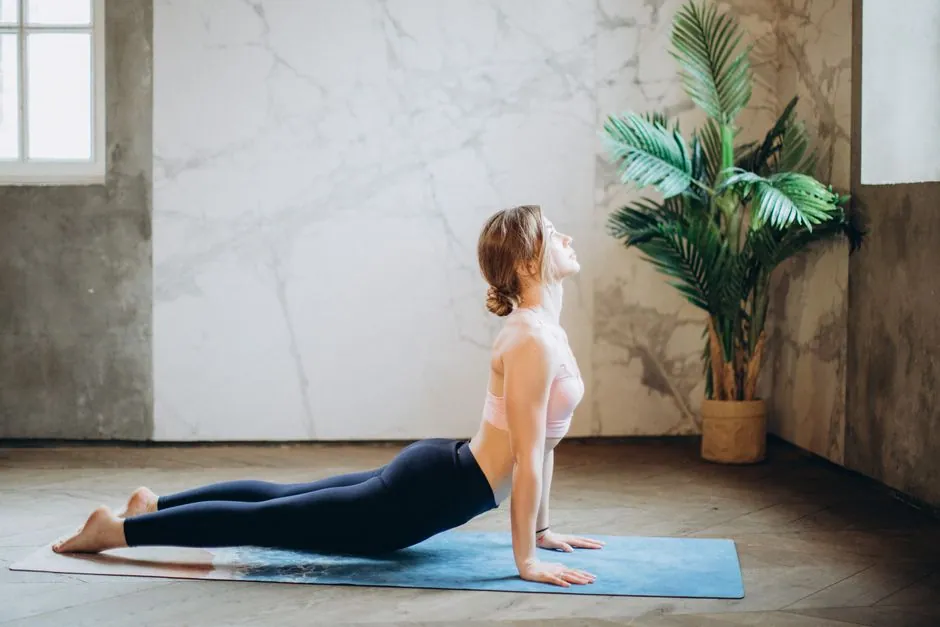
You will see the cobra pose sold as a “flat stomach” pose. It isn’t one. Bhujangasana stretches the front of your abdomen. It doesn’t burn fat from it. Fat loss comes from a sustained calorie deficit across your whole body, and holding a pose for 20 seconds burns very little. A stretched belly can look flatter while you hold the pose, which is probably where the myth started.
The same goes for digestion and thyroid claims on many Indian yoga sites. They come from tradition, not controlled trials. The accurate way to put it: cobra is a good spinal mobility pose that fits well into a balanced yoga routine. If fat loss is your goal, pair your practice with food changes. A dietitian can build an Indian meal plan around that.
Variations compared: sphinx, baby cobra, full cobra and twisting cobra
The cobra family covers a wide range of intensities. Salamba bhujangasana (sphinx) and ardha bhujangasana (half or baby cobra) are for beginners and sore backs. Purna bhujangasana, the full cobra where the feet reach towards the head, is an advanced backbend that most people never need.
| Variation | How it differs | Hold | Rounds | Best for |
|---|---|---|---|---|
| Salamba bhujangasana (sphinx) | Forearms on the floor, elbows under shoulders | 30–60 s | 2–3 | First-timers, stiff backs, desk workers |
| Ardha bhujangasana (baby cobra) | Chest lifts a few cm, elbows stay bent, little hand pressure | 15–20 s | 3–5 | Beginners and Surya Namaskar flows |
| Bhujangasana (classic cobra) | Arms straighten partly, pubic bone stays down | 15–30 s | 3–5 | Regular practitioners with no back symptoms |
| Tiryaka bhujangasana (twisting cobra) | From cobra, turn your head and chest to look back at the opposite heel | 2–3 breaths each side | 2 per side | Intermediate students who want side-body mobility |
| Purna bhujangasana (full cobra) | Knees bend and feet reach towards the head in a deep backbend | A few breaths | 1–2 | Advanced practitioners under supervision only |
Salamba bhujangasana (sphinx pose)
Place your elbows directly under your shoulders with your forearms parallel. Push the floor away and let your chest lift. This is the gentlest backbend in the family, because your forearms control the load on your lower back. It is also the one to try first if a regular cobra pinches.
Ardha bhujangasana (half or baby cobra)
Keep your elbows bent and your lift low, about as high as your back can manage alone. This is the version used in most Surya Namaskar flows. After Ashtangasana, you slide forward into a low cobra, not a maximal one.
Purna bhujangasana (full cobra)
The feet-to-head version needs a lot of thoracic and hip-flexor flexibility plus a strong, well-warmed spine. Don’t attempt it from photos. Only try it after years of regular backbending, with a teacher watching.
Bhujangasana contraindications and precautions
Skip or modify bhujangasana if you are pregnant (after the first trimester, or earlier if lying prone is uncomfortable), have had recent abdominal or spinal surgery, have an unrepaired hernia, or have spinal stenosis or spondylolisthesis whose pain gets worse when you arch back. When in doubt, check with your doctor or physiotherapist before you try it.
| Condition | Why cobra is a problem | Safer option |
|---|---|---|
| Pregnancy | Lying on the belly becomes impractical as the bump grows. The NHS also advises against lying flat on the back for long after 16 weeks. | Cat-cow on all fours, done with a teacher who knows how many weeks pregnant you are |
| Spinal stenosis / spondylolisthesis | Pain from both is typically worse when standing or arching and eased by bending forward | Sphinx at a very low height only if pain-free, or skip. Ask your physio. |
| Hernia or recent abdominal surgery | Belly-down pressure and abdominal stretch load the healing area | Wait for surgeon clearance. Try seated chest openers meanwhile. |
| Acute back pain with leg numbness or weakness | May point to nerve irritation that needs assessment first | See a doctor before any backbending |
| Wrist pain / carpal tunnel | Hand pressure loads the wrists in extension | Sphinx (forearms down) or no-hands cobra |
| Recent neck injury | Tipping the head back compresses the neck | Keep your gaze at the floor ahead, with the neck in line with the spine |
The pregnancy guidance comes from the NHS exercise-in-pregnancy page, which also says your yoga teacher should know you are pregnant and how many weeks along you are. The US National Center for Complementary and Integrative Health adds that pregnant women should avoid hot yoga and long periods lying on their backs. For stenosis, Cleveland Clinic notes that lumbar stenosis pain typically eases when you lean forward. Arching back does the opposite. The NHS describes spondylolisthesis pain the same way, as “often worse when standing or walking and relieved when sitting or bending forward”.
General bhujangasana precautions for everyone
- Practise on an empty stomach or 2–3 hours after a full Indian meal. Lying on a stomach full of dal-chawal is uncomfortable.
- Warm up first with 5 minutes of walking, cat-cow or a round of slow Surya Namaskar.
- Stop right away if you feel sharp, pinching or radiating pain. A mild stretch in the abdomen and chest is normal. Pain in the lower back is not.
- If you are 65 or over, take extra care. NCCIH notes that older adults have higher rates of yoga-related emergency visits, and that most yoga injuries are sprains and strains.
Six mistakes that make cobra hurt, and how to fix them
Almost every “cobra hurts my back” complaint comes from one of the six problems below. Work through them in order. The first two fix most cases.
- Pushing up with straight arms. When your arms do all the work, the bend dumps into the lowest part of your lumbar spine. Fix: keep your elbows slightly bent and test with the no-hands lift.
- Hands too far forward. This makes a long lever and a flat, sagging back. Fix: palms under your shoulders, or slightly behind them.
- Shoulders shrugged to the ears. Fix: pull your shoulder blades down your back before lifting, as if putting them in your back pockets.
- Cranking the head back. Fix: the neck continues the curve of the upper back. Look ahead, not at the ceiling.
- Squeezing the buttocks hard. Clenched glutes compress the lower back for many people. Fix: firm your thighs and press the tops of your feet down instead.
- Holding your breath. Fix: inhale as you lift, then take slow nasal breaths. If you can’t breathe calmly, you have gone too high.
Troubleshooting: what the sensation tells you
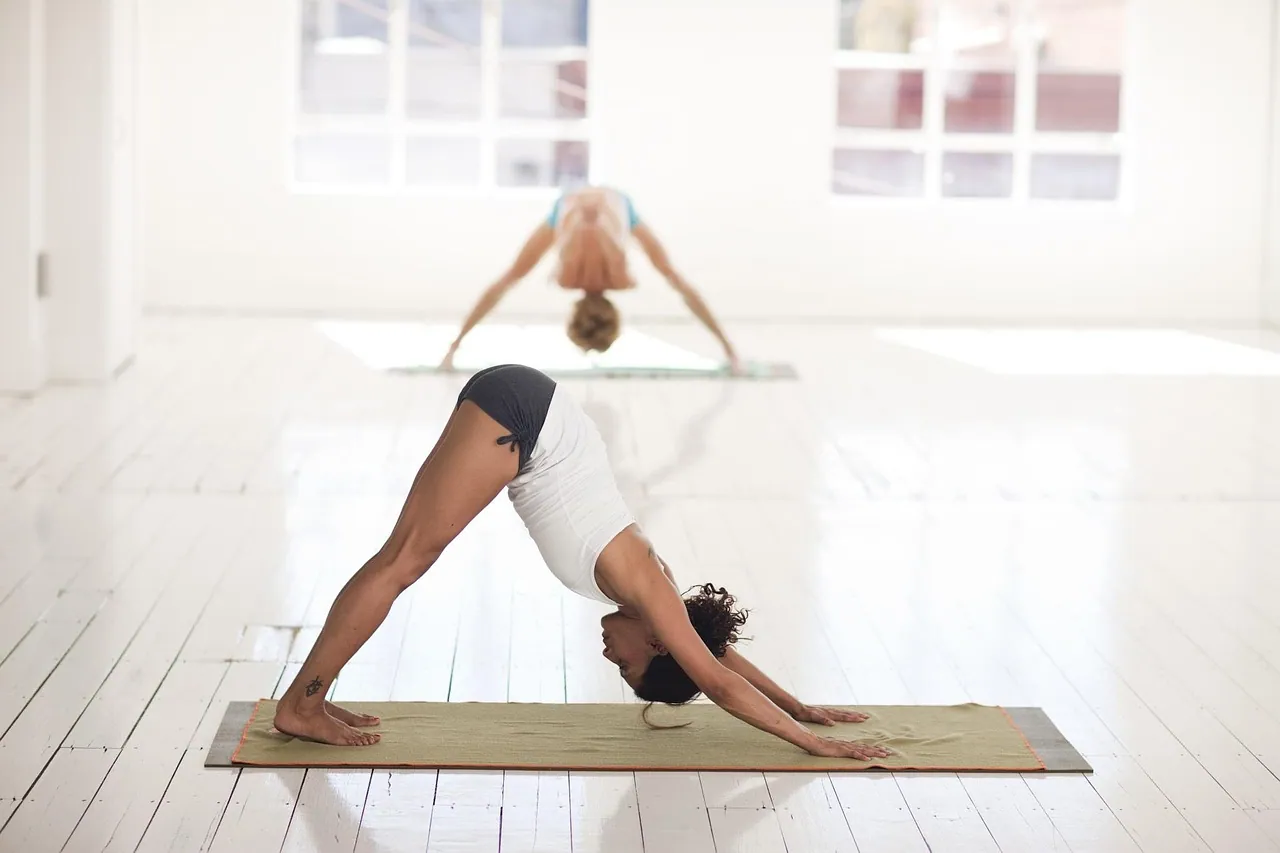
A pinch at the belt line means you’re too high. Drop to baby cobra or sphinx. Wrist ache means the load is going through your hands, so shift to your forearms. A stretch in your abdomen and hip fronts is the pose working as intended. Cramping in your hamstrings or calves usually means your feet are pointed too hard, so relax the toes slightly.
How long to hold, how many rounds, and where it fits in a sequence
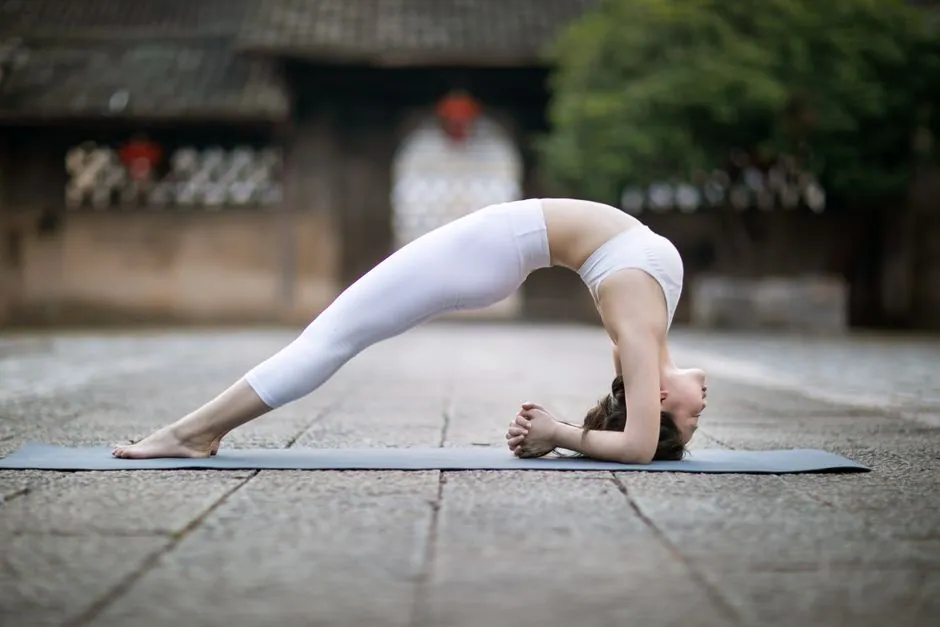
For most healthy beginners, a sensible dose is 3–5 rounds of 15–30 seconds, with 10–20 seconds of rest in child’s pose between rounds, 3–5 days a week. Holding longer isn’t better. Several short, well-formed rounds build endurance with less compression on the lower back.
Where the cobra goes in a session:
- In Surya Namaskar: pose 7, after Ashtangasana (eight-limbed pose) and before Parvatasana (downward dog).
- In a floor sequence: after warm-ups and before deeper prone backbends. Sphinx → cobra → salabhasana (locust) → dhanurasana (bow) is a classic progression.
- Counter poses: balasana (child’s pose) or a gentle knees-to-chest stretch lying on your back.
- At the end of a workout: a sphinx or low cobra fits well into a post-workout cool-down stretch routine.
| Week | Variation | Sets × hold | Rest between sets | Form cue to focus on |
|---|---|---|---|---|
| 1 | Sphinx (salamba bhujangasana) | 3 × 30 s | 20 s in child’s pose | Elbows under shoulders, pull chest forward through the arms |
| 2 | No-hands cobra + sphinx | 3 × 3 breaths, then 2 × 30 s | 20 s | Lift from the upper back, lower back relaxed |
| 3 | Baby cobra (ardha bhujangasana) | 4 × 20 s | 15 s | Elbows bent and hugged in, shoulders down |
| 4 | Classic cobra (only if pain-free) | 3–5 × 20–30 s | 15 s | Straighten arms only to the height the lower back tolerates |
Who benefits most: desk workers, runners, older adults
Desk and laptop workers
If you sit 8–10 hours a day, a few rounds of sphinx or baby cobra reverse the rounded-forward shape. They’re easy to do on a bedroom floor at lunch. Two rounds morning and evening is enough to start with.
Runners, cricketers and gym-goers
Cobra stretches the hip flexors and abdominals, which get tight from running and crunch-heavy training. Use it after training, not as a replacement for loaded back work. Our guide to essential yoga poses shows other asanas that pair well with it.
Adults over 60
The UCLA kyphosis trial suggests regular yoga that includes gentle backbends can modestly reduce upper-back rounding. Start with sphinx, move slowly, and make sure getting down to and up from the floor is safe for you first. A 1-on-1 trainer can check your form live if you have osteoporosis or balance concerns.
Frequently asked questions
What is bhujangasana called in English?
Bhujangasana is called cobra pose in English. The Sanskrit word bhujanga means serpent or cobra, and asana means posture. The name comes from the shape: your chest rises like a cobra’s raised hood while your lower body stays on the ground.
How long should I hold bhujangasana?
Beginners should hold bhujangasana for 15–30 seconds (about 3–5 slow breaths) and repeat it 3–5 times, resting in child’s pose between rounds. Several short holds with good form are safer for the lower back than one long hold.
Can bhujangasana reduce belly fat?
No. Bhujangasana stretches the abdominal muscles but does not burn meaningful fat from the belly. Fat loss needs a sustained calorie deficit through diet and overall activity. Cobra can be part of a routine, but it can’t spot-reduce fat.
Is bhujangasana good for back pain?
It can help as part of a yoga programme. A 2022 Cochrane review of 21 trials found small improvements in chronic low back pain, similar to other back exercise. It is not suitable for everyone. Stop if it causes sharp or radiating pain, and see a doctor about back pain that lasts more than 3–4 weeks.
Who should not do bhujangasana?
Avoid bhujangasana or get medical advice first if you are pregnant, have had recent abdominal or spinal surgery, have a hernia, or have spinal stenosis, spondylolisthesis or back pain that gets worse when you arch backwards. People with wrist pain can do sphinx pose instead.
What is the difference between bhujangasana and sphinx pose?
In sphinx pose (salamba bhujangasana) your forearms rest on the floor with elbows under your shoulders, which keeps the backbend low and supported. In bhujangasana your hands are under your shoulders and your arms partly straighten, which makes a deeper, more demanding backbend.
When is the best time to do bhujangasana?
Do bhujangasana on an empty stomach or 2–3 hours after a meal, and after a short warm-up. Morning practice suits most people. In the evening, a gentle sphinx or baby cobra can ease stiffness after a long day of sitting.
Photos can’t tell you if your elbows are flaring or your lower back is taking the load. A teacher watching you live can. Book a trial of Fitstrot’s online yoga classes and have an instructor check your cobra in the first session.


