

There are hundreds of yoga poses, but you only need about 25 to build a complete, safe home practice. This guide groups the most useful yoga poses into six families (standing, seated, balancing, backbends, inversions and restorative), gives each one its Sanskrit and English name, a difficulty rating, the main benefit and the single alignment cue that matters most. Then it turns them into a 20-minute beginner sequence you can do on a mat in your living room tomorrow morning.
This is not a weight-loss plan. If that is your goal, our separate guide to yoga poses for weight loss covers it.
How many yoga poses are there, really?
No single official number exists. Classical hatha texts refer to 84 principal asanas, while modern style manuals list anywhere from 200 to more than 900 variations. For practical purposes, roughly 25 foundational poses cover every movement direction the spine and hips need: forward bending, backbending, twisting, side bending, balancing, inverting and resting.
The large numbers online come from counting every variation separately. Warrior I, II, III, Reverse and Humble Warrior are five “poses” on a list but share one foundation: a long lunge with a stable front knee.
Asana yoga poses: what the word actually means
“Asana” is Sanskrit for “seat”. In the Yoga Sutras it meant a steady seat for meditation; the hatha tradition later widened it to any posture, hence Tadasana (mountain), Vrikshasana (tree) and Bhujangasana (cobra). Asana yoga poses and “yoga poses” are the same postures; the Sanskrit names are the original labels you will hear in most Indian classes, including the Ministry of AYUSH’s Common Yoga Protocol used on International Day of Yoga every 21 June.
Yoga poses with names, sorted into six families
Grouping poses by what they ask of your body beats memorising an alphabetical list. A well-built class usually moves through the families in this order: standing, balance, backbends, seated folds and twists, then restorative poses and rest.
- Standing: build leg strength and teach alignment. The base of every practice.
- Seated: forward folds, hip openers and twists. Quieter, better for flexibility.
- Balancing: one foot or hands only. Train ankle stability and concentration.
- Backbends: open the chest and hip flexors, strengthen the back of the body.
- Inversions: head below heart. Ranges from gentle (legs up the wall) to advanced (headstand).
- Restorative: supported, held longer, designed to switch the nervous system down.
Standing yoga poses: the foundation
Standing yoga poses are where beginners should spend most of their first month. They load the legs through a full range of motion, which is why the NHS lists yoga among the activities that count toward the recommended muscle-strengthening work on at least 2 days a week for adults aged 19 to 64. They also teach you the alignment language (stack the knee over the ankle, lengthen the spine) that every other family depends on.

| Sanskrit name | English name | Level | Main benefit | Key alignment cue |
|---|---|---|---|---|
| Tadasana | Mountain | Beginner | Posture awareness, grounding | Weight even across both feet; lift the crown, soften the ribs down |
| Adho Mukha Svanasana | Downward-facing dog | Beginner | Hamstring and calf length, shoulder strength | Bend the knees first to get a long spine; heels to floor is optional |
| Virabhadrasana I | Warrior I | Beginner | Leg strength, hip flexor stretch | Front knee over ankle, never past the toes; back heel down at 45° |
| Virabhadrasana II | Warrior II | Beginner | Thigh and glute endurance | Front knee tracks toward the second toe, not inward |
| Utthita Trikonasana | Extended triangle | Beginner | Side-body and hamstring stretch | Hand on shin or block, not the floor; keep both sides of the waist long |
| Utkatasana | Chair | Beginner | Quadriceps and upper-back strength | Sit the hips back as if into a chair; knees stay behind the toes |
| Uttanasana | Standing forward fold | Beginner | Hamstring release, calming | Bend the knees generously; hinge from the hips, not the lower back |
| Parsvakonasana | Extended side angle | Intermediate | Leg strength, rib-cage opening | Forearm on the thigh is fine; do not collapse the chest toward the floor |
A note for Indian homes: marble and vitrified tiles get slippery once you sweat. A basic 6 mm mat costs roughly ₹500 to ₹1,500 and is the first thing worth buying.

Sitting yoga poses and balance yoga poses
Balance poses come early in a session while your legs and focus are fresh; seated poses come later, when the body is warm enough to fold safely.
Sitting yoga poses for flexibility and calm
Most Indians already have one advantage here: years of sitting cross-legged on the floor for meals and pujas mean Sukhasana (easy pose) feels familiar. The seated forward folds are harder. Tight hamstrings from long hours in office chairs pull the pelvis backward and round the lower back, so the rule is simple: sit on a folded blanket or a firm cushion to tilt the pelvis forward before you fold.
Balance yoga poses for stability
Balance is the family with the clearest research support in older adults. A 2016 meta-analysis in Age and Ageing pooling 6 trials and 307 people aged 60 and above found that yoga produced a small improvement in balance (Hedges’ g 0.40) and a medium improvement in mobility (g 0.50). Use a wall or a chair back for support; that is a modification, not a failure.
| Sanskrit name | English name | Family | Level | Main benefit | Key alignment cue |
|---|---|---|---|---|---|
| Sukhasana | Easy pose | Seated | Beginner | Breathing, meditation base | Sit on a cushion so knees are level with or below hips |
| Dandasana | Staff | Seated | Beginner | Postural strength | Press thighs down, lift through the sternum; hands beside hips |
| Paschimottanasana | Seated forward bend | Seated | Beginner | Hamstring and back-body stretch | Lead with the chest, not the head; knees may bend |
| Baddha Konasana | Bound angle / butterfly | Seated | Beginner | Inner thigh and hip opening | Do not press knees down with the hands; let gravity work |
| Ardha Matsyendrasana | Half lord of the fishes (twist) | Seated | Intermediate | Spinal rotation | Lengthen on the inhale, twist on the exhale; do not crank with the arm |
| Vrikshasana | Tree | Balance | Beginner | Ankle stability, focus | Foot on the calf or inner thigh, never pressing on the knee joint |
| Garudasana | Eagle | Balance | Intermediate | Shoulder and outer-hip stretch | Sit low as in chair pose before wrapping the legs |
| Virabhadrasana III | Warrior III | Balance | Intermediate | Glute and hamstring strength | Hips stay level; lift the back leg only to hip height |
| Vasisthasana | Side plank | Balance / arm | Intermediate | Oblique and shoulder strength | Drop the bottom knee to the floor until you can hold 20 seconds cleanly |
Backbends, inversions and restorative poses
These three families carry the most rewards and, for inversions in particular, the most risk. The U.S. National Center for Complementary and Integrative Health advises that new practitioners avoid headstands, shoulder stands, the lotus position and forceful breathing until they have built a base, and that people with glaucoma, severe high blood pressure or spinal disease get clearance and modified poses. The table below flags which poses sit in that category.
| Sanskrit name | English name | Family | Level | Main benefit | Key cue / caution |
|---|---|---|---|---|---|
| Bhujangasana | Cobra | Backbend | Beginner | Spinal extension, chest opening | Elbows bent and close; lift with the back muscles, not by pushing the arms straight |
| Setu Bandhasana | Bridge | Backbend | Beginner | Glute strength, hip-flexor stretch | Knees hip-width, pointing forward; do not turn the head once lifted |
| Urdhva Mukha Svanasana | Upward-facing dog | Backbend | Intermediate | Wrist and shoulder strength | Thighs lift off the floor; shoulders away from the ears |
| Ustrasana | Camel | Backbend | Intermediate | Deep front-body opening | Hands on lower back first; skip the head drop if you feel dizzy |
| Viparita Karani | Legs up the wall | Inversion (gentle) | Beginner | Relaxation, tired legs | Hips close to the wall on a folded blanket; avoid in late pregnancy |
| Salamba Sarvangasana | Supported shoulder stand | Inversion | Advanced | Upper-body strength, calming | Only with a teacher; never turn the head; skip with neck problems, glaucoma or high BP |
| Salamba Sirsasana | Supported headstand | Inversion | Advanced | Shoulder and core strength | Weight in the forearms, not the head; learn against a wall with supervision |
| Balasana | Child’s pose | Restorative | Beginner | Lower-back release, rest | Knees wide and a pillow under the chest if hips do not reach the heels |
| Supta Baddha Konasana | Reclined bound angle | Restorative | Beginner | Hip opening, breath | Pillows under each knee so there is no strain on the groin |
| Savasana | Corpse | Restorative | Beginner | Nervous-system down-regulation | Stay 3 to 5 minutes; rolled towel under the knees if the lower back aches |
Basic yoga poses for beginners: a 20-minute sequence
This sequence uses only beginner-rated poses from the tables above and needs nothing but a mat and a pillow. Do it 3 times a week for 4 weeks before adding anything new. Practise on an empty stomach, either first thing in the morning or 2 to 3 hours after a meal; a full stomach of dal-chawal makes forward folds and twists uncomfortable.
| # | Pose | Rounds × hold | Rest / transition | Form cue |
|---|---|---|---|---|
| 1 | Sukhasana with slow breathing | 1 × 2 min | None | Exhale slightly longer than the inhale |
| 2 | Cat-cow (Marjaryasana-Bitilasana) | 1 × 8 slow cycles | Table-top, 3 breaths | Move from the tailbone upward, one vertebra at a time |
| 3 | Downward-facing dog | 3 × 5 breaths | Child’s pose, 3 breaths | Knees bent, long spine; pedal the heels |
| 4 | Tadasana → Uttanasana | 3 × 5 breaths each | Roll up slowly | Hinge at the hips, soft knees |
| 5 | Warrior II | 2 × 30 sec per side | Tadasana, 3 breaths | Front knee over the ankle, toward the second toe |
| 6 | Triangle | 2 × 30 sec per side | Tadasana, 3 breaths | Hand on shin or a block made of two thick books |
| 7 | Tree (wall assisted) | 2 × 30 sec per side | Shake out the legs | Foot on the calf, not the knee |
| 8 | Bridge | 3 × 5 breaths | Lower slowly, 3 breaths | Knees hip-width and pointing forward |
| 9 | Seated forward bend | 1 × 1 min | None | Sit on a folded blanket; lead with the chest |
| 10 | Supine twist | 1 × 45 sec per side | None | Both shoulders stay heavy on the mat |
| 11 | Child’s pose | 1 × 1 min | None | Pillow under the chest if needed |
| 12 | Savasana | 1 × 3 to 5 min | Roll to the right side before sitting up | Let the breath become natural |
Hold times are ranges, not targets. If your breath becomes jerky or you start holding it, you have gone too deep; back off until you can breathe smoothly through the nose.
Myth: “I’m not flexible enough for yoga”
This gets the order backwards. Flexibility is an outcome of practice, not an entry requirement, just as nobody is too weak to start going to the gym.
What stiff beginners actually need is permission to modify. Bend the knees in every forward fold. Put the bottom hand on a block, a stack of books or your shin in triangle. Keep the back knee down in lunges. Sit on a cushion. These keep the stretch in the muscles it was meant for instead of loading the lower back or knee. Full splits and feet-to-head backbends reflect years of practice plus individual anatomy; some bodies will never do them, and that is normal.
Yoga poses and their benefits: what the evidence supports
Good-quality research shows that regular yoga improves balance and mobility in adults over 60, produces modest improvements in chronic low back pain and function, and helps with anxiety and stress. Benefits are real but moderate; yoga is not a cure-all, and the size of the effect depends heavily on consistency over 8 to 12 weeks or more.
- Low back pain: a 2022 Cochrane review of 21 trials and 2,223 participants found yoga gave small improvements in back-specific function and pain at 3 months compared with no exercise, and results similar to other back-focused exercise. Honest reading: helpful, not magic.
- Knee arthritis: Harvard Health reports on a 2014 study in which 36 women with knee osteoarthritis practising about 112 minutes a week had 38% less pain and 35% less stiffness after 8 weeks.
- Balance in older adults: small-to-medium improvements, as above, which matters because falls are a leading cause of injury after 60.
- Activity levels in general: the WHO estimates that 31% of the world’s adults, about 1.8 billion people, were physically inactive in 2022. For many of them, a home yoga routine is the most realistic way to start moving.
Yoga on its own usually does not reach the WHO’s 150 minutes a week of moderate aerobic activity unless you practise vigorous, flowing styles. Pair it with brisk walking or a dance class; if you like music-led cardio, Zumba is a natural partner to a slower yoga practice.

Who should modify or avoid certain asanas?
Yoga is about as safe as other forms of exercise, but risk rises with age and with advanced poses. People over 65, pregnant women, and anyone with glaucoma, uncontrolled high blood pressure, recent surgery, osteoporosis or a spinal disc problem should check with their doctor first and avoid full inversions and deep backbends without supervision.
The reassuring data first. A 2015 meta-analysis of 94 randomised trials with 8,430 participants concluded that yoga appears as safe as usual care and other exercise, with no difference in serious adverse events.
Now the caution. A study of U.S. emergency departments estimated 29,590 yoga-related injuries between 2001 and 2014, with a 2014 injury rate of 57.9 per 100,000 participants aged 65 and above versus 11.9 per 100,000 in those aged 18 to 44. Nearly half (46.6%) involved the trunk, and sprains or strains were the most common diagnosis. Older bodies need smarter progressions, not avoidance.
- Pregnancy: avoid hot yoga, deep twists and closed twists, and lying flat on your back for long periods after the first trimester. Choose a prenatal-trained teacher.
- High blood pressure or glaucoma: skip headstand, shoulder stand and long forward folds with the head below the heart.
- Neck or disc problems: no plough, shoulder stand or headstand; keep forward folds with bent knees.
- Knee pain: never let the knee collapse inward in warriors; avoid lotus and deep kneeling if it hurts.
- Osteoporosis: avoid loaded rounding of the spine (deep seated forward folds, plough); favour standing and balance work.
If you have a medical condition, the safest route is a teacher who knows your history. A 1-on-1 trainer can adapt the sequence around an injury rather than asking you to follow a group class.
Troubleshooting: when a pose doesn’t feel right
Most beginner discomfort comes from a few predictable mistakes:
- Wrists hurt in downward dog or plank: spread the fingers wide, press through the index-finger knuckle and shift weight back toward the legs.
- Lower back aches in forward folds: your hamstrings are pulling the pelvis back. Bend the knees and sit on a blanket.
- Knee pain in warrior or chair: the knee has drifted past the toes or inward. Shorten the stance and line the knee up with the second toe.
- Neck strain in bridge or cobra: gaze straight up in bridge, chin gently tucked in cobra.
- Falling out of tree pose: fix your gaze on one unmoving point at eye level, press the foot and leg into each other, and use a wall.
- Sharp or pinching pain anywhere: stop. Stretching sensation is normal; sharp, electric or joint pain is not.
Advanced yoga poses: when are you actually ready?
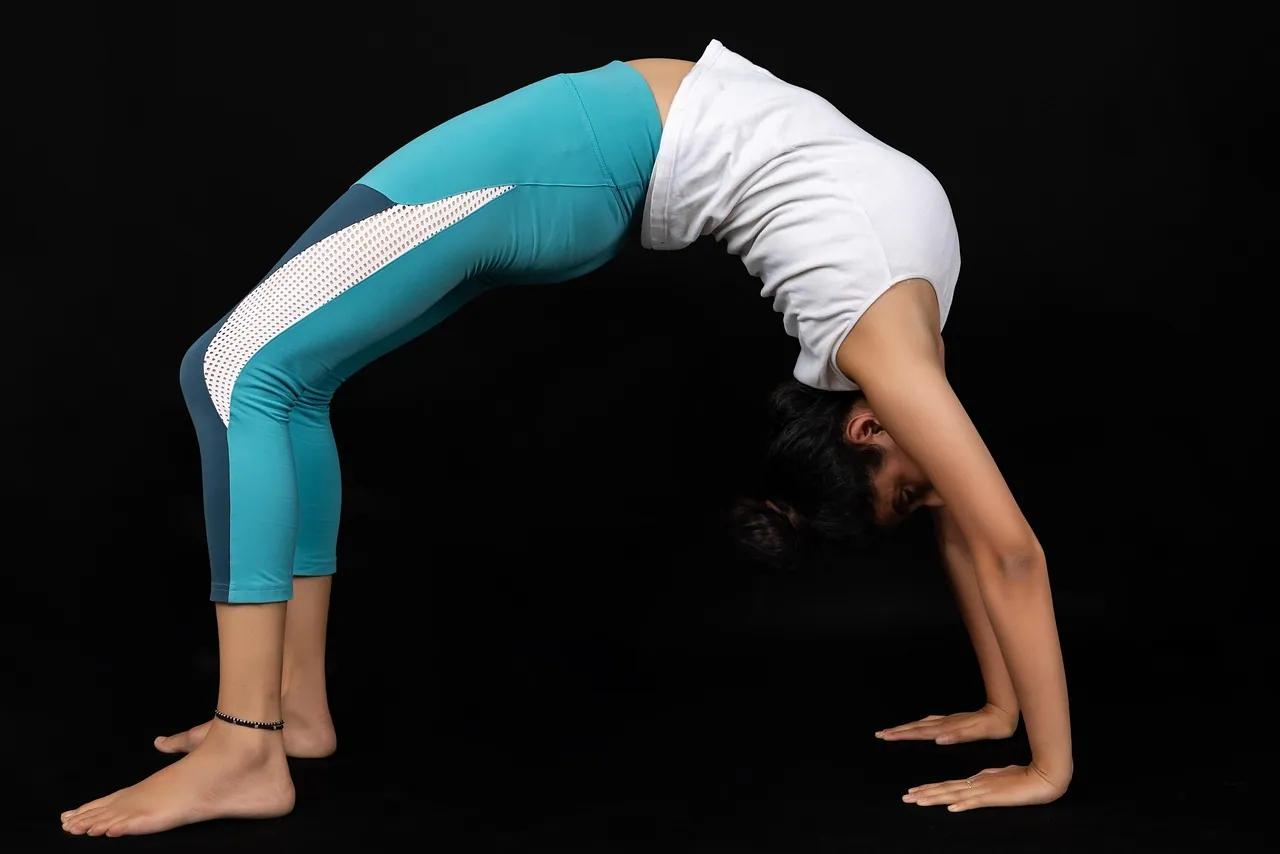
Advanced yoga poses such as headstand, crow (Bakasana), wheel (Urdhva Dhanurasana), full lotus and forearm balance are earned by strength and control, not by time on the mat alone. A reasonable test before attempting them:
- You can hold a clean plank for 60 seconds and a forearm plank for 60 seconds.
- You can hold downward dog comfortably for 10 breaths without shaking.
- You can hold bridge for 30 seconds with the knees staying parallel.
- You have practised at least 3 times a week for 3 months without recurring pain.
Even then, learn inversions against a wall with a teacher watching. The goal is not to collect poses; it is to keep practising into your 60s and 70s.
Frequently asked questions
How many yoga poses should a beginner learn first?
Start with 10 to 12 foundational poses: mountain, downward dog, warrior I and II, triangle, tree, cat-cow, cobra, bridge, seated forward bend, child’s pose and savasana. These cover every major movement pattern. Practise them 3 times a week for about 4 weeks before adding new ones.
What are the 5 basic yoga poses?
Most teachers would name mountain (Tadasana), downward-facing dog (Adho Mukha Svanasana), warrior II (Virabhadrasana II), tree (Vrikshasana) and child’s pose (Balasana). Together they teach standing alignment, weight-bearing through the arms, leg strength, balance and rest.
How long should I hold each yoga pose?
For beginners, 3 to 5 slow breaths (about 20 to 30 seconds) is enough for most active poses. Restorative poses such as child’s pose or legs up the wall can be held 1 to 5 minutes. If your breathing becomes strained, come out earlier.
Can I do yoga poses every day?
Yes, gentle daily practice is safe for most healthy adults. Alternate harder standing and balance sessions with lighter stretching and restorative days, and take a rest day if a joint feels sore rather than just stretched.
Is it better to learn yoga poses online or in a studio?
Both work. Live online classes with a teacher who can see you give real-time alignment corrections without the commute. Pre-recorded videos are fine for familiar poses but cannot correct a knee drifting inward or a rounded back.
Which yoga poses should I avoid with high blood pressure?
Avoid headstand, shoulder stand, plough and long holds with the head below the heart, and do not hold your breath in any pose. Gentle standing poses, seated poses and savasana are generally suitable. Check with your doctor before starting.
What is the difference between an asana and a yoga pose?
There is no practical difference. Asana is the Sanskrit word for a posture, originally meaning a steady seat for meditation. Yoga pose is the English equivalent, so Vrikshasana and tree pose are the same thing.
Learn these poses with a teacher watching. Fitstrot’s live online yoga classes take you through this beginner sequence with real-time alignment corrections, from your own mat at home. Book a trial session and start with the 12 poses above this week.


