
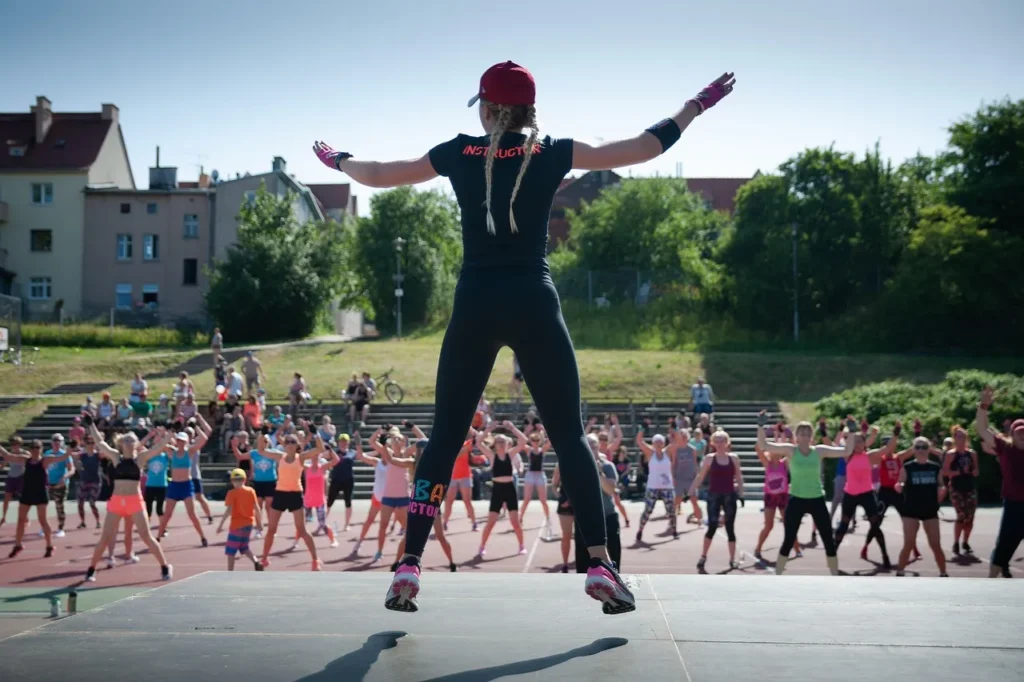
What is Zumba? It is a Latin-inspired dance fitness class in which you follow an instructor through short, repeating dance routines set to high-energy music, usually for 45 to 60 minutes. There is no mirror-perfect choreography to master and no counting of reps. You copy the moves, keep moving between songs, and the workout happens almost without you noticing.
In Indian cities you will now find it in gyms, society clubhouses, corporate wellness calendars and on video calls. This guide covers where Zumba came from, what a class contains minute by minute, the different formats, what research says about intensity, and how to start safely.
What is Zumba, in plain terms?
Zumba is a group dance-fitness workout built on Latin rhythms such as salsa, merengue, cumbia and reggaeton, led by a licensed instructor through simple follow-along routines. A standard class runs 40–60 minutes and mixes low- and high-intensity songs, so the session behaves like interval cardio. It needs no equipment and no dance background.
Harvard’s Nutrition Source describes it as aerobic exercise using Latin-inspired dance themes and music, with choreography that is less formal than a traditional dance class and typically 40–60 minutes long. It also notes something beginners should hear early: intensity varies widely depending on the choreography and the instructor’s energy. Two classes called “Zumba” can feel very different.
The difference from a dance class is the goal: a dance class wants you to perform a routine well, while a Zumba class wants your heart rate up and wants you back next week.
Meaning of Zumba: where the name comes from
The word has no formal Spanish meaning. It is a brand name, usually explained as a playful coinage evoking fast movement, close to the Colombian slang “rumba” (a party). Pérez even titled his book Zumba: Ditch the Workout, Join the Party!
Zumba meaning in Hindi (Zumba kya hota hai?)
If you are wondering “Zumba kya hota hai”, the short answer in Hindi is: Zumba ek dance-fitness workout hai jismein Latin aur Bollywood gaanon par aasaan dance steps karke cardio exercise ki jaati hai. There is no separate Hindi word for it. People say “Zumba class” or “Zumba dance” in Hindi, Marathi, Tamil and Malayalam alike.
From a forgotten cassette in Colombia to a global class
The origin story is well documented. In the 1990s, Colombian aerobics instructor Alberto “Beto” Pérez arrived at a class without his usual aerobics music. He improvised with the salsa and merengue tapes he had with him and choreographed as he went. The class loved it. Pérez moved to Miami in 1999 and, in 2001, partnered with Alberto Perlman and Alberto Aghion (the “three Albertos”) to turn it into a business. Reference summaries now put participation at roughly 15 million people taking at least one class a week.
Zumba is a trademark: only licensed instructors can call a class “Zumba”, and most keep that licence active through the Zumba Instructor Network, which supplies new choreography and music monthly. Fitstrot explains what ZIN membership means separately.
A typical session, minute by minute
Most licensed classes follow the same shape: warm-up, alternating fast and slow songs, a strength-flavoured track and a cool-down. Here is a realistic 55-minute class, studio or online.
| Block | Minutes | Songs | Typical rhythm | What you do | Form cue |
|---|---|---|---|---|---|
| Warm-up | 0–7 | 2 | Merengue, slow pop | March, step-touch, shoulder rolls, gentle hip sways | Soft knees; heels come down on every step |
| Build | 7–20 | 3–4 | Salsa, cumbia | Basic salsa step, cumbia shuffle, grapevines, arm patterns | Keep steps small until you know the pattern |
| Peak block 1 | 20–32 | 3 | Reggaeton, soca | Jumps, jacks, fast travelling steps (low-impact option offered) | Land through the whole foot, knees tracking over toes |
| Recovery song | 32–36 | 1 | Bachata or Bollywood slow track | Rhythm-based side steps, breathing reset | Stand tall; let the heart rate settle but keep moving |
| Peak block 2 | 36–46 | 3 | Bollywood, bhangra, samba | Bhangra arms, hops, samba bounce | Pivot on the ball of the foot, never on a planted heel |
| Strength track | 46–50 | 1 | Mid-tempo pop | Squats, lunges, plank taps to the beat (about 16–24 reps each) | Hips back in squats; brace the core in planks |
| Cool-down | 50–55 | 1–2 | Slow ballad | Calf, hamstring, hip-flexor and chest stretches | Hold each stretch 20–30 seconds, no bouncing |
First-timers are usually surprised by how few pauses there are. Rest comes from slower songs, not standing still, and you learn steps by missing them once and catching them on the next chorus.
The music: salsa, merengue, cumbia, reggaeton and Bollywood in India
The programme is built on four core rhythms: salsa, merengue, cumbia and reggaeton, with samba, soca, bachata and hip-hop added by many instructors. Indian classes typically add Bollywood and bhangra. Rhythm sets intensity: merengue’s steady march is easy, while reggaeton and soca drive the jumps.
Zumba Gold, Toning, Aqua Zumba and Strong Nation: which class is which?
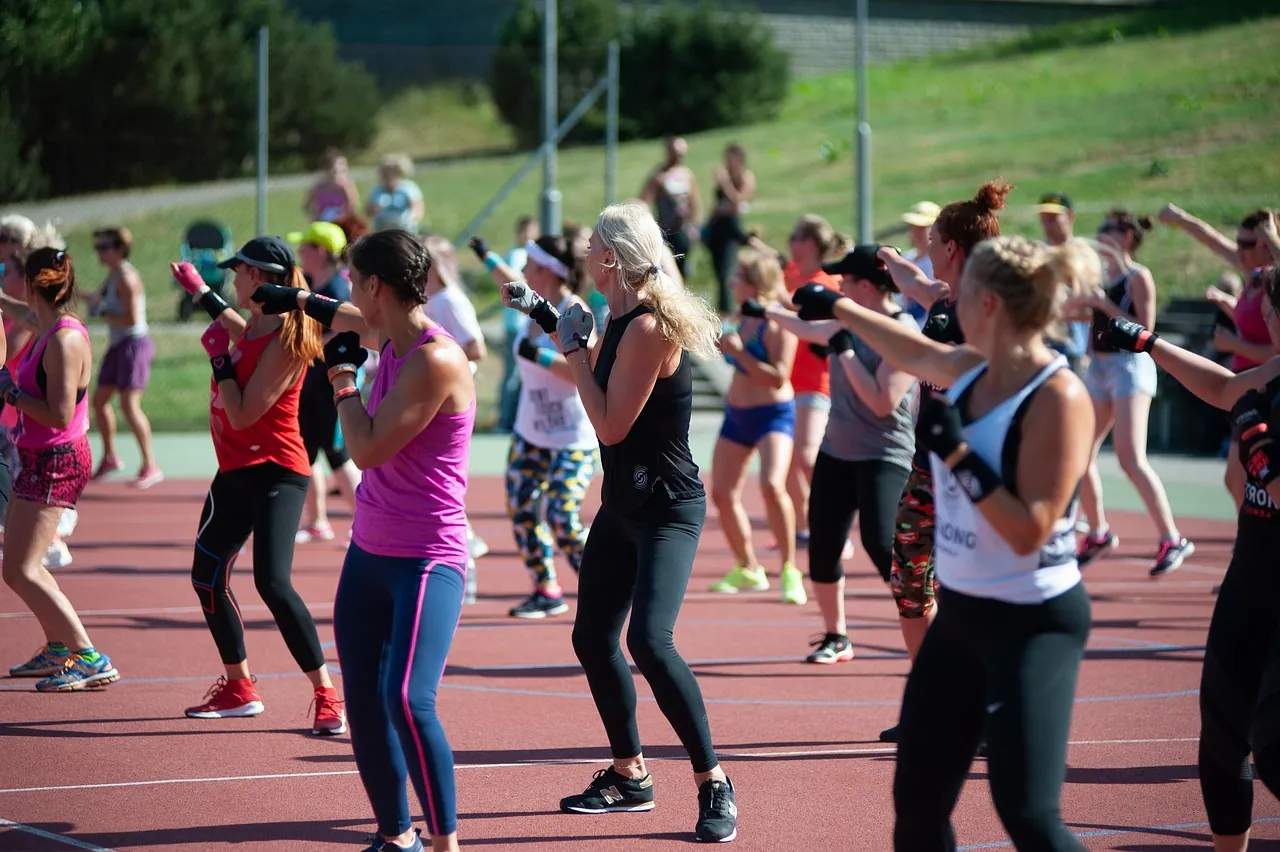
“Zumba” is also an umbrella for a family of formats, each licensed separately. Knowing the names helps you pick the right class, especially if you are older, recovering from an injury, or signing up a child. The descriptions below follow the company’s own class-type directory.
| Format | What it is | Best for | Intensity | Equipment | Works online at home? |
|---|---|---|---|---|---|
| Zumba (standard) | The original mix of low- and high-intensity dance songs | Most healthy adults | Moderate to vigorous | None | Yes |
| Zumba Gold | Slower tempo, simpler steps, focus on balance and coordination | Beginners, adults 50+, people returning after a long break | Light to moderate | None | Yes |
| Zumba Toning | Dance plus muscle work with light toning sticks | People who want some strength work in the same hour | Moderate | Toning sticks or 0.5–1 kg dumbbells | Yes |
| Zumba Step | Dance routines on and off a step platform | Legs and glutes emphasis | Moderate to vigorous | Aerobic step | Yes, with a sturdy step |
| Aqua Zumba | Low-impact dance moves in a swimming pool; water adds resistance | Joint pain, higher body weight, arthritis | Moderate | Pool | No |
| Zumba Sentao | Chair-based dance and strength work | Core and strength without jumping | Moderate | Sturdy chair | Yes |
| Zumba Kids / Kids Jr. | Games and simplified routines; Kids is ages 7–11, Kids Jr. is ages 4–6 | Children | Playful, variable | None | Yes, with an adult nearby |
| STRONG Nation | High-intensity interval training synced to music, not a dance class | Fitter adults who want HIIT | Vigorous | None or light weights | Yes, with floor space |
Note that STRONG Nation came out of the Zumba company but is bodyweight HIIT, not dance. If you want dance, pick standard Zumba or Gold.
Is Zumba dance exercise a real workout? What the numbers say
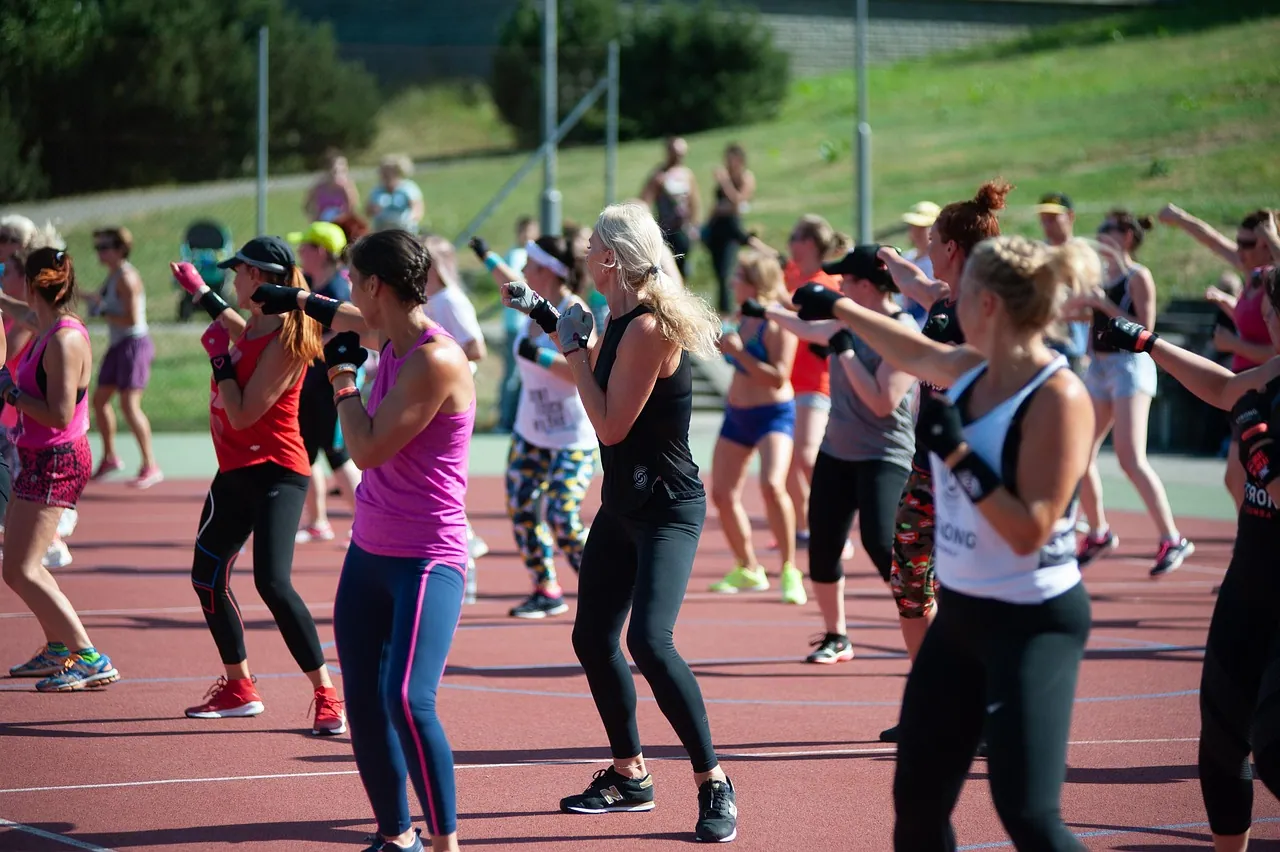
Yes. In a 2012 study commissioned by the American Council on Exercise, 19 women aged 18–22 burned an average of 369 kcal in a roughly 39-minute Zumba class, or 9.5 kcal per minute, while working at 80% of maximum heart rate. That meets ACSM intensity guidelines for improving cardiovascular fitness.
The study, run at the University of Wisconsin–La Crosse and published as a letter in the Journal of Sports Science and Medicine (2012), is the most-quoted piece of Zumba research. ACE’s own write-up adds the detail: participants averaged 154 bpm, 64% of VO2max and 8.8 METs, with per-minute burn ranging from 5.1 to 15.3 kcal. That range matters. The same class can be a moderate session for one person and a very hard one for another, depending on how big the moves are.
Keep the limits in mind: the volunteers were young, fit and already knew Zumba. Beginners still learning the steps usually burn less.
For older adults, ACE funded a second study on Zumba Gold. Sixteen men and women aged 40–85 did a 45-minute class and averaged about 198 kcal at 4.3 METs, a moderate intensity that still met the guidelines for maintaining cardiorespiratory fitness. The researchers also noted that some individuals crossed into vigorous intensity, which is why screening matters for people with heart disease or type 2 diabetes.
Across longer programmes, a 2016 systematic review in PM&R covering 11 studies and 586 participants concluded that Zumba reliably improves aerobic capacity, gives small positive changes in body weight and measurements, and has psychological and social benefits. It found only limited evidence for gains in muscular strength and flexibility. A later 8-week trial published in 2022 put 21 inactive women aged 35–45 through three 60-minute sessions a week. Compared with a control group, their lung function improved (forced expiratory volume up 0.65 litres) and their fat mass dropped, but the sample is small.
In guideline terms, the WHO recommends at least 150 minutes of moderate-intensity activity a week, and its physical activity fact sheet reports that 31% of adults worldwide did not meet that level in 2022. Three 50-minute Zumba classes cover that target on their own.
Difference between aerobic and Zumba workouts
Zumba grew out of aerobics, so the two overlap heavily. The practical differences are in how the class is cued, how steps are structured, and how the music is used. The calorie column below uses Harvard Health’s figures for a 70 kg (155 lb) person over 30 minutes. Harvard does not list Zumba separately. The Zumba row is a derived estimate from the ACE study’s 9.5 kcal/min average, adjusted down for a less experienced student, and should be read as a ballpark.
| Feature | Traditional aerobics | Step aerobics | Zumba |
|---|---|---|---|
| Cueing | Counted in 8s, verbal step names | Counted, platform-based patterns | Mostly non-verbal hand cues, follow the rhythm |
| Music | Steady, fast-tempo tracks | Steady, slightly slower tempo for safety on the step | Changing tempos and genres song to song |
| Structure | Continuous, steady intensity | Continuous, steady intensity | Interval-like: fast songs, then slower songs |
| Learning curve | Moderate | Higher (coordination on a step) | Low for the basics; styling takes longer |
| Approx. kcal / 30 min | 198 (low impact) – 252 (high impact) | 252 (low) – 360 (high) | Roughly 200–285 depending on effort |
| Joint impact | Low or high versions | Moderate to high | Mixed; low-impact options on every song |
Harvard’s figures come from its calories-burned-in-30-minutes table (updated 2021), which lists disco, ballroom or square dancing at 198 kcal for a 70 kg person. Energy cost is broadly similar across all three. What differs is adherence: many people who get bored counting eights in aerobics keep turning up for Zumba because it feels like a night out.
Five Zumba myths worth dropping
- “You need to be a good dancer.” You don’t. Steps repeat on purpose, and most people feel comfortable by their sixth class.
- “It’s only for women.” Indian classes skew female, but nothing in the format is gendered. Many men take to the bhangra and reggaeton tracks fastest.
- “More classes a week means faster results.” Past a point, more classes mainly means more injury risk (see the troubleshooting section).
- “Zumba builds strength and replaces the gym.” The 2016 review found only limited evidence for strength or flexibility gains. Zumba is excellent cardio. If you want strength, pair it with two short resistance sessions, as the NHS adult guidelines recommend strengthening all major muscle groups on at least 2 days a week.
- “It’s a weight-loss programme.” It is a cardio workout. Research shows only small average weight changes, so treat any lost kilos as a bonus, not a promise.

Zumba for beginners: a 4-week starting plan
Going all-out in week one usually ends in sore calves and frustration. This plan builds tolerance first, for healthy adults who are currently inactive. Use a Zumba Gold class in week 1 if one is available.
| Week | Classes / week | Minutes per class | Effort (talk test) | Rest between classes | Focus and form cue |
|---|---|---|---|---|---|
| 1 | 2 | 30 (leave after the first peak block) or a full Gold class | Can speak full sentences | At least 1 full day | Learn footwork only; keep arms low. Low-impact option on every jump. |
| 2 | 2–3 | 45 | Can speak in short phrases | At least 1 day | Add arm patterns. Heels down on every landing. |
| 3 | 3 | 45–55 (full class) | Short phrases on fast songs, sentences on slow ones | 1 day; no back-to-back days yet | Try the high-impact option on 1–2 songs. Pivot on the ball of the foot. |
| 4 | 3 + 1 strength session | Full class + 20-min strength | Hard on peaks, recovered by the next song | 1 day between Zumba classes | Strength: 2 sets × 10–12 squats, lunges, glute bridges, wall push-ups; 60 s rest. |
By week 4 you are doing about 150 minutes of cardio plus one strength session, which matches the WHO and NHS baseline. From there, progress effort rather than adding classes. Fitstrot’s guide to beginner mistakes in personalised workout plans covers the pacing errors that derail most people in month two.
Knees, breathlessness, lost steps: troubleshooting your first month
The most common Zumba problem is knee pain, and the biggest risk factor is doing too many classes a week. In a 2013 University of Hawai’i survey of 49 regular participants, 29% reported a Zumba-related injury, 42% of those injuries were to the knees, and injured participants averaged 3.8 classes a week versus 2.7.
That 2013 survey in the Hawai’i Journal of Medicine & Public Health found that each extra weekly class raised the odds of injury about 3.6-fold after adjusting for age and experience. Harvard’s summary also notes that instructors, who teach many classes a week, are far more likely to be injured than participants. The usual fixes:
- Knee pain on twists: you are usually pivoting on a planted heel. Turn on the ball of the foot, and swap jumps for step-touches. On marble or tile, smooth-soled cross-trainers turn better than grippy running shoes.
- Calf or shin soreness: bring your heels down between steps. If soreness lasts more than 72 hours, drop one class that week.
- Breathless within 10 minutes: make the moves smaller, not slower. Keep your feet moving to the beat, with arms below shoulder height, until the next slow song.
- Always one step behind: watch the feet for the first verse and add arms on the repeat. Online, turn on mirror mode so left and right match.
- Dizziness or chest discomfort: stop and sit down. This is not something to push through. Get checked by a doctor before your next class.

Who Zumba suits, and who should check with a doctor first
Zumba suits most healthy adults who want cardio they will actually stick with, including people bored by treadmills and desk workers who need to move. Older adults do well with Zumba Gold, and children aged 4–11 have their own Kids formats.
Talk to your doctor before starting if any of these apply:
- A heart condition, uncontrolled high blood pressure, or type 2 diabetes on insulin or sulfonylureas (hypoglycaemia risk during long cardio)
- Pregnancy, especially if you were not already active. Choose low-impact options and avoid jumps and fast twists as the bump grows.
- Recent knee, ankle or back injury or surgery. Aqua Zumba or Zumba Gold is often the better entry point.
- Osteoporosis or a history of falls. Choose Zumba Gold and avoid fast direction changes at first.
For a slower recovery day between classes, Fitstrot’s live online yoga classes pair well with Zumba.
Doing Zumba online at home: what actually changes
Online Zumba keeps the format and changes the logistics. You need about 2 m × 2 m of clear floor, supportive shoes, water nearby and a screen at chest height. In Indian apartments, watch for slippery tile or marble (wear shoes, and skip the yoga mat, which catches during turns), and consider low-impact options for evening classes if you have neighbours below.
A small live online class can actually give more feedback than a crowded studio, as long as your camera shows your full body. At Fitstrot, online Zumba is led by lead trainer Yash Pathak, who is ZIN Licensed, ACE Certified and Strong Nation Certified.
Frequently asked questions
Does Zumba help in weight loss?
It can contribute, but it is not a weight-loss programme on its own. A 2016 systematic review found only small average reductions in body weight, with the clearest benefit being better aerobic fitness. Weight change depends mainly on overall diet, sleep and consistency. Zumba helps most by making regular cardio something you enjoy enough to keep doing.
How many calories does a 1-hour Zumba class burn?
In ACE’s 2012 study, experienced young women burned about 9.5 kcal per minute, which works out to roughly 570 kcal over an hour. Most beginners burn less, commonly around 300–500 kcal per hour, depending on body weight and how big the moves are. Zumba Gold averaged about 198 kcal in 45 minutes for adults aged 40–85.
Zumba kya hota hai?
Zumba ek group dance-fitness workout hai. Ismein instructor salsa, merengue, reggaeton aur Bollywood jaise gaanon par aasaan dance steps karwata hai, aur class aam taur par 45 se 60 minute ki hoti hai. Dance aana zaroori nahi hai. Steps baar-baar repeat hote hain, taaki beginners bhi saath chal sakein.
How many times a week should I do Zumba?
Two to three classes a week is the sensible range for most people. Three 50-minute classes cover WHO’s 150-minute weekly target. The 2013 Hawai’i survey linked more classes per week with higher injury risk, so add a rest day between classes and one or two strength sessions rather than a fourth or fifth Zumba class.
Do I need shoes for Zumba at home?
Yes, for most people. Wear cross-training or dance-fitness shoes with a smooth, flat sole, which lets you pivot without your knee twisting. Running shoes with heavy grip and thick heels tend to stick during turns. Barefoot on tile or marble is slippery and gives your joints no cushioning.
Is Zumba safe during pregnancy?
Many women can continue low-impact dance exercise during a healthy pregnancy if they were already active, but it needs your obstetrician’s approval first. Skip jumps, fast twists and anything that affects balance as pregnancy progresses. Stop immediately if you feel dizzy, breathless or have any pain or bleeding.
What is the difference between Zumba and ZIN?
Zumba is the workout you take as a student. ZIN, the Zumba Instructor Network, is the membership licensed instructors join to keep their licence active and receive new music and choreography each month. As a student you don’t need ZIN, but you can check that your instructor is licensed.
Try it before you decide. Book a trial of Fitstrot’s live online Zumba classes and see whether three dance sessions a week is the cardio habit that finally sticks.


