
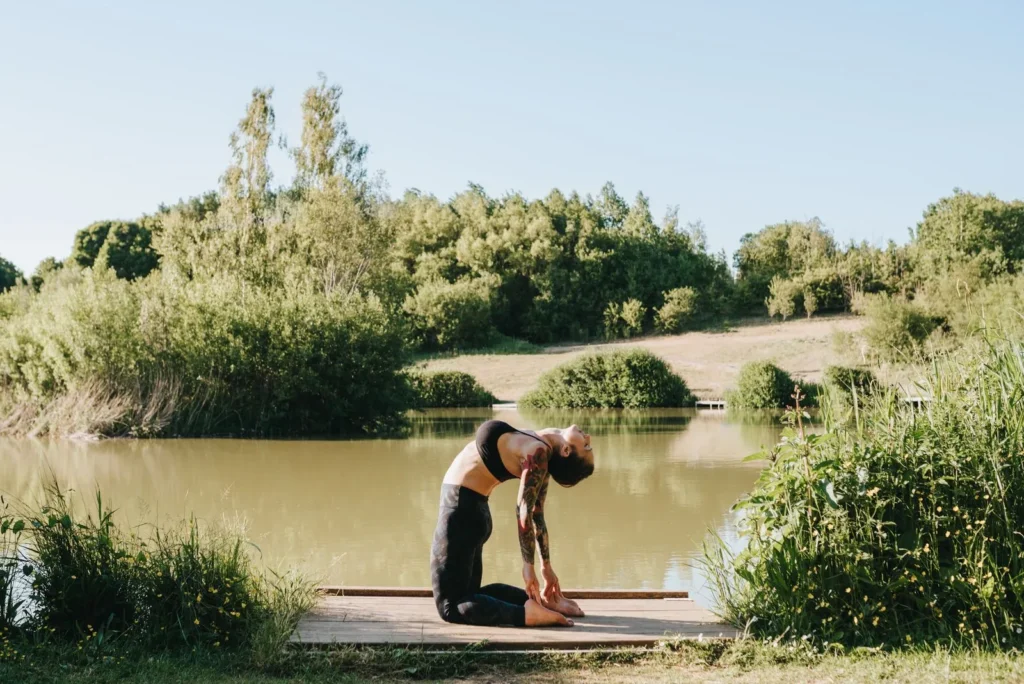
Camel pose, called ustrasana in Sanskrit, is a kneeling backbend where you lift your chest, press your hips forward over your knees and reach back toward your heels. It is a deep pose, so how you enter it matters far more than how far you go. This guide covers the steps, safer modifications, common mistakes, who should skip it, how long to hold it and what to do afterwards.
What does ustrasana mean, and is it a beginner pose?
Ustrasana comes from the Sanskrit “ustra”, meaning camel, and “asana”, meaning pose. It is a kneeling backbend usually taught at an intermediate level, because it asks for open hip flexors, shoulders and upper back. Beginners can still learn it safely through smaller versions, such as keeping the hands on the lower back.
You will also see the spelling “ushtrasana”; it is the same pose. Camel belongs to the wider family of spine-extending shapes in yoga poses, and it is the kneeling cousin of the lying-down cobra pose. If you are new to yoga, begin with yoga for beginners, then grow into the full pose over weeks rather than forcing it on day one.
How do you do camel pose step by step?
Kneel with your knees hip-width apart and thighs vertical, place your hands on your lower back, lift your chest, and lean back only as far as your hips can stay stacked over your knees. Hold three to five breaths, then come up chest first and rest in child’s pose.
- Set the knees. Kneel on a folded mat or blanket so your kneecaps are cushioned. Keep knees about hip-width apart, with thighs vertical, so your hips sit directly above your knees.
- Choose your feet. Tuck your toes under for a little extra lift, or keep the tops of your feet flat on the mat for the classical version.
- Hands to the lower back. Place your palms on your lower back or the top of your hips, fingers pointing down or out to the sides, whichever feels steadier.
- Lengthen first. Inhale and grow tall through the spine. Draw your tailbone gently down and lift the breastbone toward the ceiling.
- Lean back from the chest. Exhale and begin to arch, letting the bend come mostly from the upper back and chest. Keep pressing your hips forward over the knees so you do not fold into the lower back.
- Decide how far to go. If it feels comfortable, reach one hand at a time to a heel, or stay with the hands on your back. Keep your chin neutral or slightly tucked so the back of the neck stays long.
- Breathe and exit. Take three to five slow breaths. To come out, bring your hands back to your hips, press the hips forward, and lift the chest up first, with the head arriving last.
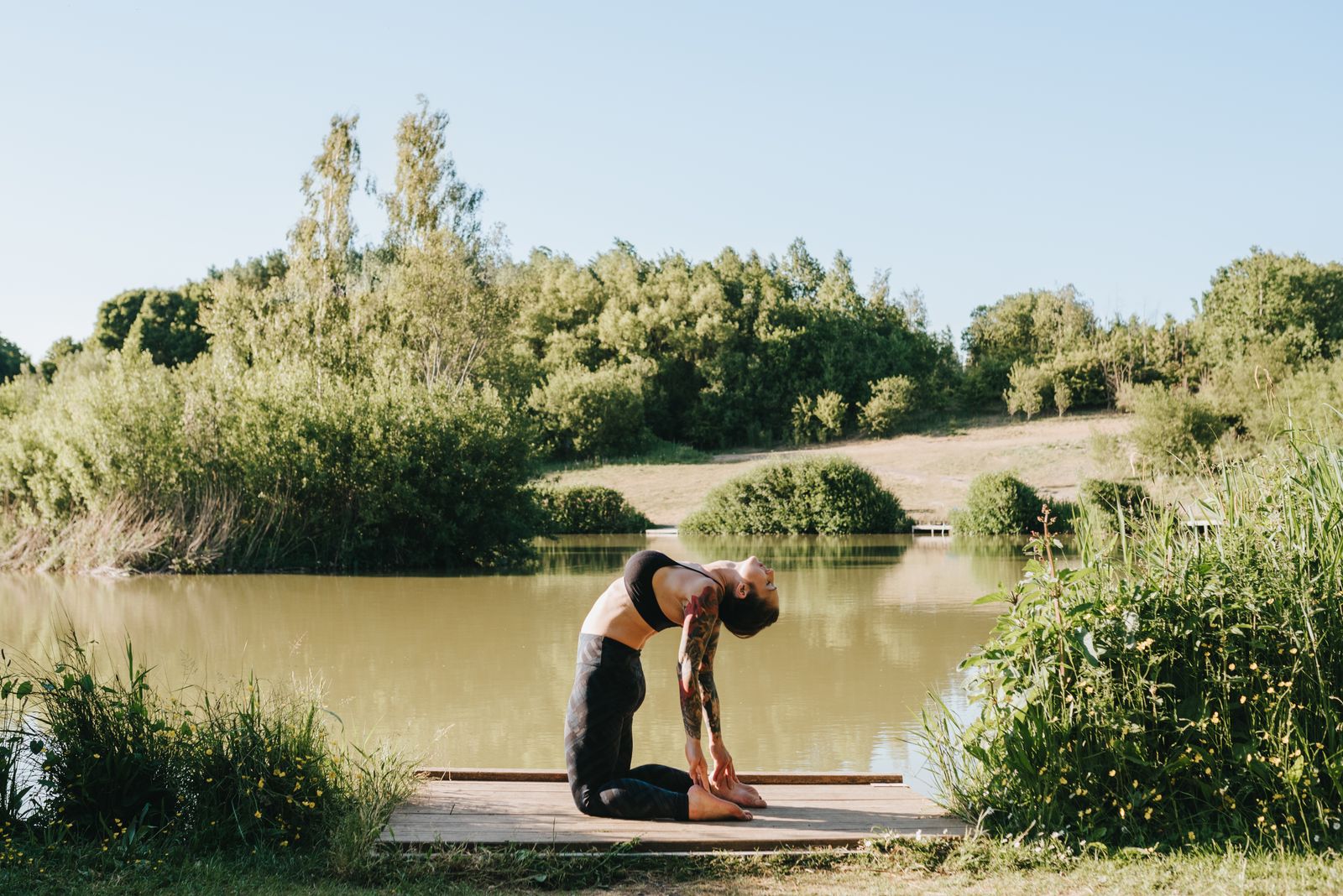
Camel pose modifications compared
You do not need to reach your heels to practise ustrasana well. The table below sets out the common versions from gentlest to most demanding, so you can choose the one that matches your shoulders, hips and comfort on the day.
| Version | Setup | Best for | What to watch |
|---|---|---|---|
| Hands on lower back | Palms on the lower back, fingers down, chest lifting | First-timers, tight shoulders, stiff upper back | Lift the chest rather than collapsing into the waist |
| Toes tucked | Toes curled under, heels lifted, hands on back or reaching to heels | Anyone who cannot reach the heels, tight ankles or thighs | Keep the hips over the knees as the heels rise |
| Block beside the ankles | Block placed outside each foot at its highest setting, hands reach for blocks | Those with some mobility but not enough to reach the heels | Do not shorten the front body to reach the block; lift the chest first |
| Half camel (ardha ustrasana) | One hand to the same-side heel or block, other hand on the hip or lifted overhead | Building toward the full pose, working one side at a time | Keep the hips square and repeat on both sides |
| Full ustrasana | Tops of feet flat, both hands on the heels | Practitioners who stay comfortable in the smaller versions | Neck stays long; no pinching in the lower back |
If you are unsure which row fits you, start with hands on the lower back.
What does camel pose actually do for your body?
Camel pose stretches the front of the body, including the chest, the front of the shoulders, the hip flexors and the thighs, while asking the muscles along the back, the glutes and the shoulders to work. It builds mobility and strength in a new range. It is not a treatment for any health condition.
How open you feel depends on your body, your warm-up and how gently you build up, and nothing here is guaranteed. If your goal is a more upright stance in daily life, camel works best as one part of a broader routine, such as the ones described in yoga for posture and yoga for flexibility.
Myth check: you have to touch your heels
You do not. Touching the heels is a result of flexibility, not the purpose of the pose, and chasing it is the quickest route to a sore lower back. A shallow camel with the hips stacked over the knees, the chest lifted and the neck relaxed is a better ustrasana than a deep one with the hips dumped backward.
A second myth is that the head should always drop back. Dropping the head is optional, and for many people it is the first thing to leave out. Letting the head fall back compresses the back of the neck and can bring on dizziness, especially if your upper back has not opened yet. Pain is not progress either: a mild stretch across the front of the body is normal, but sharp, pinching or tingling sensations mean stop and reset.
Common mistakes in ustrasana and how to fix them
Most camel pose problems come from the same few habits. If something feels off, find it in the table and apply the fix before going deeper.
| Mistake | What it looks like | Simple fix |
|---|---|---|
| Hips drift behind the knees | Thighs lean back, the bend sits in the lower back, a pinching feeling appears | Press the hips forward, return to hands on the lower back, and come up |
| Head drops back too soon | Chin lifts, the back of the neck crunches, the face feels hot or dizzy | Keep the chin neutral or slightly tucked and the gaze forward |
| Holding the breath | Jaw tight, shoulders rising toward the ears, stretch feels stronger than it should | Breathe in through the nose as you lift, out slowly as you settle; ease back if you cannot |
| Skipping the warm-up | Stiff shoulders and hips, quick compensation in the lower back | Warm up with a few sun salutations and a hip flexor stretch first |
| Reaching for heels at any cost | Ribs flare, the lower back collapses, knees slide backward | Use blocks or tuck the toes, or keep the hands on your back |
| Knees too wide or too narrow | Wobbling, uneven weight, one side doing more work | Set the knees hip-width apart and keep the thighs parallel |
Who should skip or modify ustrasana?
Skip full ustrasana, or get personal guidance first, if you have a back or neck injury, high or low blood pressure, migraines, dizziness, recent abdominal surgery, or you are pregnant. In these cases a gentler pose is usually a better choice than a deep backbend, and a doctor can tell you what suits your body.
- Back or neck injury: a deep arch loads the lower back and a dropped head loads the neck, so both are worth avoiding without professional advice.
- High or low blood pressure: changes in head position and breathing can leave you light-headed, so check with your doctor before practising backbends.
- Migraine: a head tipped back and a held breath can be a trigger for some people.
- Dizziness or vertigo: skip it, or keep the head neutral and the arch very small.
- Recent abdominal surgery: stretching the front of the abdomen is not appropriate until your surgeon has cleared you.
- Pregnancy: deep backbends are generally advised against, so choose prenatal-friendly options with a qualified teacher.
This list is not complete, and none of this replaces medical advice. See your doctor if you have any health condition, ongoing pain or doubt about whether this pose suits you. Stop straight away and come out slowly if you feel sharp pain, tingling, nausea or light-headedness.
How long should you hold camel pose, and how often?
Hold camel pose for about three to five slow breaths, roughly 15 to 30 seconds, and repeat once or twice. Two to three sessions a week is plenty for most people. Shorter holds with steady breathing are safer than one long, strained hold, and depth can build gradually over weeks.
The sample progression below is a guide, not a target. Move on only when the current stage feels easy, and stay longer at any stage if you need to.
| Stage | Version | Hold | Rounds | Rest between |
|---|---|---|---|---|
| Weeks 1-2 | Hands on lower back, toes tucked | 3 breaths | 2 | Child’s pose, 3 breaths |
| Weeks 3-4 | Half camel on each side, or blocks | 3-4 breaths | 2 | Child’s pose, 3-5 breaths |
| Weeks 5-6 | Blocks or toes tucked with both hands to heels | 4-5 breaths | 1-2 | Child’s pose, 5 breaths |
| Later | Full ustrasana, only if it stays comfortable | 3-5 breaths | 1-2 | Child’s pose, 5 breaths |
Where does ustrasana fit in a yoga sequence?
Camel pose belongs in the middle of a practice, after the body is warm and before the deepest peak pose, and it should always be followed by a counter-pose. A good order is sun salutations, a hip flexor opener, a gentler backbend, camel, then child’s pose and a forward fold.
- Warm up: a few rounds of surya namaskar raise your body temperature and mobilise the shoulders. A minute of standing tall in tadasana helps you feel your alignment before you start bending.
- Open the hip flexors: a low lunge such as anjaneyasana stretches the front of the hips, which makes it easier to keep them over the knees in camel.
- Prepare the back: a gentle backbend like cobra teaches the upper back to extend before the deeper kneeling shape.
- Camel: take one or two short rounds at the stage that suits you.
- Counter-pose: sit back into child’s pose for several breaths, letting the spine round gently and the lower back soften. Then move into a seated forward fold to bring the spine back toward neutral.
This order fits naturally into a slower hatha yoga session, where there is time to rest between poses.
Ustrasana FAQs
Is ustrasana good for beginners?
It is usually taught at an intermediate level, but beginners can start with smaller versions. Keep your hands on your lower back, hold for three breaths, and keep the hips over the knees. Move to blocks or half camel only when that feels easy and comfortable, and ideally with a teacher checking your alignment.
How long should I hold camel pose?
Hold it for about three to five slow breaths, which is roughly 15 to 30 seconds, and repeat once or twice. Short, steady holds are safer than one long hold. Rest in child’s pose between rounds, and stop sooner if you feel pinching, dizziness or tingling.
What if I cannot reach my heels in ustrasana?
That is very common and perfectly fine. Tuck your toes under to lift the heels, place yoga blocks beside your ankles, or keep your hands on your lower back. Reaching the heels is not required, and keeping your hips over your knees matters far more than depth.
Should I drop my head back in camel pose?
Not necessarily. Many teachers suggest keeping the chin neutral or slightly tucked and the gaze forward, because a dropped head can strain the neck and cause dizziness. If your neck feels comfortable and your upper back is open, a small, gentle release may be fine, but it is always optional.
Is it normal to feel dizzy after ustrasana?
A mild head rush can happen when you come out of a backbend too fast. Rise slowly, lift the chest first, and rest in child’s pose until it passes. If dizziness is strong or keeps happening, stop practising backbends and see your doctor before trying them again.
Learn camel pose with a teacher watching
Backbends are easiest to learn when someone checks your hips and neck in real time. Book an online yoga class with Fitstrot and start with the camel version that suits your body.


