

If you can barely reach your knees in a forward fold, you are in good company. Most adults who sit for hours lose range of motion in the hips, hamstrings and shoulders without noticing. The good news is that yoga for flexibility is one of the gentlest, most beginner-friendly ways to win it back. This guide gives you the poses, a simple 4-week plan, safe hold times and the mistakes that stall progress. Go slowly, breathe, and never force a stretch.
How Does Yoga Improve Flexibility?
Yoga improves flexibility by holding gentle stretches while you breathe slowly, which teaches your nervous system that a longer range is safe. Over several weeks your muscles tolerate more length and your joints move more freely. Most beginners notice looser hamstrings and hips in about 4 to 8 weeks of regular practice.
Flexibility is partly a muscle issue and partly a nervous system issue. When you stretch quickly or aggressively, your body protects itself by tightening. When you hold a pose and lengthen your exhale, that guarding softens and you can move a little further. That is why breath-led holds tend to work better than bouncing or pulling.
Yoga also moves several muscle groups in one flow. A single round of sun salutations stretches the calves, hamstrings, hips, chest and shoulders together, and many poses ask the legs and core to work while the stretch happens. That overlap is why flexibility and yoga for strength often sit in the same sequence. Strength around a joint is what lets you use new range safely.
Which Yoga Poses for Flexibility Should Beginners Start With?
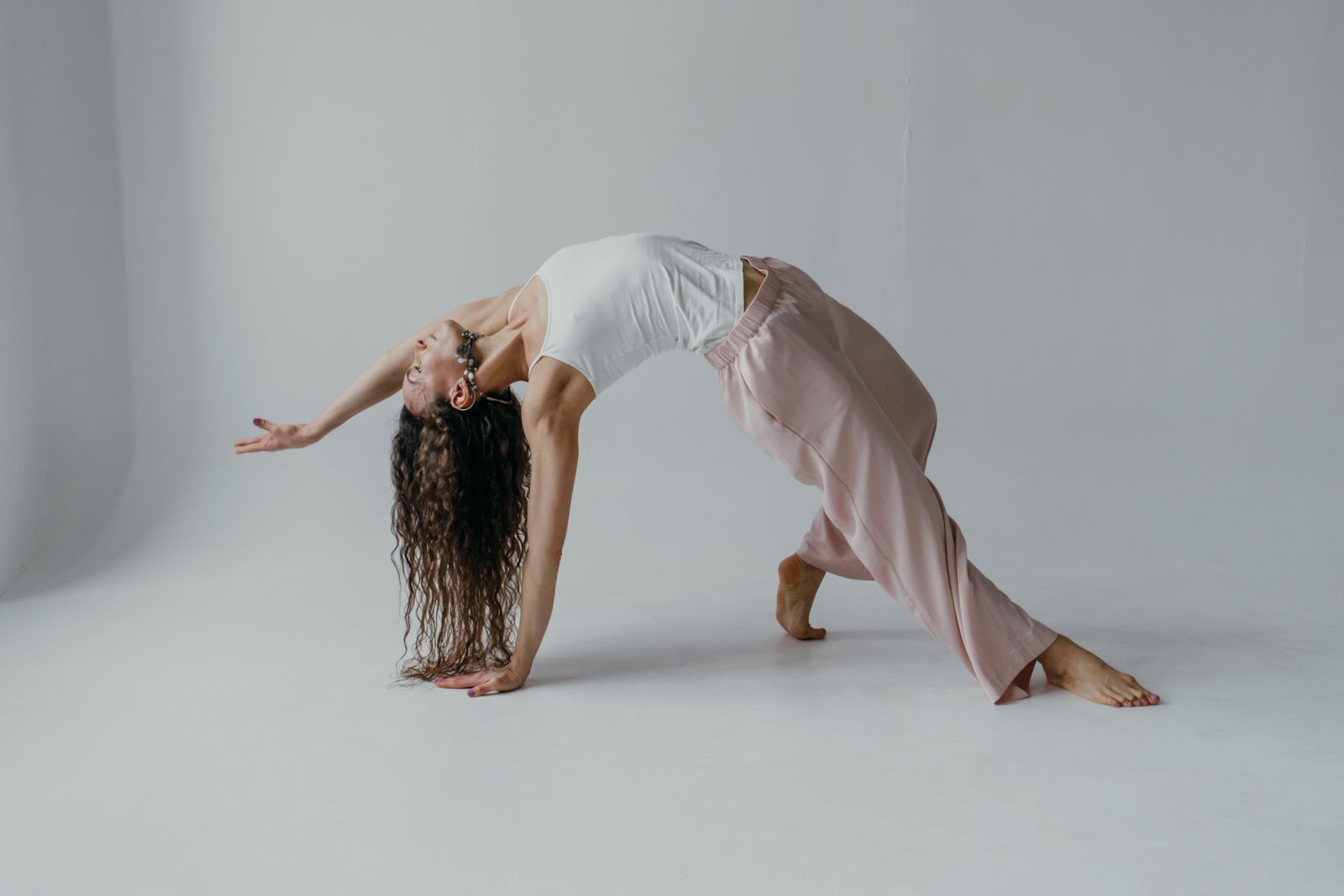
Beginners should start with downward-facing dog, low lunge, bound angle pose, seated forward fold and cat-cow. Together they cover the calves, hamstrings, hips, spine and shoulders. Hold each for about 5 to 8 slow breaths, roughly 30 to 45 seconds, stay at mild tension, and use props such as a folded blanket, block or strap.
The table below is a screenshot-friendly cheat sheet. Hold times are guides, not targets. If a pose needs you to clench your jaw or hold your breath, you have gone too far, so ease back.
| Pose | Mainly stretches | Hold | Form cue |
|---|---|---|---|
| Cat-cow (Marjaryasana-Bitilasana) | Spine, neck, chest | 8 to 10 slow rounds | Move with your breath, not faster than it |
| Downward-facing dog (Adho Mukha Svanasana) | Calves, hamstrings, shoulders | 5 to 8 breaths | Bend your knees freely and lengthen the spine first |
| Low lunge (Anjaneyasana) | Hip flexors, front of thigh | 5 to 8 breaths per side | Tuck the tailbone slightly; keep the front knee over the ankle |
| Bound angle pose (Baddha Konasana) | Inner thighs, groin | 8 to 10 breaths | Sit on a folded blanket; never press the knees down with your hands |
| Seated forward fold (Paschimottanasana) | Hamstrings, lower back | 5 to 8 breaths | Hinge from the hips; loop a strap around your feet |
| Reclined big toe pose (Supta Padangusthasana) | One hamstring at a time | 5 to 8 breaths per leg | Keep the lower back resting on the floor; a bent knee is fine |
| Cow face arms (Gomukhasana arms) | Shoulders, triceps, upper back | 5 breaths per side | Use a strap or towel if your hands do not meet |
| Child’s pose (Balasana) | Hips, lower back, shoulders | As long as comfortable | Rest here between harder poses |
These are the best yoga poses for flexibility for most beginners because none of them ask for a deep range on day one. Pigeon pose, wide-legged folds and gentle backbends such as cobra can be added once the basics feel easy, usually after a few weeks. Our types of yoga guide explains where each pose tends to appear.
A 4-Week Yoga for Flexibility Plan You Can Do at Home
You do not need a studio, only a mat, a strap or old dupatta, and about 20 minutes. This plan builds gradually, with short sessions three to four days a week and a rest day between harder ones. A yoga for flexibility routine at home works best when the time of day stays the same, because habit matters more than intensity.
| Week | Sessions | Length | What to do |
|---|---|---|---|
| Week 1 | 3 days (for example Mon, Wed, Sat) | 15 to 20 min | Cat-cow, child’s pose, downward dog with bent knees, reclined big toe pose with a strap. Hold about 5 breaths each. |
| Week 2 | 3 to 4 days | 20 min | Add 3 rounds of gentle sun salutations, low lunge and bound angle pose. Hold 5 to 8 breaths. |
| Week 3 | 4 days | 20 to 25 min | Add seated forward fold, cow face arms and a seated twist. Spend 5 minutes in a final rest. |
| Week 4 | 4 days | 25 to 30 min | Combine everything into one flow, then add one gentle backbend such as cobra, kept low and pain-free. |
Start every session with 5 minutes of easy movement: joint circles, a few cat-cows, a short walk on the spot. Finish with 3 to 5 minutes lying down in Savasana (corpse pose). If you already do the occasional run or gym session, our guide to the benefits of yoga shows how a short evening flow can complement it.
Troubleshooting: Tight Hamstrings, Stubborn Hips and Rounded Shoulders
Most flexibility progress stalls in the same three places. Here is what usually helps, and what does not.
Tight hamstrings
Hamstrings respond to patient, repeated, gentle lengthening, not to force. Keep your knees soft in standing and seated folds, and hinge from the hips rather than rounding your lower back. Use a strap in reclined big toe pose so you can stretch one leg without straining. Over weeks you can straighten the knee a little more. Never bounce, and never stretch a cold hamstring hard.
Hips that will not open
Long hours at a desk shorten the hip flexors and stiffen the outer hips, which is why hip flexibility is often the first thing people want to fix. Low lunge, bound angle pose and a supported pigeon (with a folded blanket under the hip) are good places to start. If your knees complain, you are probably forcing the hips, so raise your seat or reduce the depth. Tight hips are also linked with a stiff lower back, so you may like our yoga for back pain routines alongside this plan.
Rounded shoulders and a tight upper back
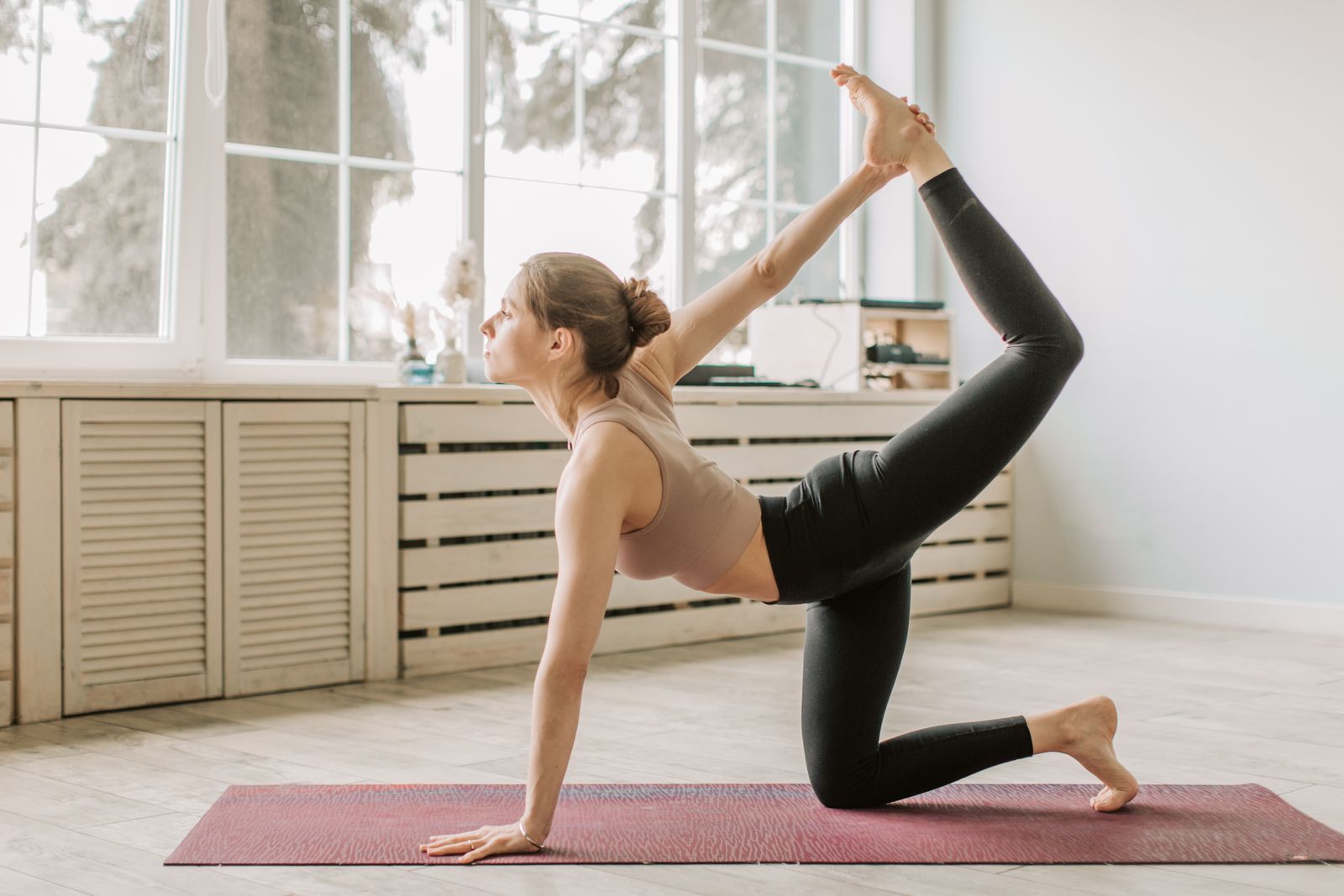
Phones and laptops pull the shoulders forward. Cow face arms, thread the needle and a gentle chest opener help, but strength matters too. Strengthening the upper back keeps the shoulders from slumping again, which is why shoulder work pairs well with yoga for posture.
Myth Check: Stretching Mistakes That Slow You Down
A few popular beliefs hold people back, and some of them are risky. Here are the ones we see most often, corrected.
- “No pain, no gain.” Wrong. A useful stretch feels like mild, steady tension that eases as you breathe. Sharp, burning, pinching or radiating pain is a stop signal. Come out of the pose slowly and do not push through it.
- “Longer holds always mean faster progress.” Not always. Short, regular sessions several times a week usually beat one long weekend session, because your body adapts to repeated, moderate effort.
- “Skip the warm-up, stretching is the warm-up.” Cold muscles resist being stretched. A few minutes of gentle movement first makes holds more comfortable and safer.
- “Flexible people are naturally better at yoga.” Flexibility is only one part of the practice. Strength, balance and breath control matter just as much.
- “Yoga will make me taller.” Once your growth plates close, usually by the late teens or early twenties, bone length does not change. Better posture can make you stand a little straighter, nothing more. We explain this in yoga to increase height.
- “Flexibility yoga burns fat fast.” Slow, held poses burn fewer calories than brisk cardio or flowing styles. Flexibility work supports a fat-loss plan by making movement easier; it is not the plan itself. See our yoga for weight loss guide for more.
Hatha, Vinyasa or Yin: Which Style Builds Flexibility Best?
Yin yoga holds poses the longest, usually 2 to 5 minutes, so it targets deep stretch most directly. Hatha holds poses for 5 to 10 breaths and suits beginners. Vinyasa flows quickly and builds heat and stamina, with flexibility gains that are slower but still real. A mix works well.
| Style | Typical hold | Pace | Best for |
|---|---|---|---|
| Yin | About 2 to 5 minutes per pose | Very slow, passive | Deep, long stretches for hips and back; quiet evenings |
| Hatha | About 5 to 10 breaths per pose | Steady, with pauses | Beginners who want clear alignment and gentle strength |
| Vinyasa | 1 to 3 breaths, moving continuously | Flowing, warming | Stamina, warmth and mobility together |
A balanced week might be two hatha yoga or vinyasa yoga sessions and one slow, long-hold session. If you are unsure which to choose, begin with hatha and add the others as your confidence grows.
Who Needs Extra Care With Flexibility Yoga?
Yoga is gentle for most healthy adults, but people with a recent injury, disc or joint problems, hypermobility, pregnancy, arthritis or osteoporosis should take extra care. If any of these apply to you, speak to your doctor or a physiotherapist before starting or deepening a flexibility routine.
- Recent injury, disc problems or joint pain. Get clearance before deep hip openers, forward folds or backbends. Ask which movements to avoid.
- Hypermobility. If your joints bend further than most people’s, you do not need more stretching. Focus on strength and control, keep joints slightly soft, and avoid hanging in the end range.
- Pregnancy. Check with your doctor first. In general, avoid deep twists, lying flat on your back for long and intense stretching, as pregnancy changes how your joints feel.
- Older adults or those with arthritis or osteoporosis. Choose supported, chair-friendly versions and avoid deep forward folds and strong twists unless your doctor agrees.
Sharp pain, numbness, tingling or pain that lingers the next day means you did too much. Stop, rest and get it checked if it does not settle. If sitting is the problem, short breaks every hour matter as much as the mat.
Stress also matters. Tense muscles are slower to release, which is one reason many people do well combining stretching with calming practice. If that sounds like you, read about yoga for stress and yoga for anxiety, and breathe slowly through every hold, ideally with a longer exhale than inhale.
How Long Does It Take to Get Flexible With Yoga?
Most people feel a little looser within 2 to 3 weeks of practising 3 to 4 times a week. Visible changes, such as reaching closer to your toes or sitting more comfortably in a hip opener, usually take about 8 to 12 weeks. Progress varies with age, body type, sleep and consistency.
Do not chase a particular pose. Track simple things instead: how close your hands get to the floor in a forward fold, how comfortable you feel sitting cross-legged, or whether your shoulders feel looser at your desk. Notice these every two weeks. Small, steady gains are real gains, and they last longer than quick ones that came from forcing.
Quick Answers About Yoga for Flexibility
How often should I do yoga to become flexible?
Aim for 3 to 4 sessions a week of 20 to 30 minutes. Short daily sessions of about 10 to 15 minutes also work well. Consistency matters more than session length, and a rest day between harder sessions helps your body recover.
Can inflexible people do yoga?
Yes. Yoga meets you where you are, and props such as blocks, straps and bolsters make poses accessible. Many people begin yoga because they are stiff. Start with gentle poses, bend your knees freely and let range of motion arrive gradually.
Which yoga poses for flexibility are best for tight hips?
Low lunge, bound angle pose and a supported pigeon are good choices for tight hips. Hold each for about 5 to 8 breaths, use a folded blanket under your seat or hip, and stay at mild tension. Avoid pushing your knees down with your hands.
Does yoga for flexibility also build strength?
Yes. Many poses, such as warrior II and chair pose, need your legs, core and shoulders to work while you stretch. This helps you control your new range, which is one reason yoga is considered gentler on joints than passive stretching alone.
Is it okay to feel sore after a flexibility session?
Mild stiffness for a day is common when you are new. Sharp pain, pain in a joint, numbness or tingling is not normal and means you should stop and rest. If it does not settle in a few days, see a doctor or physiotherapist.
Take the Next Step
A teacher who can see your alignment makes flexibility work safer and faster. Book a live session through Fitstrot’s online yoga classes and tell your trainer about any injury or condition before your first class.


