
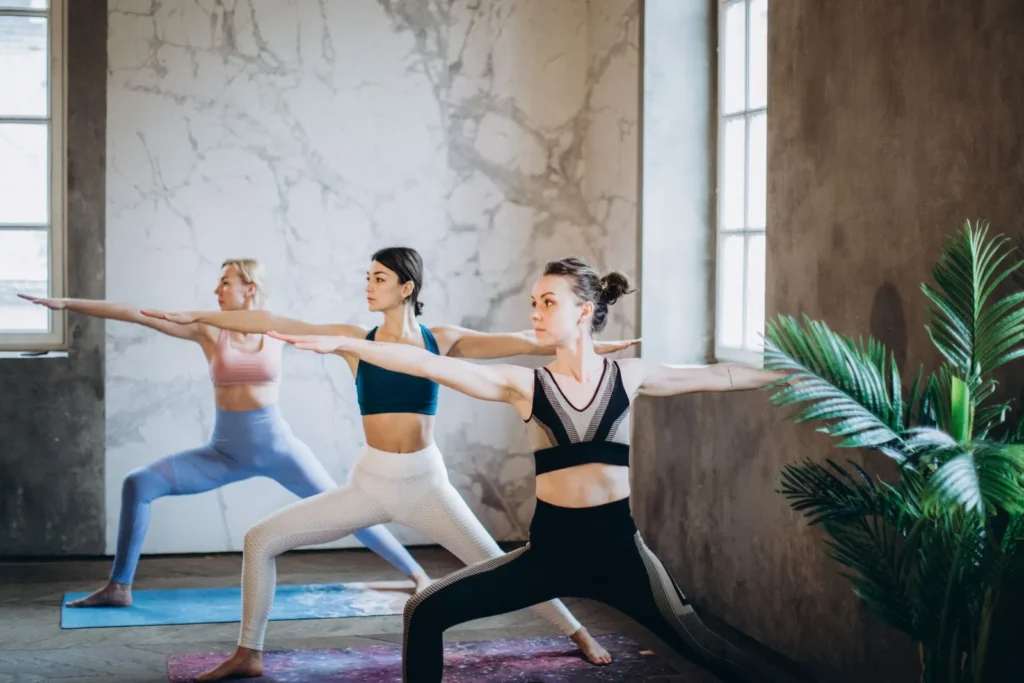
Can you build real power on a mat? Yes, within limits. Done well, yoga for strength works because poses like plank, chair, warrior II and side plank make your muscles hold your own bodyweight for about 20-60 seconds at a time. That builds bodyweight strength, muscular endurance and joint stability. It will not match a loaded barbell for maximal strength or large muscle gain. Below: the best styles and poses, a weekly plan, how to progress without weights, and where yoga fits beside gym training.
Does yoga build muscle or only flexibility?
Yoga builds muscle strength and endurance, mainly in beginners and people returning to exercise. Poses such as plank and chair hold muscles under load for about 20-60 seconds, training strength, stability and stamina. It does not build large muscle or maximal strength beyond the beginner stage, because bodyweight is the only resistance.
Most strength in yoga comes from isometric holds, where a muscle works hard without changing length. Slow transitions add more: lowering from plank into chaturanga takes real control from the shoulders, triceps and core. Standing poses like warrior II keep the thighs and glutes busy, and balance poses train small stabilising muscles that machines rarely reach.
The type of strength differs from lifting. Yoga favours time under tension and control over heavy, short efforts. If you want yoga for muscle strength that shows up in daily life, such as carrying shopping and climbing stairs, it delivers. If you want a heavy squat or visible muscle size, treat it as a partner to weights.
Can yoga replace weightlifting?
For general fitness, strength-focused yoga can be enough to feel stronger and move better. It cannot fully replace lifting if you want maximal strength or visible muscle size, because yoga cannot keep adding load the way plates on a bar can. Most people do best with yoga two or three days a week alongside weights.
| Factor | Yoga | Weight training |
|---|---|---|
| Resistance | Bodyweight and isometric holds | External load that you increase over time |
| Best at | Functional strength, balance, mobility, endurance | Maximal strength and muscle size |
| Strength ceiling | Limited by your bodyweight and leverage | Keeps rising as you add load |
| Beginner entry | Easy to scale with knees-down versions | Needs coaching on form and load |
| Equipment | A mat, optionally two blocks and a strap | Gym access or dumbbells |
| Best use together | Mobility, core control, recovery days | Progressive overload on 2-3 days |
Yoga wins on mobility, balance and endurance. If you want to add weights safely, 1-on-1 personal training gives you a plan matched to your level. If the mat is your main event, power yoga is the closest thing to a strength class in the yoga world.
Three myths about strength and yoga
- Myth: yoga is just stretching. Plank, boat and chair are muscular holds with no stretch at all.
- Myth: you need arm balances to get strong. Plank, side plank and chair build most of the useful strength and are safer to progress than crow.
- Myth: yoga alone gives big muscles. It firms and strengthens, and beginners can gain some muscle, but a gym-like physique from yoga alone is an exaggeration.
Which yoga styles build the most strength?
Ashtanga, power yoga and vinyasa build the most strength because they repeat chaturanga, plank and standing holds with little rest. Hatha builds strength through longer holds at a slower pace. Restorative and yin styles use props and passive stretches, so they help recovery but do very little for strength.
Hatha. Poses are held 30-60 seconds or more, adding time under tension. This is the easiest route into hatha yoga for strength.
Vinyasa. Vinyasa yoga links poses into continuous flows, so you get endurance and a raised heart rate together.
Ashtanga. Ashtanga yoga follows a fixed sequence with jump-throughs and demanding core transitions, and it is tough on the arms and abdominals.
Restorative and yin. Useful on rest days, not for getting stronger. Unsure which class fits? See types of yoga for a comparison.
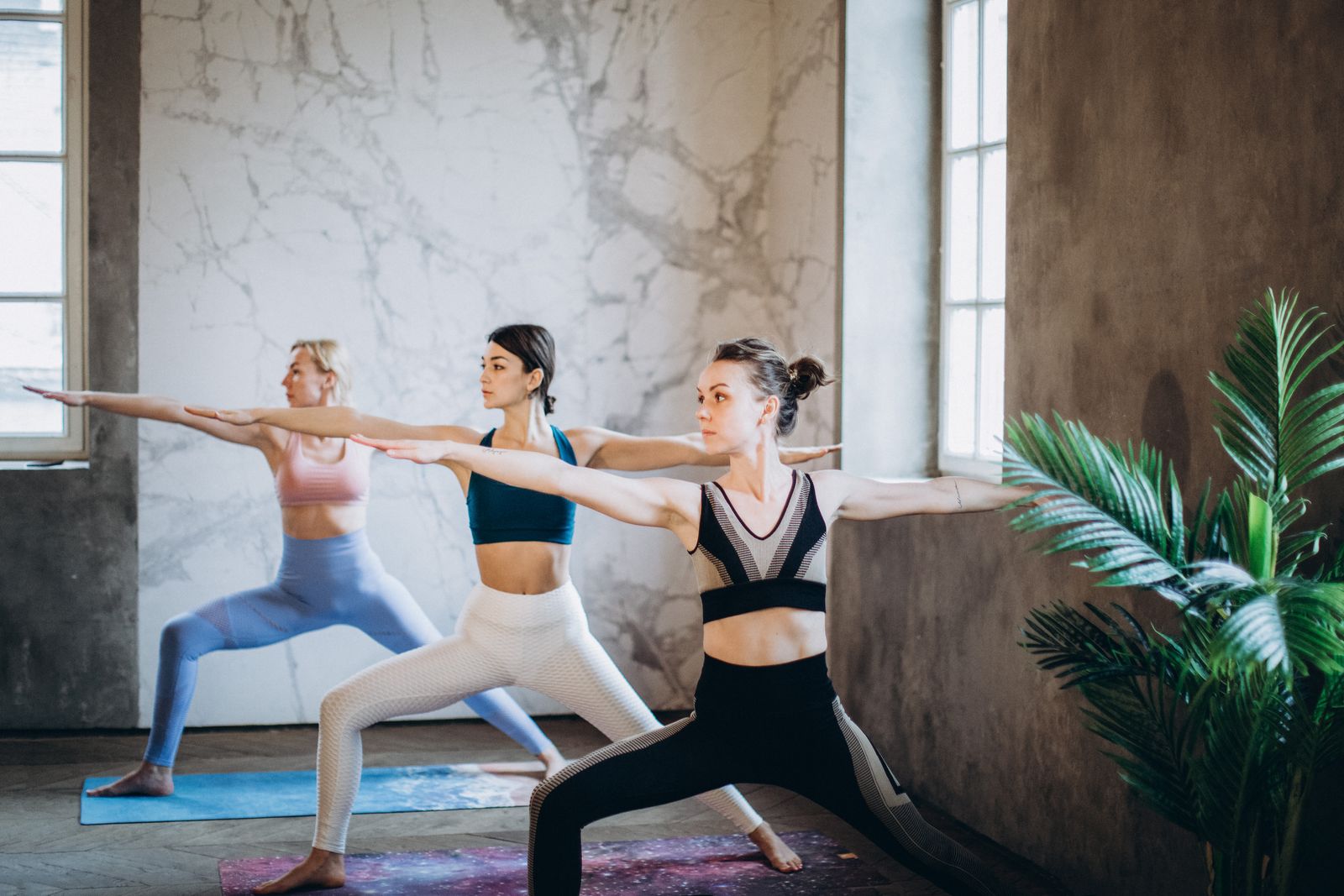
Yoga poses for strength: muscles, hold times and form cues
Start at the lower end of each hold and build towards the target over several weeks. End a hold when your form breaks, not when the clock says so.
| Pose | Main muscles worked | Hold: start to target | Easier version | Form cue |
|---|---|---|---|---|
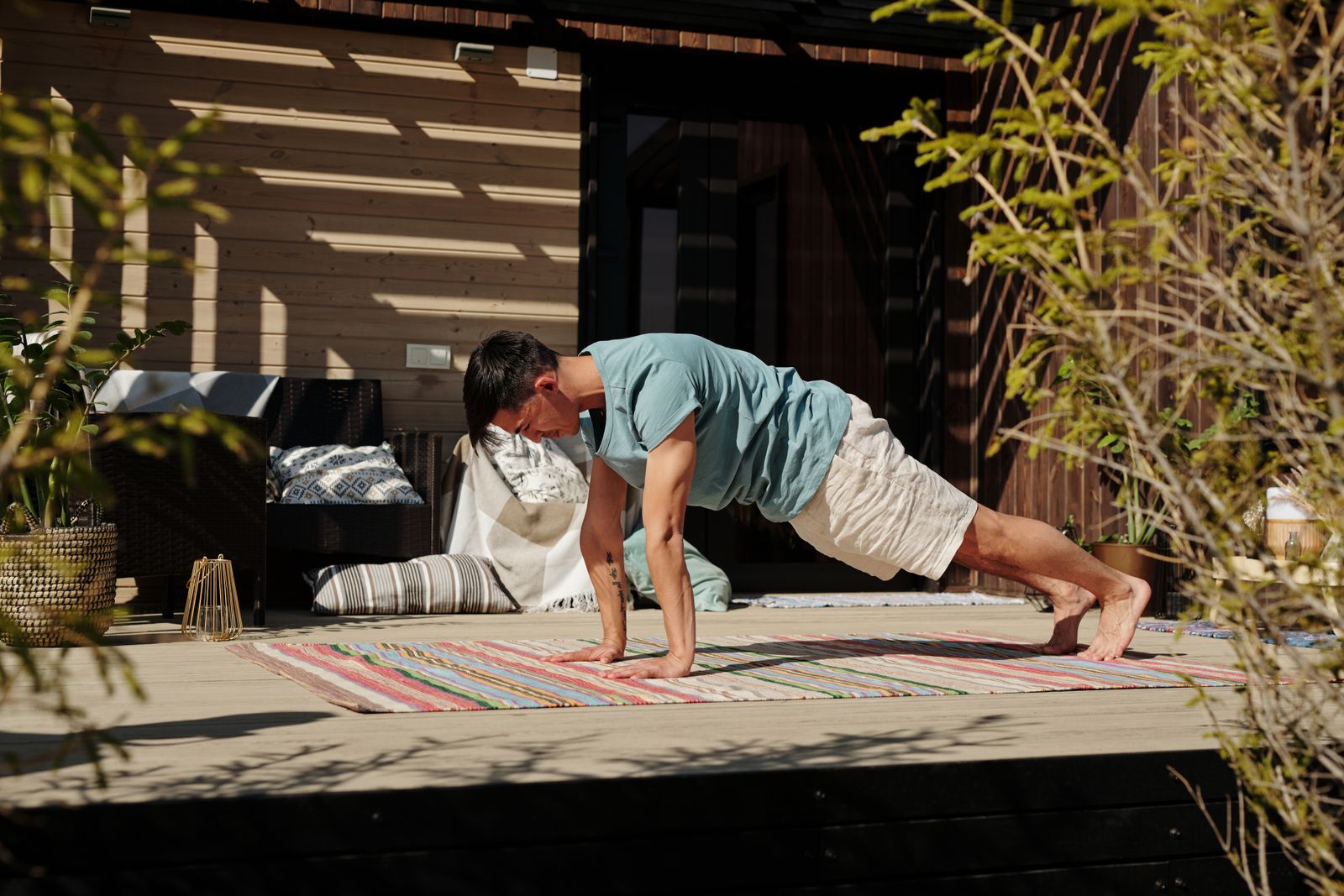
| Plank | Core, shoulders, chest, quads | 15 s to 45-60 s | Knees down or hands on a wall | Straight line from head to heels, hips level |
| Chaturanga (low plank) | Triceps, chest, shoulders, core | 3-4 s lowering, 3-5 reps | Lower with knees down | Elbows hug the ribs, shoulders no lower than elbows |
| Chair (utkatasana) | Quads, glutes, core | 20 s to 45 s | Back near a wall, shallower bend | Weight in the heels, ribs pulled in |
| Warrior II | Thighs, glutes, hip abductors | 20 s to 45 s each side | Shorter stance | Front knee tracks over the second toe |
| Warrior III | Standing-leg glutes, hamstrings, back | 10 s to 30 s each side | Hands on a chair or wall | Hips square to the floor |
| Side plank | Obliques, shoulders, hip abductors | 10 s to 30 s each side | Bottom knee down | Stack the shoulders over the wrist, lift the hips |
| Boat (navasana) | Hip flexors, abdominals | 10 s to 30 s, 3 rounds | Bent knees, hands behind thighs | Keep the chest lifted, spine long |
| Locust (shalabhasana) | Back extensors, glutes | 10 s to 20 s, 3 rounds | Lift only the chest | Look down, keep the neck long |
| Crow (bakasana) | Wrists, forearms, shoulders, core | 3 s to 10 s | Feet on a block, or skip for now | Gaze forward, knees high on the upper arms |
Plank is the simplest benchmark: a hold that rises from 15 seconds to a minute over a couple of months means a stronger core and shoulders. A stronger core also takes load off the lower spine, which is why boat pose features in many yoga for back pain sequences. For more abdominal work, see yoga for core strength.
A weekly strength yoga routine for beginners
This strength yoga routine for beginners spaces three strength days apart so muscles recover, and needs only a mat.
| Day | Focus | What to do | Time |
|---|---|---|---|
| Monday | Strength A: legs and core | Sun salutations, chair, warrior II, boat, plank | 35 min |
| Tuesday | Rest or walk | Easy walk, light stretching | 20-30 min |
| Wednesday | Strength B: arms and back | Plank, chaturanga on knees, side plank, locust, downward dog | 35 min |
| Thursday | Restorative | Child’s pose, supported twists, slow breathing | 20-30 min |
| Friday | Strength C: full body | Flow of sun salutations, warrior III, chair, plank, boat | 40 min |
| Saturday | Optional | Gym or a long walk, or a gentle flexibility class | 30-45 min |
| Sunday | Rest | No structured exercise | – |
A 35-minute strength session can run like this:
- Minutes 0-5: cat-cow, shoulder rolls and two slow sun salutations.
- Minutes 5-15: chair, warrior II on each side and warrior III on each side. Hold each for 20-30 seconds.
- Minutes 15-25: plank for 20-30 seconds, lower to the floor, repeat 3 times. Add side plank for 10-15 seconds each side.
- Minutes 25-30: boat pose for 10-20 seconds, three rounds, with rests in between.
- Minutes 30-35: locust, child’s pose and a gentle forward fold to cool down.
How do you get stronger with yoga without adding weights?
Progress by changing difficulty, not load. Hold each pose about 5 seconds longer each week, slow your chaturanga to a 3-4 second lowering, move to one-leg or one-arm variations, and shorten rests. Change one thing every 1-2 weeks, and keep form clean before making a pose harder.
- Longer holds: add 5 seconds to each hold, up to the target in the pose table.
- Slower tempo: take 4 seconds to lower into chaturanga and 4 to rise out of chair.
- Smaller base: lift one foot in plank, or move from warrior II to warrior III.
- Fewer rests: cut the pause between plank sets from 30 seconds to 15.
Food matters too. A common guide for active adults is roughly 0.8-1.2 g of protein per kg bodyweight a day, which a 60 kg person can approach with dal, curd, paneer, eggs, sprouts and a little chicken or fish across the day. A dietitian can tailor this to a medical condition.
How often should you do yoga for strength, and when will you see results?
Aim for 2-4 strength-focused sessions a week of 30-45 minutes, with a rest or gentle day between. Most beginners notice longer plank holds and less shaking in about 3-4 weeks, while firmer tone usually takes roughly 8-12 weeks. Results vary with sleep, protein and consistency.
Daily maximal-effort sessions tend to backfire, because muscles and wrists need recovery. Treat these timelines as rough guides: some people see changes sooner, many later.
Troubleshooting: when strength yoga does not feel right
- Wrists hurt in plank: spread your fingers, press through the whole palm and try forearm plank or wall plank. If pain persists, stop and see a doctor or physiotherapist.
- Shoulders pinch or click: push the floor away and keep elbows close to the ribs in chaturanga. Use knees-down versions until steady, and see a doctor if pain continues.
- Lower back sags in plank or boat: the core is tiring, so end the hold, tuck the tailbone slightly and bend the knees in boat.
- You shake in every pose: this is normal early on. Shorten the hold and breathe steadily.
- Progress has stalled: change one variable from the list above, and check sleep, protein and rest days.
- You hold your breath: breathe slowly through the nose during every hold.
Who strength-focused yoga suits best
Desk workers. Sitting for long hours rounds the shoulders and weakens the back. Locust, plank and chair build the muscles that hold you upright, and yoga for posture pairs well. Better posture can make you look a little taller, but adults cannot lengthen their bones, so be wary of claims around yoga to increase height.
Gym-goers and runners. Yoga improves hip and shoulder mobility. Balance strength with stretching from yoga for flexibility so tight muscles do not limit your poses.
Beginners and people over 40. Low impact and easy to scale. Start with hatha, hold poses a little shorter and build up.
Anyone managing weight. Strength yoga burns a modest amount of energy and helps you keep muscle, but diet and daily activity do most of the work. See yoga for weight loss.
See your doctor first if any of these apply
Talk to a doctor or physiotherapist before starting if you have a recent injury, joint problems, wrist or shoulder pain, high or low blood pressure, heart concerns or osteoporosis. If you are pregnant, get medical clearance and prenatal-specific guidance, because many strength poses need changes. Stop a pose if you feel sharp pain, dizziness, chest discomfort or numbness. Mild muscle fatigue is normal; sharp joint pain is not.
Frequently asked questions
Can yoga alone make you strong?
Yes, for functional strength and muscular endurance. Regular plank, chair, warrior and side plank work strengthens the core, legs, shoulders and back. It will not build maximal strength like heavy lifting, since resistance stays at your bodyweight, but for everyday strength and stability it is genuinely effective, especially for beginners.
Is power yoga better than hatha for strength?
Power yoga is more demanding because it repeats chaturanga, plank and standing holds quickly, so it builds strength and stamina together. Hatha uses longer, slower holds and is better for learning form. Beginners often do well starting with hatha and moving to power yoga after a few weeks.
How many days a week should I do yoga for strength?
Two to four sessions a week of 30-45 minutes works for most people. Keep at least one lighter or rest day between harder sessions so your muscles and wrists can recover. If you also lift weights, two yoga days a week is a sensible starting point.
Can beginners do yoga for strength at home?
Yes, with a mat and modified poses. Do plank from the knees, hold chair for 10-15 seconds and keep a wall nearby for balance poses. Following a trainer on camera helps because someone can check your form, which is hard to judge alone.
Does yoga for strength help with weight loss?
It can help a little. Strong sessions burn a modest number of calories and help you keep muscle, but yoga alone is rarely enough for significant fat loss. Combine it with sensible portions, enough protein, daily walking and good sleep for better results.
Pick two strength days this week, follow the plan above, and let a trainer check your plank and chair form in a live session with FitStrot’s online yoga classes.


