

A good yoga routine is a fixed weekly pattern, not a daily improvisation: a few short sessions, each with a clear purpose, that you can repeat without thinking. Most beginners do well with 15 to 20 minutes on four or five days a week, plus one proper rest day. This guide shows how to build that week around the time you actually have and the one thing you want from yoga, with a chart you can copy, a 20-minute walkthrough with alignment cues, and the safety checks people usually skip.
How do you build a weekly yoga routine around your time and goal?
Start with a time slot you can keep, then pick one goal. For most beginners that means 15 to 20 minutes, four or five days a week, each session built on one theme: standing strength, spine and shoulders, hips and hamstrings, or slow stretching. Add one rest day and review the plan after two weeks.
- Fix the slot first. Attach it to an existing habit, such as right after brushing your teeth or before the evening chai. A morning yoga slot is often easiest to protect because nothing has interrupted your day yet; a fixed evening time works just as well.
- Pick one goal for the first four weeks. Less stiffness, better sleep or more strength are all fine. One goal stops the routine becoming a random collection of poses.
- Give each day a theme. Themes remove the daily decision and keep the week balanced.
- Write it down and keep it for two weeks. Repetition is what lets you notice that a pose feels easier.
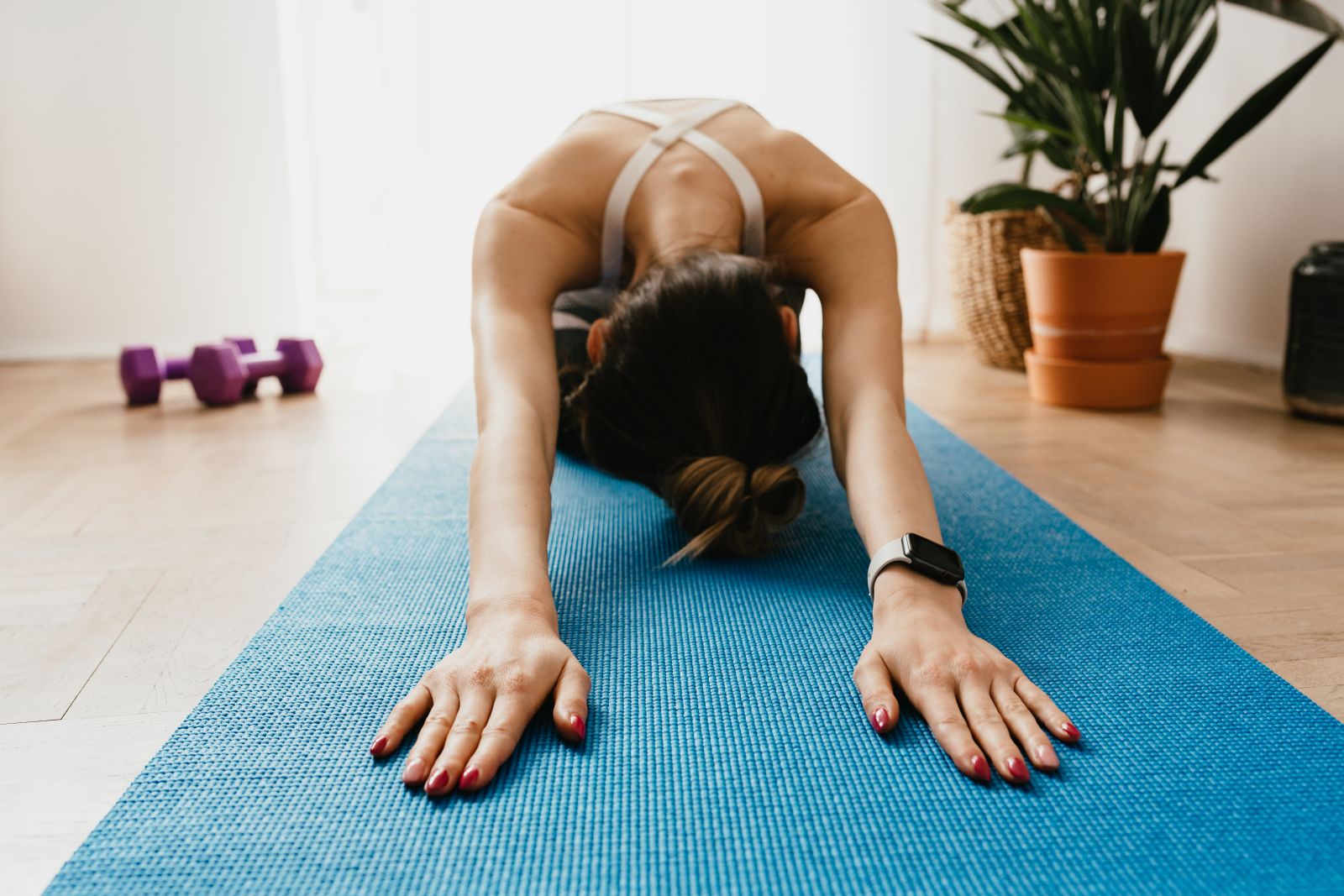
Which yoga routine fits 10, 20 or 40 minutes a day?
With 10 minutes, repeat one short sequence five or six days a week. With 20 minutes, rotate two or three themes across four or five days. With 30 to 45 minutes, practise three or four times a week and add one long, slow session. Roughly 60 to 180 minutes of total weekly practice is a workable range for most beginners.
| Time per session | Days per week | Shape of the week | Roughly per week | Suits you if |
|---|---|---|---|---|
| 10 minutes | 5 to 6 | One fixed sequence of 4 or 5 poses, ending with 2 minutes of rest | 50 to 60 minutes | You sit at a desk all day or are just starting the habit |
| 20 minutes | 4 to 5 | Rotate three themes: standing, spine and hips, slow stretching | 80 to 100 minutes | You want a balanced beginner week |
| 30 to 45 minutes | 3 to 4 | One theme per session plus one long, slow session | 90 to 180 minutes | You want more strength, balance or range of motion |
| Weekends only | 2 | Two sessions of 40 to 60 minutes, plus 5-minute stretch breaks on weekdays | 100 to 120 minutes | Weekdays are genuinely full; progress will be slower |
Frequency usually matters more than session length. A 10 minute yoga routine done six days a week is easier to keep than one long class every Sunday, because the habit gets rehearsed more often.
A 7-day yoga routine chart you can copy
This weekly yoga routine assumes 20 to 30 minutes a day and rotates the body area so nothing is overworked. Swap days freely, but keep the rest day.
| Day | Focus | Sequence | Minutes |
|---|---|---|---|
| Monday | Standing strength and balance | Mountain pose, chair pose, Warrior II, tree pose (3 to 5 breaths each, both sides) | 20 to 25 |
| Tuesday | Spine and shoulders | Cat-cow, thread the needle, sphinx, supine twist | 20 |
| Wednesday | Hips and hamstrings | Low lunge, bound angle pose, reclined hamstring stretch with a belt | 20 |
| Thursday | Core and balance | Knee-down plank, bent-knee boat pose, side plank on knees, tree pose | 20 |
| Friday | Linked flow | String the week’s poses together slowly, one breath per movement | 25 to 30 |
| Saturday | Slow, long holds | Supported forward fold, reclined bound angle, legs up the wall (2 to 4 minutes each) | 30 |
| Sunday | Rest | Rest, or a 10-minute gentle stretch and a short walk | 0 to 10 |
Friday is where you start moving between poses on the breath; our guide to yoga flow explains how to link them smoothly. Saturday borrows from yin yoga and restorative yoga, which use long, supported holds. If you want to practise on the rest day as well, the daily yoga guide covers how to keep a seven-day habit without overdoing it.
Walkthrough: a 20-minute yoga routine for beginners, pose by pose
Use this as your midweek workhorse and do it as written for the first two weeks. Move on the exhale and breathe through the nose. If you cannot breathe evenly in a pose, you have gone too far into it.
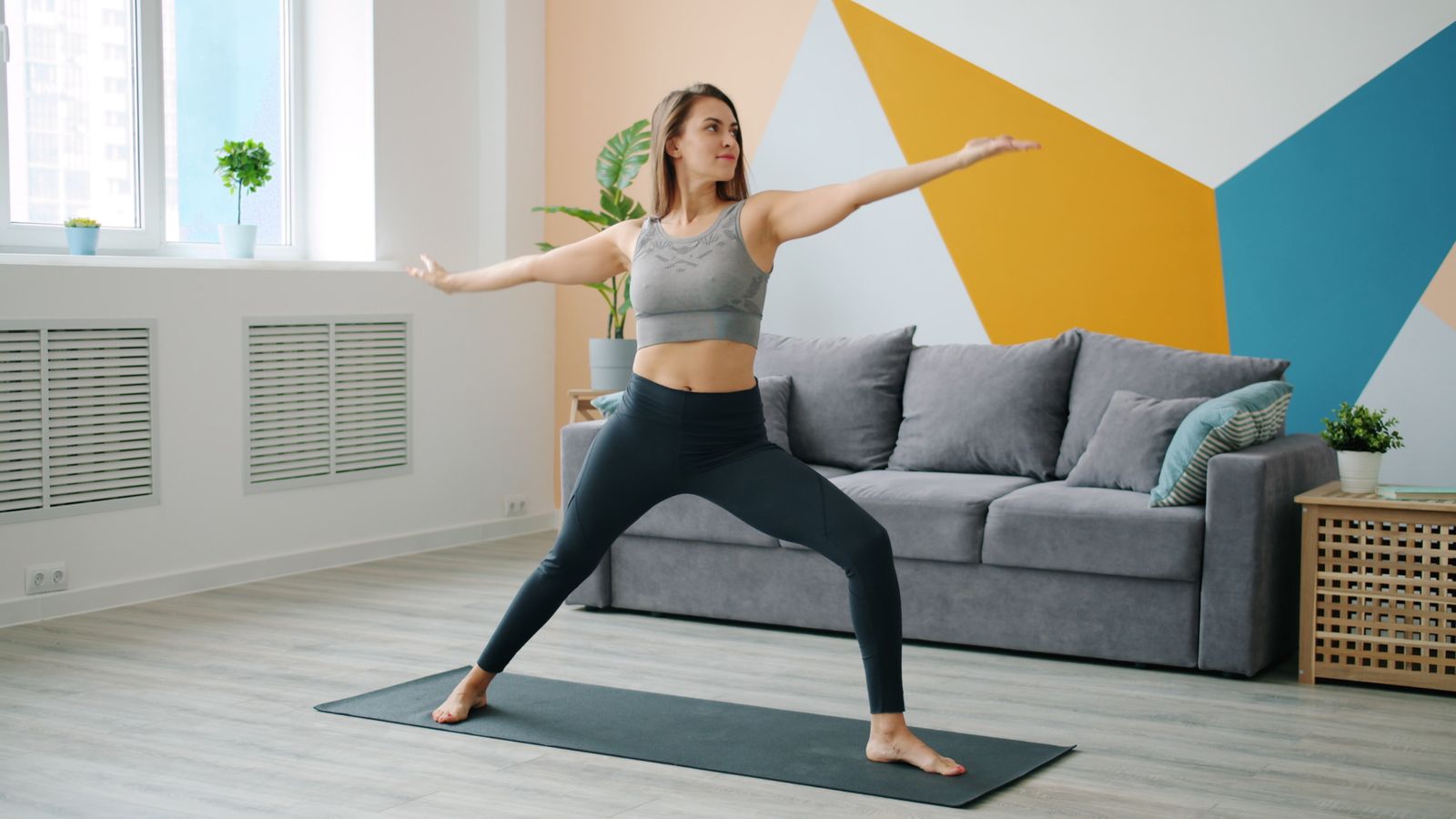
| Pose | Hold | Alignment cue | Easier option |
|---|---|---|---|
| Easy seat (centring) | About 1 minute | Sit-bones heavy, ribs stacked over the pelvis, shoulders soft | Sit on a folded blanket if your knees rise above your hips |
| Cat-cow | 8 to 10 slow breaths | Wrists under shoulders, knees under hips; move through the whole spine | Seated version with hands on knees if wrists complain |
| Downward-facing dog | 5 breaths | Press the floor away, lengthen the spine first; heels need not touch down | Bend the knees generously, or press hands into a wall |
| Low lunge | 5 breaths per side | Front knee over the ankle, hips square, tailbone drawing down | Fold a blanket under the back knee |
| Warrior II | 5 breaths per side | Front knee tracks over the second toe, shoulders stacked over hips | Shorten the stance and keep the knee bend small |
| Seated forward fold | 5 to 8 breaths | Hinge from the hips with a long spine, not from the lower back | Bend the knees; loop a belt or dupatta around the feet |
| Bridge pose | 5 breaths, twice | Feet hip-width, knees over ankles, press through the feet to lift | Lift only as high as the lower back feels comfortable |
| Supine twist | 5 breaths per side | Both shoulders stay on the floor; let gravity do the work | Place a cushion under the knees |
| Corpse pose (savasana) | 3 to 4 minutes | Legs relaxed, palms up, jaw and forehead soft | A rolled towel under the knees; a light cover if you feel cold |
A non-slip mat is the one worthwhile purchase; for everything else, household substitutes work: two thick books or a stable stool for a block, a cotton dupatta or belt for a strap, and a folded blanket or bedsheet under the knees. The yoga at home guide covers how to set up a corner that stays ready to use.
How should your yoga routine change with your goal?
Match the emphasis to the goal rather than adding more poses. For stiffness, add hip and hamstring work. For stress and sleep, lengthen the slow sessions and exhales. For strength, add standing poses and longer holds. For weight management, pair yoga with walking, strength work and sensible food, because no pose burns fat from one body area.
- Desk stiffness: Keep the Wednesday hip session and add a 2-minute standing forward fold and chest opener at your desk.
- Stress and sleep: Make Saturday your anchor and add a second slow session on a weeknight. Finish with at least 5 minutes of rest. Our benefits of yoga guide explains what yoga can and cannot reasonably be expected to do.
- Strength and balance: Hold standing poses for 5 to 8 breaths on Monday and progress from knee-down to full planks gradually.
- Weight management: Yoga alone burns a modest amount of energy and cannot reduce fat in one spot, so pair it with brisk walking, two short strength sessions a week, or a dance-cardio option such as online Zumba classes.
- Yoga routine for men: The routine does not change by gender, but anyone who lifts or sits long hours may want an extra hip and hamstring session.
Style matters too. Slow, hold-based Hatha yoga suits beginners who want to learn the shapes. Vinyasa yoga links poses with the breath and feels more like a workout once you are comfortable with the basics.
Three myths that quietly break a yoga routine
- “I need an hour a day.” You do not. Ten focused minutes on most days builds the habit faster than a rare hour-long class.
- “I must be flexible first.” Flexibility is a result of practice, not an entry ticket, and bending your knees is never cheating.
- “Harder poses mean progress.” Real progress is steadier breathing and more control in familiar poses. Jumping to advanced shapes early is a common cause of hamstring, wrist and lower-back strain. Build your vocabulary from our yoga poses guide one new pose at a time.
Who should modify the routine or check with a doctor first?
Check with your doctor before starting if you are pregnant, have high blood pressure, glaucoma, a disc or spine problem, vertigo, a recent surgery, or an injury to the wrist, knee or shoulder. Most poses can be modified, but some should be skipped, and a doctor or qualified teacher should decide which ones for you.
- Pregnancy: Avoid deep twists, strong belly compression and lying flat on your back for long in later months. Practise only with medical clearance and, ideally, a prenatal-trained teacher.
- High blood pressure or eye pressure: Avoid holding head-down poses such as downward dog or deep folds for long, never hold your breath, and come up slowly.
- Back or disc problems: Keep the knees bent in forward folds and skip deep twists and backbends unless your doctor or physiotherapist has cleared them.
- Knees and wrists: Pad kneeling poses, avoid deep seated postures like lotus, and use fists or forearms if full weight on the wrists hurts.
Stop and seek advice if you feel sharp or shooting pain, numbness, tingling, dizziness or chest discomfort. A stretch should feel like mild tension that eases as you breathe; pain means back off. Yoga can complement medical care but does not replace it.
Troubleshooting: why a yoga routine falls apart in week two
- You missed two days. Do the 10-minute version the next day instead of making up for it.
- You are bored. Keep the sequence but change one thing every two weeks, such as a new pose or a longer hold.
- You feel sore the next morning. Mild muscle soreness is common at the start, but joint pain is not. Shorten holds, deepen less and add a rest day.
- You feel no progress. Re-test after four weeks: can you hold a pose a few breaths longer without strain?
How do you progress a yoga routine over 12 weeks?
In weeks one and two, learn the sequence and breathe steadily. In weeks three and four, extend holds from 3 breaths to 5 to 8. In weeks five to eight, add one new pose a week. From week nine, begin linking poses into short flows. Progress is control and breath quality, not how advanced the shapes look.
Two short strength sessions and some walking or dance cardio fit comfortably around four yoga days. A live teacher can also spot alignment issues that a video or chart cannot.
Yoga routine questions, answered
How many days a week should I do a yoga routine?
Four to six days a week is a realistic target for most beginners, with at least one full rest day. If you practise daily, alternate a more active session with a gentler one so your body gets both effort and recovery.
Can I do a yoga routine every day?
Yes, for most healthy adults, because beginner yoga is low-impact and you can back off when a stretch feels like too much. The risk is repetitive strain from stretching the same tight spot every day, so rotate the focus using the weekly chart above.
Do I need to be flexible to start a yoga routine?
No. Flexibility develops with practice and is not a prerequisite. Bent knees, a folded blanket, a belt or a wall make every pose in the beginner sequence accessible, whatever your current range of motion.
Is a 10-minute yoga routine worth doing?
Yes. Ten minutes of mindful movement and breathing on most days is easier to sustain than occasional long sessions, and many people find it eases everyday stiffness and helps them unwind. For more strength or range of motion, add a longer session once or twice a week.
How long until I notice results from a yoga routine?
Many people feel looser and calmer within two to three weeks of regular practice. Gains in strength, balance and range of motion usually take about eight to twelve weeks. Results vary with age, starting point and consistency.
If you would like a teacher to check your alignment and set up the week with you, join a live session in FitStrot’s online yoga classes and bring this chart along.


