

Yin yoga is a slow, floor-based style where you settle into a pose and hold it for roughly 3 to 5 minutes (sometimes up to 10), keeping your muscles soft so the stretch reaches the joints and connective tissue around them. There is no flow and no sweat, just gravity, breath and patience. If your hips lock up after a day at a desk and your mind will not switch off at night, this is the practice built for that gap.
What is yin yoga and how does a class actually feel?
Yin yoga is a passive practice of five to eight floor poses, each held for about 3 to 5 minutes (up to 10 for experienced students). You move until you feel a mild, steady stretch, relax your muscles, and stay still. Props such as bolsters, blocks and blankets support the body so the hold stays comfortable.
The first minute is usually easy. Minutes two and three are where most beginners fidget and check the clock. By minute four the stretch often feels broader and quieter, and your breathing slows without being forced. Staying with that restlessness is half the point.
A typical class runs 45 to 75 minutes. After each pose you come out slowly and rest for 20 to 30 seconds before the next shape.
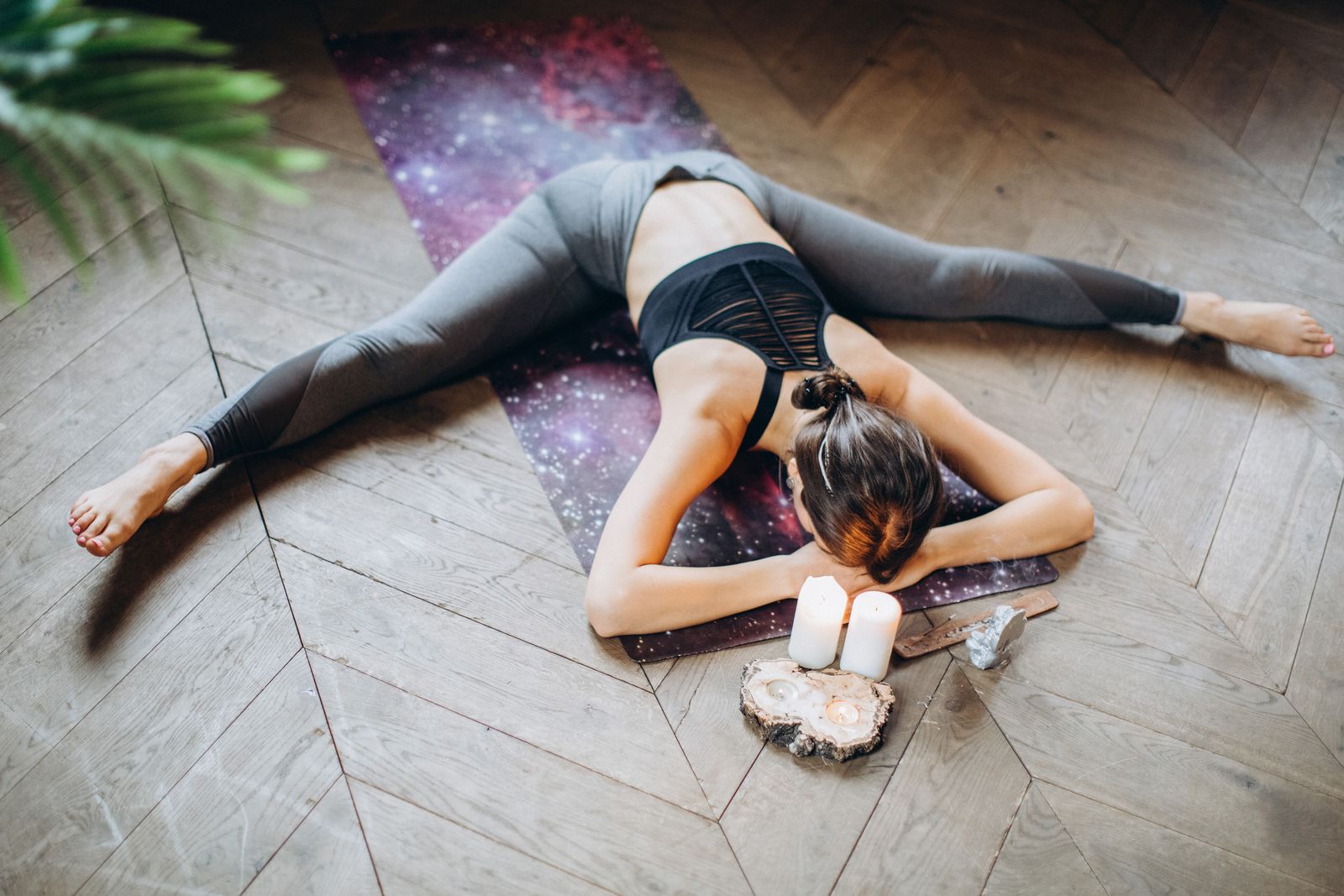
Yin yoga vs restorative yoga: how do they compare with other styles?
Yin yoga deliberately creates a mild stretch and holds it for about 3 to 5 minutes, while restorative yoga uses props to remove nearly all stretch and holds for 5 to 20 minutes. Yin targets mobility and stillness; restorative targets deep rest. Active styles like vinyasa and power yoga work the muscles instead.
Students mix these up because both are slow and prop-heavy. The simplest test is sensation: in restorative you feel nothing pulling, while in yin you feel a clear but tolerable stretch, around 5 or 6 out of 10, that never turns sharp or tingly.
| Style | Pace | Typical hold | Muscles | Best for |
|---|---|---|---|---|
| Yin yoga | Very slow, floor-based | About 3 to 5 min, up to 10 | Relaxed | Hip and spine mobility, winding down |
| Restorative yoga | Very slow, fully supported | About 5 to 20 min | Fully relaxed | Burnout, recovery, deep rest |
| Hatha yoga | Slow to moderate | Roughly 30 sec to 1 min | Active | Beginners learning basic poses |
| Vinyasa yoga | Continuous flow | A few breaths | Active, warming | Cardio, strength, stamina |
| Power yoga | Fast, strong | A few breaths | Very active | Strength and calorie burn |
Where does the name “yin” come from, and is it ancient?
The name comes from Taoist philosophy, where yin means the still, cool, receptive quality and yang means the active, warm, moving one. Muscles are treated as yang tissue because they respond quickly to exercise, while joints and connective tissue are yin because they change slowly under long, gentle loading.
Modern yin yoga is generally credited to American teacher Paul Grilley, who built on ideas from martial artist Paulie Zink and his own study of anatomy in the late 1980s and 1990s. His student Sarah Powers helped spread it widely. Its influences are old, but its current form is recent, not a centuries-old lineage.
Three yin yoga myths worth dropping
Myth 1: It should hurt a little to work. It should not. Sharp, shooting, burning or tingling sensations mean you are too deep or on the wrong tissue. Back off, add a prop, or leave the pose. A dull, spreading stretch is the target.
Myth 2: Yin yoga “releases” fascia and lengthens ligaments. How much yin changes connective tissue is still debated, so be cautious of teachers who promise it. What most people reliably notice is a higher tolerance for the stretch, easier movement in stiff hips and a calmer body afterwards.
Myth 3: It replaces other exercise. It will not replace strength work or cardio, and it burns very few calories, so do not treat it as a weight loss tool.
Which yin yoga poses should you start with, and for how long?
Start with Butterfly, Dragon, Sleeping Swan, Caterpillar, Sphinx and Shoelace, holding each for about 3 minutes (per side where relevant) as a beginner. Build towards 5 minutes over several weeks. These yin yoga poses cover the hips, thighs, spine and lower back, the areas that stiffen most from sitting.
| Pose | Hold | Where you feel it | Form cue or prop |
|---|---|---|---|
| Butterfly | 3 to 5 min | Inner thighs, lower back | Soles together, fold from the hips, rest your head on a bolster or stacked cushions |
| Dragon (low lunge) | 3 to 5 min per side | Hip flexors, front thigh | Back knee on a folded blanket, hands on blocks, hips sinking forward |
| Sleeping Swan | 3 to 5 min per side | Outer hip, glute | Cushion under the hip of the bent leg so the pelvis stays level |
| Caterpillar | 3 to 5 min | Hamstrings, back of the spine | Soft knees, rounded back, bolster across the thighs for the forehead |
| Sphinx | 3 to 5 min | Lower back, front of the hips | Elbows under shoulders, legs relaxed, stop if the low back pinches |
| Shoelace | 3 to 4 min per side | Outer hips, glutes | Stack the knees, sit on a blanket if your hips lift off the floor |
A 30-minute home yin yoga sequence you can follow tonight
Yin yoga at home needs a mat, a bolster (or two firm pillows), two books or blocks, and a folded blanket. The timings below are approximate and include the short pauses between poses.
| Minutes | Pose | Props | What to focus on |
|---|---|---|---|
| 0 to 3 | Seated breathing | Folded blanket under the hips | Slow exhales, longer than the inhale |
| 3 to 7 | Butterfly | Bolster or pillows for the forehead | Let the spine round, jaw loose |
| 7 to 13 | Dragon, 3 min each side | Blanket under the back knee | Sink the hips, keep the front knee over the ankle |
| 13 to 17 | Sphinx | None, or a cushion under the pelvis | Breathe into the belly, keep the neck long |
| 17 to 23 | Shoelace, 3 min each side | Blanket under the hips | Fold forward only as far as the stretch stays gentle |
| 23 to 25 | Child’s pose | Bolster under the chest | Wide knees, forehead heavy |
| 25 to 30 | Final rest on your back | Blanket over the body | Let go of all effort and breathe naturally |
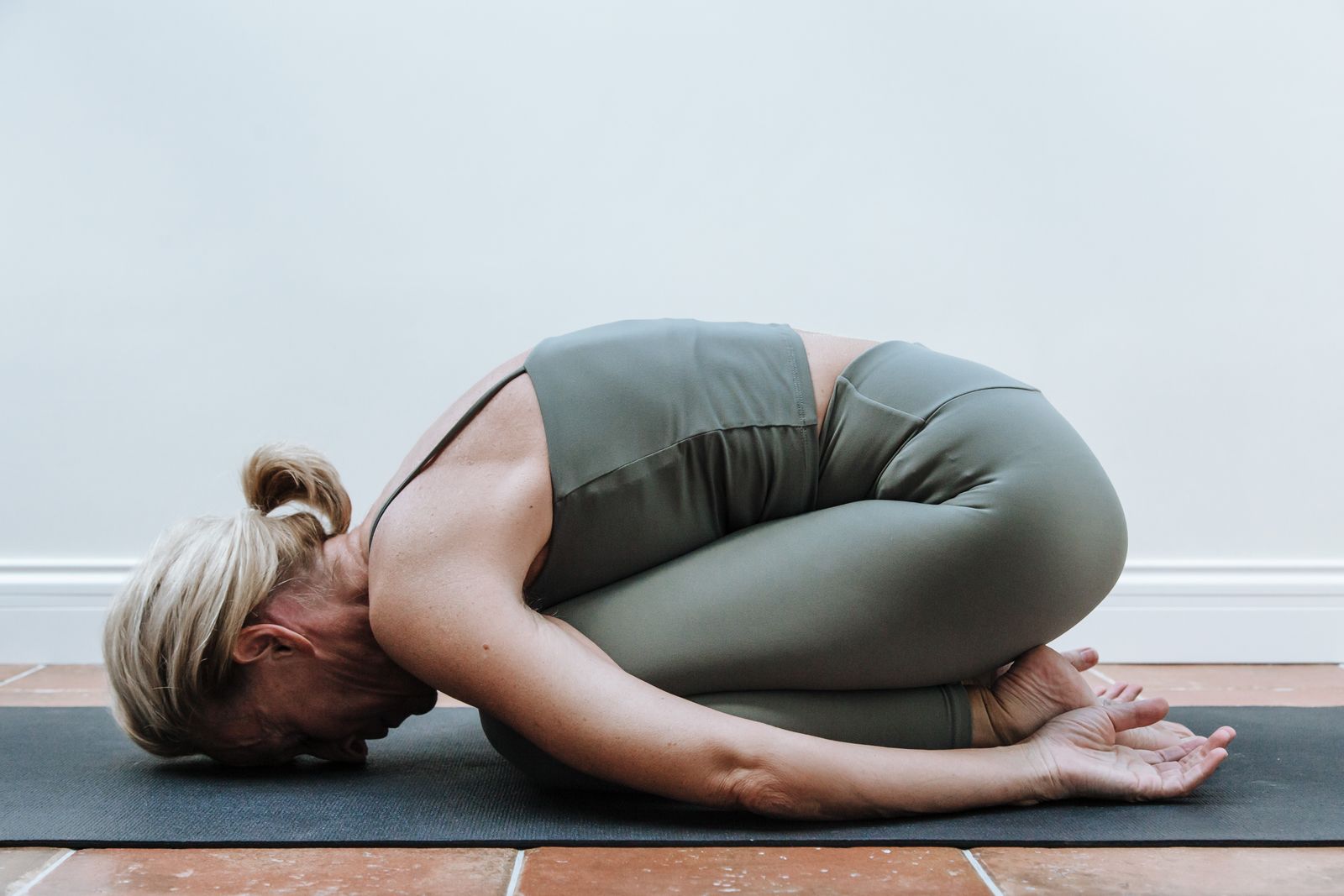
Evenings work best, roughly 90 minutes after a full dinner. Without a bolster, a rolled dhurrie, a folded chadar or a firm pillow works just as well. Set a gentle timer so you are not watching the clock. If your lower back is the main reason you are here, read our yoga for back pain guide too.
What are the real yin yoga benefits?
Yin yoga benefits include easier hip and lower-spine mobility, a calmer nervous system after slow holds, and better tolerance of stillness. Most people notice looser hips within 3 to 4 weeks of practising 2 to 3 times a week. It is not a cure for pain, anxiety or insomnia, and results vary.
Long gentle holds are a good counterweight to hours of sitting, which is common for desk workers and long daily commuters. Runners and gym-goers use yin yoga for flexibility on rest days, since it asks very little of tired muscles.
Slow breathing and long holds tend to shift the body towards rest, and many people sleep more easily on yin evenings. These are commonly reported experiences, not guaranteed outcomes. If anxiety or chronic pain significantly affects your life, speak with a doctor or qualified therapist as well. For more calming practices, see online yoga for stress relief.
Troubleshooting: what to do when a yin pose goes wrong
You feel pinching in the hip or groin. That is usually bone meeting bone, not a tight muscle. Change the angle: move the knee wider or narrower, lift the hips on a blanket, or switch to a different shape. Do not push through a pinch.
Your foot or leg goes numb or tingly. Come out slowly, shake the leg out, and wait for normal sensation before trying again with more padding or a shallower fold.
Your knees hurt. Skip deep knee-bending shapes like Saddle and the full Shoelace, and add padding under the knees. Our types of yoga overview can help you choose a gentler style while the knees settle.
You get restless or bored. This is normal. Count ten slow breaths, then ten more.
Is yin yoga right for beginners, and who should be careful?
Yes, yin yoga suits most beginners because it needs no strength or flexibility and the pace is slow. Start with 2 to 3 minute holds, use plenty of props, and practise 1 to 2 times a week. People with hypermobility, osteoporosis, recent injuries or pregnancy should get advice first.
- Hypermobile joints: Long passive stretching can push loose joints too far. Stay well short of your end range.
- Osteoporosis or a recent fracture or joint surgery: Check with your doctor or physiotherapist first.
- Pregnancy: Avoid lying flat on the belly (Sphinx, Seal) and any deep compression of the abdomen. Use a bolster and a prenatal-trained teacher.
- Knee, hip or lower-back pain: Modify aggressively or choose a different style until a professional has seen you.
- Chronic conditions: Mention them to your teacher first. Yin yoga is not a substitute for medical care.
How do you combine yin yoga with other styles during the week?
Pair one to three yin sessions a week with your more active practice, for example strength or flow on two or three days and yin on a recovery evening.
If you already enjoy a demanding practice like ashtanga yoga, yin offers a very different counterbalance. Bikram yoga is practised in a room heated to roughly 40 degrees Celsius with 26 fixed postures, whereas yin is done at normal room temperature with soft muscles, so the two feel nothing alike. Aerial yoga also uses supported, gravity-assisted shapes, but with a hammock.
The same slow-and-sustained idea appears in face yoga, which uses patient, repeated holds for facial muscles. If you want the guidance of a teacher while you build the habit, FitStrot’s online yoga classes let you pair live sessions with your own home practice.
Yin yoga cards, workshops and teacher training: what to know
Yin yoga cards are pose decks with one shape per card, usually listing hold time, target area and modifications. They help home practitioners vary their sequence without searching online mid-practice. Pick a deck that groups poses by body area so you can build a balanced session quickly.
A yin yoga workshop is a single longer session, often 2 to 4 hours, on a theme like hips or spine health. It is a low-risk way to test whether you like the style. Check that the teacher has specific yin training and that props are offered freely.
Yin yoga teacher training is commonly an add-on of around 50 to 100 hours taken after a general 200-hour course. It covers connective tissue anatomy, sequencing and prop use. India, and Rishikesh in particular, runs many such programmes, usually over one to four weeks. Compare syllabus and teacher background, and be wary of promises of guaranteed income or medical outcomes.
Frequently asked questions about yin yoga
What is yin yoga?
Yin yoga is a slow, passive style in which you hold floor poses for about 3 to 5 minutes (up to 10 for experienced students) with relaxed muscles. The aim is a gentle, sustained stretch around the joints and connective tissue, plus a calmer nervous system. Props like bolsters and blocks keep every pose comfortable.
How long should you hold yin yoga poses?
Beginners should hold each pose for about 2 to 3 minutes and build towards 3 to 5 minutes over several weeks. Experienced students sometimes stay up to 10 minutes. Come out earlier if you feel sharp pain, pinching, numbness or tingling.
Can you do yin yoga every day?
Most people do well with 2 to 4 yin sessions a week. Daily practice is possible if the holds are gentle and short, around 15 to 20 minutes, but long, deep holds every day can leave joints sore. Listen to your body, and take a day off if anything feels irritated.
Is yin yoga good for beginners?
Yes. It needs no strength or prior flexibility, the pace is slow and props let you adjust every pose. Begin with 2 to 3 minute holds, 1 to 2 times a week, and tell your teacher about any injuries, pregnancy or hypermobility so they can suggest safe variations.
Is yin yoga good for back pain?
Gentle yin poses like Sphinx, Caterpillar and a supported Child’s pose can ease stiffness from long sitting for many people. But back pain has many causes, and deep folds or backbends can aggravate some of them. If pain is severe, constant or travels down a leg, see a doctor before starting.
Try your first yin session with a teacher
Pick one evening this week, book a live yin-style session through FitStrot’s online yoga classes, and tell the instructor about any joint issues beforehand so your props and holds are set up properly from the first minute.


