
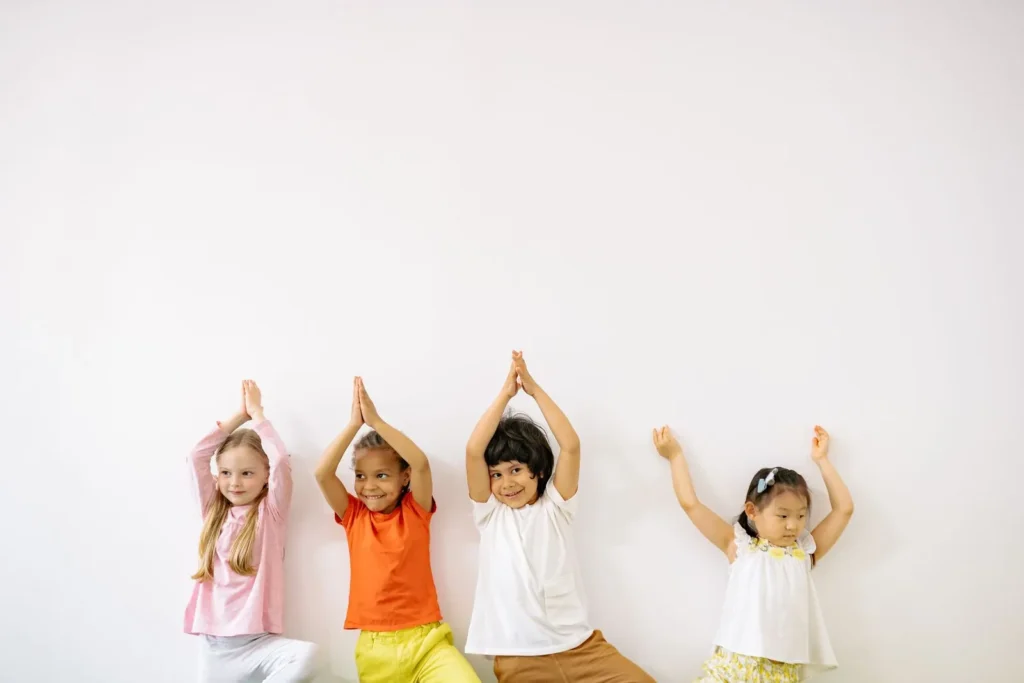
Yoga poses for kids work best when they feel like play: a cat arching its back, a snake lifting its head, a tree swaying in the wind. This guide gives you ten animal-themed poses with hold times, a 10-minute story sequence, an age-by-age table and, most importantly, the safety rules. Every pose here is gentle, held for only a few breaths and done with an adult close by. Nothing is forced and nothing is upside down.
Which yoga poses for kids are easiest to start with?
The easiest yoga poses for kids are Child’s Pose, Butterfly, Cat-Cow, Star and Mountain, because none needs strength or balance. Children aged 3 to 5 can hold each one for one to three breaths, roughly 5 to 10 seconds. Add Tree, Cobra and Puppy (Downward Dog) once a child moves confidently, usually from age 5 or 6.
Young children learn through pictures, not instructions. Say “be a cat” and the body finds the shape, which is why animal yoga poses for kids beat Sanskrit names for anyone under eight. Begin on the floor, where there is nothing to fall from, and save standing balance for the second or third session. Let your child add the sound too; a roar, hiss or bark keeps the breathing going.
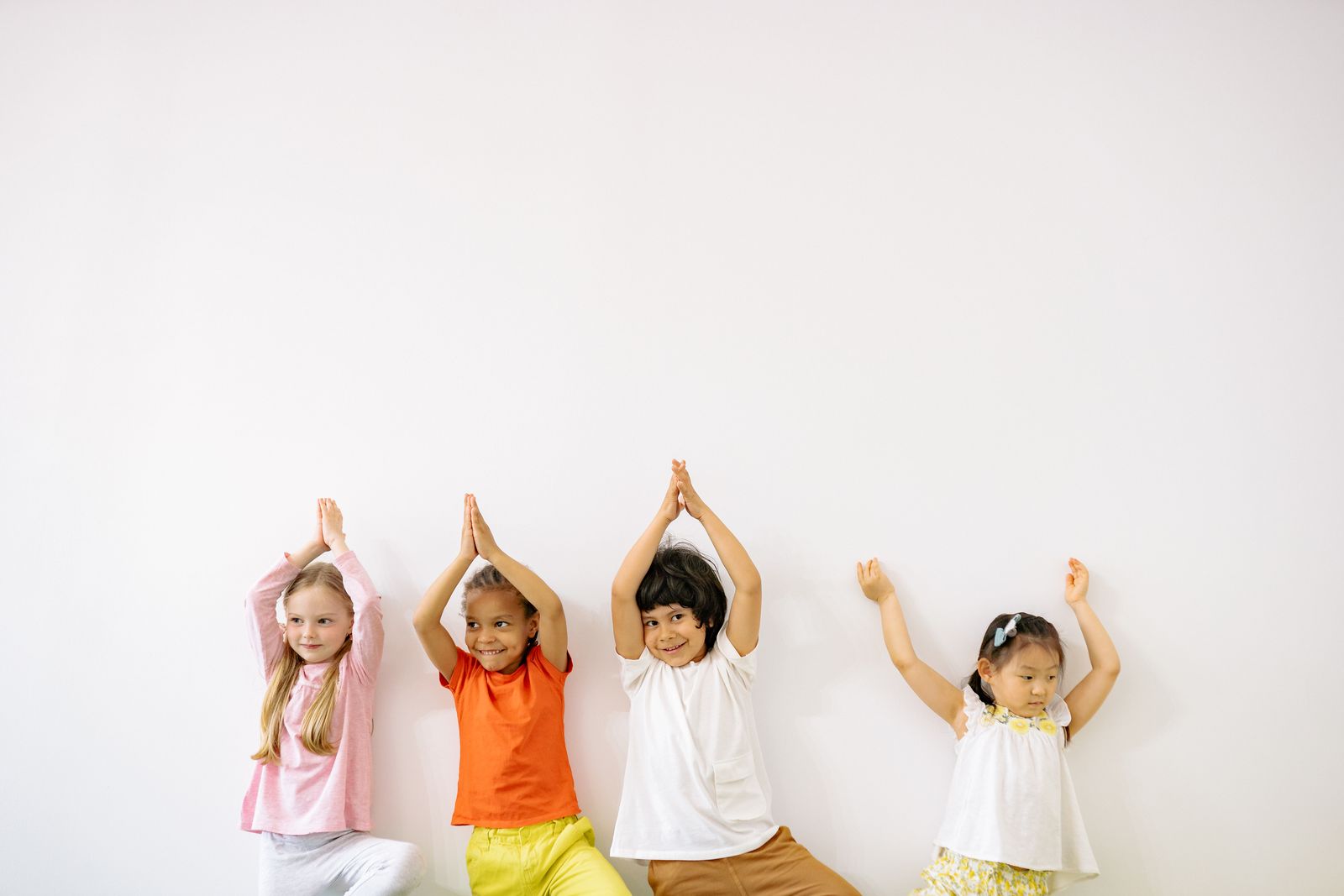
Animal yoga poses for kids: shape, hold time and safety cue
Hold times suit children aged 6 to 8; halve them for ages 3 to 5. Sanskrit names are there for parents only, since children learn from the animal.
| Animal pose | How to make the shape | Hold | Safety cue for the adult |
|---|---|---|---|
| Cat-Cow (Marjaryasana-Bitilasana) | On hands and knees, round the back like a cat, then dip the belly like a cow | 5 slow rounds | Keep movement small; never throw the head back |
| Cobra (Bhujangasana) | Lie on the belly, hands under shoulders, lift the chest a little and hiss | 3 breaths | Hips stay down; stop if the lower back pinches |
| Puppy / Downward Dog (Adho Mukha Svanasana) | Hands and feet down, hips high, knees bent as needed | 3 breaths | Bent knees are fine; rest in Child’s Pose |
| Butterfly (Baddha Konasana) | Sit with soles together and flap the knees like wings | 10 gentle flaps | Never press the knees down |
| Frog (Malasana variation) | Low squat, hands between the feet, then hop | 3 breaths | Heels may lift; skip if knees complain |
| Elephant | Stand tall, clasp hands as a trunk and sway side to side | 8 to 10 swings | Soft knees, slow swings |
| Tree (Vrikshasana) | Stand on one leg, other foot on calf or ankle, arms as branches | 3 to 5 breaths per side | Foot never on the knee; stay near a wall |
| Lion’s Breath (Simhasana) | Kneel, inhale through the nose, exhale with mouth open and tongue out | 3 roars | Keep roars short; stop if dizzy |
| Eagle arms (Garudasana, seated) | Sit tall and wrap one arm around the other | 3 breaths per side | Arms only; leave the leg wrap for later |
| Child’s Pose (Balasana) | Kneel, sit back and fold forward, arms resting | As long as comfortable | A rest pose, never a punishment |
Standing poses such as Tree and Elephant suit children from about age 4, once single-leg balance develops. The adult versions are in our standing yoga poses guide, but children only need the gentle shapes above.
How do you run a 10-minute yoga sequence for a child?
Run one story with one pose per minute: start standing, move through floor stretches, add a single balance pose and finish with Child’s Pose and a minute of lying still. Ten poses in ten minutes suits ages 5 to 8, with about three breaths per pose. Shorten it to five poses for younger children.
| Minute | Pose | Story line | Breaths |
|---|---|---|---|
| 1 | Mountain or Star | “Standing tall at the zoo gate” | 3 |
| 2 | Elephant | “Elephant says hello” | 8 swings |
| 3 | Cat-Cow | “Cat stretches in the garden” | 5 rounds |
| 4 | Cobra | “Snake peeks from the grass” | 3 |
| 5 | Puppy | “Dog stretches after a nap” | 3 |
| 6 | Frog | “Hop to the pond, then freeze” | 3 |
| 7 | Tree | “A tall tree by the pond” | 3 per side |
| 8 | Butterfly | “Butterfly lands to rest” | 10 flaps |
| 9 | Lion’s Breath | “One big goodbye roar” | 3 roars |
| 10 | Child’s Pose, then lying still | “The zoo sleeps” | Rest 1 minute |
To teach it, follow five steps:
- Set the space. Clear a floor area about two arm-spans wide and lay a non-slip mat.
- Tell the story first. Spend 30 seconds on where you are going.
- Show, do not correct. Do the pose, then let your child copy it their own way.
- Keep moving. If your child wanders, turn it into a cheetah run and rejoin the story.
- Finish quietly. Lower your voice and end on the floor, with the slow pacing of restorative yoga.
What yoga poses for kids suit each age?
Ages 2 to 4 suit animal poses held for one or two breaths in sessions of about 5 minutes. Ages 5 to 8 can hold three to five breaths across 10 to 15 minutes. Ages 9 to 12 can manage five to eight breaths and 15 to 20 minutes. Younger children always need an adult within arm’s reach.
| Age | Hold per pose | Session length | Good poses | Adult role |
|---|---|---|---|---|
| 2 to 4 years | 1 to 2 breaths | About 5 minutes | Star, Butterfly, Cat-Cow, Child’s Pose, Elephant | Join in, stay within arm’s reach, sing or narrate |
| 5 to 8 years | 3 to 5 breaths | 10 to 15 minutes | All ten poses in the chart, partner Tree, Seesaw | Demonstrate, encourage, correct only for safety |
| 9 to 12 years | 5 to 8 breaths | 15 to 20 minutes | Tree, Cobra, Puppy, Eagle arms, longer story sequences | Stay nearby, let the child lead the order |
These are easy yoga poses for kids at every stage, paced differently. Children of 9 or older can start to move towards the routines in yoga for students, and yoga for children covers how practice changes as they grow.
How do you keep yoga poses for kids safe?
Keep yoga poses for kids safe with five rules: an adult always present, a non-slip mat on a clear floor, short holds of a few breaths, no forcing or pushing into a stretch, and no upside-down poses. Stop any pose that causes pain, dizziness or tears, and never compare one child’s flexibility with another’s.
- Supervise every session. Stay close enough to catch a wobble, especially in standing poses.
- Choose the space well. Keep furniture, stairs and hard corners away. A mat with grip beats a slippery rug.
- Time it sensibly. Wait about an hour after a full meal and avoid the hottest hours of the day.
- Warm up first. Two minutes of marching or Cat-Cow comes before any stretch.
- Use the pain rule. A stretch is a mild pull. Sharp pain, pinching or tingling means come out slowly.
- Let the child lead. A “no” is useful information; offer a different animal.
This is general guidance for healthy children, not medical advice.
Which yoga poses should children skip?
Children should skip headstand, handstand, shoulder stand, plough, wheel and other deep backbends, along with full lotus and any pose that makes the neck carry body weight. These need neck, shoulder and spine control that growing bodies do not safely offer without expert, in-person teaching. Stay with the gentle poses above.
Searches for advanced yoga poses for kids bring up photos of very flexible children in dramatic shapes. Do not copy them. Our advanced yoga poses guide is written for adults; for children, read it as a list of what to leave out. Crow and other arm balances can wait until the school years, and then be taught in person by a qualified teacher.
Very bendy children need the same care: flexibility is not stability, so keep holds short and ranges comfortable.
Myth check: four beliefs that make kids’ yoga less safe
Myth 1: children must hold still and get the pose perfect. Young children cannot hold a pose silently for long, and they should not have to. Correct only what is unsafe, such as a foot pressed on a knee.
Myth 2: more flexibility means a deeper pose. Depth is not progress. A comfortable, balanced pose is a good pose, toes touched or not.
Myth 3: yoga can replace running and play. Children also need roughly an hour of active play most days. Yoga adds balance and a calm ending, but it complements running and games. For a broader comparison, see yoga vs exercise.
Myth 4: yoga treats anxiety, poor focus or posture problems. The general benefits of yoga build with regular practice, but it is not a treatment. If you worry about your child’s mood, attention or posture, speak to a doctor.
Troubleshooting: what to do when your child will not cooperate
- Loses interest after two poses. Shrink the session to five poses and let your child teach a soft toy.
- Falls out of Tree again and again. Move next to a wall or rest the toes on the floor. Falling and laughing is fine.
- Giggles through everything. Good. Channel it with Lion’s Breath, then ask for three slow breaths.
- Refuses a pose. Skip it without comment and offer a different animal.
- Too wound-up to settle at the end. Close slowly: Butterfly, Child’s Pose, then a minute lying still with a soft toy rising and falling on the belly.
- Complains of pain. Stop at once and rest. If it keeps happening, check with a doctor.
- Cannot do it every day. Ten minutes, three or four days a week, is enough.
Yoga poses for kids at home, in class and with siblings
At home. Yoga poses for kids at home need only a mat or clean carpet and ten minutes. If you are new to yoga, try the shapes first with yoga for beginners or yoga for beginners at home, so you can move with your child. Pick a theme, such as a jungle or a farm, and let your child name the next animal.
In class. A classroom session works best as a two-to-five-minute reset between lessons: seated Cat-Cow, Eagle arms and belly breathing at the desk, with no mats needed.
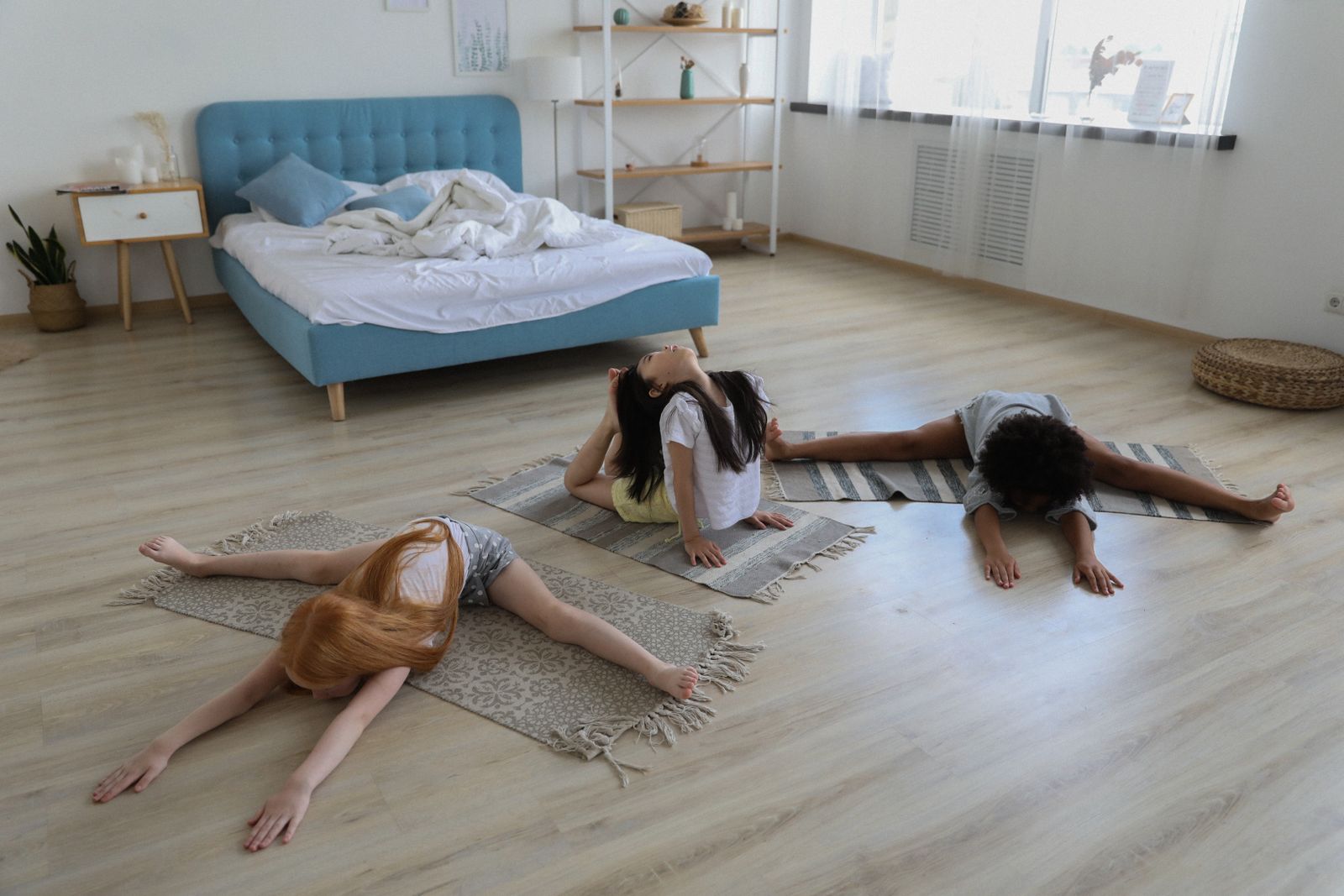
With siblings or friends. Partner yoga poses for kids turn practice into a cooperative game. In Partner Tree, two children stand side by side, link inner arms and lift their outer foot to the ankle. In Seesaw, they sit facing each other, hold hands and rock gently. Pair children of similar size, use a mat and stay close. Skip any pose where one child lifts or pulls the other. Our partner yoga poses guide covers adult versions, and yoga for kids has wider group ideas.
When should you check with a paediatrician before starting?
Check with your child’s paediatrician before starting yoga if your child has a heart or breathing condition, joint hypermobility, scoliosis, a recent injury or surgery, seizures or any diagnosed developmental or health condition. Also see a doctor if pain, dizziness or breathlessness appears during practice. Yoga is gentle movement, not treatment, and never replaces medical care or prescribed medicines.
Ask the doctor which poses to avoid and follow that advice over anything written here. Never stop or change a child’s medicines because of yoga. After a fall with a head knock, fainting or trouble breathing, stop and get medical help right away.
Frequently asked questions about yoga poses for kids
What is the easiest yoga pose for a young child to learn first?
Child’s Pose is usually the easiest first pose because it needs no balance or strength: kneel, sit back and fold forward. Butterfly and Star are close behind. Add Cat-Cow within the first week.
How long should a child hold a yoga pose?
Children under five can usually manage one or two breaths, about 5 to 10 seconds. Ages 5 to 8 can hold for three to five breaths, and ages 9 to 12 for five to eight. Short holds with frequent changes are safer than long, still holds.
At what age can children start yoga poses?
Children as young as 2 or 3 can copy simple animal shapes in playful sessions of about 5 minutes with an adult beside them. Longer holds and balance poses suit children from about 5 or 6.
Are yoga poses safe for kids?
Gentle, supervised poses held for a few breaths are generally suitable for healthy children. Use a non-slip mat, never force a stretch and leave out inverted poses and deep backbends. If your child has a health condition, check with a paediatrician first.
What are good partner yoga poses for two kids?
Partner Tree and Seesaw are the safest starting points. In Partner Tree, two children stand side by side, link inner arms and balance on one leg. In Seesaw, they sit facing each other, hold hands and rock gently. Pair children of similar size.
If you would like a trained teacher to guide the first few sessions, explore Fitstrot’s online yoga classes and ask which sessions suit your child’s age.


