
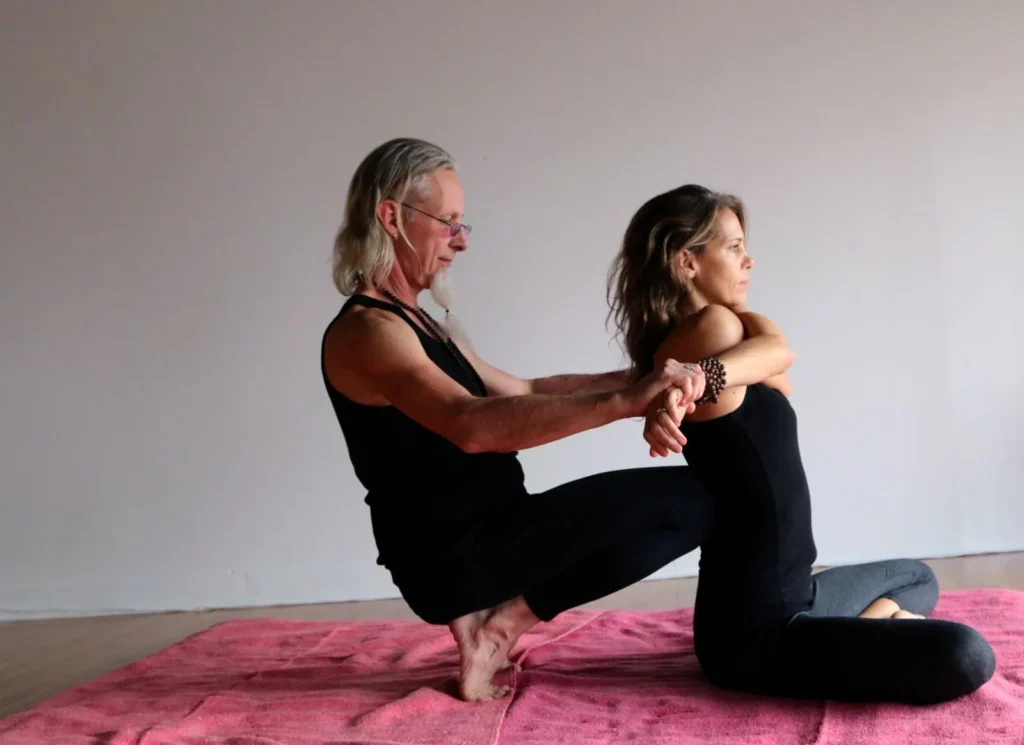
Most partner yoga poses are two-person postures where each of you uses the other’s weight, balance or resistance to stretch, steady or strengthen the body. They stay on the ground, they are slow, and they only work when both people talk. This guide covers who does what in each pose, simple communication signals, poses sorted by level, a 30-minute session plan and the safety rules that keep it comfortable.
What are partner yoga poses, and who plays which role?
Partner yoga poses are grounded two-person postures in which one partner acts as the support (the base) while the other moves into the stretch, then you swap. Unlike acroyoga, nobody is lifted off the floor. Roles change every pose so both people get the same work and the same rest.
In practice there are three roles. The base provides a stable surface, anchor or counterweight. The mover goes deeper into the stretch with that support. The observer is simply whichever of you is not speaking up: both of you watch your own body and your partner’s face and breathing. Swap base and mover after 30 to 60 seconds, so neither of you carries the load for long.
If you are new to yoga itself, it helps to know a few solo shapes first. Our guides to yoga poses and yoga asanas cover the basics, and yoga poses names helps you recognise the Sanskrit and English terms.
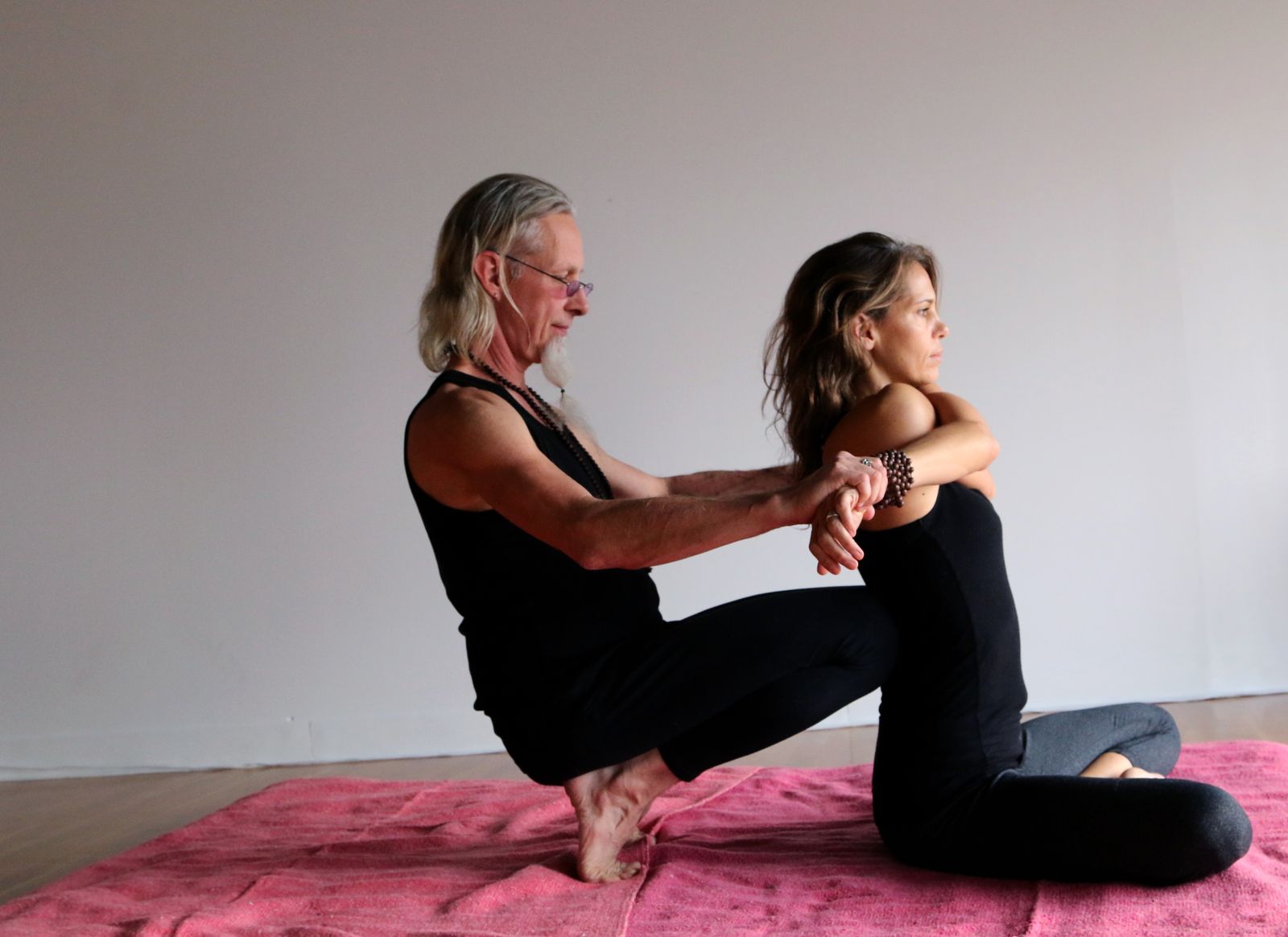
Which partner yoga poses suit which level?
Beginners should choose seated or standing poses where both people stay low and balanced, such as back-to-back breathing, seated cat-cow and double tree pose. Move to forward folds and counterbalance squats once you can talk through a pose calmly. Save weight-bearing shapes for when both of you feel steady.
| Level | Pose | How it works | Hold | Safety cue |
|---|---|---|---|---|
| Beginner | Back-to-back breathing | Sit with spines touching, match breaths | 1-2 minutes | Sit tall, do not lean heavily |
| Beginner | Seated cat-cow | Face each other, hold forearms, round and arch together | 6-8 breaths | Keep movement small, move with the breath |
| Beginner | Double tree pose | Stand side by side, arms around waists, one foot to calf or thigh | 5-8 breaths each side | Never place the foot on the knee |
| Intermediate | Partner forward fold | Sit facing, soles touching, hold hands, one folds while the other leans back | 30-60 seconds each | Pull gently, never yank; bend knees if hamstrings are tight |
| Intermediate | Seated partner twist | Sit back to back, twist to the same side, hands on opposite knees | 5 breaths each side | Lengthen first, then twist; skip if the back is sore |
| Intermediate | Counterbalance squat | Face each other, hold hands, lean back and lower together | 5-8 breaths | Even weight; if one lets go, you both fall |
| Intermediate | Double chair pose | Stand back to back, link elbows, walk feet forward and bend knees | 20-30 seconds | Stop if knees hurt; keep the knees over the ankles |
| Confident | Partner plank tap | Face each other in plank, tap the opposite shoulder, resist the twist | 5-8 taps each hand | Keep the hips level; drop to knees if the lower back sags |
| Confident | Double downward dog | One partner holds down dog; the other rests feet on the base’s hips | 3-5 breaths | Weight goes on the hips, never the lower back; try it first with an instructor |
When poses feel too easy, you can bring the same partner work into flowing classes such as vinyasa yoga or a stronger power yoga session. Take every pose slowly and leave out any shape that needs a lift off the floor until a qualified teacher has shown it in person.
How do partners communicate safely in a pose?
Agree three signals before you start: a word or double tap to stop, a thumbs-up or “good” to continue, and “more” or “less” to change depth. Check in out loud when you enter a pose, at about 15 seconds and before you release. The mover decides the depth; the base never forces it.
| Signal | Who gives it | Meaning | What the other person does |
|---|---|---|---|
| Double tap or “release” | Either partner | Stop now | Let go slowly, steady your own balance, then check in |
| “Stay” | Mover | This depth is good | Hold still and keep breathing |
| “A little less” | Mover | Reduce the pull or pressure | Ease off by a few centimetres |
| “A little more” | Mover | Go deeper, slowly | Increase by a small amount, then pause |
| Tap on the mat or a hand squeeze | Either partner | Time to swap | Come out together, rest, switch roles |
Two habits matter more than any pose. First, move on the exhale, so the body can relax into the stretch. Second, whoever feels the stretch controls it. Most injuries in partner work come from one person guessing how much the other can take.
A 30-minute partner yoga session, step by step
A good session has three phases: a few minutes of shared breathing, a middle of three to five poses from easy to harder, and a calm finish. Total time is about 30 minutes. Beginners can stop after the first two phases at around 15 to 20 minutes, with two mats side by side.
| Time | What to do | Purpose |
|---|---|---|
| 0-5 minutes | Back-to-back breathing, then shoulder rolls and a gentle neck stretch each | Settle, match breath, warm up |
| 5-10 minutes | Seated cat-cow, then double tree pose | Easy movement and balance |
| 10-20 minutes | Partner forward fold, seated twist, counterbalance squat (swap roles each time) | Deeper stretch and shared work |
| 20-25 minutes | Optional: partner plank tap or double chair pose | Light strength work |
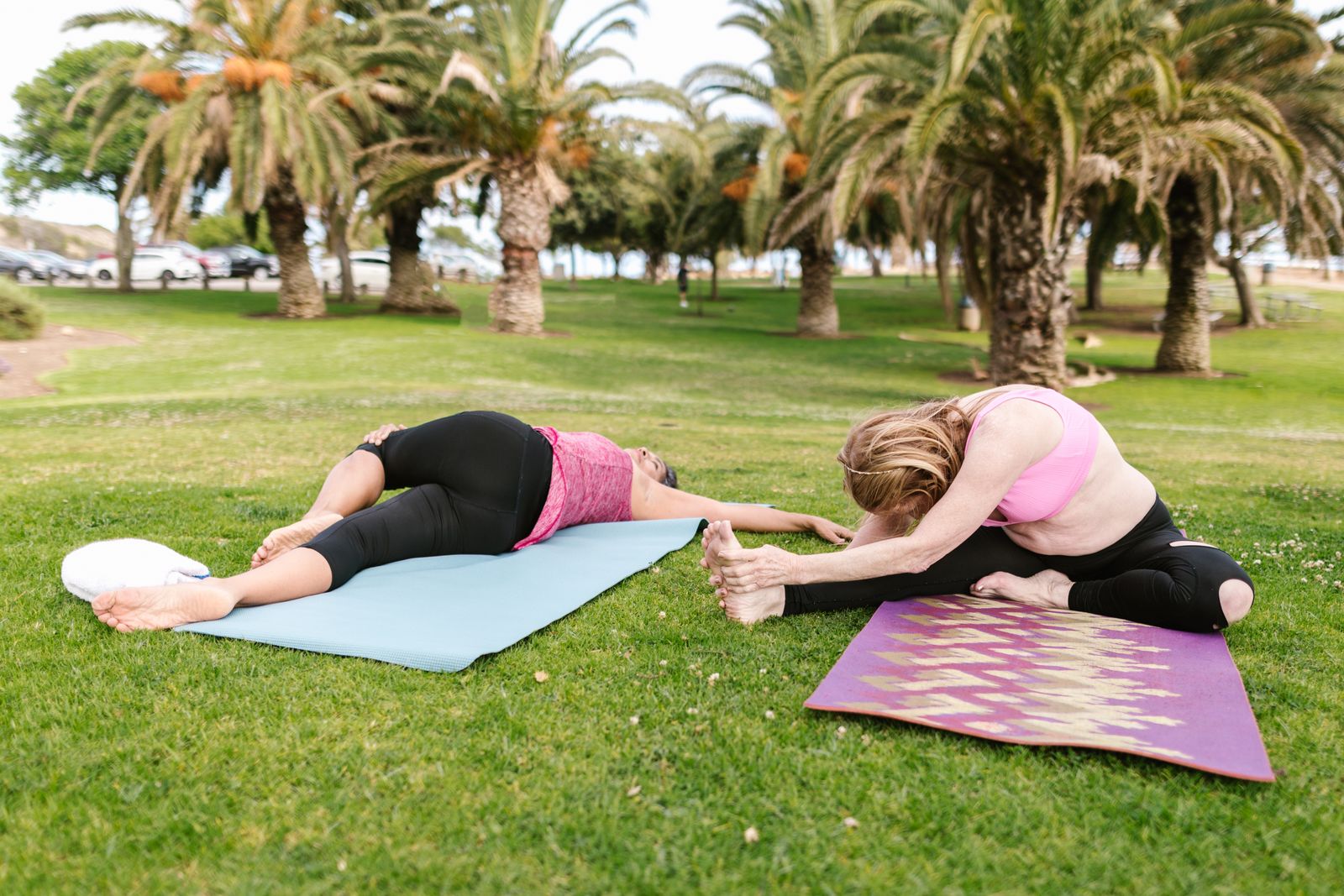
| 25-30 minutes | Seated forward fold side by side, then back-to-back breathing | Cool down and finish still |
Practise barefoot on non-slip mats, on a clear floor, ideally two hours after a heavy meal or one hour after a light snack. If you want to fit it into a weekly rhythm, our yoga routine guide shows how to combine a weekly partner session with solo days.
Safety rules: when to adjust or skip a partner pose
Skip or modify partner yoga poses if either of you has acute pain, a recent injury or surgery, dizziness, uncontrolled high blood pressure or a heart condition, or is pregnant. If in doubt, check with your doctor first. Stop at sharp pain, numbness, pinching in a joint or lightheadedness, and never push through discomfort to match the other person.
- Avoid joints under strain. Pressure should go through muscles and bones, never pinned on a knee, elbow or the lower spine.
- Skip deep twists and backbends with a sore back. The guide to yoga for back pain explains gentler options.
- Stay low. A fall from a standing balance is the most common injury, so keep a wall or a chair nearby.
- Do not hold your breath. A steady breath tells you the pose is manageable.
- Quit while you can still enjoy it. Short, careful sessions beat one strained one.
Prepare the space as well as the body. Remove watches, rings and bangles that can scratch, trim long nails, tie back long hair and wear fitted clothes that will not catch on a partner. Warm up for a few minutes first, because cold muscles tolerate a partner’s pull less well. Finish with a minute of quiet sitting so both of you notice how the body feels before you stand up and carry on with the day.
Myth check: do you need flexibility, equal size or a romantic partner?
No to all three. Partner yoga suits stiff people, because the support makes poses easier, not harder. Different heights work with small changes, such as bending the knees in a forward fold or widening the stance. Partners can be friends, parents and children, siblings or colleagues. What matters is trust and honest feedback.
Another myth is that a partner “stretches you further” safely. A partner can offer support, but the mover must remain in charge of how far to go. A third myth is that partner work replaces solo practice. It adds company and accountability, but it does not replace the pace and focus of practising alone.
Troubleshooting: when partner yoga poses feel wrong
- One of you is much heavier or stronger. Choose symmetrical poses (back-to-back breathing, cat-cow, twist) and avoid counterbalance moves until you can control the lean.
- One of you is far more flexible. Let the less flexible partner set the depth, and use a block or folded blanket under the hips.
- You keep laughing or feel awkward. That is normal. Start with breathing poses, keep eye contact optional and continue.
- You feel pulled or pinched. Stop, release evenly, and make the pose smaller before trying again.
- You lose balance. Widen your stance, use your core and slow your breath, or switch to a seated version.
Partner yoga for different people
Couples and friends. A weekly session of 20 to 30 minutes works well. Focus on breathing and simple stretches, and treat it as shared quiet time rather than a performance.
Parents and children. Keep poses playful and short: mirror poses, rowing and gentle balance games with 15 to 30 second holds. The yoga for kids guide has more age-appropriate ideas. An adult must supervise and should never pull a child into a stretch.
Older adults. Prefer seated versions with chairs, shorter holds and no weight-bearing on a partner’s frame. Move slowly when changing positions.
Pregnancy. Stick to supported, seated poses such as back-to-back breathing, and avoid deep twists, belly compression and lying flat on the back later in pregnancy. Get a doctor’s or midwife’s approval first and read about prenatal yoga.
How does partner yoga fit with a solo practice?
Partner yoga works best once or twice a week alongside two or three solo sessions. Solo practice builds your own strength, balance and breath control, while partner work adds support, accountability and communication. Traditional styles such as hatha yoga and ashtanga yoga are good solo foundations.
Frequently asked questions
Do you need yoga experience to try partner yoga poses?
No. Poses such as back-to-back breathing and seated cat-cow need no experience, only slow movement and clear communication. Start with 15 to 20 minutes and a few easy shapes, and add forward folds and counterbalance poses once you both feel steady.
What is the difference between partner yoga and acroyoga?
In partner yoga, both people stay grounded and use support, counterbalance or resistance to stretch. Acroyoga lifts one person off the floor and needs more strength, spotting and training, so it is better learned with a qualified teacher.
Can two people of different heights do partner yoga together?
Yes. Choose symmetrical or seated poses such as back-to-back breathing, cat-cow and twists, and adjust stance width or bend the knees in folds. Avoid shapes that depend on matching leg lengths until you have tried them slowly.
How often should you practise partner yoga poses?
Once or twice a week is a good starting point, for 20 to 30 minutes at a time. It works best next to two or three solo sessions, because your own strength and flexibility make the partner poses safer and more comfortable.
Are partner yoga poses safe during pregnancy?
Some gentle, supported poses can be, but check with your doctor or midwife first. Stay seated or supported, avoid deep twists, belly compression and lying flat on the back later in pregnancy, and stop at any dizziness, pain or discomfort.
Want a teacher to check your pairing and alignment? Book a live session on Fitstrot online yoga classes and bring your partner to the same screen.


