

The best couple yoga poses are two-person postures where you lean on, resist or mirror each other, so you stretch, balance and breathe in sync. You do not need flexibility or experience. The best home start is a short, grounded routine of back-to-back breathing, seated cat-cow, forward folds and twin trees, with lifting poses left for later or for a trained teacher.
This guide is built for couples practising at home in India: a pose cheat sheet, a four-week progression, fixes for mismatched size and flexibility, and an honest look at which famous poses are best skipped. It is general fitness information, not medical advice.
Are couple yoga poses safe for beginners?
Yes, if you start with grounded, seated poses and keep each hold to about 5 to 8 breaths (30 to 60 seconds). Beginner couple yoga poses involve gentle pressure, not lifting. Agree a stop word, never put weight on your partner’s spine or neck, and skip anything that causes pain, dizziness or pinching.
The safe core is simple: sit, breathe, fold, lean and balance on your own feet while holding hands. Poses that put one person’s weight on the other, such as feet on the back or lifts, carry a real risk of injury and are covered in the myth section below.
If either of you has a back, knee or neck injury, high blood pressure, is pregnant or has recently had surgery, check with your doctor before trying the stretches. Start with seated breathing and choose a low-intensity option.
Why do couples practise yoga together?
Most couples try partner yoga for connection first and fitness second. Matching your breath to another person slows you down, and the practice needs clear communication about pressure and comfort. It is a screen-free, low-cost way to spend 20 minutes together, and it adds a light stretch and core work.
It is not couples therapy, and it will not fix a strained relationship, but it can be a pleasant shared habit. Physically, the benefits match those in our guide to the benefits of yoga: mobility, breath awareness and relaxation. The shared element adds trust practice: leaning back and knowing your partner will hold steady.
Before you start: a 5-minute safety setup
- Agree a stop word. “Release” or “down” means you ease off at once, no discussion.
- Use a non-slip surface. Two mats side by side, or one wide mat, on a flat floor. Avoid polished tiles in socks.
- Warm up separately. Spend 3 to 5 minutes on neck rolls, cat-cow and a few gentle sun salutations so muscles are not cold when they take each other’s weight.
- Eat light. Wait about 2 hours after a full meal, or have a small snack an hour before.
- Keep the phone away. The point is attention, not photos.
- Never push a partner into a stretch. The person being stretched controls the depth, always.
Eight couple yoga poses at a glance
This table lists poses in order from easiest to hardest, with holds, a form cue and who should skip each one. The times are guides, not targets.
| Pose | Level | Hold | Form cue | Skip or modify if |
|---|---|---|---|---|
| Back-to-back breathing | Beginner | 2 to 5 minutes | Sit tall, backs touching lightly, breathe slowly | Sitting cross-legged hurts; sit on a cushion or chair |
| Seated cat-cow | Beginner | 8 to 10 rounds | Face each other, hold forearms, move slowly | Wrist or neck pain; use a smaller range |
| Partner forward fold | Beginner | 5 to 8 breaths each | Soles together, bend knees if hamstrings are tight | Back injury or sciatica |
| Seated twist | Beginner | 5 breaths per side | Back to back, hands on opposite knees, twist from mid-back | Pregnancy or recent abdominal surgery |
| Twin trees | Beginner | 20 to 30 seconds per side | Foot on calf or thigh, never on the knee | Dizziness; stand next to a wall |
| Back-to-back chair | Intermediate | 20 to 40 seconds | Press backs together, thighs near parallel | Knee pain; take a shallower squat |
| Partner boat | Intermediate | 3 to 5 breaths | Hold forearms, bend knees first, then straighten | Lower back pain or pregnancy |
| Assisted downward dog | Intermediate | 5 breaths | Helper’s hands on hip crease, gentle pull back and up | Wrist, shoulder or blood pressure concerns |
For solo foundations behind these shapes, see our overview of yoga poses, yoga asanas and the full list of yoga poses names.
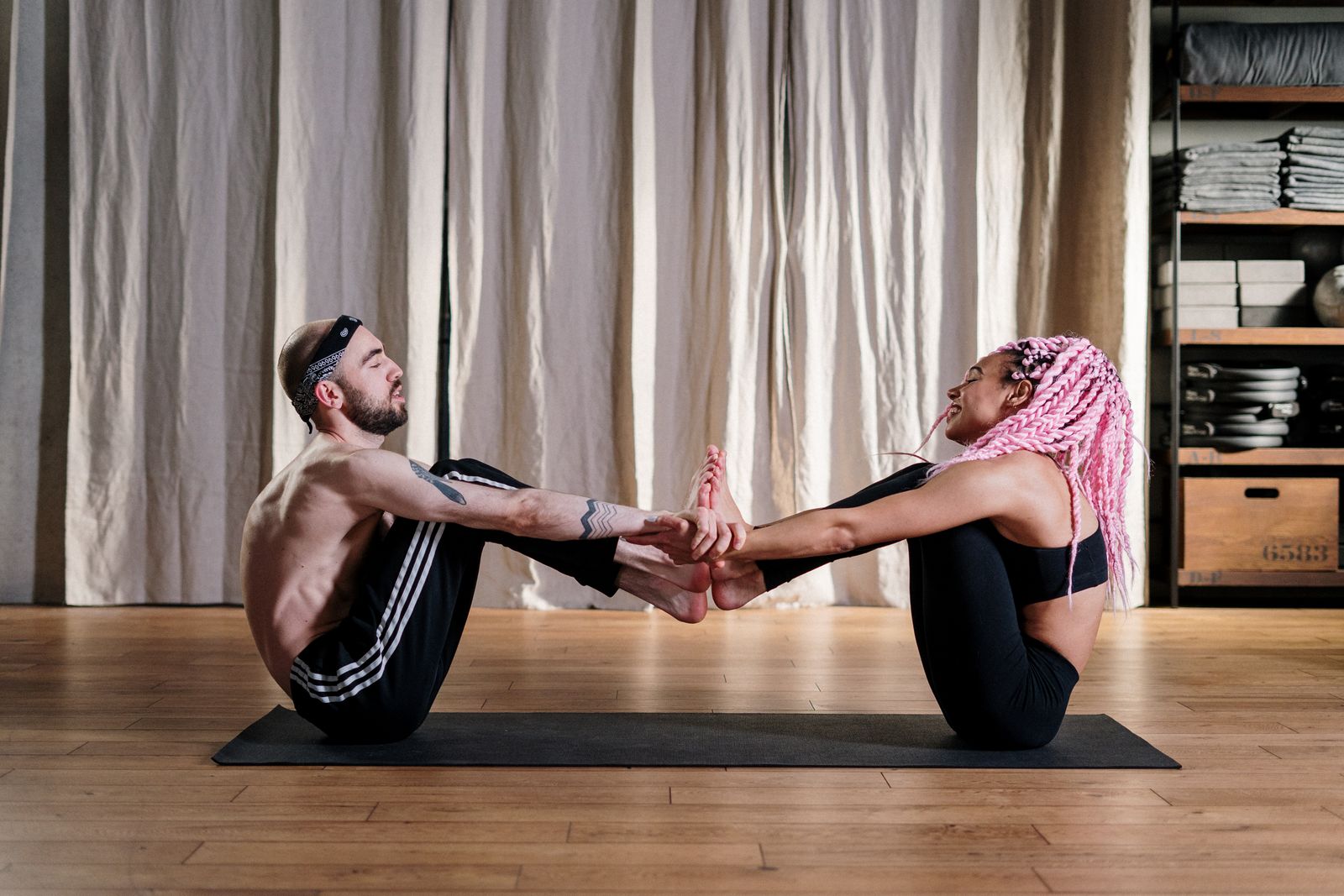
How do you do the four easiest poses step by step?
1. Back-to-back breathing. Sit cross-legged, spines pressed lightly together. Close your eyes and feel your partner’s breath expand through their back. After a minute, try to match the rhythm. Do this for 2 to 5 minutes to open every session.
2. Seated cat-cow. Sit facing each other, knees touching, and hold each other’s forearms. As one partner arches and lifts the chest, the other rounds the back. Swap with each breath. It teaches you to find a shared tempo.
3. Partner forward fold. Sit facing each other with legs extended and soles together, or wider if easier. Hold wrists. One person leans back while the other folds forward, then you swap. Bend the knees whenever the hamstrings protest, and never pull your partner.
4. Twin trees. Stand side by side with inside arms around each other’s waist. Place the outer foot on the opposite calf or inner thigh, never the knee. Look at a fixed point and breathe. Try a wall nearby if you wobble.
These are variations of shapes in yoga poses for two, but here the focus is on a calm home routine, not a catalogue.
A 4-week couple yoga plan for home
Practise three times a week for 20 to 30 minutes. Move on only when both partners feel steady and relaxed. If a week feels hard, repeat it. The table gives one version.
| Week | Poses | Session length | Focus | Communication goal |
|---|---|---|---|---|
| 1 | Back-to-back breathing, seated cat-cow, partner forward fold | 20 minutes | Breath and tempo | Agree the stop word and use it once on purpose |
| 2 | Week 1 plus seated twist and twin trees | 20 to 25 minutes | Balance and trust | Say “more”, “less” or “stay” during each fold |
| 3 | Week 2 plus back-to-back chair and partner boat | 25 minutes | Leg and core strength | Count down holds aloud together |
| 4 | Week 3 plus assisted downward dog; finish in a relaxed lying pose | 25 to 30 minutes | Smooth flow and cooling down | Swap roles without being asked |
Finish each session lying side by side for 3 to 5 minutes. If you enjoy this, add slower practices such as yin yoga and restorative yoga, or a more active vinyasa yoga flow when you both feel strong.
What if you differ in size, strength or flexibility?
Differences are normal and rarely a problem. Give the more flexible partner the deeper role, the stronger partner the supporting role, and swap often. Use props such as cushions, folded blankets and a wall. The goal is to meet in the middle, not match each other.
| Situation | What goes wrong | Fix |
|---|---|---|
| One partner is much more flexible | The stiffer partner gets pulled too far | Stiffer partner sets the depth; the flexible one uses the extra range for support |
| Big height or weight difference | Balance poses feel uneven | Choose poses where both feet stay grounded; use a block or cushion |
| One partner has tight hamstrings | Knees lock in forward folds | Bend knees, sit on a folded blanket |
| One partner gets nervous | Tension stops the breath | Return to seated breathing; hold hands, not lifts |
| Different fitness levels | One finishes quickly, one tires | Shorten holds to match the slower partner |
Myth: lifting poses are the point of couple yoga
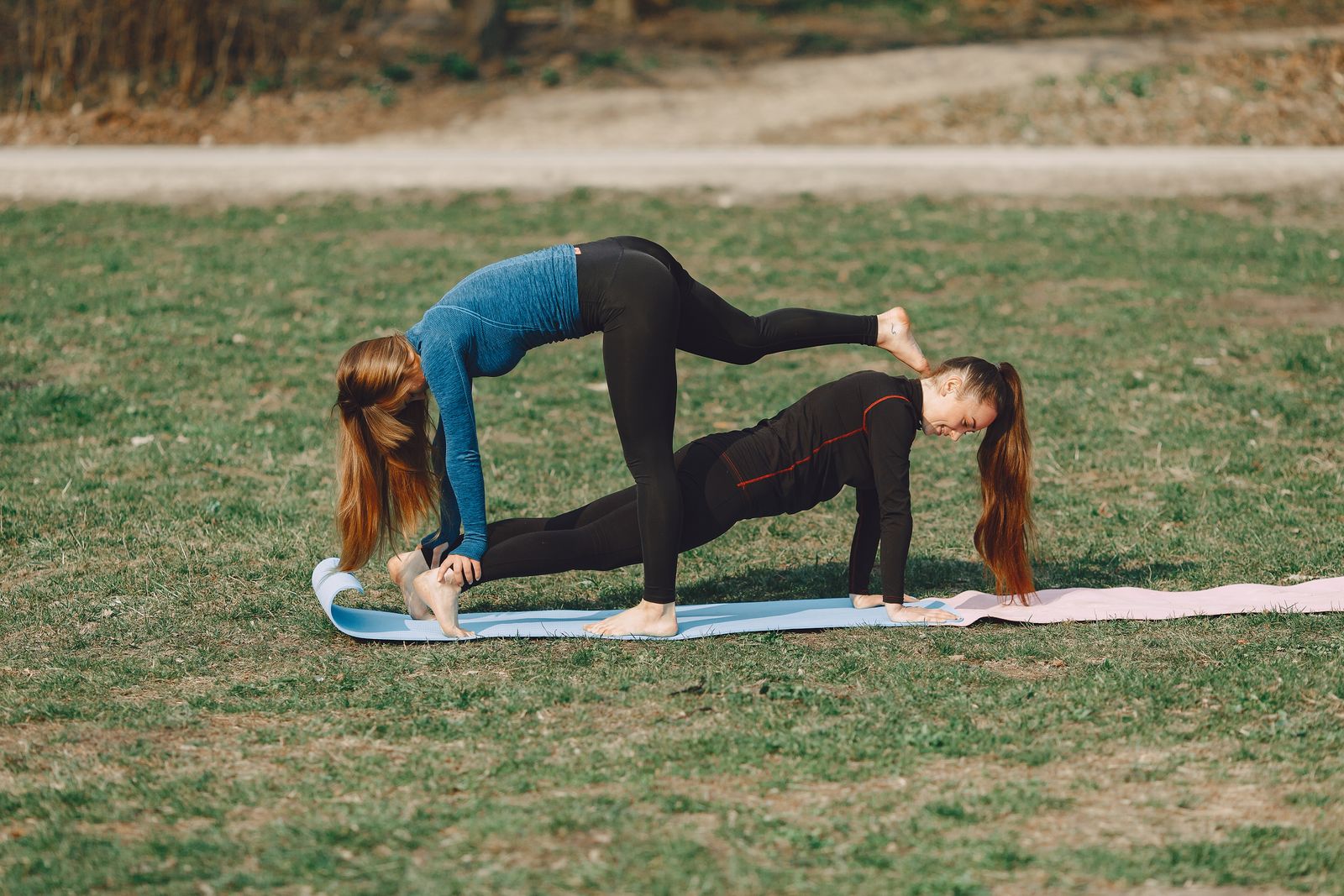
Social media shows flying and lifting poses, but they belong to acro yoga, a separate discipline. At home, without a trained spotter, they risk falls and strained backs and necks. A good rule is to avoid any pose where your partner’s weight sits on your spine, neck or lower back.
Several poses you may see online, including Double Plank with feet on the back, Bird and Throne, are best learned in a class with a teacher who can spot you. The value of a home routine lies in breath, balance and communication. You do not lose anything by skipping the dramatic photo pose.
Stiffness and sore muscles the next day are normal, but sharp pain, numbness or tingling are signs to stop. See a doctor if pain persists for more than a few days, or if it travels down a leg or arm.
Different couples, different starting points
New couples. Keep it light and playful. Laughing at wobbles is part of the pose. Choose twin trees and cat-cow, and avoid anything that feels too exposed if you are not yet comfortable.
Long-married couples. Treat it as a weekly ritual. Pair a 20-minute session with a cup of tea afterwards. If you both carry old niggles, use the chair-supported versions and consult our guide on yoga for back pain.
Parents with young kids. Evenings are busy, so aim for 10 to 15 minutes once the kids are asleep. Back-to-back breathing and a forward fold are enough.
Couples who sit all day. If you work at a desk, focus on the stretches in yoga for flexibility and partner forward folds to release tight hamstrings and hips.
What do intimate, tantric and hot couples yoga really mean?
These popular searches describe style, not new poses. “Intimate” usually means slow, close-contact poses such as seated heart-openers with synchronised breathing and eye contact. “Tantric” classes vary widely, so ask the teacher what the session involves before booking. “Hot” simply means the same poses in a heated room.
If you try heat, go with caution: two bodies generate more warmth than one, dehydration risk rises and balance poses get slippery. Learn the basics at room temperature first, then read about hot yoga before you book anything. Always follow your own comfort and consent in any close-contact practice.
Practise at home or join a class?
Home practice is free, private and flexible, while a class gives you a teacher’s eye on alignment and safer modifications for lifts. Many couples start with a few guided sessions, then keep the routine going at home. Online sessions remove any shyness about wobbling in front of strangers.
If you want guidance, book a trial with Fitstrot’s online yoga classes, tell the instructor you are practising as a couple and ask for a seated, grounded sequence to start.
Frequently Asked Questions
Do you need to be flexible to try couple yoga poses?
No. Beginner couple yoga poses such as seated cat-cow or partner forward fold depend on balance and cooperation, not deep flexibility. Bend your knees, use a smaller range and sit on a folded blanket whenever you need to.
What if my partner and I have very different flexibility levels?
That is common and workable. The stiffer partner sets the depth in every stretch, and the more flexible partner supports instead of stretching further. Seated cat-cow, twin trees and a gentle forward fold all suit mismatched flexibility.
Is couple yoga safe during pregnancy?
Some gentle seated poses may be fine, but deep twists, long periods on the back, lifts and balance poses are best avoided. Ask your doctor or a prenatal-trained instructor before practising couple yoga during pregnancy.
How long should a couple yoga session last?
A home session of 20 to 30 minutes is enough to warm up, do four or five poses and relax. Studio workshops usually run about 60 minutes, because the teacher explains each pose and lets partners swap roles.
Can beginners try acro-style lifts right away?
It is better not to. Spend a few weeks on grounded poses first, and attempt lifts only with a qualified acro teacher present. Most of the benefit of couple yoga comes from breath, balance and communication, which lifts are not needed for.


