

If your neck aches by evening and your shoulders have crept up toward your ears, yoga for screen time and posture is one of the most practical habits you can start today. A 12-minute daily sequence of chest openers, upper-back strengtheners and gentle neck work counters the head-forward, rounded-shoulder pattern that phones and laptops build. It supports comfort and better alignment; it is not a cure for any neck or spine condition, and this guide tells you who should skip or modify it.
What does screen time actually do to your posture?
Looking down at a phone or laptop pushes your head forward of your shoulders. An adult head weighs about 4.5 to 5 kg, and the further forward it sits, the harder your neck and upper-back muscles work to hold it. Over months this tends to shorten the chest, tire the upper back and produce the stiffness people call tech neck.
The common signs of this forward head posture are easy to spot once you know them:
- Your ears sit in front of your shoulders when someone views you from the side.
- Your shoulders roll forward and your upper back looks rounded.
- Your neck feels stiff at the end of the day, with tightness between the shoulder blades.
- Your chin pokes forward when you type, scroll or read.
None of this is a diagnosis. It builds from thousands of small repetitions, which is why small daily counter-movements beat one long weekend session.
Myth check: “Yoga alone will fix tech neck”
This is half true, and the half that is false is what makes people give up. Yoga does lengthen tight chest and neck muscles, strengthen the upper back and teach you to notice slumping. But if you practise for 12 minutes and then sit hunched for ten hours, the habit wins.
Three more myths worth dropping:
- “More stretching is always better.” Stretching alone leaves the weak upper-back muscles weak. You need both release and strength.
- “Roll your head in big circles.” Dropping the head fully backward can pinch the back of the neck. Slow side tilts and forward nods are safer.
- “Pain means it is working.” A mild stretch feeling is fine. Sharp, burning or tingling sensations mean stop.
How long should a daily yoga routine for screen posture take?
About 10 to 15 minutes a day is realistic and effective for most people. Posture muscles respond to frequent, repeated input, so 12 minutes daily beats one 60-minute session a week. On busy days, even three or four poses done slowly with steady breathing are worth more than skipping the practice completely.
Here is a 12-minute sequence you can do on a mat or a carpet. Move slowly, breathe through the nose, and keep every stretch at a comfortable 5 or 6 out of 10.
| Step | Pose | Time | Form cue |
|---|---|---|---|
| 1 | Seated neck side stretch | 1 min (30 sec each side) | Ear toward shoulder, opposite shoulder heavy. Do not pull the head with your hand. |
| 2 | Chin tucks | 1 min (8 to 10 slow reps) | Glide the chin straight back as if making a double chin, then release. No head tilt. |
| 3 | Cat-cow (Marjaryasana-Bitilasana) | 1 min | Inhale to arch, exhale to round. Move the whole spine, not just the lower back. |
| 4 | Thread the needle | 1.5 min (45 sec each side) | Slide one arm under the other, rest shoulder and temple down, hips over knees. |
| 5 | Sphinx or cobra (Bhujangasana) | 1.5 min (3 rounds of about 25 sec) | Lift the chest, keep the lower ribs heavy, shoulders away from ears. Low lift is enough. |
| 6 | Locust (Shalabhasana) | 1 min (3 short holds) | Lift chest and arms slightly, look at the floor, keep the back of the neck long. |
| 7 | Supported fish over a rolled towel | 1.5 min | Towel under the shoulder blades, arms open, chin level. Come out slowly. |
| 8 | Seated twist (Ardha Matsyendrasana) | 1.5 min (45 sec each side) | Sit tall first, then rotate from the ribs. Never crank the neck around. |
| 9 | Mountain pose (Tadasana) | 30 sec | Weight even on both feet, chest open, crown of the head reaching up. |
| 10 | Standing forward fold (Uttanasana) | 1 min | Soft knees, hinge at the hips, let head and arms hang heavy. |
| 11 | Child’s pose with belly breathing (Balasana) | 1 min | Forehead down, breathe into the belly and back ribs for 6 to 8 slow breaths. |
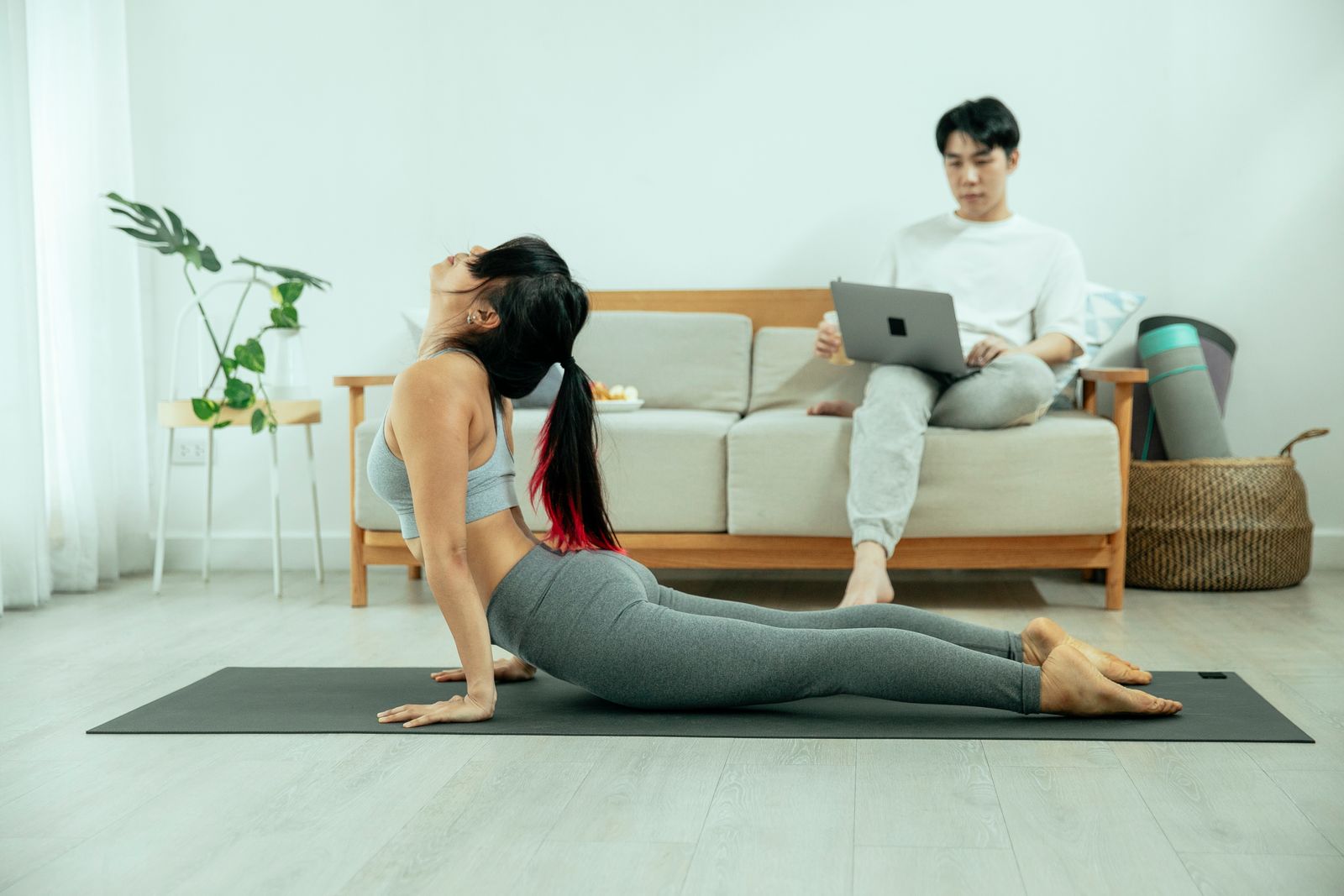
Do the whole sequence once a day, ideally after work or before dinner. Our guide to the best time to do yoga explains why consistency beats the clock, and yoga at home covers a simple space and mat setup.
Screen habit versus yoga fix, at a glance
Different habits strain different areas. This table pairs common screen positions with what they tend to tighten and the pose that counters them.
| Screen habit | What tends to tighten or weaken | Yoga counter | Quick desk version |
|---|---|---|---|
| Scrolling the phone with head bowed | Back of the neck overworks, chest shortens | Supported fish, chin tucks | Raise the phone to chest height, then do 5 chin tucks |
| Typing with elbows forward | Front of the shoulders, upper arms | Thread the needle, cow-face arms | Interlace fingers behind the back and open the chest for 5 breaths |
| Laptop on the lap or bed | Whole spine rounds, hips tighten | Cat-cow, cobra, seated twist | Sit tall on the edge of the chair and twist gently, 5 breaths a side |
| Long sitting without breaks | Hip flexors, glutes, lower back | Forward fold, child’s pose | Stand and walk for 1 to 2 minutes |

Prop the laptop on a stack of books so the top of the screen sits near eye level, keep a separate keyboard if you can, and stand up every 30 to 45 minutes. Our guide to desk yoga for office workers has a full set of seated moves, and a day-long reset such as digital detox with yoga helps if the phone is the bigger culprit.
Troubleshooting: when the routine does not feel right
Most problems come from doing too much too soon.
- Neck feels worse after backbends. Lower the lift. In cobra and locust, keep your gaze on the floor a hand’s width ahead rather than looking up. Swap to sphinx on forearms.
- Shoulders pinch in thread the needle. Place a folded blanket or cushion under the shoulder and head, and reach less far.
- Lower back complains in cobra or locust. Lift less, squeeze the glutes lightly and keep the pubic bone heavy. If the ache stays, read our notes on yoga for back pain and consider asking a professional to check your form.
- You keep forgetting. Attach the practice to a fixed cue, such as right after you shut the laptop, and build it into a simple self-care yoga routine.
How long until yoga improves screen posture?
Many people notice less end-of-day neck and shoulder stiffness within about two to three weeks of near-daily practice. Visible changes in how the head and shoulders sit usually take one to three months. Results vary with age, hours on screens, workstation setup and any existing neck issues, so treat these as rough timeframes, not promises.
This four-week ramp-up keeps things sustainable. It is a general guide for healthy adults without neck or spine problems.
| Week | Daily practice | Focus | What to check |
|---|---|---|---|
| 1 | 6 to 8 min: steps 1 to 4, 7 and 11 only | Gentle mobility, belly breathing | Can you finish without sharp pain or tingling? |
| 2 | 10 min: add sphinx and the seated twist | Opening the chest | Do shoulders feel looser by evening? |
| 3 | 12 min: full sequence, add locust | Upper-back strength | Is sitting upright less tiring? |
| 4 | 12 min daily plus two 1-minute desk breaks | Holding the gains | Do the wall test: heels, hips, upper back and head touching the wall comfortably |
After week four, keep the full sequence three to five days a week and use the desk breaks daily. A broader look at posture beyond screens is in our guide to yoga for posture.
Who should avoid or modify these poses?
Skip this sequence, or get a doctor’s or qualified teacher’s advice first, if any of the following applies. Yoga here is supportive only, never a treatment, and these situations need individual guidance on which poses are safe, how deep to go and what to leave out entirely:
- A recent neck, shoulder or spine injury, fracture or surgery.
- A diagnosed disc problem, cervical spondylosis, or any condition with nerve symptoms, unless your doctor has cleared exercise.
- Osteoporosis or low bone density: avoid deep backbends and forceful twists.
- Pregnancy: avoid lying on the belly (cobra, locust) and deep twists, and ask your doctor or a prenatal-trained teacher for safe alternatives.
- Uncontrolled high blood pressure, dizziness, vertigo or eye-pressure conditions: avoid staying head-down in forward folds and move slowly between positions.
- Very flexible or hypermobile joints: keep stretches short and focus on the strengthening poses.
- Children and teenagers: practise only simple poses with adult supervision.
See your doctor or physiotherapist if you have any of these. Do not try to stretch your way through them:
- Tingling, numbness or weakness in the arms or hands.
- Pain that shoots down an arm or into the shoulder blade.
- Severe, sudden or frequent headaches, or dizziness when you move your neck.
- Neck pain after a fall, accident or sports injury.
- Night pain that wakes you, or neck stiffness with fever.
- Pain or stiffness that has not eased after several weeks of gentle, regular practice.
Yoga can support posture and comfort, but it cannot diagnose or treat a medical condition. Do not change any prescribed treatment or medication on the basis of this article.
Audience guide: students, remote workers and phone-heavy commuters
Students. Long study blocks on a laptop or tablet, often on a bed or floor, are a classic recipe for rounded shoulders, especially around exams. Study in 40 to 45 minute blocks, stand and do chin tucks between them, and see yoga for exam stress for calming breathwork.
Remote and hybrid workers. The dining table or sofa is rarely set up for eight hours of typing. A laptop riser, a separate keyboard and a chair that supports your lower back make the biggest difference. Put the 12-minute sequence at the end of the workday as a clear boundary.
Phone-heavy commuters. Auto, metro and bus rides invite long head-down scrolling. Lift the phone nearer eye level, keep your elbows close to the body, and do five slow chin tucks before you get off.
Questions people ask about yoga for screen time and posture
How many minutes of yoga a day do I need for tech neck?
About 10 to 15 minutes a day is enough for most healthy adults, ideally paired with a one to two minute movement break every 30 to 45 minutes of screen work. Frequent short sessions beat one long weekly class. If you are not sure whether your neck pain is tech neck, get it checked first.
Which yoga poses are best for rounded shoulders and forward head posture?
Chest openers such as supported fish and thread the needle, strengtheners such as sphinx, cobra and locust, and gentle chin tucks work well together. Add cat-cow and a seated twist for mobility. Keep every pose in a comfortable range and stop if you feel sharp pain or tingling.
Can yoga cure tech neck or forward head posture?
No. Yoga can support better posture, reduce stiffness and build upper-back strength, but it is not a cure, and results depend on your screen habits, workstation and any underlying issue. Persistent pain, numbness or arm weakness should be assessed by a doctor or physiotherapist rather than managed with yoga alone.
Is it safe to do these poses if I already have neck or back pain?
It depends on the cause. Mild stiffness from sitting often eases with gentle movement, but pain with nerve symptoms, a known disc problem or a recent injury needs a doctor’s advice first. If you get the all-clear, start with the week 1 version and avoid deep backbends and big head movements.
Do I need a mat or props for yoga for screen posture?
A mat helps for floor poses like cobra, locust and thread the needle, but neck stretches, chin tucks, shoulder rolls and seated twists work on a chair. A rolled bath towel or firm cushion is enough for supported fish. No special equipment is needed.
Want someone to check your form and build a posture routine around your actual workday? Book a session in Fitstrot’s online yoga classes and start with the week 1 plan.


