
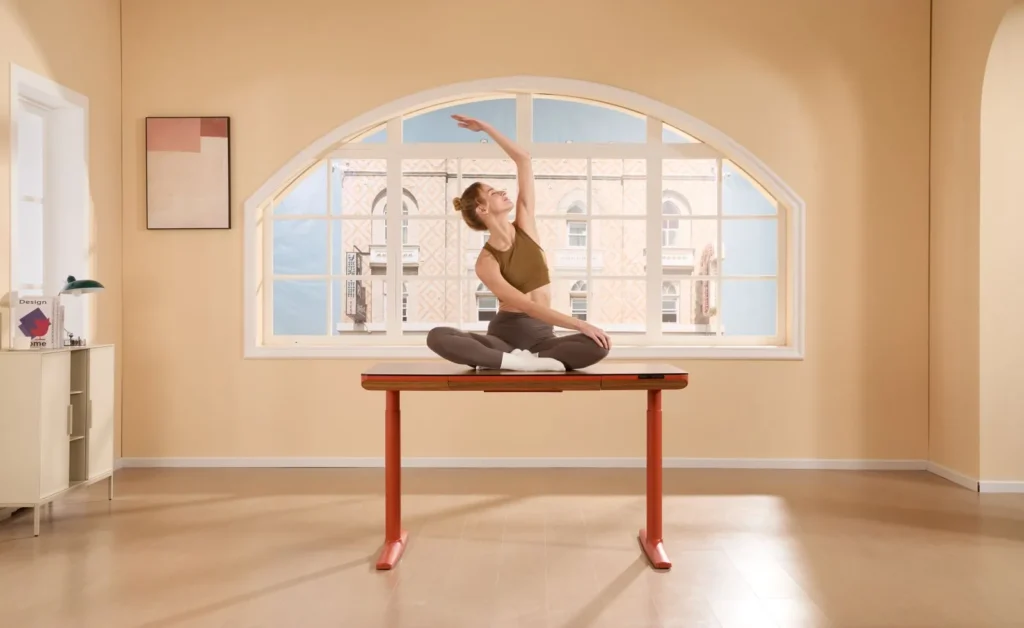
The best desk yoga for office workers is short, quiet and done in your work clothes: a few seated stretches, some slow breaths and a standing break every hour or so. Think 60 seconds to 5 minutes at a time, not a full class. It eases the neck, shoulders, wrists and hips that long sitting stiffens, but it is supportive only. It will not cure back pain or make up for a badly set-up desk.
What is desk yoga, and what can it realistically do for you?
Desk yoga is a set of seated or standing stretches and breathing exercises adapted to an office chair and desk. Done for 60 seconds to 5 minutes, several times a day, it can reduce stiffness and help you reset your posture. It is a supportive habit, not a treatment for any medical condition.
Think of it as chair yoga at work with an office slant: you borrow the shapes of familiar poses and drop anything that needs a mat. Our guide to the types of yoga shows where these shapes come from, and vinyasa yoga is the full-length cousin of what you do at your desk.
What can you honestly expect? Most people notice looser shoulders and a calmer breath within a session or two. Lasting change in posture comes from doing it daily for weeks, alongside a sensible workstation and regular walking. What you should not expect: a cure for disc problems, sciatica, carpal tunnel syndrome, high blood pressure or anything else a doctor would diagnose. For the wider effects of a regular mat practice, see the benefits of yoga.
Who should skip or modify desk yoga?
Most healthy adults can do gentle seated stretches, but some should check with a doctor first or skip certain moves. Anyone with recent injury, severe pain, numbness, uncontrolled blood pressure, or a pregnancy should get medical advice before starting, and everyone should stay in a comfortable, pain-free range.
See your doctor or physiotherapist first, or stop and get checked, if you have:
- pain, tingling or numbness that travels down an arm or leg, or weakness in a hand or foot
- neck or back pain after a fall, accident or injury, or pain that wakes you at night
- a known disc problem, spinal condition, recent surgery or osteoporosis
- high or low blood pressure, a heart condition, or a history of fainting or dizziness
- glaucoma or a recent eye procedure (ask before any head-down fold)
- pregnancy, especially for deep twists and forward folds
- a sudden severe headache, chest pain, breathlessness or loss of vision, which need urgent medical care, not a stretch
Never change or stop any medicine because of yoga. Desk yoga supports a healthy routine; it does not replace medical care.
Who should avoid or adapt which moves:
- Neck problems or dizziness: skip neck rolls and any backward head tilt. Keep to small, slow side tilts.
- Lower back or disc issues: skip deep forward folds and forceful twists. Stay tall and move only within comfort.
- Blood pressure or heart conditions: avoid breath holds and fast breathing. Use easy, even breaths only.
- Pregnancy: skip deep twists and ask your doctor about forward folds.
How do you set up your desk before you stretch?
Set up takes about two minutes: sit on a stable, non-rolling chair, keep both feet flat on the floor, push the chair back so your elbows and knees have room, and loosen anything tight at the waist. A steady base lets you move slowly and safely through every pose below.
- Chair: lock the wheels or use a stable chair. A rolling chair makes twists and standing moves risky.
- Feet: flat on the floor or on a footrest, roughly hip-width apart.
- Timer: a phone reminder every 45 to 60 minutes beats waiting until you feel stiff.
Which seated yoga poses work best at a desk?
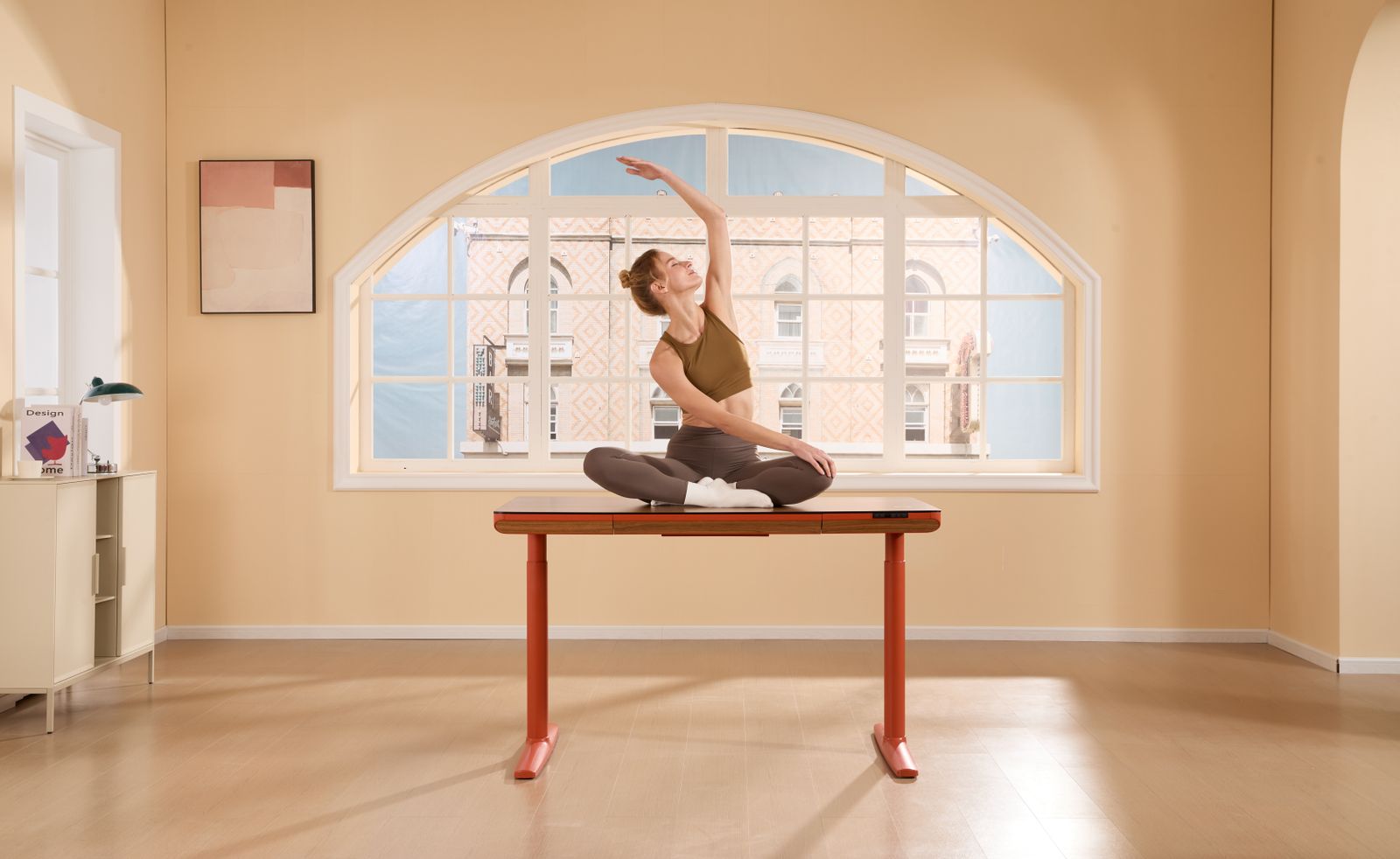
The most useful seated yoga poses at a desk are neck side tilts, shoulder rolls, seated cat-cow, a spinal twist, a chair figure-four hip stretch, a standing fold with hands on the desk, and a wrist stretch. Hold each for roughly 5 slow breaths, or 20 to 30 seconds.
| Pose | Where it helps | How long | Form cue |
|---|---|---|---|
| Neck side tilt (ear toward shoulder) | Side of neck | 20-30 seconds per side | Opposite shoulder stays low. Let head weight do the work; do not pull. |
| Shoulder rolls | Upper back, trapezius | 5-8 slow circles each way | Big circles, jaw relaxed, breathe normally. |
| Seated cat-cow | Mid-back | 6-8 breaths | Hands on knees. Arch on the inhale, round on the exhale, small range. |
| Seated spinal twist | Spine, ribs | 5 breaths per side | Sit tall first, then rotate from the ribs with hips facing forward. |
| Chair figure-four | Outer hip, glutes | 5 breaths per side | Ankle on opposite knee, flat back, hinge from the hips. |
| Standing fold at the desk | Hamstrings, lower back | 5 breaths | Hands on desk edge, back flat, knees slightly soft. |
| Wrist flexor and extensor stretch | Forearms, wrists | 15-20 seconds each | Gentle pull on the fingers only. Elbow straight but not locked. |
| Palming | Tired eyes | 15-20 seconds | Warm palms cupped lightly over closed eyes. No pressure on the eyeballs. |
The twist is a seated adaptation of Ardha Matsyendrasana, and the standing fold is a supported cousin of Uttanasana.
Walkthrough: a 5-minute desk reset
With only a few minutes, run this order, top of the body down, finishing with the breath.
- Minute 1, shoulders and neck: roll the shoulders slowly back 6 times, then tilt the ear toward each shoulder for about 20 seconds.
- Minute 2, mid-back: seated cat-cow for 6 breaths. Keep the movement smooth and let the breath lead.
- Minute 3, spine: sit tall and twist gently to each side for 5 breaths.
- Minute 4, hips and wrists: chair figure-four on each side for a few breaths, then a quick wrist stretch each way.
- Minute 5, breath: sit upright, hand on the belly, and take 8 to 10 slow breaths with the exhale slightly longer than the inhale.
If you are new to all of this, the basics in our yoga for beginners guide will help you keep the movements gentle and correct.
How often should you do desk yoga during a workday?
Aim for a 60-second micro-break every hour and two or three 3 to 5 minute resets spread across the day. In total that is roughly 10 to 15 minutes. Frequent short breaks interrupt long sitting better than one long session, and consistency across the week matters more than how deep any single stretch feels.
| When | Time needed | What to do | Why then |
|---|---|---|---|
| On arrival | 2 minutes | Shoulder rolls, seated cat-cow, 5 slow breaths | Undo the commute posture before you start typing. |
| Mid-morning | 3 minutes | Seated twist both sides, wrist stretches, look far away for 20 seconds | Counters the first long stretch of screen work. |
| Before lunch | 1 minute | Standing fold at the desk, then walk to lunch | Gets you out of the chair on a natural cue. |
| Early afternoon | 5 minutes | Figure-four, neck tilts, slow breathing | The post-lunch slump is when posture and focus both sag. |
| End of day | 3-5 minutes | Standing fold, twist, long exhales | Leaves the desk loose before the journey home. |
If you spend most of your day on video calls from home, the habits in our guide to yoga for work from home pair neatly with this schedule, and a gentle self-care yoga routine in the evening rounds it out.
Can breathing exercises at your desk really calm you down?
Slow, even breathing at your desk can help you feel calmer within a minute or two. Breathe in for about 4 counts and out for about 6, for 8 to 10 breaths. A longer exhale tends to settle the body. It eases tension, but it does not treat anxiety or blood pressure.
- Belly breathing: one hand on the belly, breathe so it rises on the inhale and softens on the exhale, rather than lifting the chest.
- Longer exhale: inhale for roughly 4, exhale for roughly 6. Never strain for the count.
- Sighing breath: a long exhale through slightly parted lips, 3 to 5 times, after a stressful email or call.
- Box breathing: equal counts in and out with pauses. Skip the pauses if you have blood pressure, heart or breathing issues, or if holding makes you uneasy.
Avoid fast or forceful breathing, and stop if you feel light-headed. Our piece on yoga for exam stress uses the same ideas for high-pressure days.
Four myths about desk yoga
Myth 1: “Desk yoga fixes bad posture.” It helps, but posture is mostly set by your workstation and how often you move. Monitor height and regular standing breaks matter as much as any stretch.
Myth 2: “More stretch is better.” A desk stretch should feel like gentle release, never sharp pain. Forcing the neck or lower back is the quickest way to make things worse.
Myth 3: “It replaces exercise.” It is a supplement to walking and a proper workout, not a substitute.
Myth 4: “It can cure my back or neck pain.” It can support comfort, and many people feel better for it, but it is not a cure. Ongoing or worsening pain deserves a proper assessment from a doctor or physiotherapist.
Troubleshooting: what to do when a stretch hurts or nothing seems to help
Most desk discomfort has a simple trigger such as screen height, wrist angle or long unbroken sitting. Match your symptom, try the gentle fix, and watch for the warning signs that mean you should stop stretching and see a professional.
| Problem | Likely desk cause | Gentle fix to try | Stop and see a doctor if |
|---|---|---|---|
| Neck tight by afternoon | Screen too low, head pushed forward | Raise the screen, do small side tilts and shoulder rolls | Pain, tingling or numbness runs down an arm, or you feel weakness |
| Lower back aches after sitting | Long static posture, tight hips | Stand every 30 to 60 minutes, seated cat-cow, figure-four | Pain travels down a leg, wakes you at night, or comes with leg weakness |
| Wrists ache or tingle | Bent wrists on the keyboard, hard desk edge | Keep wrists neutral, take short breaks, gentle forearm stretches | Numbness is constant or wakes you from sleep |
| Dry, tired eyes and a dull headache | Long unbroken screen time | Look 20 feet away for 20 seconds every 20 minutes, blink fully, palming | Sudden vision change or a severe headache |
| Dizzy after a standing fold | Holding breath, rising too fast | Fold less deep, breathe through it, come up slowly | You faint, or feel chest pain or palpitations |
Desk yoga for different kinds of workdays
Open-plan office: stick to quiet options such as shoulder rolls, seated twists, wrist stretches and breathing. Save standing folds for a quieter corner.
Work from home: you have more freedom, so you can step away from the desk and use the wall or floor. Our page on yoga for work from home goes deeper on that setting.
Beginners and people returning after a break: start with two or three poses and keep the range small. If you have an injury or a health condition, a one-to-one session with a trainer who can adjust each move is safer than copying videos, which is where 1-on-1 personal training can help.
Desk yoga questions answered
How long should a desk yoga session be?
Between 60 seconds and 5 minutes is enough for one session. A 60-second micro-break every hour plus two or three 3 to 5 minute resets adds up to roughly 10 to 15 minutes a day.
Is desk yoga the same as chair yoga?
They overlap heavily. Chair yoga is a broader practice for anyone who needs seated support, including older adults and people with limited mobility. Desk yoga is framed around office strain and often uses the desk itself as a prop. Many routines mix the two.
Can desk yoga help with neck and shoulder pain from sitting?
It can ease general stiffness from long sitting when done gently and often, and it can make you more aware of posture. It is not a treatment, so see a doctor or physiotherapist if pain is severe, lasts more than a few weeks, or spreads into an arm or leg.
Do I need a yoga mat or special clothes for desk yoga?
No. Almost every move is done seated in a stable chair or standing beside the desk in normal work clothes. Just loosen a tight waistband first.
Who should not do desk yoga without checking with a doctor?
Check first if you have severe or radiating pain, numbness, a spinal or disc condition, recent surgery, osteoporosis, blood pressure or heart problems, glaucoma or are pregnant. Even then, many gentle moves may suit you once your doctor agrees and you avoid deep folds, forceful twists and breath holds.
Next step: if you would like someone to check your form and build a routine around your workday, book a session with Fitstrot’s online yoga classes and start with the 5-minute reset above this week.


