
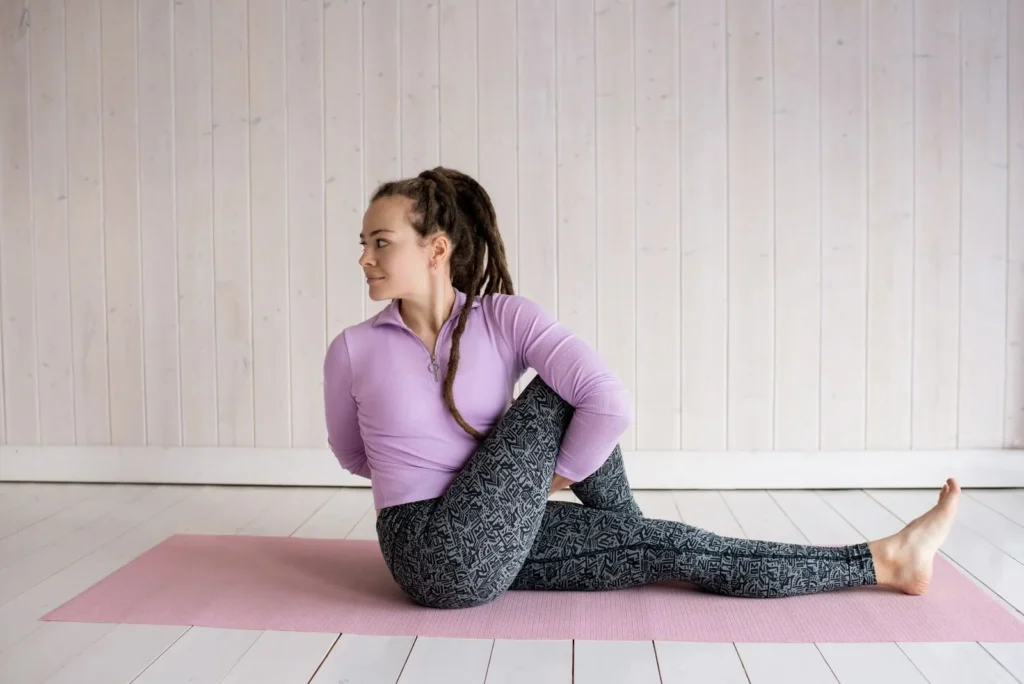
A good seated twist is one of the cheapest ways to feel your spine move again after a long day at a desk. The classic one is ardha matsyendrasana, the Half Lord of the Fishes Pose: your torso rotates over a steady pelvis while one foot stays planted and the opposite elbow hooks outside the bent knee. It takes about a minute per side and needs only a mat. This guide covers exact alignment, honest benefits, props and modifications, and who should skip the pose.
What does ardha matsyendrasana mean, and where does it come from?
Ardha Matsyendrasana is Sanskrit for Half Lord of the Fishes Pose: ardha means half, matsya means fish, and indra means lord. It is a seated spinal twist named after Matsyendra, a sage honoured in the hatha yoga tradition. The half version uses a simpler leg position than the full Matsyendrasana, so most students learn it first.
Tradition says Matsyendra, in the form of a fish, overheard Shiva teaching yoga to Parvati and carried that teaching to humans. Treat it as a teaching story rather than recorded history. Many classes simply call the pose the half spinal twist. If you are still building your vocabulary of postures, our guide to yoga poses shows where this twist sits among the others.
How do you do ardha matsyendrasana step by step?
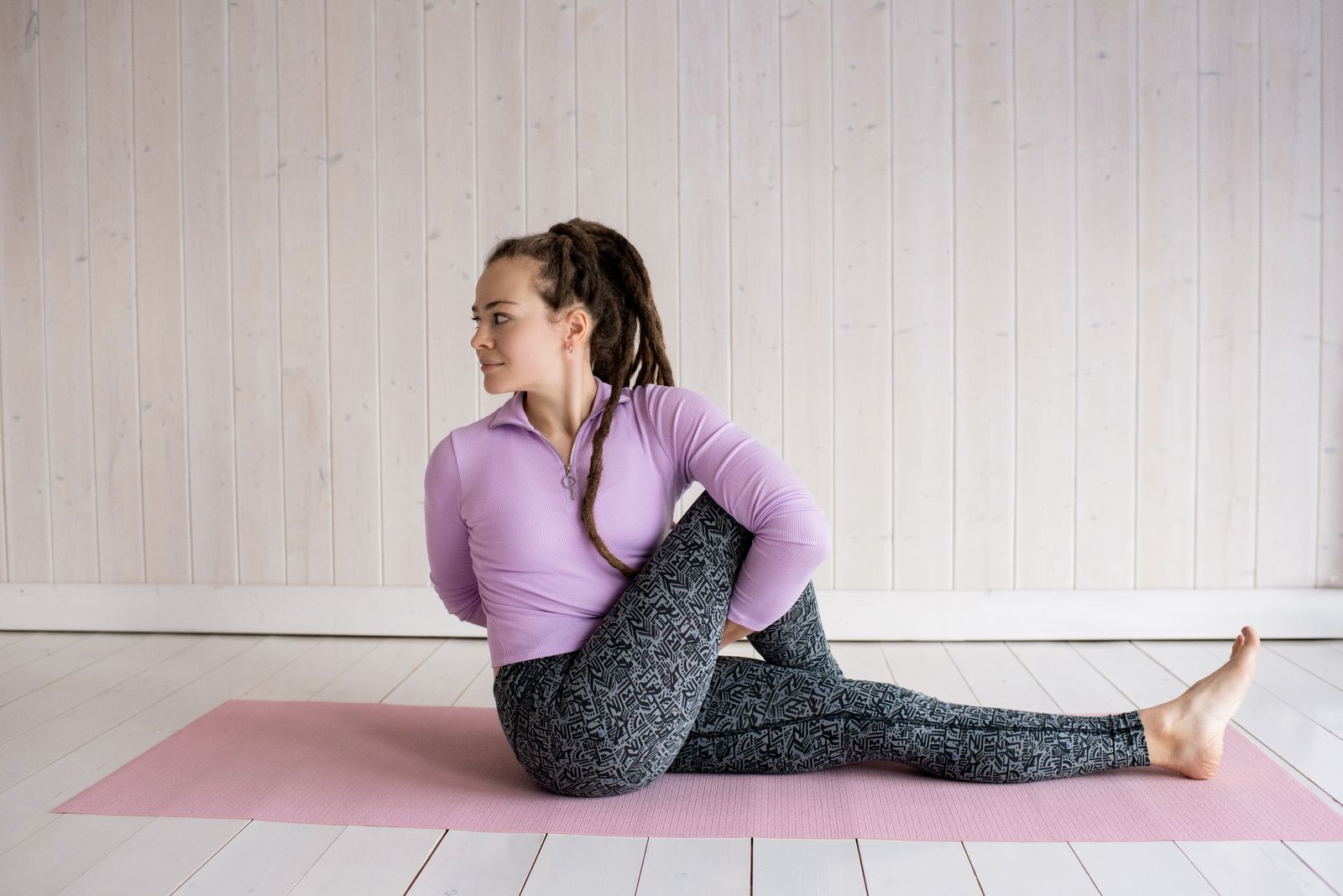
Sit tall with both legs straight, cross your right foot over the left thigh and plant it flat. Inhale to lengthen the spine, then exhale to twist right, hooking your left elbow outside the right knee. Hold 5 to 8 slow breaths, release, and repeat on the other side, keeping both sit bones grounded.
- Sit on the floor, or on a folded blanket, with legs extended in front of you (Dandasana, or Staff Pose).
- Bend your right knee and place the right foot flat on the floor outside your left thigh, close to the knee.
- Bend your left leg and bring the left foot near your right hip. If your knees complain, keep the left leg straight instead.
- Press both sit bones evenly down and lift your spine tall on an inhale, as if a string pulls the crown of your head upward.
- On an exhale, turn your torso to the right and bring your left elbow, or upper arm, outside the right knee. Keep the elbow soft rather than locked.
- Place your right fingertips on the floor behind your tailbone, a hand-width or so away, to help you stay tall.
- Turn your head to look over the right shoulder only if your neck feels comfortable; otherwise keep the gaze forward.
- With each inhale, grow taller; with each exhale, rotate a little further. Release on an exhale and repeat on the left side.
Cold spines twist poorly. A few rounds of Surya Namaskar, or even a minute of standing in Tadasana to stack your posture, loosens the shoulders and hips before you sit down to twist.
Alignment checklist: what to check from the floor up
Depth matters far less than a long spine and an even base. Run through this table each time you set up, ideally with a mirror or a quick phone video from the front.
| Body part | What you want | Common fault | Quick fix |
|---|---|---|---|
| Sit bones | Both pressing evenly into the floor | The bent-knee side lifts off the floor | Sit on a folded blanket about 5-8 cm high |
| Spine | Tall, with the natural curves intact | Rounding as you twist | Inhale to lengthen before every exhale-twist; reduce the depth |
| Planted foot | Flat, knee pointing up or slightly inward | Foot rolls onto its outer edge | Slide the foot a little farther from the thigh |
| Bottom leg | Comfortable, knee free of pinching | Knee twisted sharply to fit the foot near the hip | Extend the leg straight |
| Elbow | Softly hooked outside the knee | Jamming the elbow to crank deeper | Use the arm as a light lever, not a crowbar |
| Back hand | Fingertips behind the tailbone | Hand too far back, shoulder collapses | Bring the hand closer or rest it on a block |
| Shoulders and neck | Shoulders relaxed, chin level | Neck wrenched past the spine | Let the head follow the chest, not lead it |
Troubleshooting: why does the twist feel stuck, pinchy or wobbly?
Most problems trace back to one of a handful of causes, and each has a simple correction.
- My back rounds as I turn. You are probably twisting deeper than your spine allows. Sit on a blanket, lengthen on the inhale, and rotate only as far as you can stay tall.
- One hip keeps lifting. Tight hips tilt the pelvis. Raise the seat with a folded blanket or a firm cushion until both sit bones feel equally heavy.
- My knee hurts. Stop and straighten the bottom leg. Sharp knee pain is a signal to modify, not to push through.
- I cannot reach my elbow past the knee. Hug the knee with your arm instead, or press the palm lightly against the outer thigh. This is a normal variation, not a failure.
Modifications and props: which version suits your body?
You can keep the benefits of a seated twist without forcing the full shape. Pick the row that matches your situation.
| Situation | Version to try | Prop | Cue to remember |
|---|---|---|---|
| Tight hips or short hamstrings | Classic pose with the bottom leg straight | Folded blanket under the hips | Hips higher than knees |
| Knee discomfort | Both legs extended, only the top knee bent | Rolled towel under the bent knee | No pain in the joint |
| Stiff mid-back | Chair twist, sitting sideways on a sturdy chair | Chair backrest | Use the backrest to turn, not to pull |
| Short arms or tight shoulders | Hug the knee instead of hooking the elbow | Yoga block behind you | Chest lifts first, then turns |
1-on-1 personal training sessions can include mobility work like this, tailored to your hips, back and daily routine.
Myth check: does a twist really detox your organs?
No. You will often hear that wringing the torso squeezes toxins out of the liver and kidneys, but those organs clear waste through their own biochemistry, not through mechanical squeezing. What a twist can do is apply gentle abdominal pressure, move the spine and ease tension, which many people find settles a bloated stomach.
That is a modest, plausible benefit, and it is worth enjoying without exaggeration. If digestion is your main goal, build a short routine around the poses in our guide to yoga for digestion and pair it with regular meals, water and fibre rather than relying on one posture.
What are the real benefits of ardha matsyendrasana?
Practised regularly, ardha matsyendrasana benefits include better spinal rotation, looser hips and shoulders, relief from sitting stiffness, and a calmer breath. It will not fix a weak core, cure a bad back, or burn meaningful calories, but one to two minutes a day is a sensible addition to mobility work.
- Spinal rotation: The thoracic spine, the stretch between the base of your neck and your lower ribs, stiffens with desk work. Twisting regularly helps keep it turning.
- Hip opening: The crossed leg stretches the outer hip, including the piriformis and glute muscles.
- Core engagement: The deep abdominal muscles work gently to control the rotation, while the obliques lengthen on one side and shorten on the other.
- A calmer breath: Slow breathing with longer exhales tends to feel settling, which is why twists often sit late in a class.
Is ardha matsyendrasana good for back pain?
It can ease mild, non-acute back stiffness caused by sitting, if you keep the twist gentle, stay tall and stop at a mild stretch. It can aggravate disc problems, sciatica or acute pain. If your back pain has a diagnosis, or comes with numbness, tingling or leg weakness, ask your doctor before twisting.
For ordinary tightness, a smaller, taller twist usually helps more than a deep, collapsed one. Hold for several breaths and come out slowly. Our guide to yoga for back pain lists gentler options if you want a wider routine, and it is a better starting point than any single pose.
Who should avoid or modify ardha matsyendrasana?
Skip deep versions of the pose if you have an acute back injury, a herniated or bulging disc, recent spine or abdominal surgery, a hernia, or osteoporosis, unless your doctor has cleared you. Pregnant students should avoid closed twists that compress the belly. People with knee problems should keep the bottom leg straight.
- Beginners: Start with the chair twist or the simple cross-legged version and hold each side for 15 to 20 seconds.
- Older adults: Choose the chair twist, avoid forcing rotation, and keep the spine long. If you have been told you have low bone density, check with your doctor first.
- Pregnancy: Many teachers suggest open twists that turn away from the belly, and a prenatal instructor can guide you in each trimester.
See your doctor if you notice sharp, shooting or radiating pain, numbness, dizziness or pain that lingers after practice. A normal twist feels like a stretch, never like a stab.
How long should you hold ardha matsyendrasana?
Hold ardha matsyendrasana for about 30 to 60 seconds per side, or roughly 5 to 10 slow breaths. Beginners can start with 15 to 20 seconds. Always hold both sides for the same time, so the spine is not left rotated more in one direction.
Here is a gentle four-week progression. Treat the numbers as a guide, and stay longer on any week that still feels like a strain.
| Week | Hold per side | Rounds per side | Days per week | Focus |
|---|---|---|---|---|
| 1 | 15-20 seconds | 1 | 3 | Set-up, even sit bones, easy version |
| 2 | 20-30 seconds | 2 | 3-4 | Tall spine, slow exhales |
| 3 | 30-45 seconds | 2 | 4-5 | Soft elbow hook, relaxed shoulders |
| 4 | 45-60 seconds | 2 | 5-6 | Smooth entry and exit, balanced sides |
Where does ardha matsyendrasana fit in a yoga session?
Place ardha matsyendrasana in the second half of a session, after warm-up movement and before the final rest. A typical order is Surya Namaskar, a hip opener, the twist on both sides, then Savasana. Twisting sets you up for calm, which is why it works well before relaxation.
Standing balance work such as Vrksasana prepares the hips and focus, and it is a natural lead-in. Flowing styles like Vinyasa yoga use the pose as a cooling step between more active sequences, while a steady Hatha yoga class tends to hold it longer and pay more attention to alignment.
Compared with the full Matsyendrasana, it skips the demanding arm bind and deeper leg fold, so it suits intermediate students and well-prepared beginners. After the twist, a few rounds of slow pranayama or a long-hold Yin yoga posture continues the calming effect.
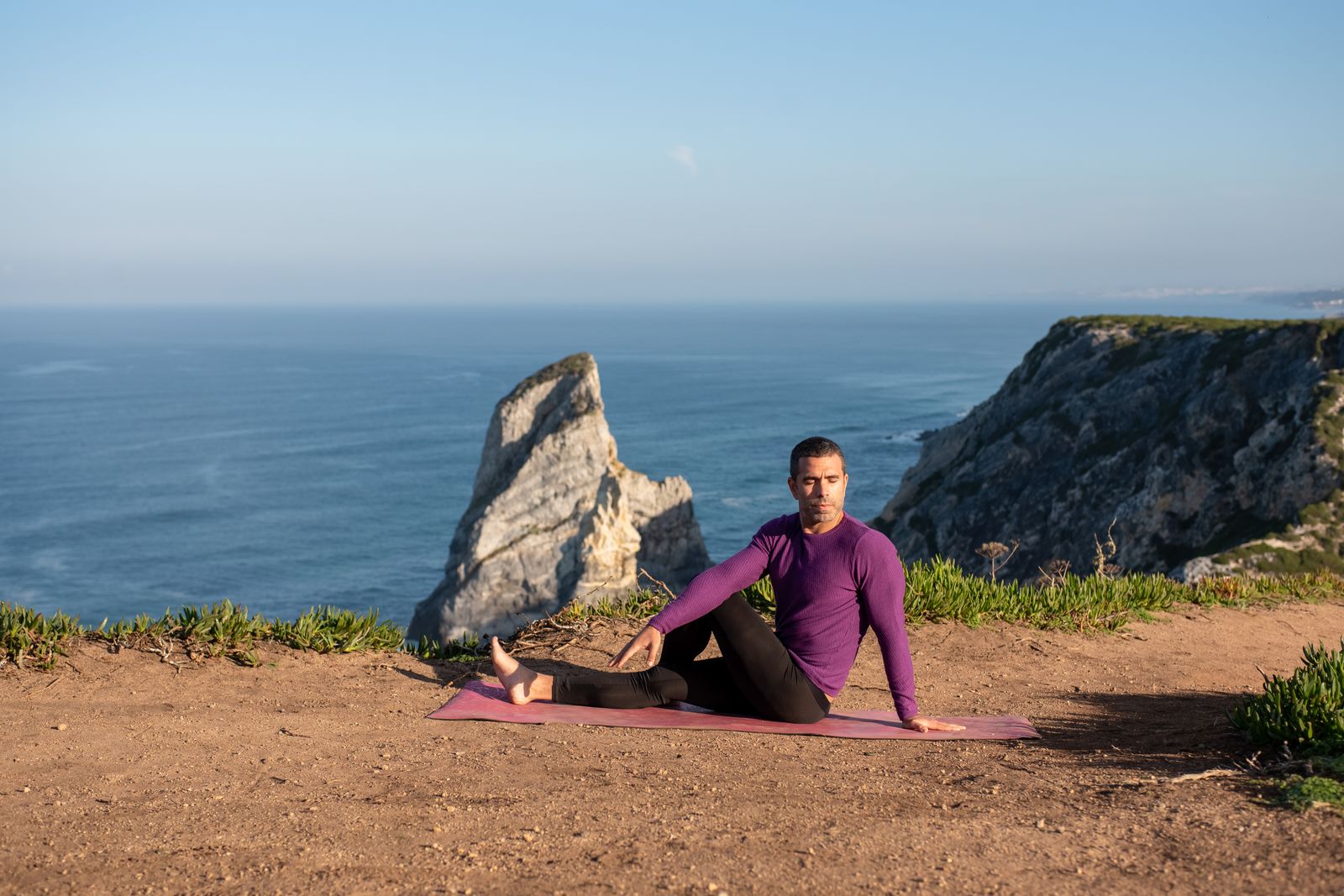
Frequently asked questions about ardha matsyendrasana
What is ardha matsyendrasana in English?
Ardha matsyendrasana in English is Half Lord of the Fishes Pose, often shortened to the half spinal twist. It is a seated posture where the torso rotates over a stable pelvis, one foot is planted, and the opposite arm hooks around the bent knee.
Is ardha matsyendrasana a beginner pose?
It is usually taught as an intermediate pose, but beginners can do easier versions such as the chair twist, a straight bottom leg, or a hug-the-knee arm position. Build up with short holds and keep the spine tall rather than chasing depth.
Which side should you twist first?
Many teachers begin with a twist to the right, partly because it follows the direction of the digestive tract, but this is a convention. The more important point is to hold both sides for the same number of breaths so the spine stays balanced.
Can you do ardha matsyendrasana after eating?
It is best to wait about 2 to 3 hours after a full meal and about 30 to 60 minutes after a light snack. Compressing a full stomach can cause discomfort or reflux, so an empty or nearly empty stomach is more comfortable.
Should you feel pain in ardha matsyendrasana?
No. You should feel a moderate stretch through the back, hips and shoulders. Sharp, shooting or radiating pain, or any knee pain, means you should release the pose, move to an easier version, and have the problem checked if it continues.
Get your twist checked live
Cues about hip height, spinal length and breath timing are much easier to feel with someone watching your form. Join a live session in Fitstrot online yoga classes and bring this twist to your next class for personal feedback.


