
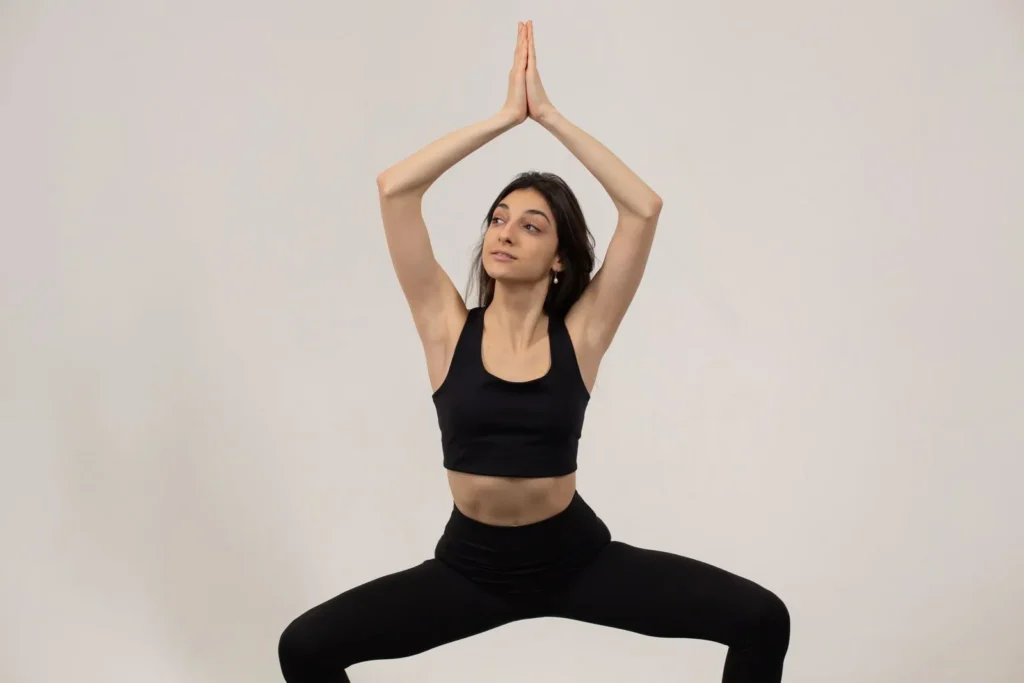
Utkatasana is the Sanskrit name for chair pose: a standing posture where you bend your knees, sit your hips back as if lowering onto an invisible chair, and reach both arms overhead. It looks simple, but most discomfort in it comes from two alignment details: where the knees point and how the hips fold. This guide covers both, plus wall-supported and shallow versions, who should skip the pose, and how long to hold it.
What does utkatasana mean, and why is it called chair pose?
Utkatasana comes from “utkata”, usually translated as fierce, powerful or intense, plus “asana”, meaning pose. In English it is called chair pose because the body resembles someone seated on a chair that is not there. Some teachers also call it fierce pose or awkward pose. The name signals intent: this is an active, effortful hold, not a passive stretch.
How do you do chair pose step by step?
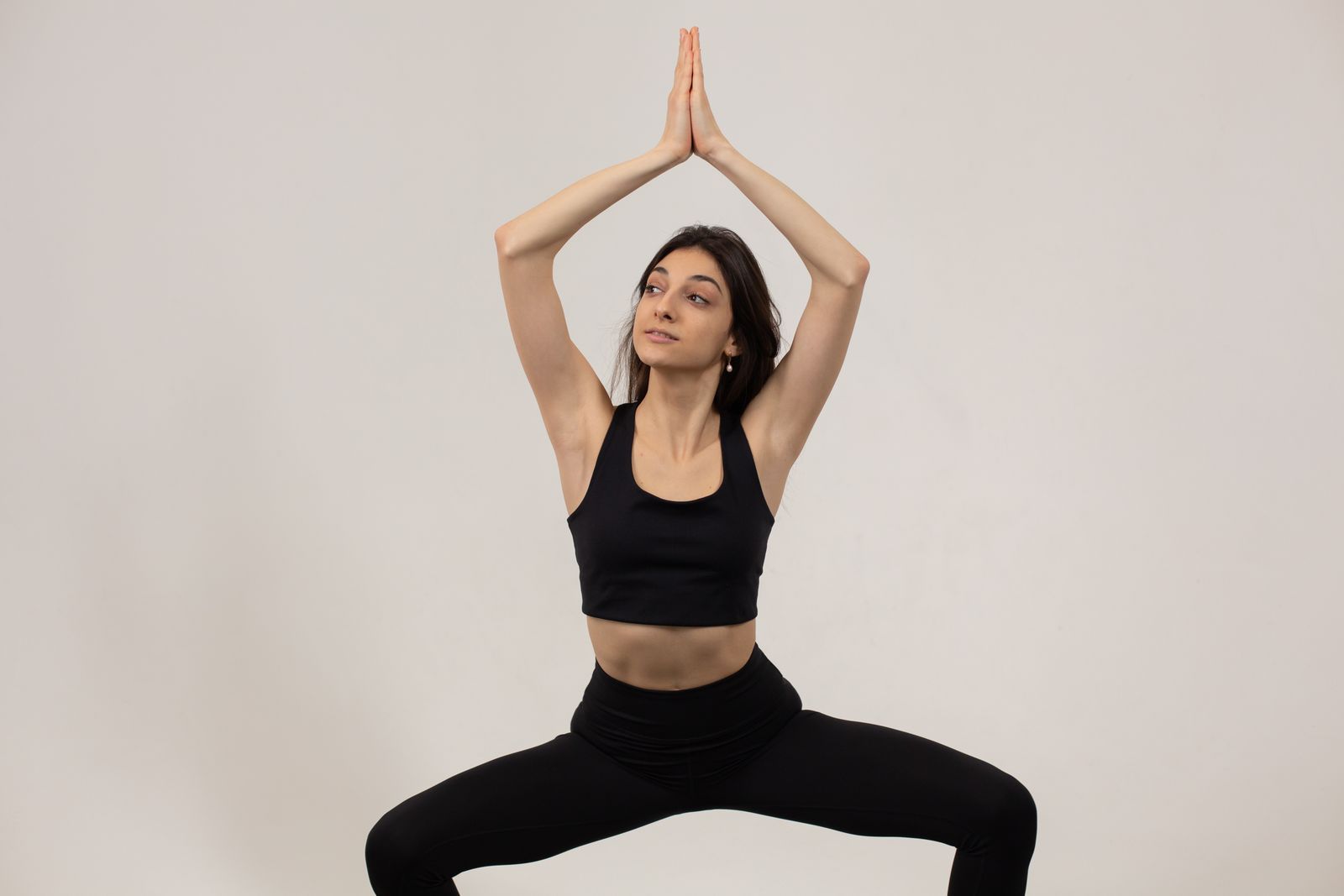
To do chair pose, stand with feet hip-width apart, inhale your arms overhead, then exhale and bend your knees while sending your hips back and down. Keep your weight in your heels, your spine long and your thighs angled toward parallel to the floor. Hold for 5 to 10 slow breaths, then inhale to stand tall.
- Start in mountain pose. Stand tall with the feet hip-width apart. If you want a refresher on this base shape, see our guide to Tadasana.
- Raise the arms. Inhale and sweep them up beside the ears, shoulder-width apart, palms facing in or pressed together.
- Fold at the hips first. Exhale and push the hips straight back, as if reaching for a chair behind you. The knees bend because the hips moved, not the other way round.
- Lower to a depth you can control. For most beginners that is a quarter to a third of the way down, thighs clearly above parallel.
- Lengthen the spine. The torso leans forward a little, but the back stays long. Draw the lower ribs in and the tailbone slightly down.
- Breathe and hold. Soften the shoulders and jaw, count 5 to 10 steady breaths, then press through the heels to stand.
Knee tracking and hip hinge: the two cues that fix most chair pose problems
Knee tracking means your kneecaps point over your second and third toes as you bend. The hip hinge means the hips travel backward first, so the torso leans forward from the hip crease, not from the lower back. Together these cues spread the load across hips and thighs and keep stress off the knees and spine.
- Front view, knee line. Knees sit above the second and third toes. If they drift together, press the outer edges of the feet down. If they flare wide, bring the feet slightly closer.
- Side view, heel check. You should be able to wiggle your toes while the heels stay planted. If the heels lift, you have tipped forward and the hips need to go further back.
- Side view, hip crease. Look for a clear fold where thigh meets pelvis. A smooth rounded line from hips to shoulders means you are bending the spine, not hinging.
Myth check: should your knees never go past your toes?
This rule is too blunt. In any bent-knee pose the knees travel a little forward as you lower, and that is normal. What matters more is that your heels stay down, your hips move back and your knees point in line with your toes. Knees that cave inward are a bigger concern than knees that move slightly forward.
What muscles does utkatasana work, and what are the benefits?
Chair pose mainly works the quadriceps, glutes and calves, with the abdominals, back muscles and shoulders holding the torso and arms in place. Held for several breaths, it trains leg and core endurance, balance and focus.
- Leg endurance: thighs and glutes hold a steady load, which helps with stairs and getting up from the floor.
- Core and posture awareness: staying upright with arms overhead teaches you to brace the trunk without gripping the neck.
- Balance and ankle control: keeping the heels heavy works the small stabilising muscles around the ankles.
It will not fix a medical problem on its own, and it does not replace a full strength plan. Our overview of the benefits of yoga puts the pose in a wider context.
Wall-supported chair pose: a stage-by-stage table
A wall-supported chair pose means leaning your back against a wall while you bend your knees, so the wall gives feedback on your spine and takes some of the load. It suits beginners and anyone who tips forward onto the toes.
| Stage | Setup | What to aim for | Hold |
|---|---|---|---|
| 1. Wall lean | Back and hips on the wall, feet about one foot-length away, arms by your sides | Slide down a short way, knees over the toes, lower back gently flat | 15 to 20 seconds |
| 2. Hands at chest | Same stance, palms pressed together | Relaxed shoulders, even breathing, heavy heels | 20 to 30 seconds |
| 3. Arms up | Lift the arms overhead if the shoulders allow | Ribs stay down, no arching away from the wall | 20 to 30 seconds |
| 4. Wall as a guide | Stand a hand’s width from the wall, then do the free pose | Hips hover just short of the wall, a cue for how far back to sit | 3 to 5 breaths |
Thigh burn is normal. A sharp or pinching knee sensation is not, so come up and reduce the bend.
How deep should you go? A shallow squat depth guide
A shallow chair pose means bending the knees only about 20 to 45 degrees, so the thighs stay well above parallel. It still works the legs with far less strain on the knees. Deepen gradually over weeks, not in a single class.
| Depth level | Rough knee bend | Where the thighs sit | Best for |
|---|---|---|---|
| Hint of a bend | About 20 degrees | Almost standing | First-week beginners, ankle stiffness, knee sensitivity (with your doctor’s okay) |
| Shallow | About 30 to 45 degrees | Well above parallel | Most beginners, long desk days |
| Moderate | About 60 degrees | Slightly above parallel | Those who keep heels down and knees steady |
| Deep | About 90 degrees or more | Near or at parallel | Experienced practitioners with no knee or ankle issues |
A simple test: if you could hold the depth for two or three more breaths without the form falling apart, it is the right one.
What are the most common chair pose mistakes?
The most common chair pose mistakes are knees collapsing inward, heels lifting, a rounded or over-arched lower back, shrugged shoulders and a held breath. Quick fixes: point the knees over the toes, sit the hips back, lengthen the tailbone, slide the shoulder blades down and breathe steadily through the nose.
- Knees drifting inward. Press the outer feet down, or hold a yoga block or folded towel between the thighs.
- Heels lifting. Move the hips further back and reduce the depth.
- Rounded lower back. Often from tight hamstrings. Bend less and think hinge, not curl.
- Over-arched lower back. Usually from reaching the arms too far back. Aim them forward of the ears and draw the lower ribs in.
- Shrugged shoulders. Reach the fingertips up while sliding the shoulder blades down.
Who should skip or modify utkatasana?
Skip or modify chair pose if you have a knee injury, low blood pressure, a headache or an ankle problem. The pose loads the knees and ankles, holds the arms overhead, and ends with a rise from a squat, which can cause light-headedness in some people. Get guidance first for anything that causes pain.
- Knee injury or pain. Avoid deep bends. Use a wall, a very shallow depth or a different pose until your doctor or physiotherapist says otherwise.
- Low blood pressure. Rising fast from a bent-knee position can cause dizziness. Keep holds short, come up slowly and keep a wall or chair within reach.
- Headache. Arms overhead and a held breath can make a headache feel worse. Skip the pose, or keep the hands at your chest and the depth very shallow.
- Ankle problems. A stiff or recently injured ankle struggles to keep the heel down. Stay shallow or choose another pose.
- Pregnancy and shoulder issues. Use a wider stance, a shallow bend, a wall for support and palms at the chest.
See your doctor if you have knee pain that is sharp, swelling, a knee that gives way, or discomfort that lingers after practice. Do not push through knee pain in this pose. A doctor or physiotherapist can find the cause and tell you which movements are safe.
How long should you hold chair pose?
Most people hold chair pose for 5 to 10 slow breaths, which is roughly 30 to 60 seconds. Beginners can start with 15 to 20 seconds, and stronger practitioners may build toward about a minute. Two or three rounds with a short rest work better than one long, shaky hold.
| Experience level | Hold per round | Rounds | Rest between |
|---|---|---|---|
| Brand new | 15 to 20 seconds (3 to 4 breaths) | 2 | 30 seconds standing |
| Beginner | 20 to 30 seconds (4 to 6 breaths) | 2 to 3 | 20 to 30 seconds |
| Intermediate | 30 to 45 seconds (5 to 8 breaths) | 3 | 20 seconds |
| Experienced | 45 to 60 seconds (8 to 10 breaths) | 3 | 15 to 20 seconds |
To progress, add one breath at a time over a few weeks. If your heels lift or knees drop in, end the round there.
Where does utkatasana fit in a yoga sequence?
Utkatasana appears in Surya Namaskar B, where it opens and closes the flow, and it also works well before balance poses because it warms the legs and core. Our Surya Namaskar guide breaks down the whole sequence, and Vrksasana (Tree Pose) is a natural next step for single-leg balance. Once the basic shape is steady, try one variation at a time:
- Twisted chair (Parivrtta Utkatasana): palms together, hinge, then turn the chest to one side.
- Eagle-arm chair: wrap the arms as in Garudasana while keeping the leg shape.
- Heel lift: rise onto the balls of the feet with the knees bent, for a calf and balance challenge.
How is chair pose different from a squat or a wall sit?
Chair pose is a held, shallower position with arms overhead and a focus on breath and spine length. A bodyweight squat moves up and down through a deeper range, and a wall sit uses a wall to take your back weight. All three work the thighs, but chair pose adds more balance, core and shoulder control.
It complements strength work rather than replacing it. See yoga for strength for how to combine standing poses, and yoga for back pain if lower back stiffness is a concern. The vinyasa yoga guide shows it in flowing classes.
How often should you practise it?
Practise chair pose two to three times a week, on non-consecutive days if your legs are sore. Warm up with mountain pose and a slow sun salutation round, then place chair pose mid-session.
To explore more postures, browse our yoga poses library and the guide to the types of yoga. If you want your knee line and hip hinge checked, our 1-on-1 personal training includes form checks for strength moves like this.
Utkatasana FAQs
Is utkatasana the same as chair pose?
Yes. Utkatasana is the Sanskrit name and chair pose is the common English name. Some teachers also say fierce pose or awkward pose. They all describe the same posture: bent knees, hips back, arms raised, spine long.
Why do my legs shake in chair pose?
Shaking is common when muscles hold a steady load, especially the quadriceps. It usually settles as your endurance improves over a few weeks. Shorten the hold or reduce the depth if the trembling makes your form slip, and stop if you feel pain.
Can beginners do utkatasana?
Yes, with a shallow bend and, if needed, a wall behind you. Start with 15 to 20 seconds, keep your heels down and your knees over your toes, and build up slowly. If you have any joint concerns, ask a doctor or qualified teacher first.
Is chair pose safe if I have knee pain?
Not always. Knee pain deserves a proper check, so see your doctor or physiotherapist before holding the pose. If you are cleared to practise, use a very shallow bend or a wall, and stop right away if you feel sharp or increasing pain.
How is utkatasana different from a wall sit?
A wall sit rests your back against the wall and is usually held at a deeper angle for time. Utkatasana is free-standing, with arms overhead and an emphasis on hip hinge, spine length and breath, which asks more of your balance and core.
Practise chair pose with a teacher
If you would like a teacher to watch your knee line and hip hinge and adjust your depth, join a live session in Fitstrot’s online yoga classes and start with the shallow version.


