

A shoulder and bicep workout is one of the easiest sessions to build well and one of the easiest to build badly. Done right, it gives your delts a heavy press first, finishes with focused arm work, and leaves you recovered for the next session. Done wrong, it becomes 90 minutes of random curls and raises with no order and no plan. This guide covers exercise order, sets and reps, weekly volume, recovery and troubleshooting, so you walk into the gym knowing exactly what to do.
Is a shoulder and bicep workout a good way to split your week?
Yes, for most people training 4 to 6 days a week. Pairing shoulders and biceps gives each muscle its own slot, uses two different movement patterns (pressing and curling) so one does not drain the other, and keeps the session near 60 minutes. With only 3 training days, a full-body or upper/lower split usually works better.
The usual problem with a push/pull style week is that shoulders get squeezed onto chest day, where they are trained after heavy bench presses and get whatever energy is left. Side and rear delts suffer most. Moving shoulders to their own day, and pairing them with biceps, gives the delts three proper angles of work without adding a seventh training day for a small muscle group.
This is not the only good option. If you prefer to keep shoulders with pressing, our chest, shoulder and tricep workout shows that layout, and the chest and bicep workout covers the other common biceps pairing. Pick the split you will actually repeat for 8 to 12 weeks.
The 60-minute session: exercises, sets, reps, rest and form cues
This is a template for an intermediate lifter and takes about 60 to 70 minutes including warm-up. Choose loads that leave 1 to 2 reps in reserve on every working set, and treat the rep ranges as targets, not suggestions to ignore.
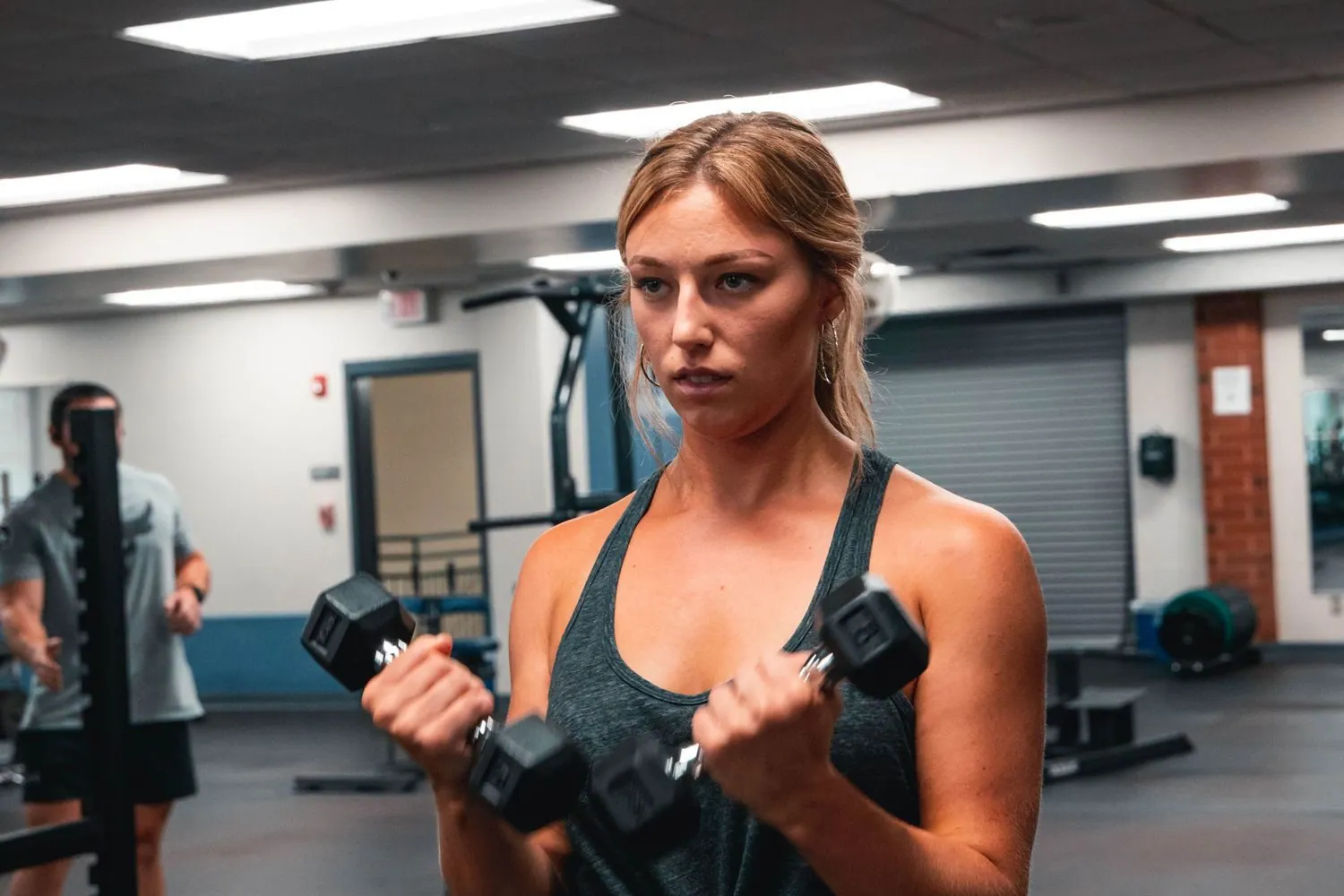
| Order | Exercise | Sets x reps | Rest | Form cue |
|---|---|---|---|---|
| 1 | Seated dumbbell shoulder press | 3-4 x 6-10 | 2 min | Forearms vertical, ribs down, no big back arch |
| 2 | Cable or dumbbell lateral raise | 3 x 12-15 | 60-75 sec | Lead with the elbows, stop at shoulder height |
| 3 | Reverse pec deck or bent-over rear delt fly | 3 x 12-20 | 60 sec | Light load, elbows travel out and back, no shrugging |
| 4 | Barbell or EZ-bar curl | 3 x 8-10 | 90 sec | Elbows beside ribs, no hip swing, lower for 2-3 sec |
| 5 | Incline dumbbell curl | 3 x 10-12 | 75 sec | Upper arms stay behind the torso, full stretch at the bottom |
| 6 | Hammer curl | 2-3 x 10-12 | 60 sec | Neutral grip, wrists straight, no leaning back |
That adds up to roughly 17 to 19 hard sets, split almost evenly between shoulders and biceps. There is no front raise in the list on purpose: the front delts work hard on every press, so adding more tends to crowd out the side and rear delts that actually need the attention. For a deeper look at all three heads, see our deltoid workouts guide, or print the full shoulder workout chart if you like a visual reference at the gym.
Myth check: are shoulders and biceps opposite muscles?
Not exactly. The true opposite of the biceps is the triceps. Shoulders and biceps are better described as a press-and-curl pairing: they use different prime movers, so fatigue in one barely limits the other. That is still a good reason to train them together, just not a strict antagonist superset.
The overlap is small but real. The front delts help a little during curls, and the long head of the biceps crosses the shoulder joint. In practice this means two things. Do the heaviest, most technical lift first, and do not expect curls to feel the same right after an all-out set of presses. You can save time by alternating a lateral raise with a curl, but keep the press as its own block with a full rest.
How to run the session, step by step
- Warm up for 5 minutes. Easy arm circles, 2 sets of 15 band pull-aparts, then two light sets of the press at roughly 40 percent and 70 percent of your working weight.
- Press first, with full rest. Take 2 minutes between sets. If your reps drop by more than 2 from set to set, you are rushing, not weak.
- Move to lateral raises with lighter weights. Strict reps beat heavy swinging here. If you need momentum, drop the weight one step.
- Do rear delts while you are still warm. Keep them light and controlled, and finish each set with a one-second pause.
- Start biceps with the heaviest curl. Barbell or EZ-bar curls come first, then incline curls, then hammer curls as the lighter finisher.
- Write the numbers down. Weight, reps and sets. Next week you only have to beat them by one rep.
If biceps are your weakest area, you can curl first for a 6 to 8 week block. Expect your press numbers to dip slightly while you do this. That is a fair trade only if arm size is genuinely your priority.
How many sets do shoulders and biceps need each week?
Roughly 10 to 16 hard sets per week for shoulders and 8 to 14 for biceps suits most intermediate lifters, spread over 1 or 2 sessions. Beginners do well on 6 to 9 sets each, and advanced lifters may go up to about 20. Count only sets that finish within 1 to 3 reps of failure.
| Training level | Sessions per week | Shoulder sets per week | Biceps sets per week | Typical session length |
|---|---|---|---|---|
| Beginner (under 1 year) | 1 | 6-9 | 6-8 | 40-50 min |
| Intermediate (1-3 years) | 1-2 | 10-16 | 8-14 | 55-70 min |
| Advanced (3+ years) | 2 | 14-20 | 10-16 | 50-65 min each |
These are starting ranges, not targets to hit at any cost. Other days contribute too: bench and incline presses train the front delts, while rows and pulldowns train the biceps. If you also do a hard back day, your biceps may need fewer direct sets than the table suggests. Start at the lower end, and add sets only when you recover well and your numbers keep rising.
Where the session fits in a 4, 5 or 6 day week
Leave about 48 to 72 hours between hard sessions for the same muscle. Avoid putting shoulders and biceps the day after a heavy back day, because tired biceps will cap your curls and your grip will be sore. The layouts below keep the gaps sensible. For more split ideas, browse our workout guides.
| Split | Week layout | Shoulder and bicep sessions | Why it works |
|---|---|---|---|
| 4 days | Mon chest and triceps, Tue back, Thu legs, Fri shoulders and biceps | 1 | Back day is 3 days before curls, so the biceps are fresh |
| 5 days | Mon chest and triceps, Tue back and abs, Wed legs, Thu shoulders and biceps, Sat lower body and core | 1 | Each upper-body muscle gets about a week to recover |
| 6 days | Mon heavy shoulders and biceps, Tue legs, Wed chest and back, Thu legs, Fri light shoulders and biceps, Sat optional cardio | 2 | Two exposures, with a lower-volume second session to protect recovery |
Progression and recovery from week to week
Use double progression. Stay at the same weight until you hit the top of the rep range on every set, then add the smallest jump available. Presses often move 2 kg per dumbbell, while lateral raises and curls may only move 1 kg or not at all. When you cannot add weight, add a rep or slow the lowering phase to three seconds.
Plan a lighter week every 6 to 8 weeks, or sooner if your numbers stall for two weeks straight. Cut the sets by about a third and keep the weights the same. Most people come back stronger.
Recovery matters as much as the session. Aim for 7 to 9 hours of sleep and roughly 1.6 to 2.0 g of protein per kg of body weight daily. For a 70 kg lifter, that is about 110 to 140 g spread over 3 to 4 meals, from dal, curd, paneer, eggs, chicken or soya chunks. If you are unsure how to fit that into your day, a plan from an online nutritionist removes the guesswork. Judge the split after 8 weeks, not after 8 days.
Troubleshooting: when shoulders or biceps stop responding
- The press has stalled for 3 weeks. Check rest first. Two full minutes between sets, sleep and a small calorie surplus fix more stalls than changing exercises.
- Your traps take over lateral raises. The load is too heavy. Drop it, lean forward slightly, raise the elbows rather than the hands, and stop at shoulder height.
- You swing the weight on curls. Reduce the load by 10 to 20 percent, pin your elbows to your sides and take 2 to 3 seconds to lower. Our biceps workout for beginners covers the basic setup.
- Rear delts feel like nothing. Slow the rep down, use a lighter weight and think of pulling your elbows apart. They are small muscles and respond to light, controlled work.
- The shoulder pinches or the elbow aches. Stop that exercise rather than training through it. Try a neutral grip or a smaller range of motion on a lighter day. If sharp pain or discomfort stays, get it assessed by a physiotherapist or doctor before continuing.
Adjusting the session for beginners, home lifters and women
Beginners: Run four exercises, a seated press, lateral raise, curl and hammer curl, for 2 to 3 sets each. Once the movements feel smooth, add the rear delt exercise. Do this once a week for the first 6 to 8 weeks.
Home lifters: A pair of adjustable dumbbells covers almost everything. Use dumbbell presses, lateral raises, bent-over rear delt flys, incline or standing curls and hammer curls. Resistance bands work for raises and curls too. Slower lowering makes light weights harder. Our shoulder workout at home guide lists more options.
Women: The template is identical. Pick loads that let you hit the rep targets with good form and progress from there. Lifting heavy through the shoulders will not make you bulky; building large muscle takes years of focused training and a calorie surplus.
Whatever your level, the shoulder workout routine article has a deeper delt-only session for days when you want extra volume.
Frequently asked questions
Is it good to train shoulders and biceps together?
Yes. Pressing and curling use different prime movers, so one muscle group recovers while the other works. It fits neatly into a 4 to 6 day week and keeps sessions near 60 minutes. The pairing is a convenience rather than a magic combination, so choose it if it suits your schedule.
How many exercises should a shoulder and bicep workout have?
Most intermediate lifters do well with six exercises: three for shoulders (a press, a lateral raise, a rear delt movement) and three for biceps. That is roughly 17 to 19 sets. Beginners can start with four exercises, two per muscle group, at 2 to 3 sets each.
Should I train biceps with shoulders or with back?
Either works, but they behave differently. Biceps after back means they are tired from rows and pulldowns, which can limit your curls. Biceps with shoulders means they start fresher, so you can usually curl heavier. If you pair them with back, keep the curl volume modest.
Can I do a shoulder and bicep workout at home with dumbbells?
Yes. A seated or standing dumbbell press, lateral raises, bent-over rear delt flys, incline or standing curls and hammer curls cover the whole session. Use 3 sets of 10 to 15 reps, slow the lowering phase to 3 seconds, and add a rep each week when weights are limited.
How often should I do a shoulder and bicep workout?
Once a week is enough for beginners and many intermediates, and twice a week works for advanced lifters who split the volume into a heavy day and a lighter day. Leave 48 to 72 hours between sessions, and cut back if your presses or curls start dropping week after week.
Want this session built around your schedule, equipment and current lifts? Fitstrot’s 1-on-1 personal training pairs you with a coach who checks your form online and adjusts your sets and loads each week.


