

This shoulder workout routine is built to be followed live: open it on your phone, start a timer and work down the list. There is a gym version that takes about 35 to 40 minutes and a home version that needs only a pair of dumbbells and a resistance band. Both train the front, side and rear delts in a sensible order, with sets, reps, rest times and one form cue for every exercise. Pick the version that fits where you are training today, and swap between them whenever your week changes.
If you want the muscle-by-muscle background first, our guide to deltoid workouts covers it. This page is the session itself, start to finish.
What should a good shoulder workout routine include?
A good shoulder workout routine includes one or two overhead presses for the front delts, three or four sets of lateral raises for the side delts, and rear delt plus face pull work for the back of the shoulder. That adds up to roughly 12 to 16 hard sets and about 40 minutes, including the warm-up.
The order matters more than the exercise count. Presses go first because they are heavy and need the most energy. Raises come next because the side and rear delts are small muscles that respond to controlled, higher-rep work. Face pulls finish the session and keep the back of the shoulder strong.
Most people already hit the front delts hard through bench pressing and push-ups, so this routine gives the side and rear delts the larger share of the sets. For more shoulder exercises to rotate in later, see our main shoulder workout guide.
The six-minute warm-up before your first press
Cold, heavy shoulder sets are a poor idea. Run this warm-up every session.
- Minutes 0 to 2: easy cardio such as marching on the spot, skipping or a brisk walk until you feel slightly warm.
- Minutes 2 to 4: 10 slow arm circles each direction, 10 band pull-aparts and 8 wall slides (back and forearms on a wall, sliding the arms up and down).
- Minutes 4 to 6: two ramp-up sets of your first press. Do 10 reps with a very light pair of dumbbells, then 5 reps at roughly 60 percent of your working weight.
Gym version: the follow-along shoulder session
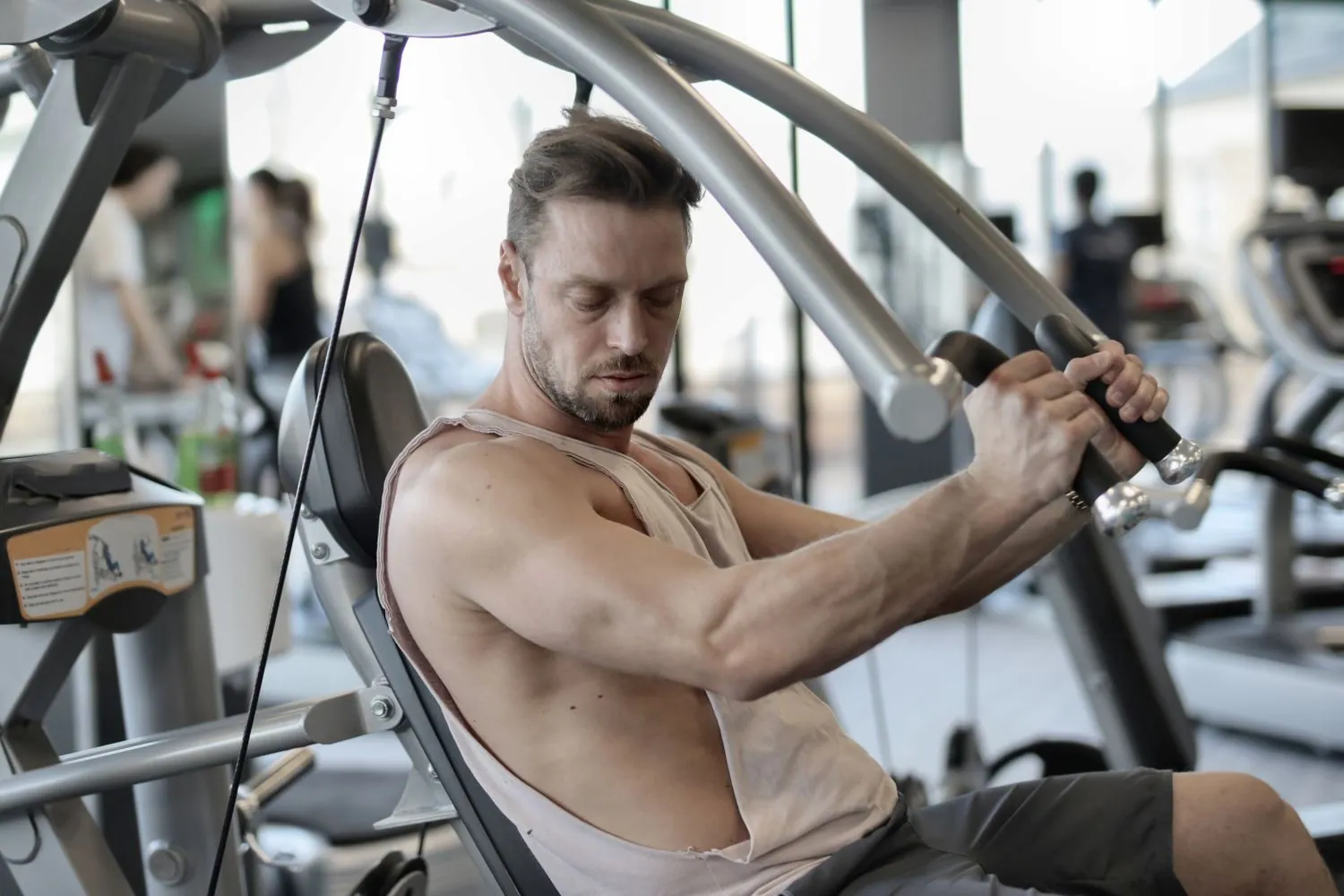
This is the full session. Work down the table in order and use the start times as a pacing guide, not a deadline. Choose a load where the last two reps of each set are hard but your form stays clean. On presses, stop about one or two reps before you would fail. On raises, the final set can go closer to failure.
| Start (min) | Exercise | Sets x reps | Rest | Form cue |
|---|---|---|---|---|
| 0:06 | Seated dumbbell shoulder press | 3 x 6-10 | 2 min | Back on the pad, ribs down, forearms vertical at the bottom |
| 0:14 | Arnold press | 2 x 8-12 | 75 sec | Rotate slowly as you press, no jerk at the bottom |
| 0:18 | Cable or dumbbell lateral raise | 4 x 12-15 | 60 sec | Lead with the elbows, stop at shoulder height |
| 0:25 | Reverse pec deck or bent-over rear delt raise | 3 x 12-15 | 60 sec | Soft elbows, think of pulling the hands apart |
| 0:30 | Cable face pull | 2 x 15-20 | 45-60 sec | Rope to forehead height, elbows high, pause for one second |
That is 14 working sets and about 35 to 40 minutes in total. The Arnold press earns its spot because its rotating path trains the front and side delts through a different arc than the straight press. If you want to pair this with arms on the same day, our shoulder and bicep workout shows how to add biceps without overloading the joint.
Home version: dumbbells, a band and a wall
Training at home changes the tools, not the structure, and this works as a complete dumbbell shoulder workout. You still press first, raise next and finish with the back of the shoulder. If you only own one pair of dumbbells, use the heavier pair for presses and the lighter pair for raises, or fill a backpack with books and hold it for extra load. A 1-litre water bottle weighs about 1 kg, which is handy for light raises.
| Start (min) | Exercise | Sets x reps | Rest | Form cue |
|---|---|---|---|---|
| 0:06 | Standing dumbbell overhead press | 4 x 8-12 | 90 sec | Squeeze the glutes, do not lean back |
| 0:15 | Pike push-up (feet on the floor or a low step) | 3 x 6-12 | 75 sec | Hips high, head travels between the hands |
| 0:21 | Leaning dumbbell lateral raise | 4 x 12-20 | 60 sec | Hold a door frame, lean away, raise to shoulder height |
| 0:28 | Bent-over dumbbell rear delt raise | 3 x 12-20 | 60 sec | Flat back, thumbs slightly down, no swinging |
| 0:33 | Band face pull or band pull-apart | 3 x 15-25 | 45 sec | Pull to the face, elbows higher than wrists |
This version has 17 sets because home loads are lighter, so the extra sets and higher rep ranges make up the difference. When the dumbbells feel too light, slow the lowering phase to three seconds. For more variations, see our guide to a shoulder workout at home, or our home workout routine for the rest of your week.
How do you perform the three lifts people get wrong?
The three most mis-performed shoulder exercises are the lateral raise, the overhead press and the face pull. Fix them with a lighter load, a two-second lift and a three-second lowering phase, ribs pulled down and elbows leading the movement. Dropping the weight by roughly 20 to 30 percent usually cleans up the form.
Lateral raise. Hold the weights slightly in front of your thighs, lift with the elbows rather than the hands and stop when your upper arms reach about shoulder height. If your traps are doing the work, your shoulders are creeping toward your ears, so lower them and use a lighter weight. A cable or leaning raise keeps tension on the side delt at the bottom, where the standing version goes slack.
Overhead press. Keep your ribs stacked over your hips so the lower back does not arch. Press up and slightly back so the weights finish over the middle of your head, with forearms close to vertical at the bottom.
Face pull. Set the rope at about head height, pull toward your forehead and rotate your hands outward at the end so the knuckles point behind you. If you are leaning back and rowing, the weight is too heavy.
How often should you train shoulders each week?
Most people do well training shoulders once or twice a week, with at least 48 hours between sessions. Beginners can start with one full session. Lifters with a few months of training can add a short second session of about six sets, focused on lateral raises and face pulls.
Count your pressing days too. If chest day already includes bench or incline presses, your front delts are getting indirect work, so keep the shoulder day lighter on pressing. A simple week might look like this: full routine on Wednesday, a top-up of lateral raises and face pulls on Saturday, and chest and back days separated from both by at least a day. Our workout routine guide shows how this fits around legs, back and rest days.
How should you progress over four weeks?
Progress by adding reps first and weight second. When you hit the top of the rep range on every set with clean form, add the smallest weight jump available, usually 1 to 2 kg per dumbbell, and drop back to the bottom of the range. This is called double progression.
| Week | Focus | Presses | Raises and face pulls | Effort |
|---|---|---|---|---|
| 1 | Learn the movements | Bottom of rep range | Bottom of rep range | 3 reps left in the tank |
| 2 | Add reps | One more rep per set | One more rep per set | 2 reps left |
| 3 | Add load or a set | Heavier pair if you hit the top of the range | Add one set to lateral raises | 1-2 reps left |
| 4 | Lighter week | Drop one set from each press | Same loads, one set fewer | 3 reps left |
After week 4, restart from week 1 with the heavier weights you earned. If you cannot add reps for three sessions in a row, check your sleep and protein before blaming the routine. Lateral raises progress slowly, so let the reps do the climbing.
Myth check: heavier lateral raises do not give wider shoulders
The belief that swinging up heavy dumbbells builds wide shoulders is one of the most common mistakes in gyms. Once the weight is too heavy, momentum and the upper traps take over and the side delt does less of the work. You end up with sore traps and slower growth than lighter, controlled raises would give.
A second myth is that you must do every shoulder exercise on every shoulder day. You do not. Five well-chosen exercises done with intent beat nine done carelessly.
Troubleshooting: what to change when a set feels wrong
Most problems come from load, range or setup, not from the routine itself. Use this quick fix list during the session.
- Traps burn instead of side delts. Drop the weight, lower your shoulders away from your ears and think “elbows to the walls” instead of “hands to the ceiling”.
- Pinching at the top of a press. Widen or narrow your grip slightly, press slightly in front of the body rather than directly out to the sides, and stop the lowering phase when your forearms are vertical. If the pinch is sharp and keeps coming back, skip overhead pressing and see a physiotherapist or doctor.
- Lower back arches on presses. Squeeze your glutes, pull your ribs down, or use the seated version with a back pad.
- One side is clearly weaker. Do raises one arm at a time, start with the weaker side and match its reps on the stronger side.
This routine is for healthy shoulders. If you have a diagnosed shoulder problem, ongoing pain or a recent injury, check with a doctor or physiotherapist before training overhead.
Adjusting the routine for beginners, desk workers and busy weeks
Shoulder workout routine for beginners. Use the home version even if you have a gym, keep to 2 sets per exercise for the first two weeks and finish in under 30 minutes. Technique matters more than load at this stage.
Desk workers. Long sitting leaves the front of the shoulders tight and the upper back weak. Give face pulls and rear delt raises the first priority within the raises block, and add a few minutes of gentle mobility work on rest days. A short session from our online yoga classes works well for this.
Busy weeks. If you only have 20 minutes, run one press for 3 sets, lateral raises for 3 sets and face pulls for 2 sets. That is a complete session in 8 working sets and a short warm-up.
Get your form checked by a coach
Reading about sets and reps only gets you so far. If you would like someone to watch your presses and raises on video and adjust the loads week by week, our 1-on-1 personal training is built for exactly that.
Shoulder workout routine: frequently asked questions
How long does a shoulder workout routine take?
The gym version takes about 35 to 40 minutes including a six-minute warm-up, and the home version takes about 40 minutes because of the extra sets. If you are short on time, a trimmed 20-minute version with eight working sets still covers all three delt heads.
Can I do this shoulder workout routine with only dumbbells?
Yes. The home version needs a pair of dumbbells, a resistance band and a wall or door frame. If you do not have a band, replace face pulls with bent-over rear delt raises and add a pause at the top of each rep.
Should I train shoulders before or after chest?
If both are on the same day, train the one you want to improve first. Doing shoulders after chest means your front delts are already tired, so use lighter presses and give more of your sets to lateral and rear delt work. Many people simply separate the two days.
How heavy should lateral raises be?
Heavy enough that the last two reps of a set are hard, but light enough to lift without swinging. For many people that means roughly 2 to 8 kg per hand. If you cannot pause for a second at the top, the weight is too heavy.
What should I do if overhead pressing hurts my shoulder?
Mild effort and muscle burn are normal, but a sharp or pinching pain is a signal to stop. Lower the weight, try a neutral grip or a landmine-style or incline press, and swap overhead work for raises. If pain returns or lingers, see a doctor or physiotherapist.


