

A good shoulder workout at home needs far less than most people assume: one pair of dumbbells or a resistance band, a bit of wall space, and about 35 minutes twice a week. This guide gives you a full session with sets, reps, rest and form cues, a no-equipment option, a progression plan, and fixes for the problems that stall shoulder training in a spare room or on a balcony. Shoulders reward control far more than heavy weights.
What is the best shoulder workout at home?
The best shoulder workout at home pairs one overhead press, one side raise and one rear-delt pull, done twice a week for 3-4 sets each. With dumbbells and a band, the session below takes about 35-40 minutes including warm-up, and its 8-20 rep ranges train every part of the deltoid.
| Exercise | Sets x reps | Rest | Form cue |
|---|---|---|---|
| Standing dumbbell shoulder press | 4 x 8-10 | 75 sec | Ribs down, glutes tight, press slightly forward of straight until arms are by your ears |
| Dumbbell lateral raise | 4 x 12-15 | 60 sec | Lead with the elbows, stop at shoulder height, lower for 3 seconds |
| Bent-over reverse flye | 3 x 12-15 | 60 sec | Hinge at the hips with a flat back, swing elbows wide, not hands up |
| Band face pull (door anchor) | 3 x 15-20 | 45 sec | Anchor at eye height, pull toward the forehead, rotate thumbs back |
| Pike push-up | 3 x 6-12 | 60 sec | Hips high, head travels between the hands, forearms stay near vertical |
| Band pull-apart | 2 x 20 | 30 sec | Straight arms at chest height, pull until the band touches your chest |
Warm-up (5 minutes): arm circles, 10 slow wall slides, one set of 15 light band pull-aparts, and one easy set of presses with half your working weight. Do the press first while you are fresh. The raises and pulls follow, when a little fatigue helps you feel the target muscle instead of swinging the weight.
That adds up to 19 hard sets, which is a bit more than you need on day one. Beginners can drop one set from each exercise. If you also train in a gym on some weeks, our shoulder workout routine covers the cable and machine version for comparison.
What equipment do you need for shoulder exercises at home?
Adjustable dumbbells are the most useful purchase, followed by a resistance band with a door anchor. Most beginners do well with roughly 2-6 kg per hand for lateral raises and 6-12 kg for presses. With nothing at all, 1-litre water bottles weigh about 1 kg each, and a loaded backpack works for presses.
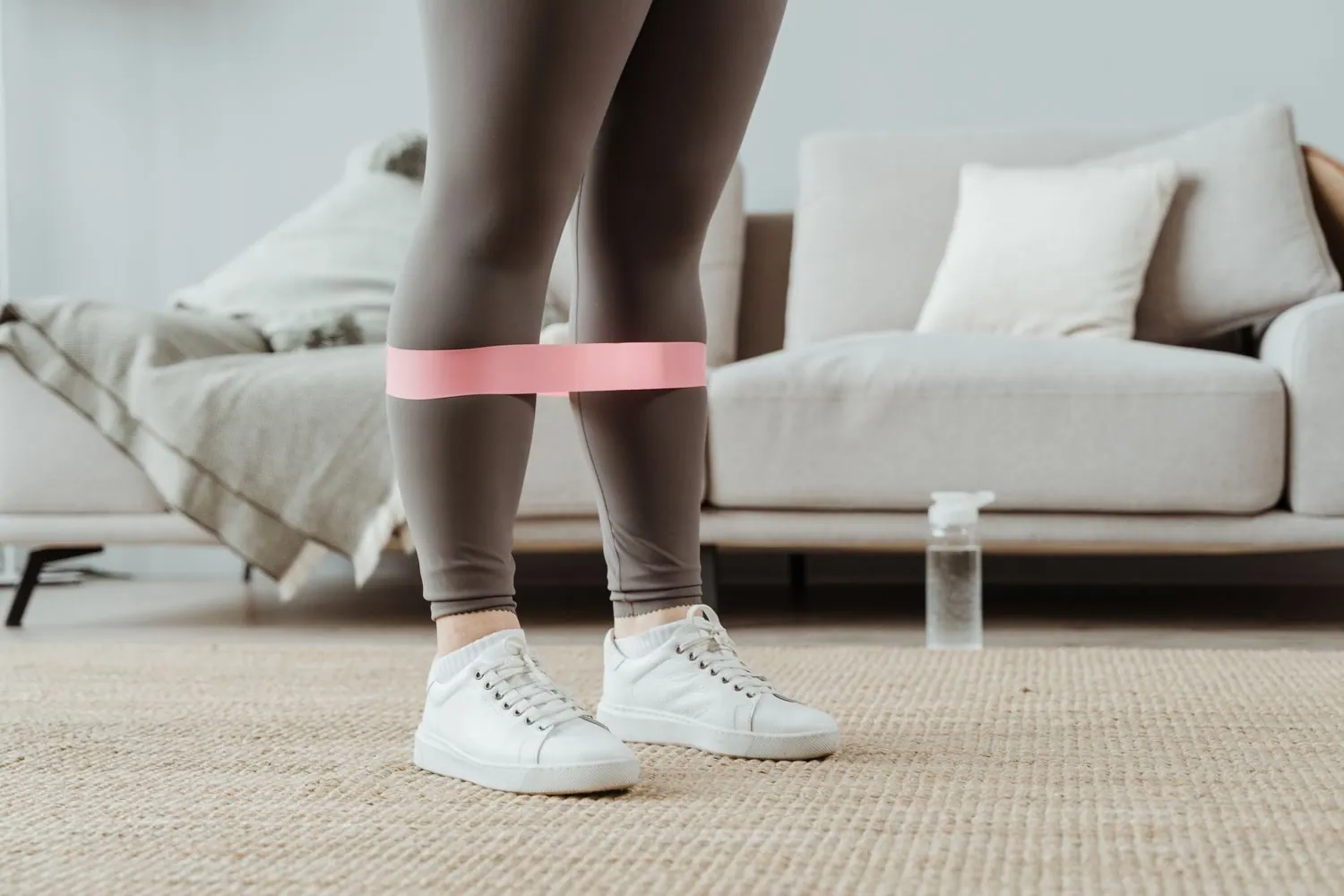
Bands are not a lesser option. They keep tension on the muscle and get harder near the top of the movement, while dumbbells are hardest when the arm is furthest from the body. Using both across a week gives a more complete stimulus than either alone. Here is how to swap movements depending on what you own.
| Muscle job | With dumbbells | With a band | No equipment |
|---|---|---|---|
| Overhead press | Standing dumbbell press | Band press, standing on the band | Pike push-up, feet on a chair to make it harder |
| Side delt | Lateral raise | Band lateral raise under the feet | Raises with two 1-litre bottles |
| Rear delt | Bent-over reverse flye | Pull-apart or face pull | Floor Y-T-W raises, lying face down |
| Front delt and stability | Front raise (optional) | Band front raise | Plank shoulder taps, 3 x 20 |
If you are building out your whole home setup beyond shoulders, our home workout guide covers the wider picture.
Three heads, three jobs: how to hit every part of the deltoid
The deltoid has front, side and rear heads, and a home plan only works if each gets direct work. Pressing hits the front head hard, lateral raises build the side head that creates width, and the rear head needs its own pulling movement. Our deltoid workouts guide goes deeper on each head.
The rear delt is the one most people skip at home, because you cannot see it in a mirror and it is harder to feel. Skip it for months and the front delts take over, leaving shoulders that sit rounded forward. Treat reverse flyes, face pulls and pull-aparts as non-negotiable, not something to squeeze in at the end if there is time.
Walkthrough: how to do the four key moves properly
Standing dumbbell press.
- Stand with feet hip-width apart, dumbbells at shoulder height, palms facing forward or slightly inward.
- Tighten your glutes and keep your ribs pulled down so your lower back does not arch.
- Exhale as you press up and slightly forward until your arms are nearly straight.
- Lower over 2 seconds to shoulder height. Do not let the dumbbells drift behind your head.
Lateral raise. Keep a soft bend in the elbows and raise the arms slightly in front of the body, not directly out to the sides, which is kinder to most shoulders. Stop when your hands reach shoulder height. Keep your wrists in line with your forearms and lower for 3 seconds. If you cannot control the way down, the weight is too heavy.
Bent-over reverse flye. Hinge forward until your torso is near parallel with the floor, back flat, knees soft. Let the dumbbells hang, then open the arms like wings, leading with the elbows. Pause for a second at the top. Light weights are normal here, often half of what you use for lateral raises.
Pike push-up. From a downward-dog shape, with hips high and hands shoulder-width apart, bend the elbows and lower the top of your head toward the floor between your hands. Press back up. Raising your feet onto a chair shifts more load onto the shoulders. Start with 3 sets of whatever number you can do cleanly.
Myth: “Light weights at home will never build shoulders”
This is the most common reason people give up on home training, and it is mostly wrong. Muscle responds to hard sets, meaning sets taken within roughly 2-3 reps of failure, across a wide rep range of about 8-25. A 6 kg dumbbell lifted slowly for 20 reps can be as demanding as a heavy weight for 8.
The real limit of home training is that you eventually outgrow your dumbbells, and that is a programming problem, not a dead end. The next section shows how to keep the muscle working without buying anything. Be honest with yourself about effort too: if you finish a set and could easily have done ten more reps, the set did not count much.
One realistic caveat applies. Very advanced lifters chasing maximum size usually do need heavier loads than a spare-room set provides. For most beginners and intermediates, though, home training is more than enough to build visible, strong shoulders over several months.
How do you keep progressing with light dumbbells or bands?
Progress with light weights by changing the demand, not only the load: lower for 3-4 seconds, pause for 1-2 seconds at the top, build sets toward 20-25 reps, then add weight or a thicker band. Following this order for about 8 weeks keeps shoulders adapting without new equipment.
| Weeks | What changes | How it should feel |
|---|---|---|
| 1-2 | Learn the moves, stop 3 reps short of failure | Controlled, no swinging |
| 3-4 | Lower every rep for 3 seconds | Burn in the side delt by rep 10 |
| 5-6 | Add a 1-2 second pause at the top of raises | Harder with the same weight |
| 7-8 | Build to 20 reps, then add 1-2 kg or switch to a thicker band | Last 2-3 reps are a real grind |
Once the basic press feels easy, learn the Arnold press. It rotates the dumbbells through the lift and adds variety without extra weight. A simple log in your phone notes, with the weight and reps for each set, is the cheapest progression tool you can own.
Troubleshooting: pinching, neck tension and stalled progress
Pinch at the top of a raise or press. Reduce the range slightly, raise your arms a little in front of your body instead of straight out, and lower the weight. A mild, dull effort is fine. A sharp pinch is not.
Neck and upper traps burning instead of the shoulder. Your shoulders are creeping toward your ears. Drop the weight, think about lengthening your neck, and do lateral raises with a lighter load for higher reps.
Lower back arching on the press. Tighten glutes, pull ribs down, and reduce the weight. If it still arches, press one arm at a time or sit with your back supported against a wall.
Swinging the weights. Cut the load by about a quarter and slow the lowering phase. Momentum is the quickest way to turn a shoulder exercise into a hip exercise.
No change after a month. Check that your final reps are hard, that you are eating enough protein spread through the day, and that you sleep roughly 7-9 hours. Rear delt work missing from the plan is the most common culprit.
See your doctor or a physiotherapist if you feel sharp pain during a lift, pain that lingers for more than a couple of days, pain at night, numbness or tingling running down the arm, or a shoulder that feels unstable. The same applies if you have had a dislocation or rotator cuff injury before. Do not train through those symptoms, and get chest pain or pain spreading to the jaw checked urgently.
How often should you train shoulders at home?
Train shoulders at home two to three times a week, with at least one rest day between sessions. Roughly 10-15 hard sets per week is a sensible target for most people. Beginners can start with two sessions of 6-9 sets each and add a third as joints and recovery allow.
Remember that shoulders also work during chest and back training, so count that overlap before adding more. If you split your week by body part, our chest, shoulder and tricep workout shows how a push day fits together, and shoulder and bicep workout pairs them on one day. For a printable layout of sets across a week, the full shoulder workout chart is a handy reference.
Small changes for beginners, desk workers and travellers
Beginners: start with 2 sets per exercise, use light weights and focus on slow lowering. Add sets only after two consistent weeks. Desk workers: long hours at a laptop tend to round the shoulders forward, so give rear delt work and wall slides extra attention. A weekly online yoga class can also help with stiff upper-back mobility. Travellers: pack a light band, keep pike push-ups and pull-aparts as your core moves, and do a short 15-minute version rather than skipping the week.
Women and men follow the same programme. Only the starting loads usually differ, so choose a weight where the last 2-3 reps are difficult.
Want a plan built around your equipment, schedule and any old injuries? Our coaches build it with video form checks in 1-on-1 personal training.
Shoulder workout at home: your questions answered
Can you build shoulders effectively at home?
Yes. The deltoid responds well to moderate loads, and no machine is needed. A press, a side raise and a rear-delt pull, done twice a week with dumbbells or bands and taken close to failure, will build strength and size over several months.
What is a good shoulder workout at home without equipment?
Pike push-ups are the best bodyweight option because they load the shoulders much like an overhead press. Add floor Y-T-W raises for the rear delts and plank shoulder taps for stability. Raising your feet on a chair makes pike push-ups harder when they get easy.
How many sets of shoulder exercises should you do at home?
Roughly 10-15 hard sets per week is a sensible target for most people, split over two or three sessions. Beginners can begin with 6-9 sets per session and increase only if recovery feels good.
Do resistance bands work as well as dumbbells for shoulders?
They work differently rather than better or worse. Bands keep tension on the muscle and get harder near the top of a lift, while dumbbells are hardest when the arm is furthest from the body. Using both across a week gives the most complete stimulus.
Why do my shoulders hurt during a shoulder workout at home?
Common causes are too much weight, swinging, raising the arms too high or straight out to the side, and shrugging. Lower the load and slow down. Sharp pain, lingering pain or numbness in the arm means stop and see a doctor or physiotherapist.


