
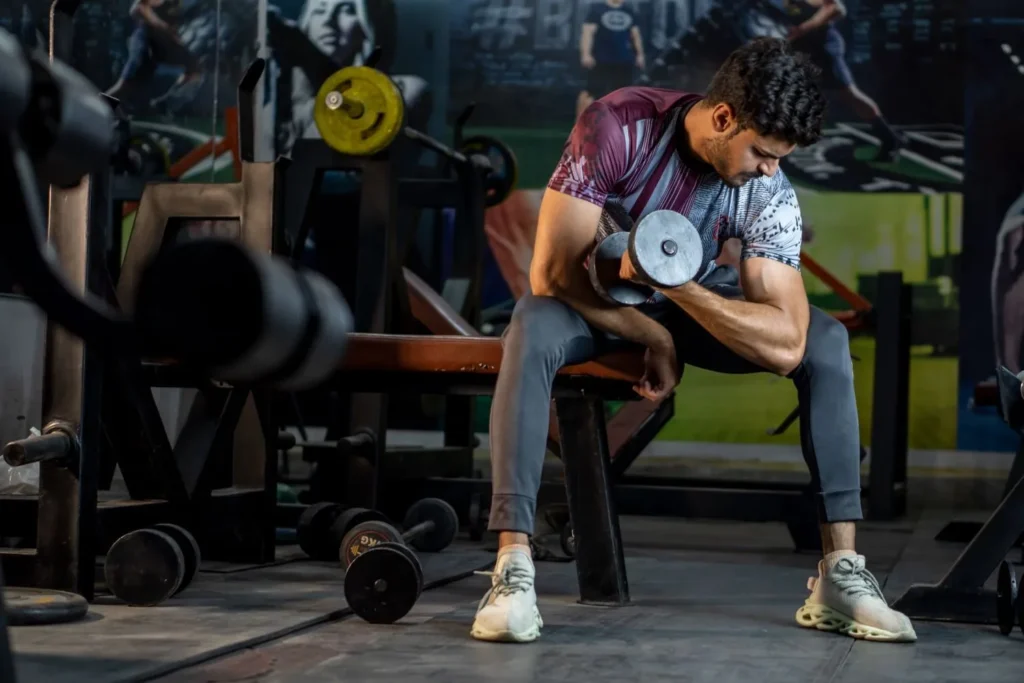
A chest and bicep workout pairs one pushing muscle with one pulling muscle in a single session: roughly three exercises for the chest, then three for the biceps, about 20 working sets in total and 60 to 70 minutes including rest. It suits people who train three or four days a week and want arm work that is not squeezed in after a long pressing day. Below you get the sets, reps, rest and form cues, a weekly split, home swaps and Indian food for recovery. Nobody can promise a fixed amount of muscle in a fixed time, but a plan you can repeat and progress is what works.
Is it good to train chest and biceps on the same day?
Yes. Chest pushes and biceps pull, so neither muscle limits the other much during the session. Your biceps stay fairly fresh through bench and incline presses, which lets you curl with real weight afterwards. It works best with three to four training days a week, and it suits beginners and intermediates alike.
The usual alternative is a chest and triceps workout. Triceps and front shoulders do the helper work in every press, so by the time you reach direct triceps exercises they are already tired. Pairing chest with biceps spreads the work more evenly.
One caveat: your triceps and front shoulders still work during every press, so avoid a hard triceps or shoulder session the next day. If you prefer shoulders as the pushing muscle, our shoulder and bicep workout uses the same logic.
What does a full chest and bicep workout look like?
A solid session runs six exercises and about 20 working sets: barbell bench press, incline dumbbell press and cable fly for chest, then barbell curl, incline dumbbell curl and hammer curl for biceps. Rest 2 to 3 minutes after heavy presses and 45 to 90 seconds after isolation work. Expect 60 to 70 minutes including warm-up.
Warm up first. Spend 5 minutes on a brisk walk or cycle with arm circles, then ramp up on the bench: 10 reps with the empty bar, 5 at about half your working weight and 3 at about 70 percent. Warm-up sets are not counted below.
| Exercise | Sets | Reps | Rest | Form cue |
|---|---|---|---|---|
| Barbell bench press | 4 | 6-8 | 2-3 min | Shoulder blades back and down, bar to lower chest |
| Incline dumbbell press | 3 | 8-10 | 90 sec | Bench at about 30 degrees, press up and slightly together |
| Cable fly | 3 | 12-15 | 60 sec | Soft elbow bend, hug a barrel, stop when hands meet |
| Barbell curl | 4 | 8-10 | 90 sec | Elbows pinned to ribs, no hip swing |
| Incline dumbbell curl | 3 | 10-12 | 60 sec | Arms hang behind torso, upper arms stay still |
| Hammer curl | 3 | 12-15 | 45-60 sec | Palms face each other, lower over 2-3 seconds |

Stop most sets with one to three clean reps still in the tank. For more chest-day layouts, see our chest workouts guide and the chest gym workout chart.
Form walkthrough: how each lift should feel
- Barbell bench press: lie with your eyes under the bar, feet flat, shoulder blades pulled back and down. Lower the bar to the lower chest over about 2 seconds, with elbows roughly 45 to 75 degrees from your torso rather than flared wide. Use a spotter or safety pins every time.
- Incline dumbbell press: set the bench near 30 degrees. A steeper angle shifts the load onto your shoulders. Lower until your elbows sit just below bench level, then press.
- Cable fly: set the pulleys at about shoulder height, take a small fixed bend in the elbows and sweep your hands together like hugging a barrel. If you want to bias the lower chest, set the pulleys high and sweep downward, as explained in our lower chest cable workout.
- Barbell curl: keep your elbows at your sides and curl to about shoulder height. Lower over 2 to 3 seconds. If you have to lean back or swing the hips, the bar is too heavy.
- Incline dumbbell curl: set the bench at roughly 45 to 60 degrees and let your arms hang straight down behind your torso. That stretch at the bottom is the point of the exercise, so use lighter dumbbells than you would standing.
- Hammer curl: palms face each other, thumbs up. This also trains the brachialis and forearm, which add arm thickness.
Why does exercise order matter in a chest and bicep workout?
Do the heaviest, most technical lift first, while you are freshest. That means bench press before flyes, and barbell curls before hammer curls. Heavy pressing needs full-body tension and a steady grip, so curling first would cost you bench weight. Finish each muscle with isolation work, where fatigue matters less.
Because chest and biceps work in opposite directions, you can also alternate them: one bench set, rest 90 seconds, one curl set, rest 90 seconds, and repeat. This saves roughly 10 to 15 minutes. Keep full rest on your heaviest bench sets, though.
How many sets and reps do you need each week?
A sensible range is roughly 8 to 16 hard sets per week for each muscle. Start at the low end and add a set or two only when progress stalls. Use 5 to 8 reps on heavy presses and 8 to 15 on isolation work, stopping one to three reps short of failure.
The table above is 10 sets per muscle, plenty for a once-a-week session. Rows and pulldowns also work your biceps, so count them as indirect volume. Allow about 48 to 72 hours before hitting the same muscle hard again.
For progress, use double progression. Pick a rep range such as 8 to 10. When you hit 10 reps on every set with clean form, add the smallest jump you have, usually 1 to 2.5 kg on curls and 2.5 to 5 kg on bench. Write your numbers down.
If you are looking for a chest and bicep workout for beginners, trim the plan to four or five exercises and two or three sets each: dumbbell bench press, push-ups or pec deck, dumbbell curl and hammer curl. Learn the movement first and add weight second. Our biceps workout at gym for beginners covers curls in more detail.
Where does this session fit in your weekly split?
On a three-day plan, put chest and biceps on day one, legs on day two and back with shoulders on day three. With four days, give chest and biceps its own day and keep a rest day or leg day before back training, so your biceps are not tired from rows when you curl.
| Days per week | Sample layout | Chest and biceps sessions | Note |
|---|---|---|---|
| 3 days | Mon: chest and biceps. Wed: legs and core. Fri: back and shoulders | 1 per week | Simple and easy to repeat. Chest is trained once, so keep sets high-quality. |
| 4 days, twice weekly | Mon: chest and biceps (heavy). Tue: legs. Thu: chest and biceps (lighter, 3 sets of 10-15). Sat: back and legs | 2 per week | Better for chest growth if you recover well. Keep the second session lighter. |
If you prefer a classic pushing day instead, read our chest, shoulder and tricep workout. A back session works your biceps hard, so leave at least one day between back and this workout, or cut your curls to two exercises when the days sit close together.
Myth check: three beliefs that waste your arm day
Myth: chest day must include triceps. Reality: triceps already work in every press. The best pairing is the one that fits your week.
Myth: swinging heavier curls build bigger biceps. Reality: momentum moves the load to your lower back and hips. Strict curls with a slow lowering phase keep the tension on the biceps.
Myth: more soreness means more growth. Reality: soreness mostly means the movement was new or the volume jumped. Track reps and weight week to week instead.
Troubleshooting: when the session stops working
- Shoulders pinch on bench press: your elbows are probably flared and your shoulder blades loose. Tuck the elbows to about 45 to 75 degrees, pull the blades back and down, or try dumbbells.
- Inner elbow aches during curls: usually too much weight or too many sets. Drop the load by 20 to 30 percent, switch to an EZ-bar or dumbbells, and slow the lowering phase.
- Triceps give out before chest: normal, since triceps assist every press. Finish with cable fly or pec deck so the chest still gets direct work without the triceps limiting you.
- Chest feels nothing: lower the weight, pause for a second at the bottom of each rep and focus on the stretch. If nothing has gone up in four weeks, adjust sets or food.
See your doctor or a physiotherapist if you feel sharp or shooting pain, pain that lasts more than one to two weeks, numbness or tingling in the arm or hand, or a pop followed by swelling or bruising near the shoulder or elbow. Chest pressure, tightness or unusual breathlessness during exercise needs medical help straight away, not a lighter set.
Can you do a chest and bicep workout at home or with only dumbbells?
Yes. Push-ups, adjustable dumbbells and a resistance band cover both muscles. Swap bench press for floor press or push-ups, incline press for feet-elevated push-ups, and barbell curls for dumbbell or band curls. Use 8 to 15 reps and slow lowering to make lighter loads harder.
| Movement | Gym option | Dumbbells only | Bodyweight or band |
|---|---|---|---|
| Heavy press | Barbell bench press | Dumbbell floor press, 3-4 sets of 8-12 | Push-ups, slow 3-second lowering |
| Upper chest press | Incline dumbbell press | Dumbbell press on a stable, propped bench | Feet-elevated push-ups |
| Chest isolation | Cable fly | Dumbbell floor fly, light weight | Band fly anchored at chest height |
| Main curl | Barbell curl | Standing dumbbell curl | Band curl, standing on the band |
| Stretch curl | Incline dumbbell curl | Seated curl, leaning back on a firm chair | Band curl with a slow lowering phase |
| Neutral grip curl | Hammer curl | Dumbbell hammer curl | Band hammer curl |
With lighter loads, finish sets one or two reps from failure and slow the tempo as you get stronger. For more ideas, see our upper chest workout at home. The same structure works for a chest and bicep workout with dumbbells at the gym.
What to eat around this session (Indian foods)
For muscle gain, a common target is roughly 1.6 to 2 g of protein per kg of body weight per day. For a 70 kg person that is about 110 to 140 g. Spread it across three to four meals.
Useful sources, with approximate protein per portion:
- 2 whole eggs: about 12 g
- 100 g paneer: about 18 g
- 100 g cooked chicken breast: about 30 g
- 50 g dry soya chunks: about 25 g
- 1 katori (about 150 g) cooked dal: about 7 to 9 g
- 200 g curd: about 6 to 7 g
Eat a carbohydrate-and-protein meal one to two hours before training, such as poha with curd, then a protein-rich meal within a few hours afterwards, and aim for 7 to 8 hours of sleep. Supplements are optional. If you have kidney or liver problems, check with your doctor or a dietitian before raising your protein intake. Our online nutritionist consultation can build this around your own food habits.
Frequently asked questions
What is a good chest and bicep workout?
A good session opens with a heavy chest press, adds one or two chest isolation moves, then moves to a heavy curl and finishes with isolation curls. Barbell bench press, incline dumbbell press, cable fly, barbell curl, incline curl and hammer curl, at about 20 sets total, covers that structure.
Should you train chest with triceps or biceps?
Both work. Chest with triceps suits higher-frequency weeks and pressing-focused lifters. Chest with biceps suits three-day splits and anyone who wants fresher arm training, since your biceps are barely involved in pressing. Choose based on how many days you can train.
How often should you do a chest and bicep workout?
Once or twice a week is enough for most people. Leave 48 to 72 hours between sessions that train the same muscle hard. If you train it twice, make one session heavy and one lighter.
Can beginners do a chest and bicep workout together?
Yes. Beginners recover quickly from moderate volume. Start with four or five exercises, two to three sets each, and focus on form before adding weight.
How long should a chest and bicep workout take?
Plan on 60 to 70 minutes including a 5-minute warm-up and rests between sets. Alternating chest and biceps sets can cut about 10 to 15 minutes.
Next step: see how 1-on-1 personal training at Fitstrot works, and have a coach shape this chest and bicep session around your gym, schedule and recovery.


