

A good chest workout is not a list of fifteen exercises copied off a bodybuilding poster. It is three to five movements, run with enough load and enough weekly volume that your pectorals have a reason to grow, plus a shoulder position that does not leave you rubbing your front delt for three days. Most people in Indian gyms train chest twice as often as they train legs and still see nothing change, because the sets are too easy, the range of motion is half-finished, and the weekly total never moves. This guide fixes that with numbers you can act on today.
Everything below is built around published exercise-science data, not gym-floor folklore, and it works whether you have a full commercial gym in Pune or a single pair of dumbbells at home in Guwahati.
What muscles does a chest workout actually train?
A chest workout trains the pectoralis major, a single fan-shaped muscle with two heads: the clavicular head running from your collarbone, and the larger sternocostal head running from your breastbone and upper ribs. Underneath sits the smaller pectoralis minor. Together these muscles rotate your shoulders, draw your arms in and forward, and stabilise the shoulder joint — which is why Harvard Health describes them as what you use pushing open a door, pushing a grocery cart, or lifting a child off the floor.
That matters for programming. Because the pec has fibres running at different angles, no single pressing angle loads all of it maximally. It also means the triceps and front deltoid are always along for the ride — they are prime movers in every press you will ever do, which is why chest day soreness so often shows up in the front of the shoulder.
The five chest exercises that earn their place
Five movements cover every job the chest has: a heavy horizontal press, an inclined press, a bodyweight press, a deep stretch-position press, and an isolation movement. Everything else is a variation. Harvard Health’s strength guidance for adults aged 18 to 64 is eight to 12 repetitions with 30 to 90 seconds of rest between sets, building from one set to three as you get stronger — the table below uses that as its backbone.
| Exercise | Sets | Reps | Rest | Form cue that matters most |
|---|---|---|---|---|
| Barbell bench press | 3–4 | 5–8 | 120–180 s | Shoulder blades pinned down and back; bar touches at nipple line, not the throat |
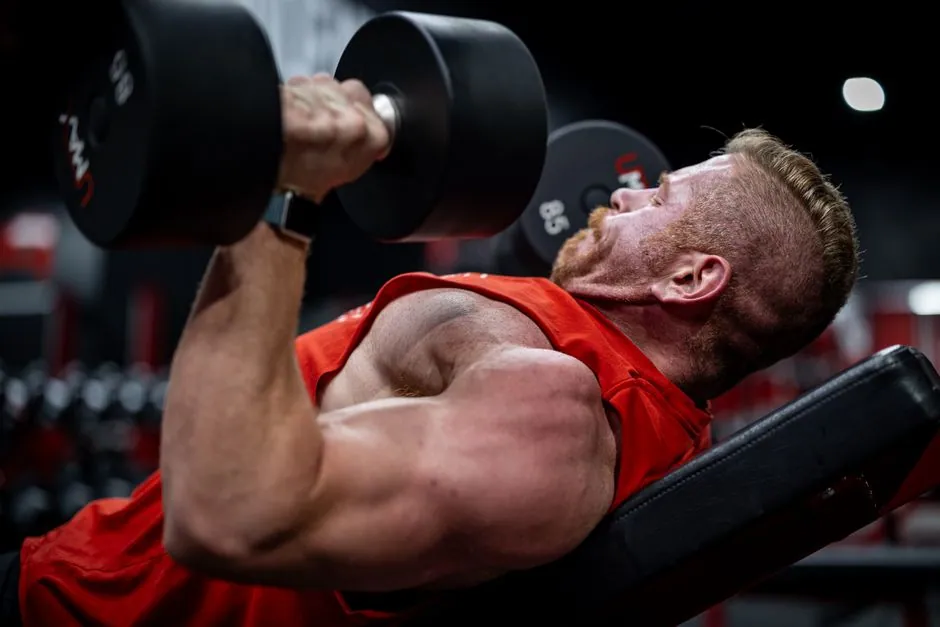
| Incline dumbbell press (30°) | 3 | 8–12 | 90 s | Elbows about 45° from the torso; stop when upper arms reach bench level |
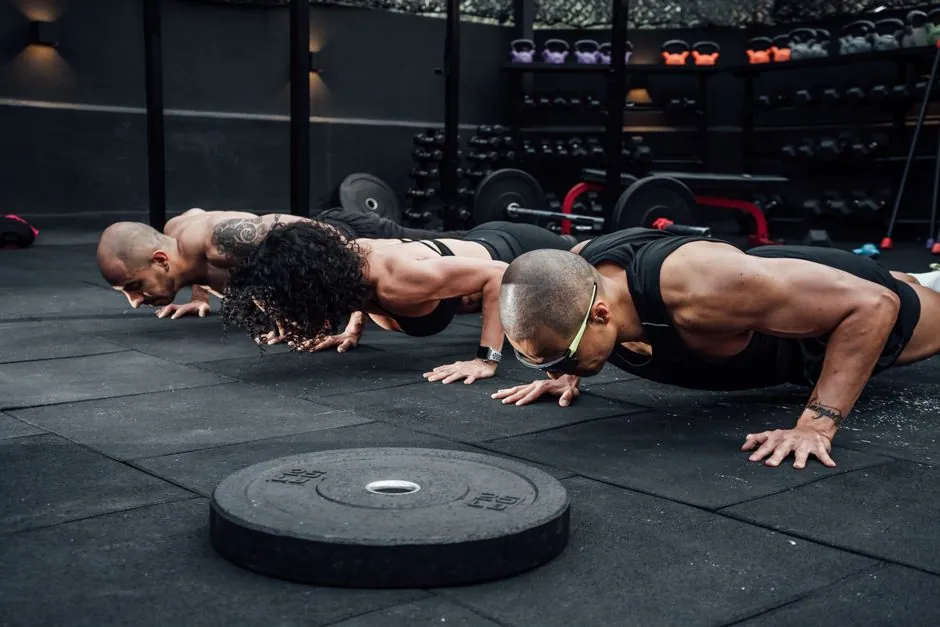
| Push-up (or feet-elevated) | 3 | 10–20 | 60 s | Ribs down, glutes squeezed — the hips should not sag before the chest touches |
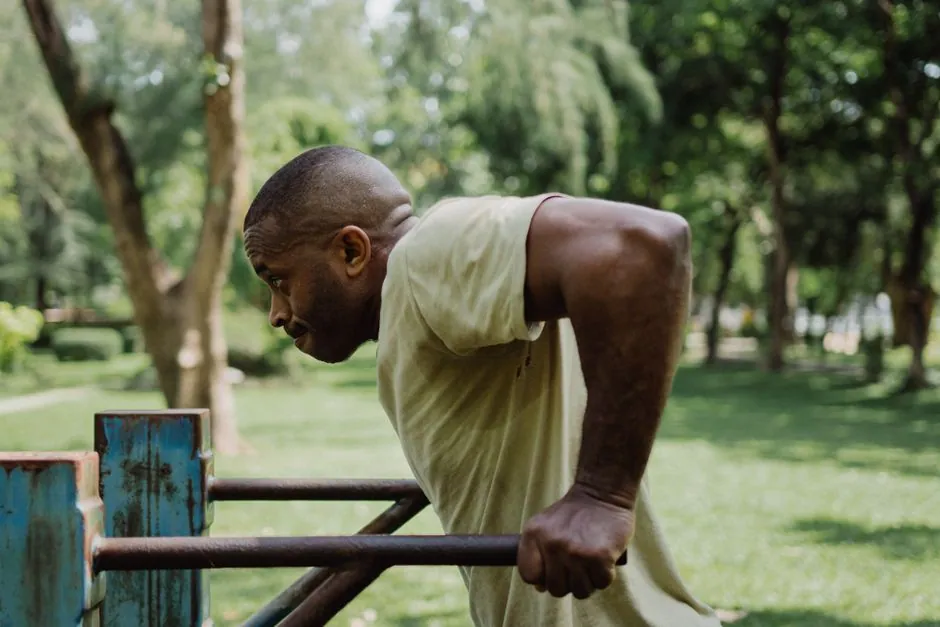
| Chest dip (slight forward lean) | 3 | 6–12 | 90 s | Lean the torso 15–30° forward; stop at the point where the shoulder feels loaded, not pinched |
| Dumbbell fly or cable fly | 2–3 | 12–15 | 60 s | Soft, fixed elbow bend throughout; think “hug”, never “press” |
Note the rep spread. The heavy press sits at 5–8 because that is where you can add weight week to week and actually measure it. The fly sits at 12–15 because loading a stretched pec heavily is how people tear things. If you like cable work specifically, our cable crossover workout breaks down angles and cable heights in more detail than fits here.
Upper chest, lower chest: what the EMG data says and what it doesn’t
You cannot isolate a “part” of the pectoralis major the way gym posters suggest, but you can bias it. A 2020 study in the International Journal of Environmental Research and Public Health measured muscle activity across five bench angles — 0°, 15°, 30°, 45° and 60° — and found peak clavicular (upper) pec activity at 30°, while the middle and lower portions were highest at 0°. Above 30°, anterior deltoid activity climbed sharply and total pec activity fell. So the shift is real, but it is a bias of maybe a few percentage points, not a switch.
Upper chest workout: the 30-degree rule
If your collarbone area looks flat, set the bench at 30°, not the 45° most gyms leave it at. At 45° and above you are running a shoulder press with a chest-shaped grip. One incline pressing movement per chest session is enough for most people; two is only worth it if the upper pec is genuinely your weak point.
Lower chest workout: dips and the decline question
For a lower chest workout, the flat bench already hits the sternocostal fibres hardest, so the decline bench is optional rather than essential. The chest dip with a 15–30° forward lean is the better use of your time because it adds a loadable stretch and needs no bench. If the sternum area feels underdeveloped, our guide to the middle chest workout covers the inner-pec question separately.
Your chest workout for gym: a 55-minute session
Here is the session itself. It runs in about 55 minutes including warm-up, needs a barbell, a pair of dumbbells, a dip station and one cable or machine, and it totals 14 working sets — comfortably inside the range where volume still pays. Run version A on Monday and version B on Thursday if you train chest twice a week.
| Order | Session A (heavy) | Session B (volume) | Sets × reps | RPE / load guide |
|---|---|---|---|---|
| 1 | Barbell bench press | Incline dumbbell press (30°) | 4 × 5–8 / 4 × 8–10 | RPE 8 — two reps left in the tank |
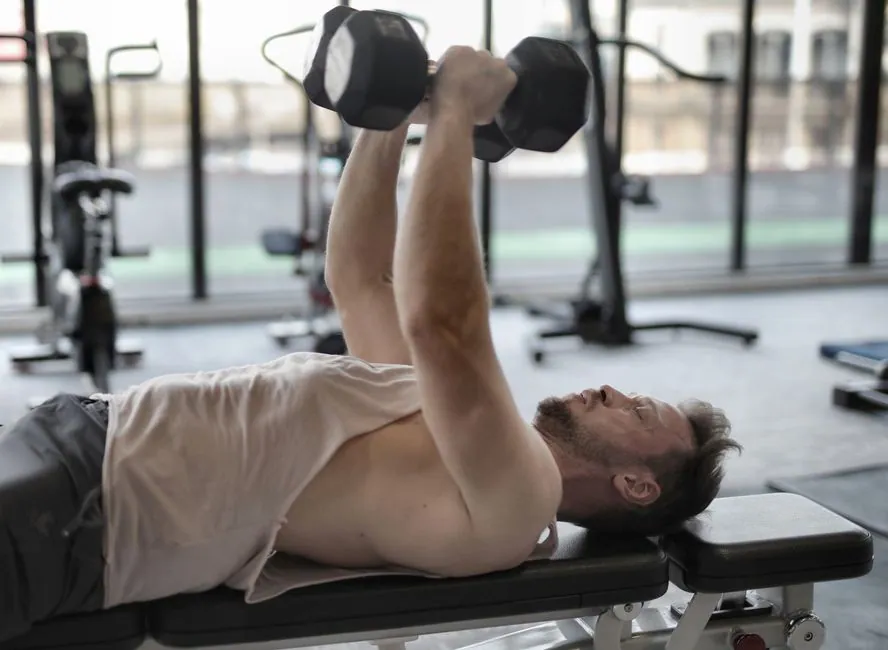
| 2 | Incline dumbbell press (30°) | Flat dumbbell press | 3 × 8–12 | RPE 8–9 |
| 3 | Chest dip (weighted if 12+ reps are easy) | Push-up, feet elevated | 3 × 6–12 / 3 × 12–20 | RPE 9 on the last set |
| 4 | Machine chest press | Cable fly, low-to-high | 3 × 10–12 / 3 × 12–15 | RPE 9 — controlled tempo |
| 5 | Cable fly, high-to-low | Machine chest press | 1 × 15–20 | Finisher, one set to near-failure |
Two rules make this work. Lower the bar or dumbbells for roughly two seconds and do not bounce. And log the weight — if the same numbers sit in your notebook eight weeks from now, the programme is not the problem, the progression is.
Chest workout in home: what works without a bench
A home chest workout works. In an eight-week trial published in the Journal of Exercise Science & Fitness, 18 young men trained twice a week with either bench press at 40% of one-rep max or push-ups matched to the same load; pectoralis major thickness rose from 17.0 mm to 20.8 mm in both groups, with similar bench-press strength gains. The catch is the word “matched” — the push-ups were adjusted so each set was genuinely hard.
| Stage | Movement | Target before moving on | Weekly sets |
|---|---|---|---|
| 1 | Incline push-up (hands on bed or sturdy table) | 3 × 15 with a 2-second lowering | 9–12 |
| 2 | Standard floor push-up | 3 × 12 clean, chest to fist height | 12 |
| 3 | Feet-elevated push-up (feet on a chair) | 3 × 12 | 12–15 |
| 4 | Deficit push-up on two books, or backpack-loaded push-up (5–10 kg) | 3 × 10 | 12–15 |
Add a pair of adjustable dumbbells — ₹2,500 to ₹5,000 for a 20 kg set in most Indian cities — and you unlock floor presses and flys, which closes almost the whole gap. Slot this chest block into your week alongside a pull day and a leg day, and the home version stops being a compromise.
How often should you train chest, and how many sets?
Train chest twice a week, for 10 to 20 hard sets in total. A 2016 meta-analysis in Sports Med comparing volume-equated frequencies found twice-weekly training produced a larger hypertrophy effect size than once weekly (0.49 versus 0.30). A separate 2017 meta-regression reported a graded dose response in which each additional weekly set was associated with roughly 0.37% more muscle gain. Rest at least one full day between sessions for the same muscle group, as Mayo Clinic advises.
For context, the public-health floor is far lower than the growth target: both the CDC and the NHS ask adults for muscle-strengthening work on at least two days a week covering all major muscle groups, chest included. Two days is the health minimum. Ten to 20 sets is the growth target. They are not the same claim.
Chest workout machine options when the gym is crowded
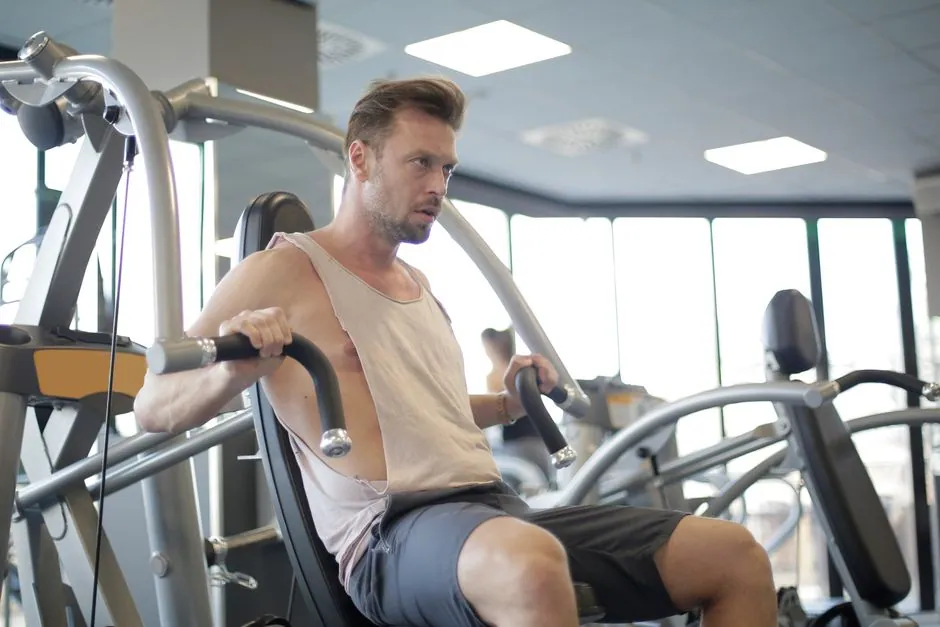
A chest workout machine — the seated chest press or the pec deck — is not a lesser option. It fixes the movement path, which means you can push closer to failure safely without a spotter, and on a packed Sunday evening in an Indian gym it is often the only free station. Use it as your third or fourth movement, in the 10–15 rep range, rather than as your opener.
Chest workout warm up and the three problems that stall people
Chest workout warm up: five minutes, three moves
Two minutes of easy rowing or skipping, 15 band pull-aparts, 10 slow shoulder dislocates with a towel, then two ramp-up sets on your first exercise at roughly 40% and 65% of your working weight. That is the whole warm-up. Static chest stretching before pressing is not required and can blunt output slightly.
“My shoulders hurt more than my chest”
Usually one of three things: the bar is touching too high on the chest, the elbows are flared to 90°, or the shoulder blades are floating instead of pinned. Fix the grip width first — most people bench far wider than they need. Narrow to roughly 1.5 times shoulder width, tuck the elbows to about 45°, and touch the bar at nipple level. If pain persists beyond a session or two, stop pressing and see a physiotherapist or sports physician rather than working through it.
“Nothing has grown in three months”
Count your actual hard sets per week — not sets performed, sets taken within two reps of failure. Most stalled trainees are doing five or six. Then check the load log. If the barbell has not moved in eight weeks and your bodyweight has not moved either, you are maintaining, not building.
Chest workout at gym for beginners: the first eight weeks
Skip the barbell for the first three or four weeks. Run machine chest press, incline dumbbell press and push-ups, two sessions a week, three sets each. That is nine sets per session and roughly 18 a week — plenty of stimulus while you learn the shoulder position. Add the barbell bench in week four with an empty bar for two sessions before loading it.
Chest workout women: what actually changes
Very little. Women’s pectorals respond to load, volume and progression exactly like men’s, and the same 30° incline and 8–12 rep guidance applies. Two honest corrections are worth making. First, chest training does not reduce breast size — breast tissue is fat and glandular tissue, and pressing does not selectively burn fat from one region. Second, it does not “lift” the breast either; it builds the muscle underneath, which changes the contour of the upper chest wall modestly.
What chest training does reliably deliver is pushing strength, better shoulder stability and improved posture against a desk-bound day. Start at stage 1 or 2 of the home progression table and follow the same twice-weekly structure. If you want the whole week structured around it, our chest, shoulder and tricep workout shows how the push muscles fit together.
Eating enough for the chest to actually grow
Training is the signal; food is the material. A 2018 meta-analysis of 49 studies in the British Journal of Sports Medicine found that protein intakes above roughly 1.6 g per kg of bodyweight per day produced no further gains in fat-free mass during resistance training. For a 70 kg lifter that is about 112 g a day — reachable on an Indian vegetarian plate with 200 g paneer, 150 g cooked rajma, two bowls of curd and 100 g of roasted chana, no powder required.
Sleep matters as much and costs nothing. If you want the food side built around your actual meals and budget, a structured online nutritionist consultation is a faster route than guessing from apps.
Frequently asked questions
How many chest exercises should I do in one workout?
Three to five. Four is the sweet spot for most intermediate lifters: one heavy press, one incline press, one bodyweight or dip movement, and one fly or machine. Beyond five, the later sets are performed with too little energy to add meaningful stimulus, and total weekly sets matter more than exercise count.
Can I train chest every day?
No. Mayo Clinic recommends resting at least one full day between sessions that train the same muscle group, and the hypertrophy evidence favours training a muscle two to three times a week rather than daily. Daily pressing accumulates shoulder and elbow stress without adding growth, because the muscle repairs between sessions, not during them.
Is the incline bench better than the flat bench?
Neither is better — they load different fibres. The 2020 EMG data showed upper-pec activity peaked at a 30° incline while the middle and lower portions peaked at 0°. Run both in the same week: flat bench as your heavy lift in one session, 30° incline as the opener in the other.
How long does it take to see chest growth?
Expect visible change in 10 to 16 weeks of consistent twice-weekly training with progressive load, not four. Measurable muscle thickness increases appeared after eight weeks in the 2017 push-up trial, but those were measurements under ultrasound, not something visible in a mirror. Beginners see faster change than experienced lifters.
Do push-ups build as much chest as bench press?
They can, if the load is matched. The eight-week trial comparing push-ups with bench press at 40% of one-rep max found both increased pectoralis major thickness from 17.0 mm to 20.8 mm. The limit is loading: once you can do 25 clean push-ups, you need elevation, a deficit or added weight.
Why does my chest stay flat despite training hard?
Three usual causes: too few hard sets per week (under 10), no progressive overload in the log, or eating at a calorie deficit while expecting growth. Check all three before changing exercises. Genetics affect pec shape and insertion points, but they do not prevent the muscle from getting bigger.
Should I use a spotter or a machine to train to failure?
Use a machine. Seated chest press and pec deck let you push to genuine failure with no partner and no risk of being pinned under a bar. Save near-failure work on the barbell bench for sessions where a spotter is present, and keep two reps in reserve otherwise.
Put the plan into your week
Pick the gym session or the home progression, run it twice a week for eight weeks, and write down every load. If the numbers stop moving, that is your signal to change something — not the calendar. If you would rather have the progression, the form checks and the weekly load targets managed for you, Fitstrot’s 1-on-1 personal training runs live sessions where a coach watches your bar path and adjusts the numbers as you go.
This article is general fitness information, not medical advice. If you have a shoulder, rib or heart condition, or any chest pain during or after exercise, speak to a doctor before starting a new chest training programme.


