

Ardha pincha mayurasana, usually called Dolphin Pose, is a forearm-supported inverted V: hips high, forearms flat on the mat, head hanging free between your upper arms. It is the standard strength builder for forearm stand, and a pose that teaches your shoulders to bear weight without leaning on your wrists. This guide covers the steps, the shoulder prep that makes the pose feel stable, ways to modify it, common faults and the cautions worth reading before you try it.
What does ardha pincha mayurasana mean, and what is the pose?
Ardha pincha mayurasana means “half peacock feather pose” in Sanskrit: ardha is half, pincha is feather and mayurasana is peacock pose. It is the half-way, grounded version of the full forearm stand. You keep your feet on the floor, stack hips over shoulders and load the forearms, so you train the shoulders without balancing upside down.
Teachers also call it Forearm Dog, because it copies the shape of Downward-Facing Dog with the hands swapped for forearms. If you know Downward Dog, you already know the outline. What changes is the demand: the shoulders now carry far more of your weight, and the wrists carry almost none.
How do you do ardha pincha step by step?
Start on all fours, lower to your forearms with elbows under shoulders, tuck your toes and lift your hips into an inverted V. Press your forearms down, keep the head free and hold for 15 to 30 seconds while breathing steadily. Exit by bending your knees and resting in Child’s Pose.
- Set the base. Come to tabletop on your mat. Lower onto your forearms with elbows directly under your shoulders, about shoulder-width apart. Keep the forearms parallel, palms flat or fingers interlaced loosely.
- Tuck and lift. Curl your toes under. On an exhale, lift your knees and send your hips up and back.
- Walk the feet in. Step your feet a little closer to your elbows until your hips stack over your shoulders. Bend the knees as much as you need.
- Press the floor away. Push the forearms down and spread your shoulder blades wide, so the upper back feels broad and lifted, not collapsed.
- Free the head. Let the neck lengthen and the head hang between your upper arms. Keep your gaze toward your feet or knees and do not press the crown into the mat.
- Hold and exit. Breathe through the nose for 15 to 30 seconds, then bend the knees, lower down and rest in Child’s Pose for a few breaths.
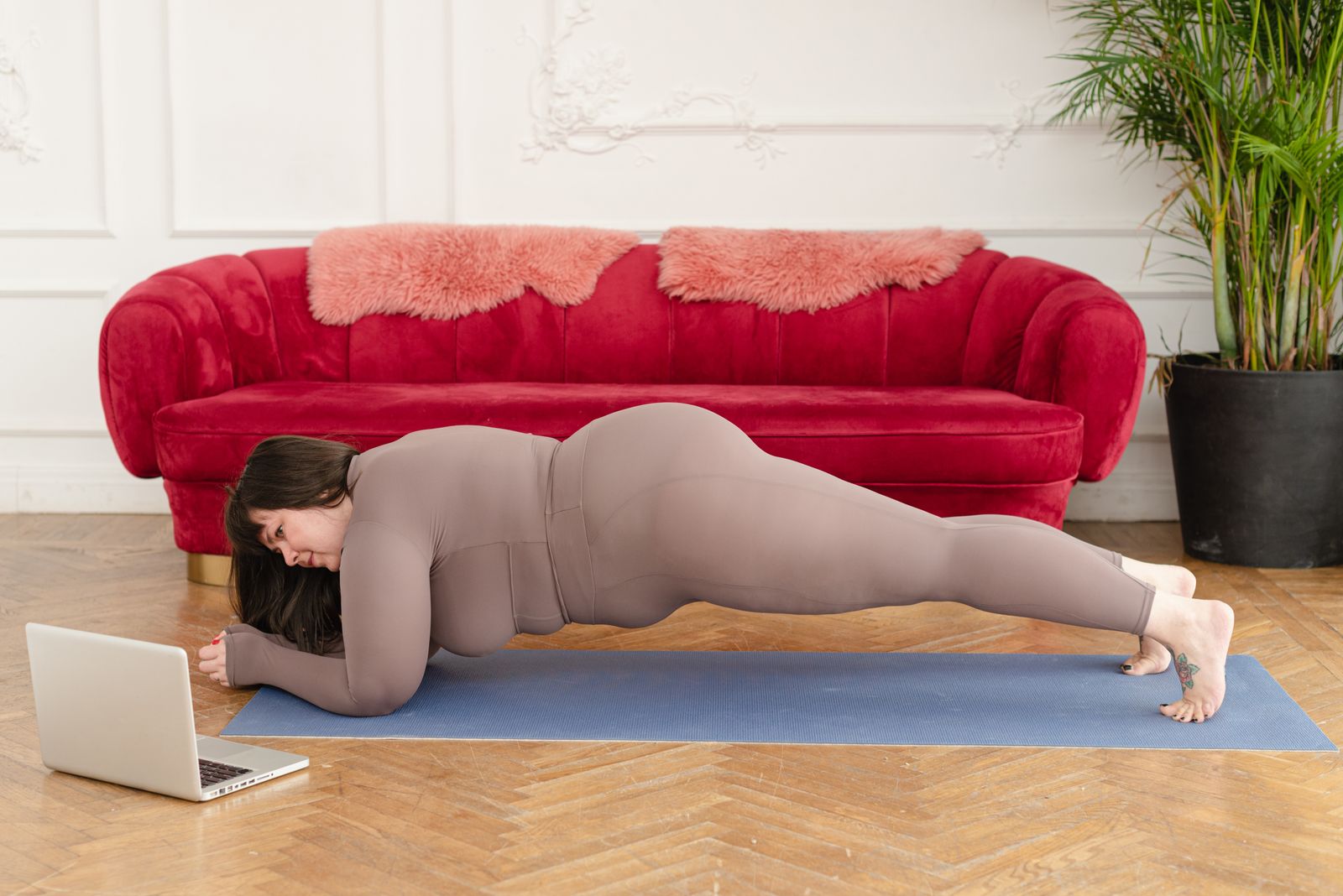
If your mat slides on a tiled floor, put it against a wall or on a rug, because forearms that skid forward will undo the pose in seconds.
How do you prepare your shoulders for ardha pincha?
Spend two to three weeks on simple shoulder drills before you hold dolphin pose for long. Forearm plank, scapular push-ups and puppy pose train the same muscles with less load. Practise three days a week and do 2 to 3 rounds of each drill.
| Prep drill | Sets and hold | What it builds | Form cue |
|---|---|---|---|
| Forearm plank | 3 x 15 to 30 seconds | Shoulder and core endurance | Elbows under shoulders, ribs drawn in, no sagging hips |
| Scapular push-ups (in plank) | 2 x 8 to 10 reps | Shoulder blade control | Arms stay straight; only the shoulder blades move |
| Downward-Facing Dog | 3 x 30 seconds | Overhead position and hamstring length | Bend the knees; push the floor away |
| Puppy pose | 3 x 20 to 30 seconds | Shoulder and upper-back mobility | Hips over knees, chest melting toward the floor |
| Wall dolphin (forearms on a wall) | 3 x 15 seconds | Learning the arm position at low load | Stand an arm’s length away, press the forearms into the wall |
Warm up first. A few rounds of Surya Namaskar raise body temperature and move the shoulders through their range before you load them. If you are new to practice, start with standing basics like Tadasana, which teaches the stacked, upright alignment you will later invert.
Which muscles does dolphin pose work, and what are the benefits?
Dolphin pose mainly works the shoulders, upper back and core. The deltoids and the muscles around the shoulder blades hold you up, the abdominals keep the ribs and hips from sagging, and the triceps help hold the forearm base. The hamstrings and calves get a gentle stretch from the straight-leg version.
- Shoulder stability: helps in other yoga poses and in daily overhead tasks like lifting a bag onto a shelf.
- Core engagement: keeping the hips high without sagging works the deep trunk muscles.
- Posture awareness: learning to broaden the upper back can carry over to desk work.
- Wrist relief: weight sits on the forearms, so it can feel kinder on sore wrists than Downward Dog.
These gains fit alongside the wider benefits of yoga, but they are strength gains, not magic. Dolphin pose will not burn off fat from any one area, though if fat loss is your goal, it can be one strength-based pose inside a wider yoga for weight loss routine.
Myth check: is dolphin pose just an easy headstand?
No. Dolphin pose is not a beginner headstand, and it should never rest weight on your head. The crown stays off the floor and the neck stays long. It is closer to a forearm plank with the hips raised, and the work is in the shoulders. Treating it as “a headstand lite” puts the neck under load it cannot manage safely.
Two further myths are common. One says the deeper your head drops, the better the pose, but a sagging chest means collapsed shoulders. The other says straight legs are the goal, but knees bent with a long spine is better than straight knees with a rounded back.
What modifications make ardha pincha easier?
Use bent knees, a wall, a folded towel under the forearms or shorter holds of 5 to 10 seconds. Each change reduces load on the shoulders or hamstrings while you keep the same shape. Choose the change that fixes your specific problem rather than changing everything at once.
| Problem | Modification | Why it helps |
|---|---|---|
| Hamstrings feel tight, back rounds | Bend the knees and lift the heels | Lets the spine stay long so the shoulders can work |
| Shoulders tire in under 10 seconds | Do 5 to 10 second holds, 5 rounds, with Child’s Pose between | Builds endurance without form collapse |
| Elbows hurt on a hard floor | Fold a towel or blanket under the forearms | Spreads pressure and protects the elbow bones |
| You feel unsteady or unsure | Put your forearms on a wall and walk the feet back | Reduces body weight on the shoulders |
| Elbows keep drifting wide | Loop a strap above the elbows, set to shoulder width | Keeps the forearm base in place |
Troubleshooting: why do my shoulders shake or my neck hurt?
Shaking shoulders and a sore neck in dolphin pose usually come from three faults: elbows too wide, a collapsed upper back and forcing straight legs. Fix those first, shorten the hold to 10 seconds, and the pose usually feels steadier within a few sessions.
- Shoulders shake. Normal when the muscles are new to the job. Shorten the hold and rest. Shaking that settles in a few weeks is progress; sharp or pinching pain is not, so come out.
- Neck feels strained. You are probably dropping your head or pressing it into the floor. Lengthen the back of the neck, push the floor away and look toward your knees.
- Upper back sinks and the chest drops. Press the forearms down and widen the shoulder blades, as if pushing the mat forward.
- Lower back rounds. Bend the knees and tilt the tailbone up. Straight legs can wait.
- Elbows splay. Check the width at the start of every round, and use a strap if needed.
- Holding your breath. Breathe through the nose. If you cannot, the hold is too long.
Filming a short clip from the side, with your phone propped at mat level, shows elbow width and hip height faster than guessing from a mirror.
How is ardha pincha different from Downward Dog and forearm plank?
Ardha pincha is Downward Dog on the forearms. Both share the inverted V, but dolphin pose shifts weight from the wrists to the shoulders. Forearm plank uses the same arm base with a flat body. Knowing the difference helps you choose the right pose for your wrists, shoulders and goals.
| Feature | Ardha pincha (dolphin) | Downward Dog | Forearm plank |
|---|---|---|---|
| Arm position | Forearms down, elbows under shoulders | Palms down, arms straight | Forearms down, elbows under shoulders |
| Body shape | Inverted V | Inverted V | Flat line |
| Main load | Shoulders and upper back | Wrists, arms and legs | Core and shoulders |
| Wrist demand | Very low | Moderate to high | Very low |
| Typical beginner hold | 10 to 20 seconds | 30 to 60 seconds | 15 to 30 seconds |
| Best for | Prep for forearm stand | Everyday flows | Core endurance |
Who should avoid or check with a doctor before ardha pincha?
Skip or modify dolphin pose, and speak to your doctor first, if you have uncontrolled high blood pressure, glaucoma or another eye-pressure condition, an unhealed neck, shoulder or wrist injury, recent surgery, or vertigo. In pregnancy, check with a prenatal-qualified teacher before any inversion.
With the head below the heart, pressure in the head and eyes can rise, and that matters for some conditions. Come out if you feel dizzy, a pounding head, pressure behind the eyes, tingling in the arms or sharp joint pain. Do not hold through it. These notes are general and cannot replace advice from a doctor who knows your history. If you are unsure, practise a milder pose, such as a forearm plank or puppy pose, with your head above your hips.
How long should you hold it, and how do you progress?
Beginners should hold ardha pincha for 10 to 15 seconds for 3 to 5 rounds, resting in Child’s Pose between rounds. Most practitioners can build to 30 to 60 seconds over four to eight weeks. Short, frequent practice beats one long, sloppy hold.
- Weeks 1 and 2: 5 rounds of 10 seconds with bent knees, three days a week.
- Weeks 3 and 4: 4 rounds of 15 to 20 seconds, with legs straightening only if the spine stays long.
- Weeks 5 and 6: 3 rounds of 30 seconds, walking the feet slightly closer to the elbows.
- Weeks 7 and 8: 2 to 3 rounds of 45 to 60 seconds, or add a slow single-leg lift if the shoulders stay stable.
Pincha mayurasana, the full forearm stand, is a separate step. Do not rush it. Work it with a teacher and a wall once you can hold dolphin pose for a minute with steady breathing.
Where does dolphin pose fit in a yoga sequence?
Place dolphin pose after a warm-up of four to six sun salutations and before inversions or deeper backbends, when the shoulders are warm and fresh. It also works as a strength hold in a vinyasa flow or a power yoga class, alongside plank and chaturanga.
A balanced practice also needs balance and rotation, so pair it with Tree Pose for balance, Ardha Chandrasana for standing stability and Ardha Matsyendrasana to release the spine afterwards. Many online yoga classes include inversion-prep sequences that build exactly this combination over several weeks.
To get your form checked live, book a session in Fitstrot’s online yoga classes and ask the instructor to watch your shoulders in dolphin pose.
Frequently Asked Questions
Is dolphin pose the same as forearm plank?
No. Forearm plank keeps the body in a flat line on the forearms and toes, while dolphin pose lifts the hips into an inverted V. They use the same forearm base and both build shoulder and core strength, but dolphin pose loads the shoulders more and is the usual step towards forearm stand.
Why do my shoulders shake in ardha pincha?
Shaking usually means your shoulder stabilisers are working at their limit, which is normal in the first few weeks. Shorten the hold, bend your knees and rest between rounds. If shaking comes with sharp or pinching pain, come out of the pose and check your elbow width.
Can ardha pincha help with tight hamstrings?
Yes, a little. Lifting the hips and straightening the legs stretches the hamstrings and calves, much like Downward Dog. If they are very tight, keep the knees bent so your back stays long, and let the stretch build over repeated sessions instead of forcing it.
How is ardha pincha different from a headstand?
In a headstand the crown rests on the floor and your whole body is stacked upside down above it, which demands balance and neck strength. In ardha pincha the head hangs free, and your weight is shared between forearms and feet, so it is a much lower-risk shoulder builder.
Do I need props for ardha pincha mayurasana?
No props are required beyond a non-slip mat. A folded towel under the forearms helps on hard floors, a strap above the elbows keeps them shoulder-width, and a wall gives confidence while you build strength. Use whichever fixes your specific problem.


