

This 7 day gym workout plan trains you hard on five days, moves you gently on one, and gives your body a full day off. It uses barbells, machines and cables you will find in any Indian commercial gym, and every exercise comes with sets, reps, rest times and a form cue. Seven days on the calendar does not mean seven days of heavy lifting.
Below you get the week at a glance, the exact exercises, how to add load safely, what to do when progress stalls, and how to adjust the plan if you are a beginner or training for fat loss.
What does a 7 day gym workout plan actually mean?
A 7 day gym workout plan is a full week of gym training laid out day by day. In this version, days 1 to 5 are strength sessions of about 60 to 75 minutes, day 6 is easy mobility and light cardio, and day 7 is complete rest. You lift five times a week, not seven.
A muscle you have trained hard needs roughly 48 to 72 hours before it is ready to be loaded hard again. A good 7 day gym routine rotates muscle groups so something is always fresh while something else is recovering. The off days are part of the programme, not a gap in it.
If you only need the printable grid, our gym workout chart is the shorter version.
The week at a glance
| Day | Focus | Working sets | Time | Effort |
|---|---|---|---|---|
| Day 1 | Chest and triceps | 16 | 60-70 min | Hard |
| Day 2 | Back and biceps | 16 | 60-70 min | Hard |
| Day 3 | Legs | 17 | 65-75 min | Hardest |
| Day 4 | Shoulders and core | 16 | 55-65 min | Moderate to hard |
| Day 5 | Full body strength | 16 | 60-70 min | Hard, fewer reps |
| Day 6 | Mobility and light cardio | 0 loaded sets | 30-40 min | Easy |
| Day 7 | Rest | 0 | 0 | None |
That adds up to about 80 working sets across the week. Each muscle group gets one dedicated session, and day 5 hits the big movers a second time through deadlifts, presses, rows and lunges. Start on Monday and Sunday becomes your rest day, which suits most office routines.
Warm up before every strength session with 5 minutes of easy cardio, then two ramp-up sets on your first lift: about 50 percent of your working weight for 10 reps, then about 70 percent for 5.
Days 1 to 3: exercises, sets, reps, rest and form cues
Pick a weight that lets you finish every set inside the rep range with about two good reps left in reserve. If you could not do two more reps with decent form, the weight is too heavy for now.
| Day | Exercise | Sets x reps | Rest | Form cue |
|---|---|---|---|---|
| 1 | Barbell bench press | 4 x 6-8 | 2 min | Shoulder blades pinched back and down, feet planted, bar to lower chest |
| 1 | Incline dumbbell press | 3 x 8-10 | 90 sec | Elbows about 45 degrees from the torso, no bouncing at the bottom |
| 1 | Cable chest fly | 3 x 12-15 | 60 sec | Soft bend in the elbows, squeeze in front of the chest |
| 1 | Assisted dip | 3 x 8-10 | 90 sec | Lean slightly forward, lower until upper arms are about parallel |
| 1 | Cable triceps pushdown | 3 x 10-12 | 60 sec | Elbows pinned to the ribs, full lockout |
| 2 | Barbell bent-over row | 4 x 6-8 | 2 min | Hinge at the hips, flat back, pull to the lower ribs |
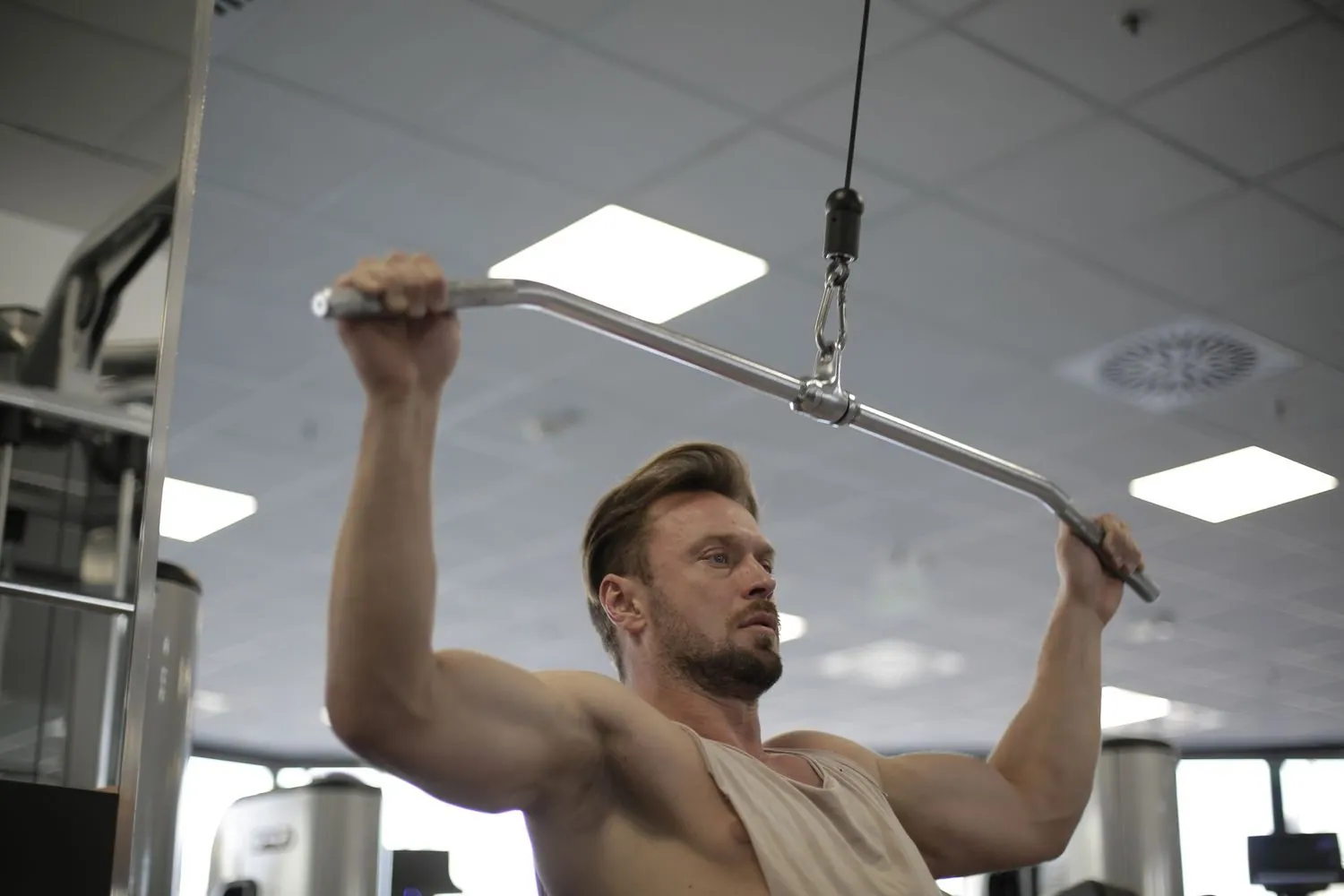
| 2 | Lat pulldown | 3 x 8-12 | 90 sec | Lead with the elbows, chest up, no swinging |
| 2 | Seated cable row | 3 x 10-12 | 90 sec | Pause one second at the chest, do not lean back to finish the rep |
| 2 | Dumbbell biceps curl | 3 x 10-12 | 60 sec | Elbows stay at your sides, lower for a slow count of two |
| 2 | Cable rope hammer curl | 3 x 12 | 60 sec | Neutral grip, wrists straight |
| 3 | Barbell back squat | 4 x 6-8 | 2-3 min | Brace the core, knees track over the toes, squat to a depth you control |
| 3 | Leg press | 3 x 10-12 | 90 sec | Lower back stays on the pad, do not lock the knees at the top |
| 3 | Seated leg curl | 3 x 10-12 | 60-90 sec | Control the return, hips stay down |
| 3 | Leg extension | 3 x 12-15 | 60 sec | Pause at the top, no kicking the weight up |
| 3 | Standing calf raise | 4 x 12-15 | 60 sec | Full stretch at the bottom, pause at the top |
Days 4 to 6: shoulders, full body and the easy day
On day 5, keep the reps low, the form strict and the total sets modest.
| Day | Exercise | Sets x reps | Rest | Form cue |
|---|---|---|---|---|
| 4 | Standing barbell overhead press | 4 x 6-8 | 2 min | Glutes tight, ribs down, move your head through once the bar passes |
| 4 | Dumbbell lateral raise | 3 x 12-15 | 60 sec | Lead with the elbows, stop at shoulder height |
| 4 | Cable face pull | 3 x 15 | 60 sec | Rope to eye level, elbows high, squeeze the upper back |
| 4 | Cable or machine crunch | 3 x 12-15 | 60 sec | Curl the ribs towards the pelvis, hips stay still |
| 4 | Hanging leg raise | 3 x 8-12 | 60 sec | Tuck the pelvis at the top, no swinging |
| 5 | Barbell deadlift | 4 x 5 | 2-3 min | Bar over mid-foot, lats tight, push the floor away |
| 5 | Machine chest press | 3 x 10 | 90 sec | Seat height so handles sit level with mid-chest |
| 5 | Machine seated row | 3 x 10 | 90 sec | Chest on the pad, pull the elbows back |
| 5 | Dumbbell walking lunge | 3 x 10 each leg | 90 sec | Long step, torso upright, front knee steady |
| 5 | Plank | 3 x 30-45 sec | 45-60 sec | Ribs down, glutes squeezed, straight line head to heel |
Day 6 is deliberately boring. Do 20 to 25 minutes of incline walking or easy cycling at a pace where you can hold a conversation, then a hip flexor stretch (two rounds of 30 seconds per side), thoracic rotations (eight per side) and one to two minutes of foam rolling on quads, back and calves. If you want more structure for the cardio part, our gym cardio workout plan shows how to scale it.
This is different from a straight 6 day gym workout schedule, where all six sessions are loaded. Here one of the six is intentionally light.
Do you need to train all seven days to get results?
No. Most people build muscle and strength well on 3 to 5 loaded sessions a week, provided they add weight or reps gradually, eat enough protein and sleep 7 to 9 hours. Training hard on all seven days usually backfires within weeks through poor sleep, stalled lifts and sore joints.
Myth: more days in the gym means faster progress. Muscle is stimulated in the gym and rebuilt afterwards, and rebuilding needs time, food and sleep. Five focused days with real recovery usually beat seven tired ones.
If you would rather train fewer days, our 5 day workout plan keeps the same logic with two full off days.
How do you progress week to week without stalling?
Use double progression. Stay at the same weight until you hit the top of the rep range on every set, for example 8 reps on all four sets. Then add the smallest jump, usually 2.5 kg on upper body barbell lifts and 5 kg on squats and deadlifts, and start again at the bottom of the range.
Write every session down: exercise, weight, reps per set. If you benched 60 kg for 4 x 6 last week, aim for 60 kg for 4 x 7 this week, or 62.5 kg for 4 x 6 if the reps felt easy.
Every 4 to 6 weeks, take a lighter week. Keep the same exercises and schedule, drop to about two thirds of the usual sets and use weights roughly 10 percent lighter.
Food matters here too. A common target for people lifting regularly is roughly 1.6 to 2 grams of protein per kg of bodyweight a day, so about 110 to 140 g for a 70 kg person. In an Indian kitchen that can be eggs (about 6 g each), dal and curd, paneer (roughly 18 g per 100 g), chicken, and soya chunks. If you want a plan around your own food habits, a session with an online nutritionist is the faster route, and our gym workout diet plan covers the basics.
Troubleshooting: when the week stops working
Your lifts have not moved in three weeks. Check the boring things first: are you sleeping at least 7 hours, eating enough protein, and actually logging your sets? If yes, repeat the same weights for one more week, then take the lighter week described above.
Day 3 leg soreness ruins day 4 and day 5. Cut one set from the leg press and leg extension for two weeks, and use a lighter deadlift on day 5 until your legs adapt. Do not skip the session altogether.
Your shoulders complain on bench or overhead press. Narrow your grip slightly, keep elbows closer to 45 degrees, and swap the barbell for dumbbells or a machine press for a few weeks. Sharp or lingering pain is a reason to stop and see a doctor or physiotherapist, not to push through.
You only have 45 minutes. Do the first compound lift at full sets, then two accessory exercises with two sets each.
How should beginners, women and busy people adjust the plan?
Beginners should start with 2 to 3 sets per exercise for the first 2 to 3 weeks, choose weights that leave three or more reps in reserve, and swap the barbell deadlift for a lighter hinge such as a Romanian deadlift with dumbbells. Get a coach to check squat, bench and deadlift form once before loading up.
For a 7 day gym workout plan for beginners, the best first goal is simply to complete the week on schedule for a month. Heavy weights can wait. If you also want help with technique, 1-on-1 personal training lets a coach watch your form live and adjust loads session by session.
Women can run this plan exactly as written. There is no separate way to “tone” a muscle: the same mix of heavier strength work and moderate reps applies. If you want more lower-body emphasis, add a set to leg curls and lunges and read our gym workout plan for women.
Fat loss goals need a calorie deficit, and the gym alone will not create one. A realistic pace for most people is roughly 0.25 to 0.75 kg a week, and anything that promises far more is not a safe target. Keep lifting through the deficit to hold on to muscle. For a structured plan, an online weight loss trainer can combine training and food targets in one place.
If you have a medical condition, an injury, or are returning after a long break, check with your doctor before starting a heavy programme.
Not sure which structure suits you? Our broader gym workout guide helps you choose between 3 and 6 days.
Frequently asked questions
Is a 7 day gym workout plan too much for beginners?
Not if it includes recovery. Beginners should use 2 to 3 sets per exercise for the first few weeks, keep weights light enough to leave reps in reserve, and treat day 6 and day 7 as non-negotiable. The plan only becomes too much when all seven days are loaded.
How long should each session last?
Plan on 55 to 75 minutes including warm-up. Leg day usually runs longest because of the heavy squats and longer rests. Regularly passing 90 minutes usually means long rests or extra exercises.
Can I follow this plan with only 4 days at the gym?
Yes. Train days 1, 2, 3 and 5, and move 3 sets of lateral raises and face pulls onto days 1 and 2 so shoulders still get work. Use the other three days for walking, stretching or full rest. Your weekly volume drops a little, but the structure still works.
How many rest days do I need in a 7 day gym workout plan?
One full rest day and one light day is a sensible minimum for most lifters. The light day should be easy walking, cycling or mobility work at a conversational pace. If you feel unusually drained, add another rest day.
Can I do cardio on the strength days?
You can, but keep it short. Ten to 15 minutes of easy cardio after lifting is fine for most people. Avoid hard intervals before leg day or deadlifts, because tired legs make those lifts less safe.
If you want this week built around your body, your schedule and a coach checking your form, book a session with a FitStrot trainer through 1-on-1 personal training and start with a form check on your squat and deadlift.


