
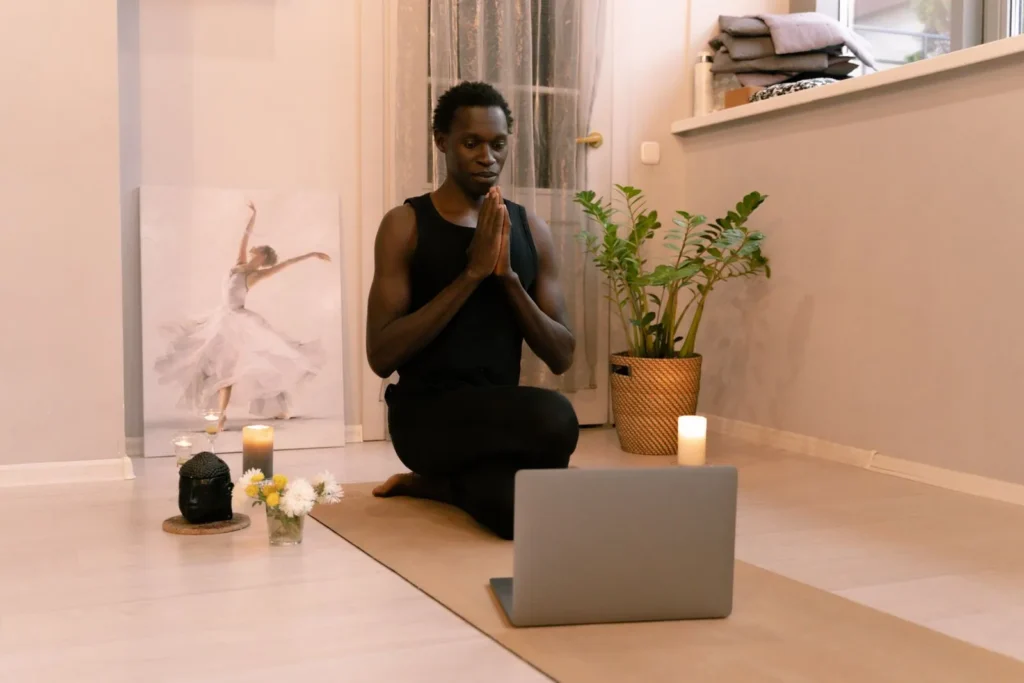
If you are weighing online yoga teacher training, the useful question is not whether it is allowed. It is whether one specific course will turn you into a teacher who can run a safe, clear class on your own. Video works well for lectures, anatomy and philosophy, and it can work for practice teaching too, but it has real limits. This guide explains how an online course is built, how to verify a school before you pay, where the format falls short and what to do when it stalls.
How does online yoga teacher training work?
Online yoga teacher training moves a standard 200-hour teacher course onto video. You attend live classes with trainers, watch recorded lectures, finish reading and written work, and teach short practice classes on camera for feedback. A typical part-time course takes roughly 13 to 20 weeks at 10 to 15 hours a week, then ends with an exam and a teaching demonstration.
A typical live-cohort week has two or three live sessions of 90 to 120 minutes (asana lab, anatomy, philosophy), three to five hours of recorded lectures and reading, one short written task, and a practice-teaching slot in a group of 3 to 6 trainees where you lead 10 to 20 minutes and get comments.
The calendar matters more than people expect. Some schools run on a global clock, so a class may start at 5 am or end near midnight in Indian time. Ask for the weekly timetable before you pay.
What does a 200 hour online yoga teacher training syllabus cover?
A 200 hour online yoga teacher training syllabus usually splits into five areas: techniques and practice (roughly 60 to 100 hours), teaching methodology, anatomy and physiology, and philosophy and ethics (each roughly 20 to 30 hours), and practicum (roughly 10 to 25 hours). Exact splits differ by school, so ask for the hour breakdown in writing.
| Syllabus area | Typical hours (approx.) | What you do online | Hardest part to learn on video |
|---|---|---|---|
| Techniques and practice | 60 to 100 | Asana labs, pranayama, meditation, guided practice on camera | Feeling your own alignment without a trainer’s hands correcting you |
| Teaching methodology | 20 to 30 | Sequencing, cueing language, timing a class, using props | Reading a room and adjusting a class on the spot |
| Anatomy and physiology | 20 to 30 | Lectures, models, joint-by-joint breakdowns, contraindications | Seeing real bodies move differently from the textbook |
| Philosophy and ethics | 20 to 30 | Text study, discussion, a teacher’s code of conduct | Little; this area translates to video very well |
| Practicum | 10 to 25 | Teaching peers live and receiving written and spoken feedback | Needs a live audience and a trainer watching; recordings alone fall short |
Not every hour is live, because schools count self-study and assignments inside the 200. What matters is how many hours happen with a trainer present. Compare any syllabus with our guide to the 200 hour yoga teacher training standard.
From enrolment to certificate: the stages in order
Most courses follow the same arc, so you can spot a program that skips a stage.
- Screening (week 0). A good school asks about your practice history and injuries.
- Foundations (weeks 1 to 3). Anatomy basics, a core pose library and breathing.
- Method (weeks 4 to 8). Sequencing, cueing and your first short practice teaches.
- Depth (weeks 8 to 12). Philosophy, ethics, meditation teaching and longer practice classes.
- Assessment (final 2 to 3 weeks). A written exam and a full class taught under observation.
- Your first 20 to 30 classes. Outside the course, but this is where most real learning happens, usually over 6 to 12 months.
Intensive formats squeeze these stages into about 4 weeks of 6 to 8 hours daily, which leaves little time to absorb anatomy.
Live, recorded or hybrid: which online format fits you?
For most people, a live cohort course gives the best balance: fixed sessions, real-time feedback on your teaching and 10 to 20 other trainees to practise with. Self-paced recorded courses cost less effort to schedule but give the least feedback. Hybrid courses add a short in-person block, usually 5 to 10 days, for hands-on work.
| Format | Feedback on your teaching | Schedule flexibility | Main risk | Best suited to |
|---|---|---|---|---|
| Live cohort online | High: trainers and peers respond in real time | Low to medium: fixed weekly slots | Missing sessions when work runs late | People who need structure and accountability |
| Self-paced recorded | Low: usually assignments marked later | High: study at 6 am or midnight | Drifting, and never practising teaching aloud | Self-driven students with a strong personal practice |
| Hybrid: online plus short in-person block | High, with hands-on adjustment practice | Medium, plus travel for the in-person days | Travel and leave from work | Anyone who wants the theory online and the touch skills in person |
If you are still unsure what separates teacher training from a general course, read our notes on a yoga certificate course and on the wider range of yoga courses. A certificate course may deepen your practice without qualifying you to teach.
How do you check that an online yoga teacher training program is legitimate?
Check five things before paying: the school’s registration, shown on the registry’s own listing; the lead trainer’s teaching history; the number of live contact hours; how many times you will teach and be critiqued; and the written refund terms. Treat a website badge as a claim, not proof.
| What to check | How to verify it | Red flag |
|---|---|---|
| School registration | Search the school by name on the registry it claims, such as Yoga Alliance; ask whether the course itself is registered, not only the school | “Approved” with no registry name, or a logo that links nowhere |
| Lead trainer experience | Ask how many years and how many hours they have taught and trained others | A trainer who has taught for a year or two |
| Live contact hours | Request a count of hours with a trainer present, in writing | Mostly recorded video sold as “live-style” |
| Practicum | Ask how many times you will teach live and who gives feedback | Fewer than a handful of teaching slots, or peer feedback only |
| Refund and deferral terms | Read the policy before payment, including what happens if you miss modules | No written policy, or pressure to pay today |
In India you may also come across the Yoga Certification Board under the Ministry of AYUSH, which runs its own certification scheme. Employers value different credentials, so ask a few studios which one they recognise. Independent graduate reviews tell you more than testimonials on the school’s own site.
Myth check: what online certification does not promise
Myth 1: “Certified in a weekend.” A credible 200-hour course takes weeks of study. A few days of training is selling a certificate.
Myth 2: “Recorded lectures equal live training.” Recordings teach content well. They cannot watch you cue a pose and tell you the instructions confused the room.
Myth 3: “Finishing the course makes you an expert.” It makes you a beginner teacher with a foundation.
What can’t online yoga teacher training teach you?
Online training cannot reliably teach hands-on adjustments, physical room presence or screening a stranger’s injury in person. A 200-hour course delivers knowledge and structured practice, but confidence usually comes from teaching real students, typically dozens of classes across your first 6 to 12 months. Plan for that gap instead of ignoring it.

Here is how to cover the main gaps:
- Hands-on adjustment: Treat it as a separate skill. Lean on verbal cues, props and demonstration, and attend an in-person workshop or hybrid block if you plan to teach in studios.
- Injury awareness: You will learn contraindications, but you are not a medical professional. Ask students about injuries and pregnancy before class and refer anything beyond that to a doctor.
- Room presence: Camera teaching hides body language, so teach a few free classes to real people in a room.
- Immersion: A residential course such as yoga teacher training in Rishikesh gives days of shared practice that a weekly video call cannot copy.
Troubleshooting: when your online training starts to slip
You are falling behind. Block fixed study slots, such as 6 to 7:30 am on weekdays, instead of “whenever there is time”. If you are more than two modules behind, tell the school early; many let you join a later cohort for missed sessions.
Feedback is thin. Ask for specific notes: one thing to keep, one to change. If you only get a score, request a 1-to-1 review before the final assessment.
Your connection drops mid-class. Use a wired connection or sit near the router, close other apps, and keep a phone hotspot as backup.
You look cramped on camera. Place the camera about hip height and a few steps away so the trainer sees your whole body, with light in front of you.
Who should choose online, and who should go in person?
Online suits working professionals, parents and people in towns without a quality school nearby, because it removes travel and a month’s leave. In-person suits people who learn by touch, want total immersion or need hands-on correction. Whichever you choose, arrive with a steady personal practice of at least 6 to 12 months.
- Complete beginners: Possible, but the pace is hard if poses are still new. Build a base first with yoga for beginners and a few months of hatha yoga.
- Flow practitioners: If your practice is mostly vinyasa yoga, check that the course also covers slower styles such as yin yoga and how to teach meditation for beginners.
- People with injuries or a medical condition: Tell the trainers up front and check with your doctor first. A 4-week intensive is a heavy physical load.
Why do online yoga teacher training fees vary so much?
Fees differ mainly because of live contact hours, cohort size, trainer experience, assessment support and what is bundled in. A course with 80 live hours in a group of 15 costs a school far more to run than one with 20 live hours in a batch of 100. We do not quote prices here because they change and vary widely.
To compare two quotes, divide the fee by the live contact hours. That shows what you pay per hour of a trainer’s attention. An affordable online yoga teacher training course has a fair cost per live hour, not just the lowest headline fee. Also ask whether manual, exam and certificate fees, registration support, recordings of missed sessions, assessment re-takes and GST are included.
Will studios and employers accept an online certificate?
Many do, provided the school is genuinely registered and the course included live practice teaching. Some studios still prefer in-person trainees or a specific credential, so ask the studios you hope to join which certificates they accept before you enrol.
The certificate opens the door, but your teaching decides what happens next. For what employers look for, see our guide to yoga instructor jobs.
Build your own practice first
The best preparation for teaching is being a student of good teaching. Join a live class on FitStrot’s online yoga classes and notice how the trainer cues, paces and corrects through a screen. Our online yoga classes guide explains what to expect from your first sessions.
Online yoga teacher training: frequently asked questions
Is online yoga teacher training worth it?
It is worth it if you pick a registered school with live teaching practice and then teach real classes. It is not worth it if the course is mostly recordings, gives no individual feedback or promises certification in days.
Can a complete beginner join an online yoga teacher training course?
Most schools prefer 6 to 12 months of regular practice first. A beginner can enrol in some courses, but the pace is demanding because poses, anatomy and teaching language arrive together.
How long does a 200 hour online yoga teacher training course take?
Part-time live courses usually take about 13 to 20 weeks at 10 to 15 hours a week. Intensives compress it into roughly 4 weeks, and self-paced programs may allow 6 to 12 months.
Does an online yoga teacher training certification count for Yoga Alliance registration?
It can, if the school or course is registered with Yoga Alliance for online delivery and meets its curriculum and contact-hour rules. Rules change, so check the current listing and ask the school to confirm in writing.
What is the difference between a yoga certificate course and teacher training?
Teacher training prepares you to lead classes, with methodology, anatomy and supervised practice teaching. A certificate course may be a general program for your own knowledge and may not qualify you to teach.


