
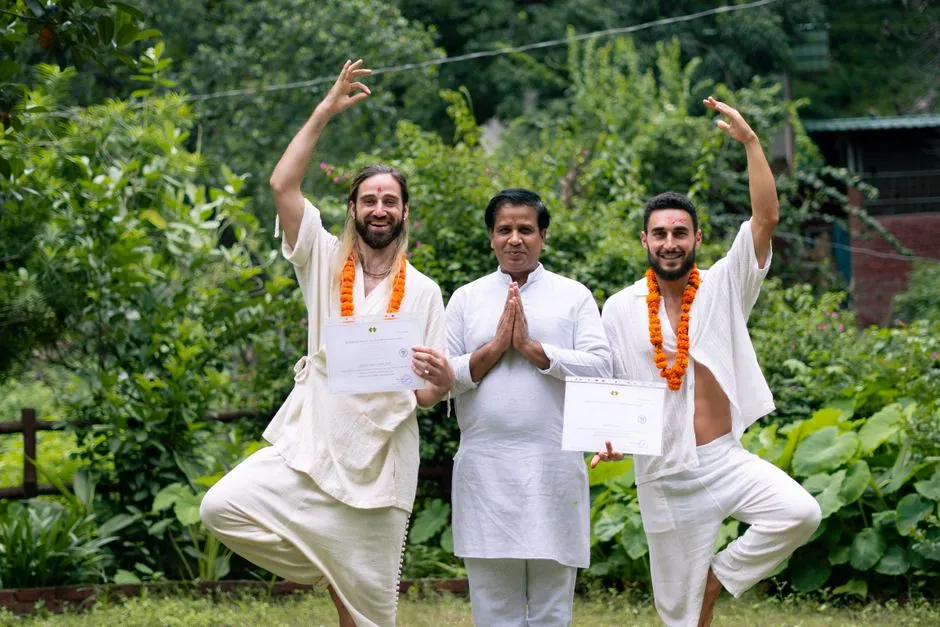
A 200 hour yoga teacher training is the entry-level qualification that turns a regular practitioner into someone certified to lead a class. Under the Yoga Alliance standard those 200 hours split across four educational categories, at least 150 must be taught by a Lead Trainer holding the E-RYT 500 credential, and at least 30 must happen live rather than as recorded video. That is the entire professional substance of the course. Everything else — the ashram, the Ganga, the ₹ price tag, the Instagram grid — is packaging, and the packaging is where most people choose badly.
This page is for the Indian reader deciding whether to spend weeks and real money on a certificate: what the hours contain, how the Yoga Alliance route differs from the Ministry of AYUSH route that governs school and government jobs here, and how to vet a school before you transfer a deposit.
What does a 200 hour yoga teacher training course actually certify you to do?
A 200 hour yoga teacher training course certifies that you completed 200 hours of structured study across asana, anatomy, yoga philosophy and teaching methodology, and were assessed as competent to lead a general-level group class. It does not certify you as a yoga therapist, does not permit you to treat medical conditions, and carries no statutory licence in India.
That distinction matters more than schools admit. Yoga Alliance is a US membership body, not a regulator, and its own standards say schools “should not graduate students simply because they have completed the teacher training” if the trainee cannot demonstrate proficiency. A certificate from a Registered Yoga School (RYS 200) makes you eligible to register as an RYT 200, which studios worldwide treat as a hiring baseline — completion plus assessment, not a licence.
The 200 hour yoga teacher training curriculum, category by category
The 2022 revision replaced the older five-category split with four categories plus a block of remaining hours. The published RYS standards allocate them as below — and a school that cannot show you this breakdown on paper is not following the standard it claims.
| Educational category | Hours | What it covers | Question to ask the school |
|---|---|---|---|
| Techniques, Training and Practice | 75 | Asana, pranayama (ujjayi, nadi shodhana, kapalabhati), meditation, chanting, mantra, mudra — teaching plus guided practice | How many of the 75 are my own practice vs learning to teach? |
| Anatomy and Physiology | 30 | Musculoskeletal and systemic anatomy plus subtle-body anatomy (chakras, nadis), applied to yoga | Who teaches this block, and with what qualification? |
| Yoga Humanities | 30 | Philosophy, history, lifestyle and ethics — formerly Yoga Philosophy, Lifestyle and Ethics | Which texts, and in translation or original? |
| Professional Essentials | 50 | Teaching methodology and practicum merged: sequencing, cueing, assists, class management, observed teaching | How many times will I teach and be assessed? |
| Remaining / elective hours | 15 | School-specific content within the four categories | What fills these? |
| Total | 200 | Minimum 30 hours synchronous; minimum 150 taught by a Lead Trainer | Name your Lead Trainer and their E-RYT 500 number |
Two numbers do most of the filtering. The 150 Lead Trainer hours stop a school handing the course to junior staff. The 30 synchronous hours are the floor for live interaction, which is why a fully recorded “watch at your own pace” package cannot be a compliant RYS 200. If the schedule shows one senior teacher appearing for a Saturday philosophy talk, the maths fails.

200 hour yoga teacher training and Yoga Alliance versus the Ministry of AYUSH route
This is the section Indian readers need most and school marketing never mentions. India’s own credentialing body is the Yoga Certification Board under the Ministry of AYUSH, which certifies yoga professionals at four levels: Level 1 Yoga Protocol Instructor, Level 2 Yoga Wellness Instructor, Level 3 Yoga Teacher and Evaluator, and Level 4 Yoga Master, alongside separate yoga therapy tracks.
The YCB route differs in three ways. It is examination-based: the Board states there is no minimum educational qualification and no age limit, and candidates may apply directly for any level. Its certificates expire — Level 1 after five years, Levels 2 and 3 after three, renewable through a Continuing Yoga Education Programme. And it is the credential Indian government bodies, CBSE schools and PSUs generally ask for.
Practically: for studios, corporate wellness and international online teaching, the RYT 200 is the useful badge. For a government, school or hospital-adjacent job in India, the YCB certification opens the door. The syllabus overlap is large, so many serious Indian teachers hold both — and the least wasteful sequence is the 200 hour course first, then the YCB Level 2 exam with the study already done.
200 hour yoga teacher training in India: Rishikesh, Goa, Kerala and Bangalore compared
India hosts more registered 200 hour programmes than any other country, and these four clusters behave very differently. This compares format, climate and trade-offs; it is not a ranking or an endorsement.
| Base | Usual format | Comfortable months | Suits you if | Honest trade-off |
|---|---|---|---|---|
| Rishikesh (Tapovan, Laxman Jhula) | 3–4 week residential, ashram or guesthouse, vegetarian mess | Feb–Apr, Sep–Nov | You want traditional Hatha, chanting and philosophy as a living lineage, at India’s lowest cost per week | School density means very uneven quality; monsoon and peak summer are hard |
| Goa (North and South coast) | 3–4 week residential at a beach resort or retreat centre | Nov–Mar only | You want a 200 hour yoga teacher training in Goa: lighter, vinyasa-leaning, international peer group | Most schools close out of season; resort setting dilutes discipline; usually costliest |
| Kerala (Varkala, Kovalam, Wayanad) | 4 week residential, often paired with Ayurveda modules | Oct–Mar | A 200 hour yoga teacher training in Kerala suits Ayurveda interest, pranayama depth, a quiet setting | Fewer programmes so dates are inflexible; humidity; longer travel legs |
| Bangalore and Mysuru | Weekend or evening modules over 3–5 months; some residential | Year-round | A 200 hour yoga teacher training in Bangalore fits if you cannot take a month off; Mysuru for Ashtanga | Momentum is hard to hold; you practise tired after work; no immersion effect |

A day inside a 200 hour yoga teacher training in Rishikesh
A typical residential day runs 5:30am to 8:00pm, six days a week: shatkarma and pranayama before sunrise, a two-hour asana class, breakfast, an anatomy or philosophy lecture, lunch and a study gap, a second asana or methodology session late afternoon, then meditation or satsang. Close to seven contact hours daily — which is why 200 hours compresses into 24 to 28 days, and why arriving prepared matters.
Online 200 hour yoga teacher training versus residential: an honest comparison
An online 200 hour yoga teacher training is fully legitimate under current Yoga Alliance rules: schools may run programmes 100% in person, 100% by distance learning or as a mix, provided at least 15% of hours (30 for an RYS 200) are synchronous. The question is not legitimacy but what each format is good at.
| Factor | Online / distance | Residential intensive | Weekend modular |
|---|---|---|---|
| Calendar cost | 3–9 months, 8–12 hrs/week | 24–28 continuous days | 3–5 months of weekends |
| Total outlay | Lowest — no travel, stay or food | Highest — tuition plus room and board | Middle — local travel only |
| Hands-on assists learned | Weakest; practise separately | Strongest; daily partner work | Moderate |
| Practicum realism | Webcam teaching; harder to read a room | Live group, mentor watching | Live, but long gaps between sessions |
| Injury and overuse risk | Low — load spread out | Higher — sudden jump in daily volume | Low |
| Retention of philosophy | Good if assignments are graded | Good, reinforced by daily repetition | Weakest without self-study |
| Best for | Working adults, carers, anyone who cannot travel | A clean break, fastest skill jump | Steady learners near a local school |
Before committing money, a few weeks of structured online yoga classes is a cheap diagnostic: watching a competent teacher sequence, cue and manage a mixed-ability room teaches you more than any brochure. Our guide to the best online yoga classes covers what to look for.
The cost of 200 hour yoga teacher training: what the fee should cover
Fees vary so widely between Rishikesh, Goa and metro weekend programmes that any figure quoted online is meaningless. What you control is the itemisation — ask for a written break-up before paying.
- Tuition — the 200 contact and non-contact hours themselves, with the Lead Trainer named.
- Accommodation and meals — how many nights, shared or private, how many meals a day, and what an early arrival costs.
- Course manual and props — a printed manual, mat, belt and blocks, or are these extra.
- Excursions and extras — Ganga aarti trips, Ayurveda treatments and kirtan evenings are often billed separately.
- Certificate issuance — whether the RYS 200 completion certificate carries any additional charge.
- Yoga Alliance registration — never included. Registering as an RYT is a separate transaction: a one-time US$50 application fee plus US$65 first-year membership, US$115 total, per the official RYT application guide — roughly ₹10,000 in year one, then annual renewal. Budget for it; it catches people out.
Confirm the refund and date-transfer policy in writing too — residential intakes fill months ahead, and a deposit that cannot move if you fall ill is a real risk.
Four things people get wrong before they enrol
“I need to be flexible first.” No. A 200 hour course is not a flexibility test, and Mayo Clinic’s guidance on yoga is explicit that you need not do every pose and should skip anything uncomfortable. What you need is enough daily practice to survive the volume — a different quality entirely.
“Yoga is injury-free, so a month of it is safe.” Safer than most activities, but not risk-free. A systematic review of nine studies covering 9,129 practitioners found adverse events during a yoga class in 22.7%, a 12-month prevalence of 4.6% and serious adverse events in 1.9% — mostly sprains and strains, with raised meniscus-injury risk versus non-practitioners (Cramer et al., Journal of Science and Medicine in Sport, 2018). Going from three classes a week to fourteen overnight is exactly what produces those sprains. The authors conclude healthy people need not be discouraged, but anyone with a serious acute or chronic condition should seek medical advice first.
“The certificate is the hard part.” It is the easy part. The US National Center for Complementary and Integrative Health records adult yoga participation rising from 5.0% in 2002 to 15.8% in 2022 — the student base tripled, and so did the number of certificate holders chasing the same studio slots. What separates working teachers from shelved certificates is hours taught after graduation.
“A month of yoga will fix my body.” It will change it measurably, not transform it. Harvard Health reports that eight weeks of twice-weekly yoga — 180 minutes a week — produced gains in muscle strength and endurance, flexibility and cardio-respiratory fitness in sedentary people (Harvard Health Publishing). Real, useful, modest. The NHS lists yoga as a muscle-strengthening activity for at least two days a week alongside 150 minutes of moderate aerobic activity — a component of a week, not a replacement for one.
Eight weeks of preparation before the course starts
The biggest predictor of enjoying a residential intensive is arriving already conditioned to daily practice. Build volume gradually over the eight weeks before your start date.
| Weeks | Asana practice | Strength and mobility | Study | Form cue to hold |
|---|---|---|---|---|
| 1–2 | 4 sessions/week, 45 min, gentle Hatha | 2 × 20 min: 3 sets × 8 squats, 3 × 6 incline push-ups, 90 s rest | One translation of the Yoga Sutras, Book 1 | Ribs down, not flared, in every overhead reach |
| 3–4 | 5 sessions/week, 60 min, add sun salutations | 2 × 25 min: 3 × 10 squats, 3 × 8 push-ups, 3 × 30 s forearm plank, 90 s rest | Sanskrit names for 20 foundational asanas | Front knee tracks over the second toe in lunges |
| 5–6 | 6 sessions/week, 60–75 min, 2 rounds of 12 sun salutations | 2 × 25 min: add 3 × 8 single-leg glute bridges, 3 × 20 s side plank each side | Basic anatomy: spine, shoulder, hip | Shoulders away from ears in chaturanga and plank |
| 7–8 | 6 sessions/week, 75–90 min, one full-length class daily | 1 × 25 min maintenance; prioritise sleep | Teach a 20-min sequence aloud to one person | Cue the breath before the shape, every time |
Starting from scratch, a structured daily yoga routine is a better on-ramp than jumping to week-7 volume. If your course is Ashtanga-based, front-load the Ashtanga primary series — arriving cold to a counted led class is a rough first morning.
How to vet a school before you transfer a deposit
Run every shortlisted school through these checks. Each takes minutes; each has sunk somebody’s money.
- Verify the RYS 200 listing independently on the Yoga Alliance directory rather than trusting a logo on a website, and check the credential is currently active.
- Get the Lead Trainer’s name and E-RYT 500 status, and confirm they teach your specific dates.
- Ask for the hour-by-hour schedule mapped to the four categories. A compliant school already has this document; hesitation here is the strongest warning sign.
- Count the practicum: how many times you personally teach, for how long, to how many people, and who gives feedback. Fewer than five observed slots in 200 hours is thin.
- Check group size. Above roughly 25 trainees, individual feedback and hands-on correction collapse whatever the trainer’s quality.
- Read the two- and three-star reviews only, looking for repeated themes — food, accommodation, an absent trainer — rather than isolated complaints.
- Confirm what happens if you fall ill mid-course — make up hours, defer, or lose the fee?
The first 90 days after you qualify
Certification is a starting line. Teachers who build something in the first three months do four things: teach free or low-cost classes to bank real hours fast; register the credential so they are findable; pick one narrow audience — desk workers with stiff necks, pregnant students, over-60s, absolute beginners — rather than marketing to everyone; and keep studying, because 30 hours of philosophy is an introduction, not a foundation.
Specialisation is not a marketing trick — the evidence supports it. A study of 33 school principals aged 40–59 who completed a one-week residential yoga programme at an Indian institute found significant reductions in overall occupational stress and in role overload, role ambiguity and powerlessness (Verma et al., Journal of Education and Health Promotion, 2020). Institutional and corporate yoga is a researched application, and a teacher who can speak to that audience has an easier conversation than one offering generic classes. Grounding yourself in the history of yoga also makes your philosophy hours usable rather than decorative.

Frequently asked questions about 200 hour yoga teacher training
Do I need to be flexible or advanced to join a 200 hour yoga teacher training?
No. Most reputable schools ask for roughly six months of regular practice and no specific postures. Teaching competence rests on observation, cueing and sequencing, not personal range of motion. Mayo Clinic guidance is explicit that no practitioner has to attempt every pose.
Is a 200 hour yoga teacher training certificate valid internationally?
A certificate from a Yoga Alliance Registered Yoga School makes you eligible to register as an RYT 200, which studios in most countries accept as a hiring baseline. It is a voluntary membership credential, not a government licence, so no country is obliged to recognise it and some employers also ask for local qualifications.
Can I teach professionally in India with only a 200 hour certificate?
For private studios, corporate wellness contracts and online teaching, generally yes. For government schools, PSUs and AYUSH-linked institutions, employers usually ask for Yoga Certification Board certification under the Ministry of AYUSH — most commonly Level 2 Yoga Wellness Instructor or Level 3 Yoga Teacher and Evaluator — which is awarded by examination.
How long does a 200 hour yoga teacher training take?
A residential intensive compresses the 200 hours into roughly 24 to 28 days at six to seven contact hours daily, six days a week. Weekend modular formats spread the same hours over three to five months, and online programmes typically run three to nine months at eight to twelve hours per week.
Is an online 200 hour yoga teacher training recognised by Yoga Alliance?
Yes. Registered Yoga Schools may deliver programmes fully in person, fully by distance learning or as a hybrid, provided at least 15% of programme hours are synchronous — 30 hours for an RYS 200. A course made entirely of pre-recorded video with no live sessions does not meet that standard.
What is the difference between a 200 hour and a 300 hour yoga teacher training?
The 200 hour is the foundational qualification; the 300 hour is advanced continuing education taken afterwards, and completing both gives the RYT 500 credential. The 300 hour standard is structured differently, with 270 of its 300 hours required as contact hours across five categories.
What should the cost of a 200 hour yoga teacher training include?
Ask for a written break-up covering tuition, accommodation, meals, manual, props, excursions and certificate issuance. Yoga Alliance registration is always separate: US$50 application plus US$65 first-year membership, US$115 in total, or roughly ₹10,000 at current rates.
Is a 200 hour yoga teacher training physically safe?
For healthy adults it is generally safe, but the jump in daily volume carries real risk. A systematic review of 9,129 practitioners found adverse events in 22.7% of yoga classes and serious adverse events in 1.9%, most commonly sprains and strains. Build up practice volume for eight weeks beforehand, and consult your doctor first if you have any acute or chronic condition, recent surgery, uncontrolled blood pressure or a joint injury.
Before you pay the deposit
Do one thing this week: email your two shortlisted schools and ask each for the hour-by-hour schedule mapped to the four Yoga Alliance categories, plus the Lead Trainer’s name for your exact dates. The one that replies within 48 hours is the one worth your money. Want to test the teaching seat first? A few weeks of guided online yoga sessions with a Fitstrot teacher will tell you more than any brochure.
General information, not medical advice. If you have a health condition, are pregnant, are recovering from surgery or have a joint injury, speak to your doctor before starting an intensive yoga programme.


