
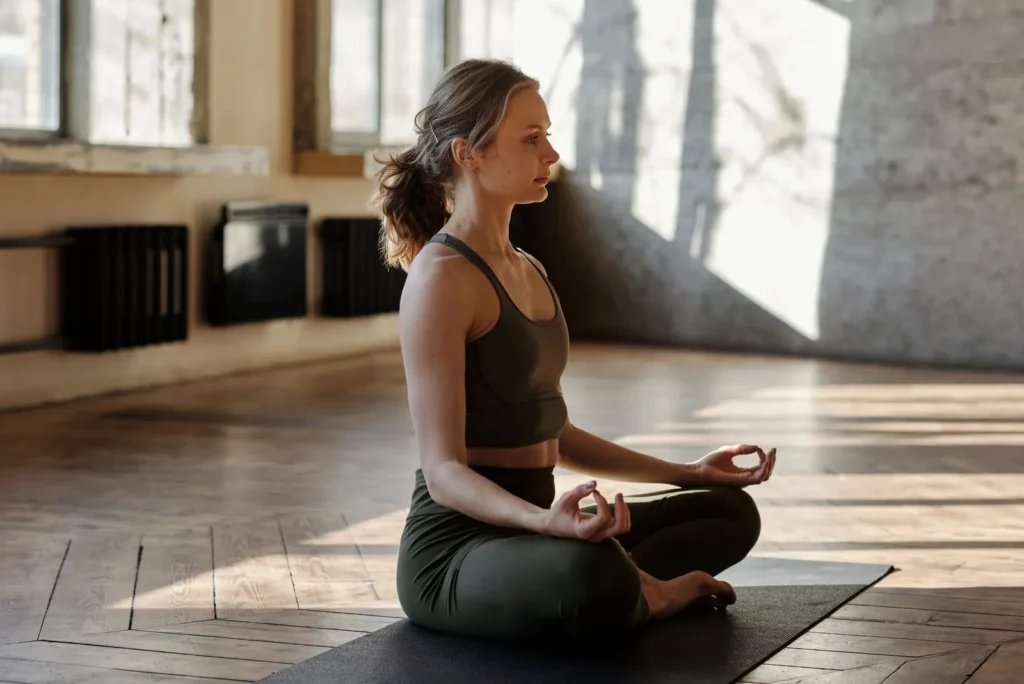
Used well, yoga for memory is a supportive habit, not a cure. A steady practice of 15 to 20 minutes, four to five days a week, can calm the stress that clouds recall, train your attention and improve sleep. It does not treat dementia, repair damage or replace medical care. Below are the poses, the breathing, a minute-by-minute routine and a plain list of who should skip what.
What does yoga for memory actually do?
Yoga supports memory indirectly. Slow breathing and stillness calm the stress response, regular practice improves sleep, and balance and breath-focus poses train sustained attention. You notice things better, so you remember them better. A routine of 15 to 20 minutes, practised most days for 8 to 12 weeks, is a sensible trial period.
Think of memory as three steps: taking information in, storing it (which happens largely during sleep) and pulling it back out. Constant stress and poor sleep interfere with all three. Yoga does not add a new memory skill; it removes some of the noise in the way. If your main struggle is staying on task, our guide to yoga for concentration covers the attention side in more depth.
A 15-minute yoga for brain memory routine, minute by minute
Do this before a study session, a work block or an important meeting, on a mat or a folded blanket, phone on silent. It uses only gentle poses, so most healthy adults can follow it. Read the safety section below first if you have any condition listed there.
| Minutes | Practice | How to do it | Form cue |
|---|---|---|---|
| 0-2 | Sit and settle | Cross-legged or on a chair, hands on knees, eyes closed | Lengthen the spine; soften the jaw |
| 2-5 | Alternate nostril breathing | Inhale left, exhale right, inhale right, exhale left. That is one round; do 8 to 10 rounds | Breath quiet, no strain, no holding |
| 5-7 | Bee breath (Bhramari) | Gentle hum on a long exhale, 5 to 6 rounds | Hum should feel smooth, not forced |
| 7-9 | Tree pose | Balance 30 seconds on each leg, gaze on one fixed point | Hand on a wall if needed |
| 9-11 | Seated forward fold | Hold 45 to 60 seconds with slow breaths | Bend knees; fold from the hips, not the back |
| 11-12 | Super Brain Yoga (optional) | 5 to 8 slow squats, steps below | Skip if knees complain |
| 12-15 | Corpse pose | Lie flat, let the breath be natural | Stay awake; observe sounds, then thoughts |
Myth check: does standing on your head “pump blood to the brain”?
Not in the way the claim suggests. Healthy brains already receive a steady blood supply, and the body works to keep it constant. Inversions are traditionally praised for memory, but the reliable benefit is calm and focus, not extra brain blood flow. They also carry real risks, so they are optional here.
Be equally wary of “yoga will reverse memory loss” or “one session fixes your memory”; no pose can do either, and any benefit builds over weeks. What you can honestly expect is a calmer mind, steadier attention and better sleep. If you want to try an inversion anyway, Sarvangasana (shoulder stand) is the classic one, and it belongs with a trained teacher watching your neck. Most people get the same calming effect from legs resting up a wall for a few minutes.
Yoga poses to improve memory: a pose-by-pose guide
None of these is magic. They are chosen because they steady the body, quiet the mind or demand attention. Pick three or four and do them well rather than rushing through ten.
| Pose | Hold | Why it is used | Skip or modify if |
|---|---|---|---|
| Sukhasana (easy pose) | 2 to 5 minutes | Stable seat for breathing practice | Hips or knees ache; sit on a chair or cushion |
| Padmasana (lotus) | 1 to 3 minutes | Traditional meditation seat | Any knee or ankle pain; use Sukhasana instead |
| Vrksasana (tree) | 30 seconds per side | Balance forces steady attention | Dizziness or balance problems; use a wall |
| Paschimottanasana (seated forward fold) | 45 to 60 seconds | Head-down fold encourages an inward, quiet state | Back injury or sciatica; keep knees bent |
| Sarvangasana (shoulder stand) | Short, with guidance only | Classic inversion in yoga tradition | Neck problems, high blood pressure, glaucoma, pregnancy, menstruation |
| Halasana (plough) | 30 to 60 seconds | Often follows shoulder stand | Same list as shoulder stand, plus tight hamstrings or back pain |
| Shavasana (corpse pose) | 3 to 5 minutes | Rest lets the nervous system settle | Lower back discomfort; place a pillow under the knees |
How to do Super Brain Yoga: a safe walkthrough
Super Brain Yoga is a short squatting exercise popular in wellness circles. It has not been proven by solid clinical research to improve memory, so treat it as a two-minute alertness ritual, not a treatment.
- Stand with feet about shoulder-width apart, facing forward.
- Cross your arms and hold the opposite earlobes, right hand on the left lobe, left hand on the right lobe, thumbs in front.
- Inhale slowly as you squat down, only as far as is comfortable.
- Exhale slowly as you rise.
- Repeat 5 to 8 times at first, building up gradually if it feels good. Stop at any dizziness.
Keep your heels down and your breath unhurried. If you have knee pain, dizziness on standing or balance trouble, do the same breathing pattern seated and hold the earlobes without squatting. Do not hold your breath, and stop if you feel lightheaded.
Pranayama for memory: which breathing practices help?
Breathing is the most useful part of this practice, because it directly calms the stress response. Alternate nostril breathing and bee breath are the two gentlest choices. Slow, even breaths at roughly 4 to 6 breaths per minute feel calming for most people, and 3 to 5 minutes is enough.
Alternate nostril breathing (Nadi Shodhana). Close the right nostril with your thumb, inhale through the left, then close the left with the ring finger and exhale through the right. Reverse the pattern. Keep the breath smooth, never forced, and skip breath holds if you are a beginner or have any heart or blood pressure concern.
Bee breath (Bhramari). Close the ears lightly with your fingers, inhale through the nose and hum as you exhale. People often use it just before studying.
Kapalbhati. This is an energising breath of short, sharp exhales, sometimes used to feel more alert. It is not a gentle practice and has real cautions: avoid it with high blood pressure, heart disease, hernia, epilepsy, recent abdominal surgery or pregnancy. Our Kapalbhati Kriya guide explains the technique and cautions properly. If in doubt, leave it out.
Who should avoid or modify these practices?
Anyone with high blood pressure, heart disease, neck problems, glaucoma, pregnancy, vertigo or joint pain should avoid or modify parts of this routine, mainly inversions, forceful breathing and deep squats. Yoga is low risk for most healthy adults, but check this list before you start:
- High or unstable blood pressure, heart disease: avoid inversions, forceful breathing such as Kapalbhati and breath holds. Stick to gentle seated breathing.
- Neck or cervical spine problems: avoid shoulder stand and plough pose completely.
- Glaucoma or other eye pressure conditions: avoid inversions and head-down positions held for long.
- Pregnancy: avoid inversions, Kapalbhati and deep squats unless your doctor and a prenatal yoga teacher approve a modified version.
- Knee, hip or ankle pain: skip lotus pose and deep squats; use a chair or cushion.
- Vertigo, dizziness, epilepsy or fainting episodes: avoid balance poses without support and skip fast breathing.
- Recent surgery, hernia or a back injury: get clearance before forward folds or breath work involving the abdomen.
See your doctor first, and do not rely on yoga for memory problems. Get a medical opinion promptly if memory loss is sudden, getting steadily worse, or noticed by family before you notice it. The same applies if you are getting lost in familiar places, repeating questions often, struggling with daily tasks, or if forgetfulness comes with confusion, headaches, low mood, or personality change. Memory changes can have treatable causes such as thyroid problems, vitamin B12 deficiency, poor sleep, depression or medication side effects, and a doctor can check these. Never stop or change any medicine because you have started yoga. Yoga can sit alongside medical care; it cannot replace it.
How often should you practise yoga for memory?
Practise 15 to 20 minutes, four to five days a week, for at least 8 to 12 weeks before judging results. Consistency matters more than intensity: short daily sessions beat one long weekend class. Place it before focused work, and keep at least one fully rest-based day each week.
Here is a simple starter week. Adjust the length to your energy, and drop anything that does not feel right in your body.
| Day | Focus | Time |
|---|---|---|
| Monday | Full 15-minute routine | 15 min |
| Tuesday | Breathing only: alternate nostril and bee breath | 10 min |
| Wednesday | Full 15-minute routine | 15 min |
| Thursday | Balance and forward fold, then rest pose | 15 min |
| Friday | Full 15-minute routine | 15 min |
| Saturday | Longer seated meditation and rest pose | 20 min |
| Sunday | Rest, or a gentle walk | – |
Stress is usually the first thing to calm, so our guide to yoga for stress is a good companion, and yoga for mental health covers mood and anxiety.
Yoga for students versus yoga after 50
For students and young professionals, the main wins are stress, sleep and focus. Use the 15-minute routine before a study block, keep screens away for the last 30 minutes before bed, and aim for about 7 to 9 hours of sleep, because much of what you studied is consolidated overnight. In exam weeks, a 5-minute breathing break between study blocks is more realistic than a long session.
After 50, the same gentle practice can be a useful part of a healthy-ageing routine alongside regular walking, good sleep, social contact and attention to blood pressure, sugar and cholesterol, which all affect brain health. Use a chair or wall for balance, skip inversions and fast breathing unless your doctor agrees, and favour calm breathing. If forgetfulness has changed noticeably, get it checked first.
Troubleshooting: “I have been doing yoga for weeks and nothing has changed”
- You are rushing. If your breath is not slow and your attention is not on it, you are doing stretching, not memory-supporting practice. Slow everything down.
- Sleep is short. Under about 6 hours a night, yoga cannot compensate. Fix bedtime first.
- You practise irregularly or multitask. Two sessions a week with long gaps rarely add up, and a phone in reach undermines attention training. Go shorter, more often, phone away.
- Your expectations are off. Yoga will not give you a photographic memory. Judge it by calmer study sessions, less forgetfulness caused by stress and better sleep.
- The cause is medical. If you have done everything right and memory still worries you, see a doctor.
Does yoga help with age-related memory loss?
Yoga may help support healthy ageing by reducing stress, improving sleep and keeping you active, but it is not proven to prevent or treat dementia or Alzheimer’s disease. Treat it as one supportive habit among several, and see a doctor for any significant or worsening memory change.
Healthy ageing is helped by many things together: movement, sleep, a balanced Indian diet with dal, vegetables, nuts and fruit, social connection, and managing blood pressure and sugar with your doctor. Yoga fits into that picture but should never be the only thing you rely on.
Frequently asked questions
Can yoga really improve memory power?
Yoga can support memory indirectly by lowering stress, improving sleep and training attention. It is not a guaranteed fix, and results differ from person to person. Think of it as a helpful daily habit, best combined with good sleep, food and medical care when needed.
How long does yoga take to improve memory?
Many people feel calmer and more focused within a few sessions, but changes in everyday recall are slower. Give a consistent routine at least 8 to 12 weeks, practising four to five days a week, before deciding whether it is helping you.
Which yoga pose is best for memory?
There is no single best pose. Easy seated pose, tree pose and a seated forward fold are gentle, accessible choices, and calm breathing matters as much as any posture. Shoulder stand is often listed but is the riskiest, so learn it only with a trained teacher.
Is Super Brain Yoga proven to work?
No. It is popular and many people find it energising, but it lacks solid clinical evidence for improving memory. Try it as a short focus ritual if your knees allow, and do not treat it as a medical remedy.
Can I do yoga for memory at home as a beginner?
Yes. Seated breathing, easy pose, tree pose with a wall and a forward fold with bent knees are safe starting points for most healthy adults. Skip inversions and forceful breathing until a teacher has checked your form, and talk to your doctor first if you have a health condition.
Want a teacher to check your form and build a gentle routine around your schedule? Book a live session with Fitstrot’s online yoga classes and start with the 15-minute routine above.


