
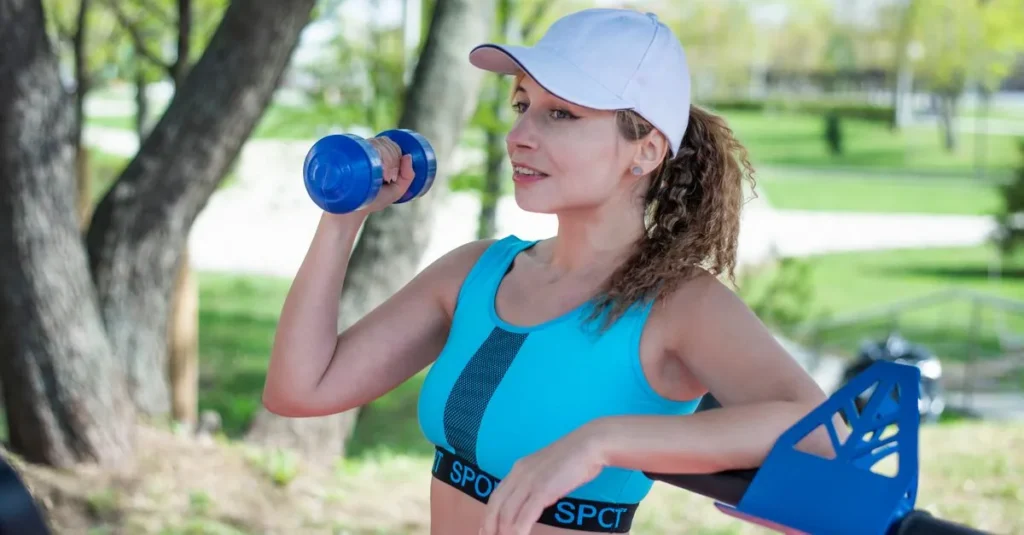
This workout plan for weight loss female beginners and returners can follow rests on two things: three strength sessions a week to protect muscle, and two or three cardio sessions to lift your weekly calorie burn, with at least one full rest day. Food still drives most of the change on the scale, but training decides what you lose and how your body looks and feels while you lose it. For meals, pair this with our weight loss diet plan for women.
What does a weekly workout schedule for weight loss look like for women?
A balanced week for most women is three full-body or split strength sessions of 40 to 45 minutes, two cardio sessions of 30 to 40 minutes, and one easy movement day such as a walk or gentle yoga. That is about 4 to 5 hours of training, with one complete rest day to recover.
The table below is a starting template. Move days around to suit your job and family, but keep a rest or easy day between strength sessions so muscles can recover.
| Day | Session | Time | Focus |
|---|---|---|---|
| Monday | Strength A: full body | 40-45 min | Squat, push, row, core |
| Tuesday | Cardio, moderate pace | 30-40 min | Brisk walk, cycling or dance |
| Wednesday | Strength B: lower body and glutes | 40-45 min | Hinge, lunge, bridge |
| Thursday | Easy day | 20-30 min | Walk, stretching or gentle yoga |
| Friday | Strength C: upper body and core | 40-45 min | Press, pull, plank work |
| Saturday | Cardio, intervals or dance | 30-35 min | Short hard efforts with easy recovery |
| Sunday | Full rest | – | Sleep, food prep, light chores |
If six days feels like too much right now, drop Thursday and Saturday to start. Three strength days and one cardio day is still a solid week for a beginner, and you can add sessions once the routine feels normal.
Myth check: will lifting weights make me bulky?
For the large majority of women, no. Gaining visible bulk takes years of deliberate heavy training, high protein intake and usually a calorie surplus. Strength work inside a calorie deficit mostly preserves the muscle you have, which is why it is the backbone of a good female weight loss workout plan.
The bigger risk is the opposite problem. A routine that is all cardio and very light weights can leave you losing muscle along with fat, finishing lighter on the scale but softer and weaker. Strength training for women also supports bone health, which matters more as you move toward and past menopause.
Two related myths are worth dropping too. You cannot spot-reduce fat from one area by training it, so thigh and belly work will not melt fat from those spots alone. And sweating more does not mean burning more fat; it mostly means a warm room.
Walking through the three strength days
Each strength session should start with 5 minutes of easy movement, then 4 to 5 exercises done for about 3 sets. Pick a weight where the last two reps of each set feel hard but your form stays clean. Add a little weight or one or two reps whenever a set starts to feel easy.
| Day | Exercise | Sets x reps | Rest | Form cue |
|---|---|---|---|---|
| A | Goblet squat | 3 x 10-12 | 60-90 sec | Chest up, knees track over toes |
| A | Incline push-up (hands on a bench) | 3 x 8-12 | 60 sec | Body in one straight line |
| A | One-arm dumbbell row | 3 x 10-12 each side | 60 sec | Pull the elbow toward your hip |
| A | Plank | 3 x 20-40 sec | 45 sec | Ribs down, glutes tight |
| B | Dumbbell Romanian deadlift | 3 x 10-12 | 60-90 sec | Hips back, soft knees, flat back |
| B | Reverse lunge | 3 x 8-10 each leg | 60-90 sec | Step back, front heel stays down |
| B | Glute bridge or hip thrust | 3 x 12-15 | 60 sec | Pause and squeeze at the top |
| C | Dumbbell shoulder press | 3 x 8-12 | 60-90 sec | Do not arch the lower back |
| C | Lat pulldown or band pull-down | 3 x 10-12 | 60 sec | Pull elbows down and back |
| C | Dead bug | 3 x 8 each side | 45 sec | Lower back stays on the floor |
Day B is where many women want extra volume. If lower-body work is your priority, our leg workout for weight loss goes deeper on that session. If form is your worry, a few sessions of 1-on-1 personal training can fix technique early, before habits set in.
How much cardio does a woman need to lose weight?
Two to three cardio sessions of 30 to 40 minutes a week is enough for most women alongside strength training. That adds roughly 400 to 800 calories burned across the week, depending on body weight and effort. Pick something you enjoy, because the best cardio is the one you will actually repeat.
Cardio is useful, but it is not magic. Thirty minutes of brisk walking burns about the same as a small banana-and-biscuit snack, so food choices still matter. The figures below are rough ranges for a woman weighing about 60 kg; heavier bodies burn more, lighter ones less.
| Cardio option | Effort | Roughly kcal per 30 min | Best for |
|---|---|---|---|
| Brisk walking (about 5.5-6 km/h) | Easy to moderate | 100-140 | Beginners, joint-friendly days |
| Cycling at a steady pace | Moderate | 150-220 | Low-impact fat burning |
| Dance fitness such as Zumba | Moderate to hard | 150-250 | Fun, long-term consistency |
| Interval session (30 sec hard, 60-90 sec easy) | Hard bursts | 200-280 | Short on time, fitter exercisers |
| Gentle yoga | Easy | 70-100 | Recovery and stress relief |
If you like music and movement, our live online Zumba classes can fill the cardio slots, and online yoga classes suit the easy day. Start intervals only after two to three weeks of steady cardio, and keep them to once a week at first.
Gym, home or a mix: setting up the plan
The plan works anywhere. In a gym you get barbells, cable machines and heavier dumbbells, which helps progression over many months. Our gym workout for weight loss covers that setup in detail.
At home, a pair or two of adjustable dumbbells, a resistance band and a sturdy chair cover almost every exercise in the table. Swap the bench push-up for a floor or wall push-up, the lat pulldown for a band pull-apart, and the hip thrust for a floor glute bridge. Our female home workout plan shows a full no-gym version.
Home training does hit one limit. After six to nine months, dumbbells can become too light for squats and deadlift variations. When your effort is high but progress stalls only because the weights have run out, that is the time to buy heavier equipment or add occasional gym sessions.
Adjusting the plan for your life
Beginners and women returning after a long break
Start with two strength days and one or two walks for the first two weeks, using light weights and focusing on clean form. Add the third strength day in week three. Soreness that peaks a day or two after a session and fades within three to four days is normal.
Busy schedules
Three 30-minute strength sessions and a daily 20 to 30 minute walk beat a perfect plan you skip. Use a shorter version of each day: three exercises instead of four or five, and fewer rest minutes between sets.
Around your menstrual cycle
Energy often feels higher in the week after your period and lower in the days just before and during it. It is reasonable to keep the same schedule but lower the weight or drop a set on heavy days. If cramps are severe or periods are very irregular, mention it to your doctor rather than pushing through.
Why the scale is not moving: troubleshooting a stall
Most stalls in the first month come from three sources: eating more than you think, sleeping under 7 hours, or judging progress by weight alone. A sensible pace for many people is roughly 0.25 to 0.75 kg a week, and it is rarely a straight line. Results vary from person to person.
- Weight is flat but clothes feel looser. Early strength training can add water and muscle while fat falls. Track waist and hip measurements and photos every two weeks, not only the scale.
- Weight jumps 1 to 2 kg overnight. Salt, hard sessions, hormones and a late dinner all shift water. Judge the trend over two to three weeks.
- Same weights for six weeks. If every set feels easy, progression has stopped. Add a little weight or a rep or two, as described above.
- Doing lots of cardio, eating little. Very low intake plus long cardio leads to fatigue, hunger swings and muscle loss. Keep the deficit modest.
- Skipping sleep and recovery. Poor sleep makes hunger harder to manage and workouts feel heavier.
If you have followed the plan consistently for 6 to 8 weeks with no change in measurements either, a personalised review helps. Our personalised weight loss plan guide explains what to adjust.
How should you eat to support this workout plan?
Aim for a modest calorie deficit and roughly 1.2 to 1.6 g of protein per kg of body weight each day. For a 60 kg woman that is about 70 to 95 g of protein daily, spread across meals, with the rest of the plate built from vegetables, whole grains and some healthy fat.
In Indian terms, an egg gives about 6 g of protein, 100 g of paneer about 18 g, a katori of cooked dal roughly 7 to 9 g, and 100 g of cooked chicken breast around 30 g. A banana with curd or a bowl of dal-chawal an hour or two before training gives most people enough energy. Our high protein diet for weight loss guide has the full breakdown, and the weight loss diet plan for women covers calories and meal timing.
When to see your doctor before you start
Check with your doctor before starting this or any new exercise plan if you are pregnant or recently gave birth, have a heart condition, high blood pressure, diabetes, thyroid or PCOS concerns, or an injury or joint problem. Stop and get medical advice if you feel chest pain, dizziness, unusual breathlessness or sharp joint pain.
Normal soreness is a dull ache in the muscle itself. Sharp, localised pain in a joint or tendon, or pain that worsens with light movement, is not normal soreness, so rest and have it checked.
Also be honest about goals. Losing 10 kg in a month is not a safe target for most people, and no workout plan can guarantee a particular result. A steady loss with strength gains is the realistic, safer version.
Frequently asked questions
What is the best workout plan for female weight loss?
A good plan combines three strength sessions of 40 to 45 minutes with two or three cardio sessions of 30 to 40 minutes each week, plus at least one full rest day. Strength work preserves muscle while you lose fat, and cardio adds to your weekly calorie burn. Pair it with a modest calorie deficit.
How many days a week should a woman work out to lose weight?
Most women do well with four to six active days a week, including three strength days, two cardio days and one easy day, plus one full rest day. Beginners can start with three or four days and build up. More days are not better if sleep and recovery suffer.
Is cardio or strength training better for weight loss in women?
Both help, but they do different jobs. Cardio burns calories during the session, while strength training helps keep muscle while you lose fat and supports bone health. For most women, doing both beats either alone, with strength given at least equal priority.
How long does it take to see results from this plan?
Many women notice better energy and strength within two to three weeks, and visible changes in how clothes fit in roughly four to eight weeks. Scale loss is usually about 0.25 to 0.75 kg a week, but results vary with food, sleep, stress and starting point.
Can beginners follow this female weight loss workout plan at home?
Yes. A pair of dumbbells, a resistance band and a chair are enough for most exercises. Start with two strength days, light weights and slow, controlled reps, then add the third day and more weight over three to four weeks as your form improves.
Get this plan built around you
A FitStrot online weight loss trainer sets your strength and cardio schedule around your fitness level, equipment and weekly routine, and adjusts it as you get stronger.


