

The most effective gym workout for weight loss is not the one that leaves you most drenched in sweat. It is a weekly plan that combines three strength sessions with two or three cardio sessions, pairs it with a moderate calorie deficit, and keeps going for 12 weeks or longer. Lifting protects the muscle you would otherwise lose while dieting. Cardio adds to the energy you burn. Food decides whether the scale actually moves.
This guide gives you that plan in full: a day-by-day weekly schedule, two gym workouts with sets, reps, rest and form cues, a 12-week progression, and an honest look at how fast weight comes off. It is written for Indian gym-goers who train 3 to 5 days a week and eat roti, dal and rice, not meal-prep boxes.
What is the best gym workout for weight loss?
The best gym workout for weight loss is 3 days of full-body resistance training plus about 150 minutes a week of moderate cardio, done alongside a calorie deficit. The NHS advises adults to do at least 150 minutes of moderate activity and strength work on 2 or more days each week. ACSM’s 2009 position stand found that more than 250 minutes a week is linked to clinically significant weight loss.
Both the UK NHS physical activity guidelines and the American College of Sports Medicine point the same way. In its 2009 position stand on weight loss (Donnelly et al.), ACSM found that 150 to 250 minutes a week of moderate activity produces only modest weight loss on its own. Losses become clinically significant above 250 minutes a week, and exercise works best when it is paired with a moderate (not severe) diet restriction.

Strength training for weight loss: what the research shows
The clearest head-to-head trial is STRRIDE AT/RT (Willis et al., 2012). It randomised 119 sedentary adults with overweight or obesity into aerobic training, resistance training, or both, for 8 months. The aerobic and combined groups lost more body mass and fat mass than the resistance-only group. The resistance and combined groups gained more lean mass than the aerobic group. The combined programme took double the time and did not lose significantly more fat than aerobic training alone, but it was the only one that both reduced fat and built lean mass.
ACSM reached a similar conclusion. Resistance training “does not enhance weight loss” measured on the scale, but it may increase fat-free mass and fat loss, and it lowers health risk.
So why put lifting at the centre of a weight-loss plan? Because what you want to lose is fat, not just kilos. A 2017 review in Advances in Nutrition (Cava et al.) found that diet-induced weight loss also takes muscle with it. Both endurance and resistance exercise help keep that muscle, and resistance exercise also improves strength. The authors recommend a calorie-reduced diet with adequate (not excessive) protein, plus more activity, “particularly resistance-type exercise.”
The practical takeaway: cardio moves the scale faster, while lifting decides what the weight you lose is made of. You need both, and the weekly plan below gives each its own days so neither gets in the way of the other.

Cardio vs weight training for fat loss: calories per 30 minutes
Gym-goers often pick exercises based on the calorie number on the treadmill screen. The figures below come from Harvard Health Publishing’s table of calories burned in 30 minutes, using its 155 lb (about 70 kg) column. Heavier people burn more and lighter people burn less.
| Gym activity (30 min) | Approx. kcal burned | Main job in a fat-loss plan |
|---|---|---|
| Weight lifting, general | 108 | Keeps muscle during the deficit |
| Weight lifting, vigorous | 216 | Keeps muscle and builds strength, with a higher burn |
| Walking, 3.5 mph (5.6 km/h) | 133 | Low-fatigue minutes you can add every day |
| Rowing machine, moderate | 252 | Full-body cardio that is easy on the knees |
| Running, 5 mph (8 km/h) | 288 | High burn but more impact, so build up to it |
| Elliptical trainer, general | 324 | High burn with low impact |
Two lessons. First, the burn per session is smaller than most people expect. A vigorous 30-minute lifting session burns about 216 kcal at 70 kg, which one extra snack can easily cancel. Training cannot make up for eating more than you need. Second, lifting’s job is protecting muscle, not burning the most energy.
Cardio or strength training for weight loss: do you have to choose?
No. In STRRIDE, the combined group got both fat loss and lean-mass gain. If you only have 3 hours a week, do 3 strength sessions of about 45 minutes and finish each with 15 minutes of incline walking. If you have 5 hours, use the full weekly plan below. For a cardio-only routine on gym machines, our gym cardio workout plan covers treadmill, bike and rower programming in more detail.
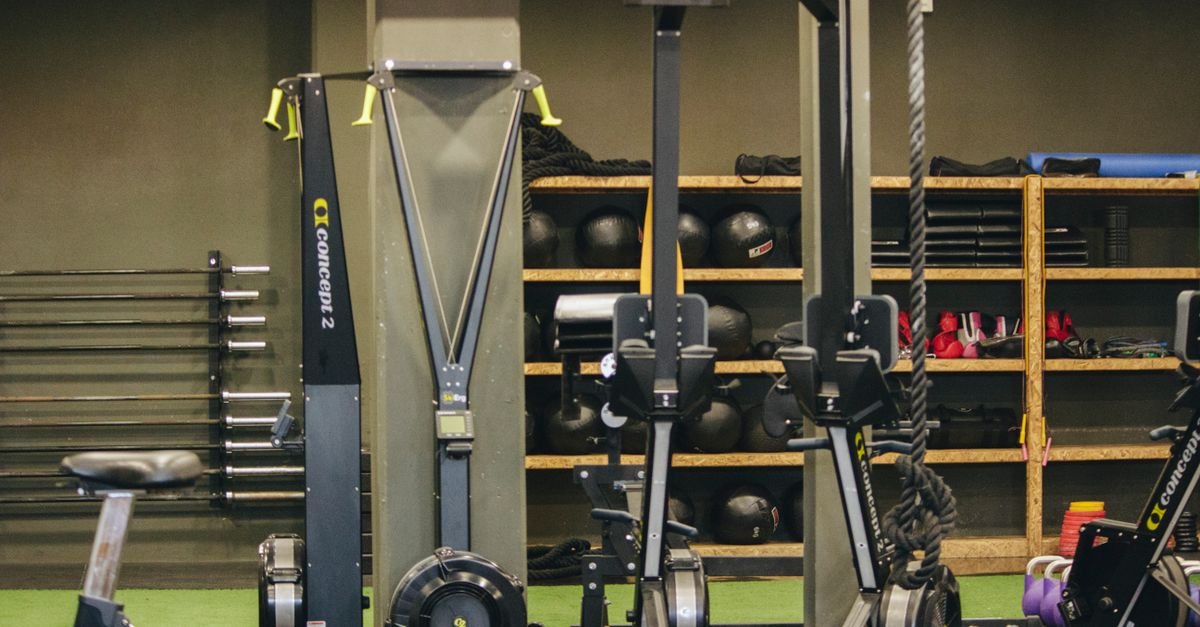
The weekly gym workout plan for weight loss
This schedule meets the NHS minimum of 150 minutes of moderate activity and 2 or more strength days. It also leaves room to work up toward the 250+ minutes ACSM links with clinically significant loss. Your daily step count does the rest.
| Day | Session | Duration | Intensity guide |
|---|---|---|---|
| Monday | Workout A (full-body strength) + 10 min incline walk | 55-65 min | Stop each set 2-3 reps short of failure |
| Tuesday | Intervals: rower or bike, 8 × 30 s hard / 90 s easy, then 3 × 15 kettlebell swings | 25-30 min | Hard rounds about 8/10 effort |
| Wednesday | Rest from the gym; brisk walk after lunch or dinner | 30 min walk | You can still talk in full sentences |
| Thursday | Workout B (full-body strength) + 10 min incline walk | 55-65 min | Stop each set 2-3 reps short of failure |
| Friday | Steady cardio: incline treadmill, elliptical or rower | 35-45 min | Moderate: breathing harder, but you can still speak |
| Saturday | Workout A again (alternate with B the following week) | 50-60 min | Add weight or reps compared with Monday |
| Sunday | Full rest or an easy walk | – | Recovery |
Each week this adds up to 3 strength sessions, about 150 to 170 minutes of deliberate cardio, and the walking on rest days. If 5 gym days are not realistic, drop Tuesday and keep the three strength days. Cutting strength to keep cardio is how most dieters lose muscle.
Want a 6 day gym workout plan for weight loss? Add a second steady-cardio session on Wednesday instead of the walk. Only do this after a consistent month with 7+ hours of sleep; extra sessions without recovery show up as stalled lifts and more hunger.

Workout A and Workout B: sets, reps, rest and form cues
Both sessions are full-body routines, so every major muscle group is trained on each of the three strength days. A 2017 meta-analysis by Schoenfeld and colleagues found a graded dose-response between weekly sets and muscle growth. Groups doing 10 or more sets per muscle per week tended to gain the most. Across three sessions, this plan gives the chest and back about 9 or more hard sets each per week and the legs more, which is enough to hold on to muscle during a deficit without draining recovery. For more on how volume works, see how many sets per workout you actually need.
| Exercise | Sets × reps | Rest | Form cue |
|---|---|---|---|
| Workout A | |||
| Goblet squat or barbell back squat | 3 × 8-10 | 90-120 s | Knees follow your toes; keep your chest tall as you sit between your hips |
| Dumbbell bench press | 3 × 8-12 | 90 s | Shoulder blades pinched back; lower until the dumbbells are level with your chest |
| Seated cable row | 3 × 10-12 | 75 s | Pull your elbows to your back pockets; don’t lean back to cheat |
| Romanian deadlift (dumbbell or barbell) | 3 × 8-10 | 90 s | Push your hips back, keep the bar close to your thighs, back flat |
| Walking lunge | 2 × 10 per leg | 60 s | Long step, back knee drops straight down, front heel stays down |
| Plank | 3 × 30-45 s | 45 s | Squeeze your glutes; keep your ribs down so your lower back doesn’t sag |
| Workout B | |||
| Trap-bar or conventional deadlift | 3 × 5-6 | 2 min | Brace before you pull; push the floor away instead of yanking the bar |
| Incline dumbbell press | 3 × 8-12 | 90 s | Bench at 30°; press up and slightly back over your shoulders |
| Lat pulldown | 3 × 10-12 | 75 s | Pull the bar to your upper chest; lead with your elbows, not your hands |
| Leg press | 3 × 10-15 | 90 s | Lower until your knees reach about 90°; keep your lower back on the pad |
| Seated dumbbell shoulder press | 2 × 10-12 | 75 s | Keep your forearms vertical; don’t arch your lower back |
| Farmer’s carry | 3 × 30-40 m | 60 s | Walk tall with heavy dumbbells; shoulders down, slow steady steps |
How heavy? Pick a weight that leaves 2 to 3 reps “in the tank” at the end of each set. When you can hit the top of the rep range on every set with good form, add the smallest jump your gym allows (usually 1 to 2.5 kg for dumbbells, 2.5 to 5 kg for barbell lifts). Light “toning” weights do not burn more fat and give muscle less reason to stay.
How to progress your gym routine over 12 weeks
Plans stall when they never change. The aim of this 12-week progression is to get a little stronger each fortnight while your body weight comes down, which is a good sign that most of the loss is fat.
| Weeks | Strength days | Cardio days | Focus |
|---|---|---|---|
| 1-2 | 2 sets per exercise, light loads | 2 × 25 min steady | Learn the movements; get muscle soreness under control |
| 3-6 | Full 3 sets; add load when you hit the top of the rep range | 1 interval + 1 steady (35 min) | Steady strength gains; log every session |
| 7-10 | Same; add 1 set to squats or deadlifts if recovery is good | Intervals up to 10 rounds; steady up to 45 min | Increase weekly cardio minutes toward 200+ |
| 11 | Drop to 2 sets at the same loads (deload) | Steady only | Let fatigue clear; check measurements |
| 12 | Test: best set of 8 on squat, press and row | Normal | Compare with week 3 and plan the next block |
Log the weight, sets and reps for every exercise. Memory overestimates progress.

Myth check: three gym beliefs that slow fat loss
“Lifting weights will make me bulky”
Building noticeable muscle takes a calorie surplus, years of progressive training and, for most people, a lot of protein. In a calorie deficit you are mostly trying to keep muscle, not add a lot. Cava et al. found that diet-only weight loss reduces muscle mass. Resistance exercise is the main tool for keeping that muscle.
“Crunches will burn belly fat”
You cannot choose where fat comes off. Crunches and planks strengthen the trunk, which is why the plank is in Workout A, but belly fat goes down with your overall body fat. That comes from the calorie deficit and total activity, not from training the abs.
“HIIT is the only cardio that works”
A 2017 meta-analysis in Obesity Reviews (Wewege et al.) pooled 13 trials in adults with overweight or obesity. It found no significant difference in fat-mass or waist reductions between high-intensity interval training and moderate continuous cardio. The main difference was that HIIT took about 40% less time. Use intervals when you are short on time and steady cardio when you need recovery. If you are new to intervals, start with 6 rounds and build up.
Gym workout for weight loss for women and beginners
Gym workout for weight loss for women
The physiology is the same, so the plan is the same. Women often start with lighter pressing loads, so use dumbbells and cables, which allow smaller weight jumps. Women are often steered toward the treadmill and light machines, but the free-weight area belongs to you as much as anyone, and squats, Romanian deadlifts and rows are where the muscle-protecting work happens. If your cycle affects energy or sleep in certain weeks, keep the same exercises but stop each set 1 rep earlier rather than skipping the session.
Beginner gym workout for weight loss
If you have never trained, start with weeks 1-2 of the progression table and use machines or goblet squats before moving to barbells. Leave a day between strength sessions. Soreness lasting over 72 hours means the dose was too high.
Safety first: if you have high blood pressure, diabetes, heart disease, joint replacements, are pregnant, or have been inactive for years, get clearance from your doctor before starting interval training or heavy lifting.

How fast will a gym routine help you lose weight?
Expect about 0.5 to 0.9 kg a week when gym training is combined with a moderate calorie deficit. The CDC notes that people who lose about 1 to 2 pounds (0.45 to 0.9 kg) a week are more likely to keep the weight off. Over a 12-week block, that works out to roughly 5 to 10 kg at most. Exercise without diet changes usually produces less.
That guidance comes from the CDC’s page on losing weight. For an 80 kg person, a 5% loss is 4 kg, already enough to improve health markers. ACSM notes that health risk falls with as little as a 3 to 5% reduction in weight.
In weeks 1-2, new training causes water retention, so the scale may stay flat or rise slightly. Judge progress by your 2-week average weight, waist at the navel, and whether lifts are going up.
Anyone promising 10 kg in a month from a gym plan is selling something; that pace is mostly water and muscle.
Troubleshooting: the scale isn’t moving after 4 weeks
- Your lifts are going up and your waist is getting smaller, but your weight is flat: you are losing fat and holding water or muscle. Keep going for another 2 weeks before changing anything.
- Weight, waist and lifts have all stalled for 3 or more weeks: cut about 200 to 300 kcal a day (for example, one less roti at dinner and no sugar in your chai) or add 2,000 daily steps. Change one thing, not both.
- You’re always hungry and your lifts are dropping: your deficit is probably too aggressive. Eat slightly more on strength days and prioritise protein at every meal.
- You keep missing sessions: drop to the 3-day version. A 3-day plan you complete beats a 5-day plan you abandon.
- Sleep under 6 hours: fix this before adding training. Short sleep increases appetite and slows recovery.
Stuck for more than six weeks? Fitstrot’s online weight loss trainer programme reviews your logs and adjusts sessions week by week.
Fuel the gym plan: protein and Indian meals
Training only protects muscle if you eat enough protein to rebuild it. A 2018 meta-analysis of 49 trials (Morton et al., British Journal of Sports Medicine) found that in people doing resistance training, gains in fat-free mass levelled off at a total protein intake of about 1.62 g per kg of body weight per day. Intakes above that added no further benefit. For a 75 kg person, that is about 120 g a day.
That is a ceiling for muscle gain, not a minimum. Many Indian diets fall well short of it, so build each meal around a protein source. Eggs or besan chilla at breakfast. Dal with curd, paneer, chicken or fish at lunch and dinner. Roasted chana or a glass of milk between meals. Cava et al. recommend adequate but not excessive protein, so people with kidney disease should agree on a target with their doctor first.
Keep rice and roti portions steady rather than cutting them out; carbohydrates fuel training, and the deficit can come from fried snacks, sweets and sugary drinks. For a meal plan matched to your training days and food preferences, book a session with Fitstrot’s online nutritionist.
For context, the WHO estimates that 31% of adults worldwide were physically inactive in 2022. Following this plan puts you well ahead of that baseline.
Frequently asked questions
Is going to the gym 4 days a week enough to lose weight?
Yes. Four days covering 3 strength sessions and 1 cardio session, plus daily walking, meets the NHS guideline of 150 minutes of activity and 2 or more strength days. Weight loss still depends on a moderate calorie deficit from your diet.
Should I do cardio before or after weights?
Do weights first. That way your squats and deadlifts get your freshest effort and best technique. Put 10 to 15 minutes of incline walking after lifting, or do longer cardio on separate days, as in the weekly plan.
Can I lose belly fat with gym workouts alone?
Not by targeting it. Fat cannot be spot-reduced, so belly fat goes down as your total body fat goes down. That needs a calorie deficit, regular strength training and enough weekly cardio minutes.
How long should a gym workout for weight loss be?
About 45 to 65 minutes for strength days, including a short cardio finish, and 25 to 45 minutes for cardio days. Longer sessions are not better if they cut into sleep or make you skip the next one.
Is HIIT better than steady cardio for fat loss?
Not for the amount of fat lost. A 2017 meta-analysis of 13 trials found similar fat-mass reductions from both. HIIT took about 40% less time. Use whichever you will do consistently.
Should I lift heavy or light weights to lose weight?
Lift moderately heavy: a weight you can manage for 6 to 12 reps with 2 to 3 reps to spare. Heavier loads give your muscles a stronger reason to stay during a calorie deficit than very light, high-rep sets.
Why did my weight go up after joining the gym?
New training causes temporary water retention in your muscles, and hunger often rises. Track your 2-week average weight and waist size. If both are still rising after 4 weeks, reduce your intake by about 200 to 300 kcal a day.
Start this week: print the weekly plan, do Workout A on Monday, and log every set. If you would rather have a coach set your loads and check your form on live video, book a trial with Fitstrot’s 1-on-1 personal training.


