
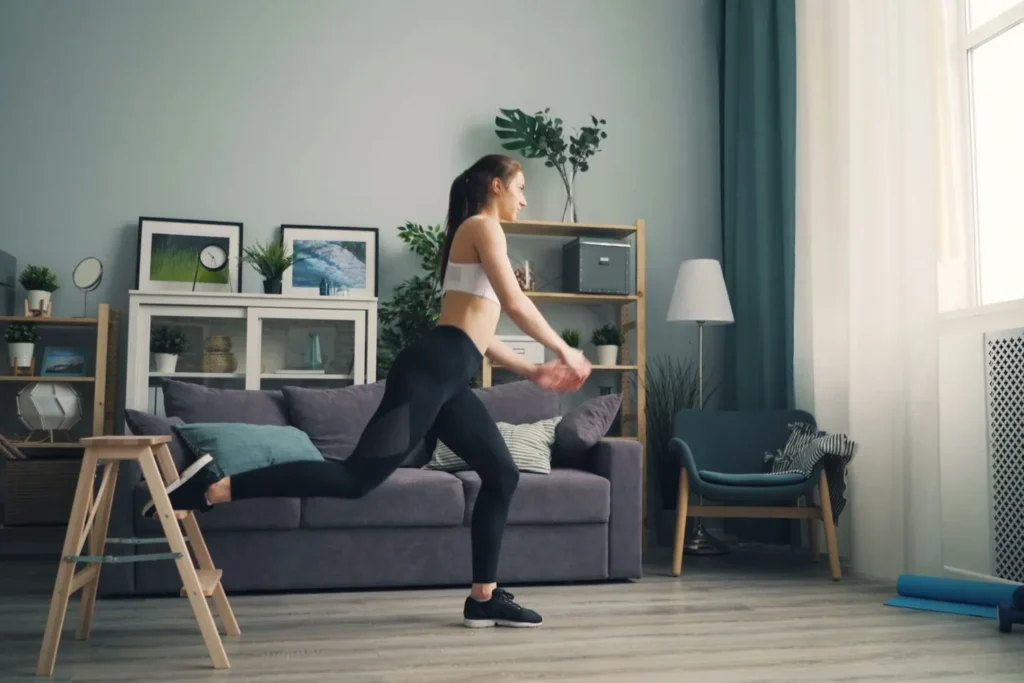
A female home workout plan works best as four strength sessions a week, split across glutes, upper body, core and one mixed day, each lasting 30 to 40 minutes. You need a mat, a loaded backpack or a pair of dumbbells, and a simple rule: add reps or weight every week or two. This guide gives you every set, rep and rest time, plus practical ways to adjust training around your menstrual cycle.
Everything below works in a small Indian flat with no machines. No plan can promise a specific change in your body, because results depend on your starting point, food, sleep and consistency.
What should a home workout plan for women include?
A solid plan trains each major area twice a week: glutes and legs for the lower body, pushing and pulling moves for the upper body, and core work for the trunk. Aim for three to four sessions weekly, about three sets per exercise, and add reps or weight whenever the last set feels comfortable.
These three areas carry everyday life: stairs, suitcases, sitting upright through a work day. “Toning” does not require light dumbbells and 30 repetitions. It means building a little muscle and, if you want, losing some body fat, and both start with lifting something that feels challenging.
The kit list is short:
- An exercise mat and a sturdy chair or sofa edge
- A backpack you can load with books, roughly 5 to 8 kg
- One or two pairs of dumbbells, for example 2 kg and 5 kg (filled 5-litre water cans work as a stand-in, since a litre of water weighs about 1 kg)
- One loop resistance band (optional)
Starting from zero? Our home workout guide covers basic movement patterns, and the home dumbbell workout article helps you choose weights. A home workout for women without equipment is fine for the first four weeks; add the backpack from week five.
Your 4-day week at a glance
Sessions sit on non-consecutive days where possible, so trained muscles get a day to recover.
| Day | Focus | Time | Effort (out of 10) |
|---|---|---|---|
| Monday | Glutes and legs | 35-40 min | 7-8 |
| Tuesday | Upper body plus one core move | 30-35 min | 7 |
| Wednesday | Easy walk or mobility | 20-30 min | 3-4 |
| Thursday | Core plus light glute work | 30 min | 6-7 |
| Friday | Rest | – | – |
| Saturday | Full body: two glute moves and two upper body moves | 35-40 min | 7-8 |
| Sunday | Rest or a relaxed walk | – | – |
Effort is how hard each working set feels. A 7 means you could do roughly three more clean reps; an 8 means about two more. If four days is too much right now, run Monday, Tuesday and Saturday only. Three consistent sessions beat four you abandon in week three.
Glute day: the session, exercise by exercise
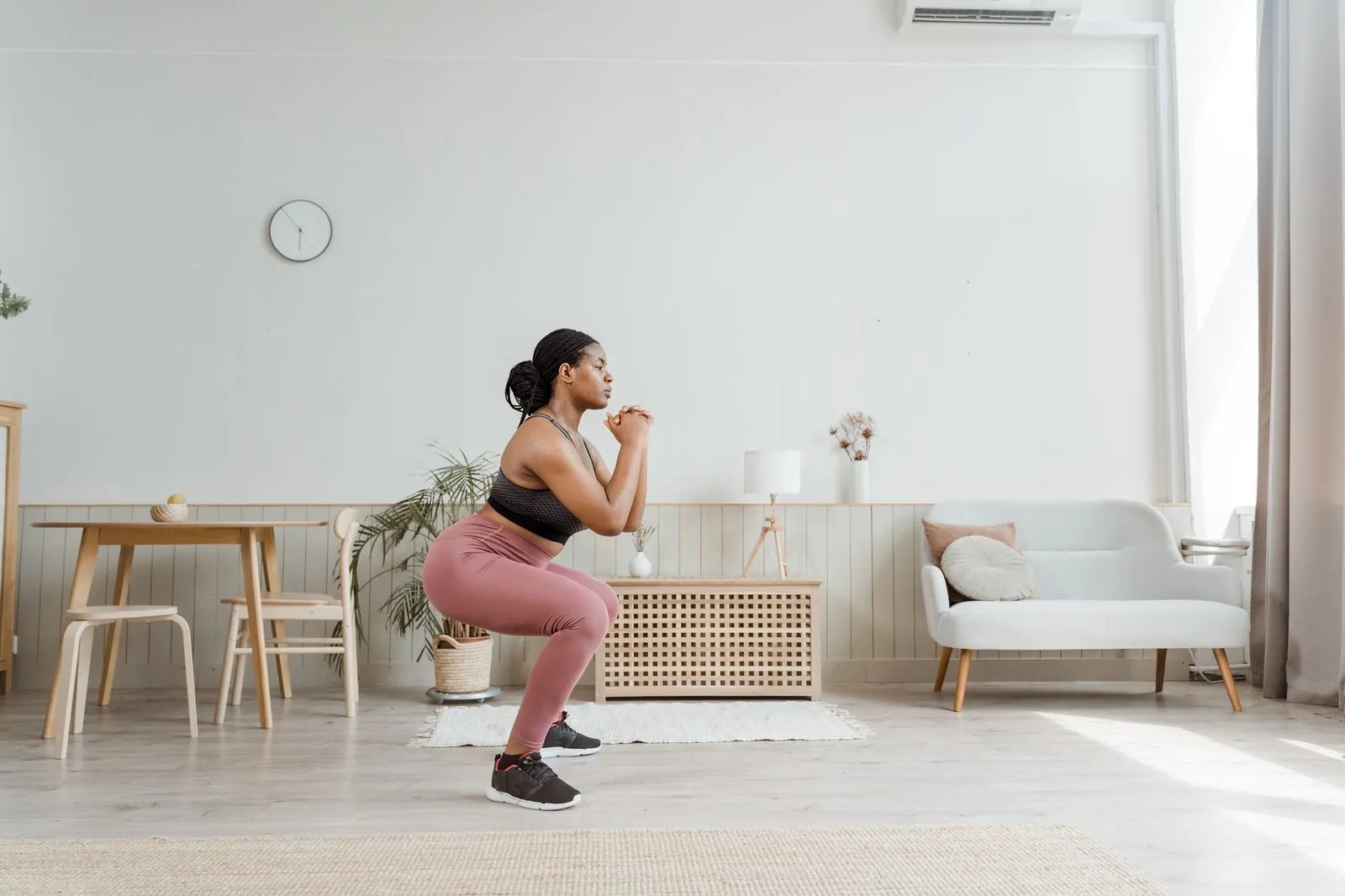
This is Monday’s session and the template for your glute workout at home. Warm up for five minutes: 10 hip circles each way, 10 bodyweight squats, 10 slow glute bridges. Lower each rep for two seconds and pause for one second at the hardest point.
| Exercise | Sets x reps | Rest | Form cue |
|---|---|---|---|
| Glute bridge | 3 x 12-15 | 60 sec | Feet flat, ribs down, squeeze hard at the top without arching your lower back |
| Goblet squat (backpack or dumbbell at chest) | 3 x 10-12 | 75-90 sec | Sit down between your hips, knees track over your toes, chest stays tall |
| Dumbbell or backpack Romanian deadlift | 3 x 10-12 | 90 sec | Push hips back, soft knees, weight slides down your thighs, back stays flat |
| Reverse lunge | 3 x 8-10 per leg | 60 sec | Step back, lower straight down, drive through the front heel |
| Banded lateral walk or side-lying leg raise | 2 x 12-15 per side | 45 sec | Small steady steps, toes forward, hips level |
| Single-leg glute bridge | 2 x 8-12 per side | 45 sec | Keep both hips the same height; stop the set if they twist |
For the first two weeks, use a weight that leaves you three or four reps short of failure. Saturday’s full-body day reuses this table: take the goblet squat and glute bridge, then add two upper body moves from the next section, three sets of 10 to 12 each.
Upper body and core days: sets, reps and cues
An upper body workout for women at home should balance pushing and pulling. Tuesday uses the first five rows plus one core move. Thursday uses the core rows, then two sets each of glute bridges, reverse lunges and lateral walks from the glute table.
| Exercise | Sets x reps | Rest | Form cue |
|---|---|---|---|
| Incline push-up (hands on a table or sofa edge) | 3 x 8-12 | 60-75 sec | Straight line from head to heels, elbows about 45 degrees from your body |
| One-arm dumbbell or backpack row | 3 x 10-12 per side | 60 sec | Pull your elbow towards your hip, no twisting of the torso |
| Seated dumbbell shoulder press | 3 x 8-12 | 75 sec | Ribs down, press slightly forward of your ears, avoid leaning back |
| Band pull-apart or reverse fly | 2 x 15 | 45 sec | Squeeze shoulder blades together, shoulders away from your ears |
| Chair triceps dip (bent knees) | 2 x 8-12 | 45-60 sec | Elbows point back, go only as deep as is comfortable for your shoulders |
| Dead bug | 3 x 8 per side | 45 sec | Lower back stays pressed into the floor |
| Forearm plank | 3 x 20-40 sec | 45 sec | Squeeze glutes, ribs down, stop the set when your hips sag |
| Side plank (knees bent if needed) | 2 x 15-30 sec per side | 30 sec | Stack shoulders over elbow, lift hips until your body is one line |
| Bird dog | 2 x 8-10 per side | 30-45 sec | Move slowly, keep your hips square to the floor |
This is a core workout at home without crunch marathons. Planks and dead bugs teach your trunk to stay stable under load, which helps your squats and rows feel stronger. They will not burn fat from your stomach specifically; no exercise does that.
How do you make the plan harder without a gym?
Use double progression: stay at the same weight until you complete the top of the rep range on every set, then add 1 to 2 kg or slow the lowering phase to three seconds. With three sets of 8 to 12 reps, most beginners can add load every two to three weeks.
When you run out of dumbbells, you still have several levers:
- More reps: move from 8 to 12 reps before touching the weight.
- More load: add books to the backpack, or use a heavier water can.
- Slower tempo: take three seconds to lower on squats, rows and push-ups.
- Harder variations: single-leg bridge, a lower incline for push-ups, or a split squat with your back foot on a sofa.
- Shorter rest: cut 10 to 15 seconds on lighter exercises.
Write down weight, reps and how it felt after every session. Without a log, it is easy to repeat the same session for six months and wonder why nothing changes. If you would rather have someone adjust the numbers for you, a personalized workout plan does exactly that.
Myth check: will lifting make you bulky?
No. Building large, visible muscle takes years of heavy, consistent training and a long period of eating more than you burn. A few kilos of dumbbells used three or four times a week will make you stronger and firmer, not bulky. The likelier problem is never lifting enough to see change.
Two related myths. Glute exercises build and shape the glutes, but they do not remove fat from your hips on their own; fat loss needs a sustained calorie deficit across the whole body. And more days is not better: six days a week at home, with nobody checking your form, tends to end in fatigue and a long break.
If fat loss is your main goal, this plan is the strength base, and our workout plan for weight loss for females shows how cardio fits around it. For pairing food with training, see the workout and diet plan guide, or speak to an online nutritionist.
Troubleshooting: when the plan does not feel right
- “I cannot feel my glutes.” Slow down, pause for one second at the top, and reduce the load. Do glute bridges first as an activation set, with your shins roughly vertical at the top.
- “My lower back takes over.” Bring your ribs down, shorten the range, and use less weight. Sharp or lingering back pain is a reason to stop and see a doctor or physiotherapist, not to push through.
- “Push-ups hurt my wrists or shoulders.” Raise your hands higher on the table, or hold dumbbell handles so your wrists stay straight. Sharp pain needs a professional opinion.
- “I have been stuck for four weeks.” Check the basics: about seven hours of sleep, protein at every meal, and whether you are really adding reps or weight. Then take an easy week at about 60 percent of your usual weights.
- “I missed two sessions.” Do not double up. Restart with the next scheduled session at the same weights as before.
Can you train around your menstrual cycle?
Yes. Most women can keep the same four-day schedule all month and simply adjust effort to how they feel. A practical approach is to keep the sessions, drop one set or about 10 percent of the weight on low-energy days, and push harder when energy is high. Severe pain or very irregular cycles are worth raising with a doctor.
Energy, sleep and strength vary from woman to woman, so your own log is a better guide than any generic chart. Add a short note beside each session, such as “tired, effort felt like 9 instead of 7”. After two or three months you will see whether a pattern exists and can plan harder sessions for the weeks you tend to feel strong.
On days with cramps or heavy fatigue, swap the session for a 20 minute walk and gentle mobility, or do the same exercises with lighter weights and one fewer set. This is general training advice, not medical advice. For more women-specific routines, see our female workout guide.
How should a beginner, a busy woman or a returning lifter adjust this?
- Complete beginner: do two sets, bodyweight only, on Monday, Wednesday and Friday for two weeks, mixing one lower body, one upper body and one core exercise each time. Add the third set in week three.
- Short on time: pick four exercises and alternate them, for example a goblet squat then an incline push-up, with 45 seconds between. A 40 minute session becomes about 25.
- Coming back after a long break: restart at about 60 percent of your old weights for two weeks. If you are postpartum, recovering from surgery or managing an injury, get your doctor’s clearance first.
- Want more challenge: use single-leg versions, move to four sets on the main lifts, and add load before reps.
Men can run almost the same structure with less glute emphasis and more chest work, as in our workout plan for men. For the general version, see our wider home workout plan guide.
Want a coach to set your starting weights and check your form on video? Book a 1-on-1 personal training session with Fitstrot and we will fit this four-day plan around your schedule and the equipment you actually have.
Frequently Asked Questions
How many days a week should women work out at home?
Three to four days is the best range for most women. Four sessions train glutes, upper body and core about twice a week each, with two or three rest days. If you are new, start with three days and add the fourth after two to three weeks.
Do you need dumbbells for a home workout plan?
No. Squats, lunges, glute bridges, incline push-ups and planks are enough for the first four weeks. After that, a backpack loaded with books, filled water cans or a pair of 2 to 5 kg dumbbells give you the extra resistance to keep progressing.
How long should a home workout last?
Thirty to forty minutes is enough, including a five minute warm-up. With three sets per exercise and 45 to 90 seconds of rest, six to eight exercises fit. With only 25 minutes, alternate exercises and cut rest to 45 seconds.
Can a complete beginner follow this plan?
Yes. Start with two sets per exercise, bodyweight only, three days a week, and focus on clean form first. Add the third set and the backpack after about two weeks. A coach reviewing a short video of your technique helps catch habits early.
Is it okay to train during your period?
For most women, yes. Keep the schedule if you feel well, lower the weight by about 10 percent or drop a set if you feel flat, and swap to a walk if you have cramps or low energy. Speak to your doctor if periods are very painful, heavy or irregular.


