
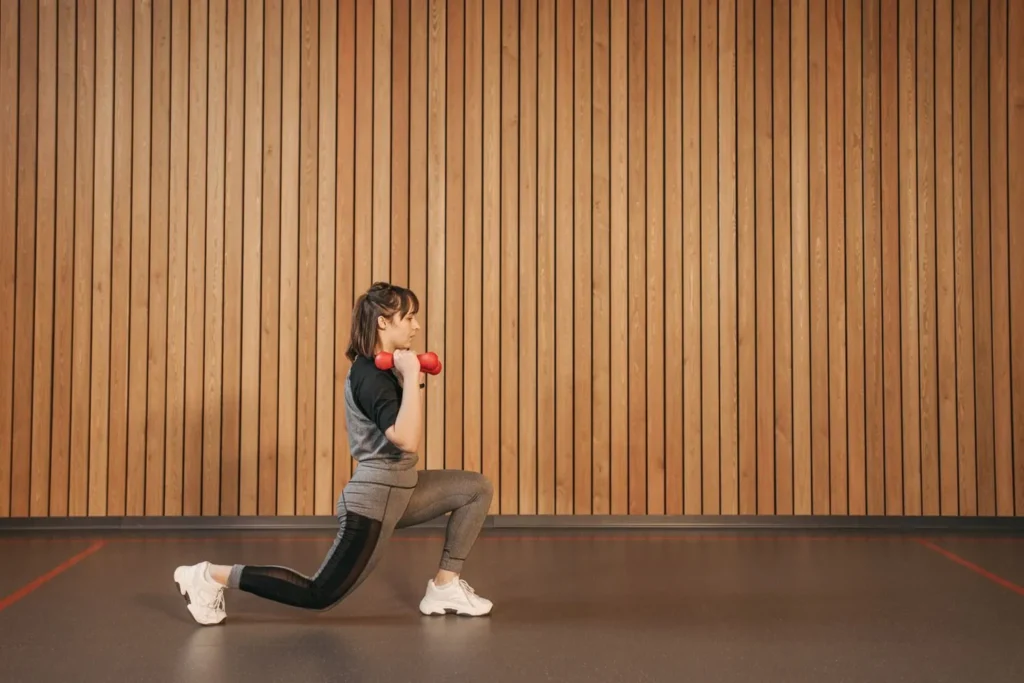
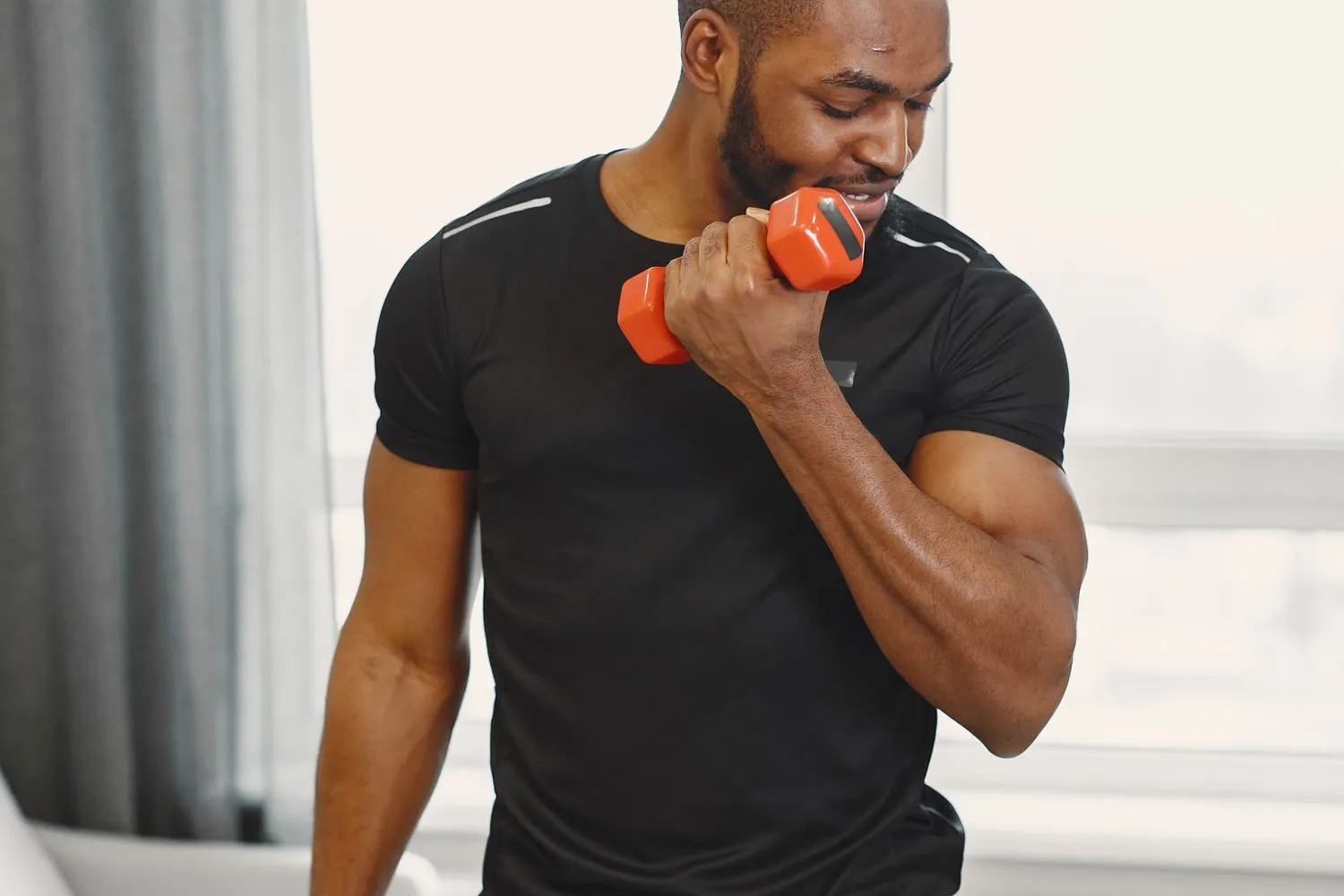
A good home dumbbell workout trains your whole body in 30 to 45 minutes with one or two pairs of dumbbells: a squat, a hinge, a push, a pull and some core work. You do not need a rack, a gym membership or a spare room. This guide gives you the exact session, a weekly plan, form cues, ways to keep progressing with limited weights, and fixes for the stalls most people hit in the first two months.
What do you need to start a home dumbbell workout?
To start a home dumbbell workout you need either one adjustable pair (roughly 2 to 20 kg per hand) or two fixed pairs, one light and one heavier, such as 4 kg and 10 kg. A sturdy chair and a yoga mat are optional extras. That setup covers nearly every exercise in a full-body routine for your first year.
Most people overbuy before their first proper session. In order of priority:
- One adjustable pair if you have the budget and floor space. It replaces a whole rack and lets you add 1 to 2 kg at a time.
- Two fixed pairs if adjustable sets are out of reach: a lighter pair for shoulders, arms and core, and a heavier pair for squats, deadlifts and rows.
- A sturdy chair or flat bench for step-ups, supported rows and seated presses. Not essential, but handy.
- A mat for floor presses and core work, especially on tiles or marble.
If your dumbbells have not arrived yet, our bodyweight workout guide is a solid bridge, and the broader home workout guide shows how dumbbells slot into a wider routine.
What should a full body dumbbell workout cover?
A full body dumbbell workout should cover five patterns: a squat for quads and glutes, a hinge for hamstrings and lower back, a push for chest, shoulders and triceps, a pull for upper back and biceps, and direct core work. Missing any one of them creates imbalances within weeks.
The most common imbalance in home trainees is a strong front and a weak back, because presses and squats are more fun than rows and hinges. On a busy day, drop the extra arm work, never the pull or the hinge.
What does a home dumbbell workout routine look like?
A solid dumbbell workout for beginners takes about 35 minutes: eight exercises, 2 to 3 sets each, 8 to 12 reps, with 30 to 60 seconds of rest between sets. Do it two to three times a week and add a rep or a small amount of weight whenever the last set feels comfortable.
| Exercise | Sets x reps | Rest | Form cue |
|---|---|---|---|
| Goblet squat | 3 x 10-12 | 60 sec | Hold one dumbbell at your chest, elbows inside the knees, heels flat |
| Dumbbell Romanian deadlift | 3 x 10-12 | 60 sec | Push hips back, soft knees, dumbbells brush your thighs, flat back |
| Dumbbell floor press | 3 x 10-12 | 60 sec | Elbows about 45 degrees from the body, pause when triceps touch the floor |
| Bent-over row | 3 x 10-12 | 60 sec | Hinge forward, pull elbows to your hips, squeeze shoulder blades |
| Standing shoulder press | 3 x 8-12 | 45 sec | Ribs down, glutes tight, press straight up past your ears |
| Reverse lunge | 2 x 10 per leg | 45 sec | Step back, front shin vertical, back knee hovers above the floor |
| Russian twist | 2 x 15 per side | 30 sec | Lean back slightly, rotate the ribcage rather than swinging the arms |
| Plank row | 2 x 8 per side | 30 sec | Feet wide, hips level, do not let the hips twist as you row |
Warm up for five minutes first: arm circles, bodyweight squats, hip hinges and a few light reps of your first exercise. Write your weights and reps down after every session; a phone note is enough.
How do you pick the right dumbbell weight?
Pick a weight that lets you finish your target reps with two good reps left in reserve. If your form breaks before rep 8, it is too heavy; if you could easily do 15 or more, it is too light. Lower-body lifts take heavier dumbbells than shoulder work.
The ranges below are rough starting points per dumbbell for a healthy adult who is new to lifting. Treat them as a guess, not a rule, and adjust after your first two sessions.
| Exercise | Beginner (about, per hand) | After 2-3 months (about, per hand) |
|---|---|---|
| Goblet squat (one dumbbell) | 6-10 kg | 12-20 kg |
| Romanian deadlift | 5-10 kg | 10-20 kg |
| Floor press | 4-8 kg | 8-16 kg |
| Bent-over row | 4-8 kg | 8-16 kg |
| Shoulder press | 2-5 kg | 5-10 kg |
| Reverse lunge | 3-6 kg | 6-12 kg |
If you only own two pairs, use the light pair for shoulder press and core work and the heavy pair for everything else. If the heavy pair feels too easy, slow the tempo or go single-limb before buying more weight.
A week of home dumbbell workouts, day by day
Here is a simple weekly layout for each schedule. Three days suits most beginners; four days works once you can recover well. Rest days are part of the plan, and walking or light stretching on them is fine.
| Day | 3-day plan | 4-day plan |
|---|---|---|
| Monday | Full body A (table above) | Upper body: presses, rows, arms, core |
| Tuesday | Rest or 30-minute walk | Lower body: squats, hinges, lunges, calves |
| Wednesday | Full body B (swap variations) | Rest or walk |
| Thursday | Rest or mobility | Upper body, different variations |
| Friday | Full body A, heavier | Lower body, different variations |
| Saturday | Optional walk or yoga | Optional core and mobility, 20 minutes |
| Sunday | Rest | Rest |
If you want to train most days, our daily workout plan at home shows how to alternate heavy sessions with lighter mobility and core days. For printable layouts, see the workout chart, or compare structures in our workout plan and workout routine guides.
How do you progress with only one or two dumbbell weights?
You progress by changing the demand, not only the weight. Add reps first, for example moving from 10 to 15, then slow the lowering phase to 3 seconds, shorten rest from 60 to 40 seconds, add a 2-second pause, or switch to single-limb versions. Each makes the same dumbbell noticeably harder.
A simple method is double progression. Choose a rep range such as 8 to 12. Stay at the same weight until you hit 12 reps on every set with good form, then move up to the next weight and drop back to about 8 reps. If your next dumbbell is a big jump, add pauses or tempo first and bridge the gap.
Once your chest presses feel too easy on the floor, the dumbbell chest workout without bench guide shows harder variations that need no extra equipment.
Myth check: do light dumbbells tone and heavy ones bulk?
No. “Toning” is simply building a little muscle while carrying less body fat, and both need challenging resistance. Heavy dumbbells will not make you bulky by accident; large muscle gain takes years, lots of food and dedicated training. Very light weights for endless reps mostly build endurance, not shape.
This myth steers many people, especially women, away from the loads that actually change their bodies. If you finish 20 reps easily, the weight is not doing much. Aim for sets that feel hard in the last two or three reps.
Is a dumbbell workout for women different?
A dumbbell workout for women uses the same exercises and the same rules as for men: squats, hinges, presses and rows built progressively. What changes is emphasis. Many women want extra glute, hip and upper-back work, so add a set of Romanian deadlifts or lunges and keep the pulling volume at least equal to pushing.
A slightly higher rep range of 12 to 15 in the first month helps you learn the movement patterns before adding load, then move back to 8 to 12 as the weights go up. Women of any age can lift moderately heavy dumbbells safely when form is right. If you are pregnant, postpartum or managing a condition, check with your doctor before starting, and lean on a coach for modifications.
How do you train your core with dumbbells at home?
You train your core with dumbbells by adding load to exercises that resist movement as well as create it. Two or three moves at the end of a session, twice a week, is enough: weighted Russian twists, plank rows, dead bugs holding light dumbbells, and suitcase carries with one heavy dumbbell.
You do not need a separate abs day, and hundreds of crunches will not remove belly fat from one spot. Squats, deadlifts and rows already work your trunk hard, so keep dedicated core work short and controlled.
Troubleshooting a stalled home dumbbell workout
Most stalled home programmes fail for the same few reasons. Check these before you buy more equipment or switch plans.
- Never changing the weight. The dumbbells that felt hard in week one should feel manageable by week six. If they do not, you may be stopping sets far too early.
- Skipping rows and hinges. Rounded shoulders and a weak lower back are the usual result. Keep at least one pull and one hinge in every session.
- Random videos with no rest structure. Strength work needs rest of 30 to 90 seconds. Without it, the session turns into tired, sloppy cardio.
- No tracking. If you are not writing weights and reps down, you are guessing.
- Eating too little protein. Many Indian vegetarian diets run low on protein. Aim for roughly 1.2 to 1.6 grams per kg of body weight a day from dal, paneer, curd, eggs, soya or chicken, spread over your meals.
If you feel sharp pain (as opposed to normal muscle fatigue), dizziness, chest pain or joint pain that lingers, stop, and see your doctor before continuing. Mild soreness for a day or two after a new session is normal.
If food is the missing piece, our online nutritionist consultation can build a protein plan around your usual Indian meals, and the online weight loss trainer programme pairs training with fat-loss coaching.
How often should you do a home dumbbell workout?
Do a home dumbbell workout two to four times a week. Three full-body sessions, with at least a day between them, is the sweet spot for most people because each muscle group gets roughly 48 hours to recover. Training heavy every single day usually backfires through poor recovery.
If you only have 20 minutes, do four exercises (squat, push, pull, hinge), 2 sets each. A short session you repeat beats a perfect one you skip. Expect to notice better strength within 3 to 4 weeks and visible changes in about 8 to 12 weeks, with big individual variation.
Frequently asked questions
What is a good home dumbbell workout?
A good home dumbbell workout trains your whole body in one session: a squat, a hinge, a push, a pull and core work, done for 2 to 3 sets of 8 to 12 reps. Repeat it two to three times a week and add reps or weight slowly. That alone builds real strength.
How do I do a dumbbell workout at home as a beginner?
Start with a light weight you can control for 12 to 15 reps. Learn the squat, hinge, press and row first, do 2 sets of each with 60 seconds of rest, and warm up for five minutes. Film a set or two to check your form, and add load only when reps feel easy.
How heavy should my dumbbells be at home?
Choose a weight that leaves you about two reps short of failure on your last set. For most beginners that is roughly 6 to 10 kg for squats and deadlifts, 4 to 8 kg for presses and rows, and 2 to 5 kg for shoulder presses. Increase gradually as reps become easy.
Can I build muscle with only two pairs of dumbbells?
Yes. Muscle grows when the effort is hard enough, and you can keep that effort high with more reps, slower tempo, pauses, shorter rest and single-limb exercises. Two pairs, one light and one heavy, can carry you through your first year or longer, though very strong lifters eventually need heavier loads.
How many days a week should I do a home dumbbell workout?
Three days a week is a good target for most beginners, using full-body sessions with a rest day between. Four days works if you split upper and lower body. Two days is still useful when life is busy. Avoid heavy dumbbell sessions daily, since recovery drives results.
Want a plan built around your own dumbbells, schedule and goals? Book a session with a Fitstrot coach through our 1-on-1 personal training service and get a written routine you can start this week.


