

A good chest workout at home with dumbbells does not need a bench. The floor supports your back, a pair of dumbbells supplies the load, and push-up variations fill the angles the floor cannot. What you lose is the last few centimetres of stretch at the bottom of a press. This guide shows exactly how much that matters, which eight exercises to use, how many sets and reps to do with the weights you already own, and a four-week plan you can run in a small Indian flat with nothing but a yoga mat and two dumbbells.
Can you really build your chest at home with dumbbells and no bench?
Yes. In a 2015 randomised trial, trained students who did 6-rep-max push-ups for five weeks gained bench press strength similar to a group that actually bench pressed (gains of roughly 13.7% to 22.2% in both). Chest growth depends on tension, effort and weekly sets, not on the furniture under your back.
That trial, by Calatayud and colleagues in the Journal of Strength and Conditioning Research (2015), matched the muscle activity of band-loaded push-ups to the bench press, and both groups improved their 1RM and 6RM by similar amounts while the control group stayed flat. A separate 2018 study found that four weeks of progressive push-up training, three days a week, raised 1RM bench press significantly in moderately trained men, just as bench training did.
The catch: a floor routine only works if you keep making it harder. A floor press you can do for 30 easy reps is no longer a chest workout.
Myth: “Without a bench, you lose half your chest gains”
This objection is overstated. On a bench, your elbows can travel below the level of your torso, which stretches the pecs further. On the floor, your upper arms stop when they touch the ground, roughly level with your body. So yes, the range is shorter. But the research on how much that costs the upper body is genuinely unsettled.
A 2020 systematic review by Schoenfeld and Grgic in SAGE Open Medicine found that full range of motion clearly helped lower-body muscle growth, but that research on upper-limb range of motion was “limited and conflicting”, too thin to draw strong conclusions. A 2025 Bayesian meta-analysis of 12 studies in the International Journal of Sports Medicine went further and found that training at longer and shorter muscle lengths produced similar hypertrophy, with only trivial differences between regions of the muscle.
The honest takeaway: training in the stretched position may give a small edge, so it is worth chasing where you can. Do it with push-ups between two raised surfaces, a slow floor fly and a floor pullover, and accept that your main press will be a partial. That trade costs you far less than skipping chest training because you do not own a bench.
The dumbbell floor press, step by step
The dumbbell floor press is the anchor of every bench-free chest session. Because the floor stops the bottom of the rep, it is also kinder to cranky shoulders than a deep bench press.
- Set up. Sit on a mat with a dumbbell standing upright on each thigh. Lie back, letting the dumbbells roll onto your chest as you go. Bend your knees and plant your feet flat, about hip-width apart.
- Position the arms. Hold the dumbbells over your lower chest with your upper arms at roughly 45 degrees from your body, not flared straight out like a “T”.
- Press. Breathe out and push the dumbbells up until your arms are straight but not locked hard. Keep your wrists stacked directly over your elbows.
- Lower slowly. Take 2 to 3 seconds to lower until the backs of your upper arms touch the floor.
- Pause. Let your triceps rest on the floor for a full second. No bouncing. The pause removes momentum and makes a lighter dumbbell feel heavier.
- Finish safely. Bring the dumbbells to your chest and roll to one side to set them down.
Floor press variations worth rotating
- Neutral-grip floor press: palms facing each other, elbows closer to your ribs. Usually the most shoulder-friendly version and a good default if a standard grip pinches.
- Single-arm floor press: one dumbbell at a time. Your core has to stop your body rolling toward the working side, and a single 10 kg dumbbell becomes a real challenge for one arm.
- Glute-bridge floor press: lift your hips into a bridge and hold them up while you press. This tilts your torso into a slight decline, which shifts some of the work toward the lower chest.
- Squeeze press: press the two dumbbells together as hard as you can throughout the rep. Less weight, a lot more inner-chest tension.
The 8 best bench-free chest exercises, with sets, reps and form cues
This menu covers every job a bench normally does: heavy pressing, stretch under load, upper and lower chest angles and high-rep finishers. The plan below uses three or four per session.
| Exercise | Main target | Sets | Reps | Rest | Key form cue |
|---|---|---|---|---|---|
| Dumbbell floor press | Mid chest, triceps | 3-4 | 8-12 | 90-120 s | Pause 1 s with triceps on the floor; no bounce |
| Single-arm floor press | Chest, core anti-rotation | 3 | 8-12 per side | 60-90 s | Keep both shoulder blades on the floor |
| Floor dumbbell fly | Chest (stretch) | 3 | 10-15 | 60 s | Soft, fixed elbow bend; touch the floor lightly |
| Floor dumbbell pullover | Chest, lats | 2-3 | 10-12 | 60 s | Lower behind your head only as far as your ribs stay down |
| Glute-bridge floor press | Lower chest | 3 | 10-12 | 60-90 s | Squeeze glutes so hips do not sag mid-set |
| Feet-elevated push-up | Upper chest, front shoulders | 3 | 6-15 | 60-90 s | Body in one straight line from heel to head |
| Deficit push-up on dumbbells | Chest (deep stretch) | 3 | 6-12 | 60-90 s | Use hex dumbbells only; chest dips below hand level |
| Squeeze press | Inner chest | 2 | 12-20 | 45 s | Press dumbbells together hard for the whole set |
Floor dumbbell fly: the stretch movement
The floor dumbbell fly is where you get back some of the stretch the floor press loses. Lie in the same position as the floor press, hold the dumbbells over your chest with palms facing each other, and open your arms in a wide arc with a slight, fixed bend in the elbows. Lower slowly until your upper arms brush the floor, then hug the weights back up. Go light: roughly half your floor press weight.
Push-up variations for chest that pair with dumbbells
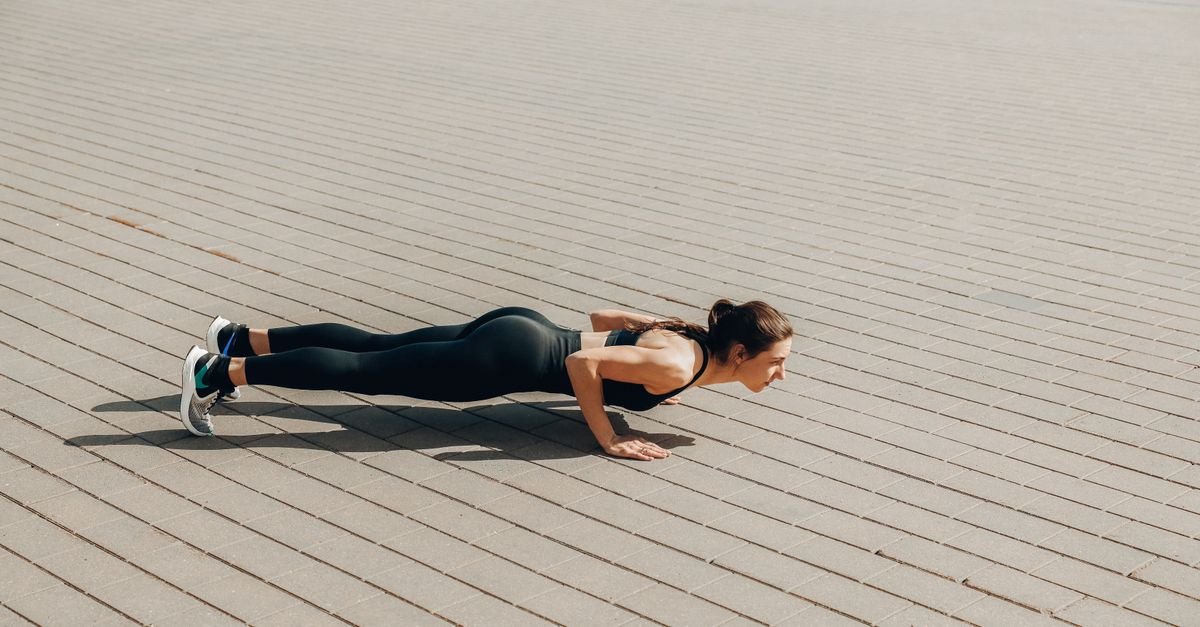
Push-ups build pressing strength comparable to the bench press when they are hard enough. Choose a variation that keeps you in the 6 to 15 rep range:
- Too easy? Elevate your feet on a sofa or bed, slow the lowering to 3 seconds, or add a pause at the bottom.
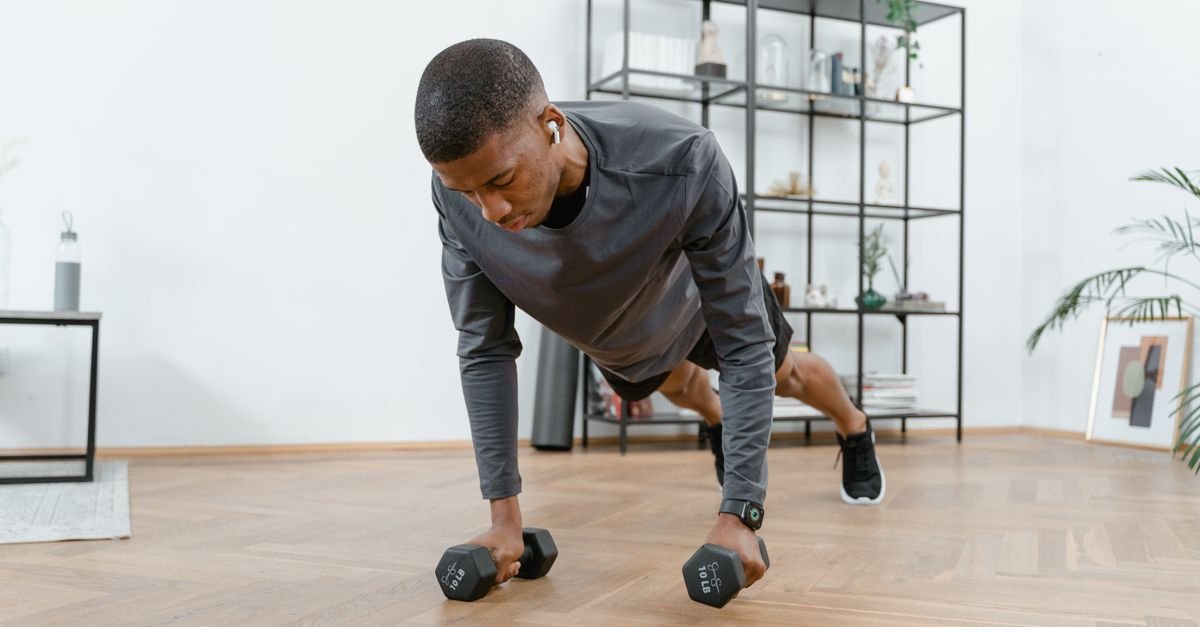
- Still too easy? Do deficit push-ups with your hands on two hexagonal dumbbells so your chest can sink below your hands. This is the closest bench-free match to a deep dumbbell press. Never use round dumbbells for this; they roll.
- Too hard? Put your hands on a kitchen counter or a sturdy chair and work down to the floor over weeks.
Upper chest workout at home with dumbbells
Without an incline bench, you create the angle with your body. Feet-elevated push-ups press at an upward angle relative to your torso, which shifts work toward the upper (clavicular) chest and front shoulders. A reverse-grip floor press (palms facing your head) is also popular for the upper chest, though the evidence behind that specific claim is limited, so treat it as a variation, not a magic fix.
Lower chest workout at home with dumbbells
Reverse the angle. The glute-bridge floor press puts you in a slight decline, and incline push-ups (hands on a raised surface, feet on the floor) do the same for bodyweight work. If you have a pair of sturdy chairs placed back to back against a wall, chair dips also hit the lower chest hard; see our dips workout guide for form and safety before you try them.
What about the standing dumbbell fly?
Many home videos show a standing dumbbell fly, arms sweeping forward at chest height. Gravity pulls a dumbbell straight down, so when you stand upright the resistance falls mostly on your front shoulders, not your chest. If you want a standing chest fly, use a resistance band anchored behind you at chest height, where the pull runs in the right direction. With dumbbells, lie down and do the floor fly instead.
How many sets and reps should you do for a home chest workout?
Aim for about 10 or more hard sets for the chest per week, split across 2 to 3 sessions, mostly in the 6-12 rep range. The American College of Sports Medicine’s 2009 position stand recommends 8-12 rep loads for beginners, 2-3 training days a week, and a 2-10% load increase once you beat your target reps by one or two.
Those figures come from the ACSM position stand on progression models in resistance training (2009), which also recommends 1 to 2 minute rests between sets for muscle growth. On volume, a 2017 meta-analysis of 15 studies by Schoenfeld, Ogborn and Krieger found a graded dose-response: each extra weekly set was linked to about 0.37% more muscle gain, and higher-volume groups gained 3.9% more than lower-volume groups.
The good news for home trainees with light dumbbells is a separate 2017 meta-analysis of 21 studies by Schoenfeld and colleagues, which found that muscle growth was similar between low loads (60% of 1RM or less) and high loads, as long as sets were taken to muscular failure. Heavy loads still won for maximal strength. So light dumbbells can still build muscle, but only if you push sets much closer to failure.
What to do with the dumbbells you already own
Most Indian home setups have one fixed pair, often 2.5 to 10 kg each, or a small adjustable set. Match your weight to the right strategy for a chest workout at home with dumbbells:
| Dumbbells per hand | Who it suits | Best use | Reps to aim for | How to make it harder |
|---|---|---|---|---|
| 2.5-5 kg | Complete beginners, most women starting out | Floor fly, squeeze press, single-arm floor press | 12-20 | 3-second lowering, 1-second pause, then switch press to one arm |
| 7.5-10 kg | Beginners to early intermediates | Floor press, glute-bridge press, pullover | 10-15 | “1.5 reps” (half rep plus full rep counts as one), shorter rests |
| 12.5-17.5 kg | Intermediates | Floor press as the main lift, all variations | 8-12 | Add a weighted backpack to deficit push-ups |
| 20 kg and above | Experienced lifters | Heavy floor press for strength blocks | 6-10 | Slow eccentrics; consider adjustable dumbbells to keep progressing |
Effort check: on your final set you should have only 1 to 3 clean reps left. If you could do 10 more, the set did little for growth.
Dumbbell chest workout without bench: a 4-week home plan
Run two chest sessions a week (for example Monday and Thursday) with at least 48 hours between them. Each session takes 30 to 40 minutes, including a 5-minute warm-up of arm circles and light push-ups. This fits alongside legs, back and core work; if you need a full week built around it, our home workout plan slots chest into a complete schedule.
| Week | Session A | Session B | Weekly chest sets | Progression rule |
|---|---|---|---|---|
| 1 | Floor press 3 x 10; Floor fly 3 x 12; Push-up 2 x max (stop 2 reps short of failure) | Glute-bridge press 3 x 10; Feet-elevated push-up 2 x 8; Squeeze press 2 x 15 | 15 | Learn the movements. Leave 3 reps in reserve. |
| 2 | Floor press 4 x 10; Floor fly 3 x 12; Push-up 2 x max | Glute-bridge press 3 x 12; Feet-elevated push-up 3 x 8; Pullover 2 x 12 | 17 | Add the 1-second floor pause on every press rep. |
| 3 | Floor press 4 x 8-12 (3 s lowering); Single-arm floor press 2 x 10/side; Floor fly 3 x 12 | Deficit push-up 3 x 8-12; Glute-bridge press 3 x 12; Squeeze press 2 x 15 | 17 | Take the last set of each exercise to 1 rep short of failure. |
| 4 | Floor press 4 x top of range; Floor fly 3 x 15; Push-up 2 x max | Deficit push-up 3 x max; Pullover 3 x 12; Squeeze press 2 x 20 | 17 | If you hit 12 reps on every floor press set, move up 1-2.5 kg or switch to single-arm. |
After week 4, repeat the cycle with heavier dumbbells or harder variations. Log weight and reps for every set; if the numbers are not climbing every two or three weeks, change something.
Muscle is built in the kitchen too. Spread your protein across meals with foods like dal, paneer, curd, eggs, chicken, soy chunks and chana. If you are unsure whether your thali covers your needs, a session with an online nutritionist can check your current diet against your training goal.
Adjustments for beginners, women and adults over 40
Beginners. Start with push-ups from a counter or chair, the floor press with 2.5 to 5 kg dumbbells, and the floor fly. Your first month is about lowering slowly with shoulder blades pinned; 2 sessions a week is plenty.
Women. Chest training will not make you look bulky; it builds the muscle under the breast tissue and everyday pushing strength. The same exercises and rep ranges apply. Many women start with lighter dumbbells, so the 2.5 to 5 kg row of the strategy table, with slow lowering and single-arm presses, is a practical starting point.
Adults over 40. The floor press is one of the most joint-friendly presses you can do, because the floor limits how far the shoulder travels. Prioritise the neutral grip, warm up a little longer and skip deficit push-ups until you have trained consistently for a few months. The NHS physical activity guidelines recommend strengthening activities that work all major muscle groups, chest included, on at least 2 days a week, and specifically list push-ups and lifting weights as ways to do it.
If you have a past shoulder injury, chest pain on exertion, high blood pressure that is not controlled or any heart condition, check with your doctor before starting a new strength programme.

Troubleshooting: why your home chest workout is not working
“I feel it in my shoulders, not my chest”
Your elbows are probably flared out at 90 degrees. Tuck them to around 45 degrees, pull your shoulder blades together and down before each set, and keep them pinned to the floor. Switching to a neutral grip helps most people within one session.
“My elbows bang on the floor”
You are lowering too fast. Count three seconds on the way down and let your triceps land softly. A yoga mat helps.
“My triceps give out before my chest”
Common on floor presses, because the short bottom range shifts work to the lockout. Put the floor fly first in the session so the chest is tired before the press, and pair it with deficit push-ups for a deeper chest stretch.
“I’ve stopped progressing”
First check sleep, protein and whether you are really adding reps or weight. If all are fine, your dumbbells may be too light. Move to single-arm presses, slower tempo, or 1.5 reps before you spend money. When those stop working, a heavier pair or an adjustable set is the next step.
How this fits with the rest of your chest training
This page is about training the chest at home when you have dumbbells but no bench. If you also train in a gym, our chest workouts guide covers bench, cable and machine options and how to split chest volume across a full week.
Start this week: two sessions, the floor press, the floor fly and one push-up variation, written down set by set. If you want a trainer to build and adjust it around your dumbbells and your schedule, book a 1-on-1 online personal training session with Fitstrot.
FAQ
Can I build a bigger chest with only dumbbells at home?
Yes, if you progress the load or difficulty over time. Studies show push-ups and floor-based pressing build strength comparable to the bench press, and muscle growth is similar across light and heavy loads when sets are taken close to failure. The limit is usually how heavy your dumbbells are, not the lack of a bench.
Is the dumbbell floor press as good as the bench press?
It is a very good substitute. The floor press shortens the bottom of the rep, so it puts slightly more emphasis on the triceps and lockout. Research on how much a shorter range affects upper-body growth is limited and mixed, so pair it with floor flys and deficit push-ups for extra stretch.
How many times a week should I train chest at home?
Two to three sessions a week suits most people, with at least 48 hours between them. The ACSM recommends 2-3 resistance training days a week for beginners, and spreading 10 or more weekly chest sets across two sessions keeps each workout manageable.
What weight dumbbells do I need for a chest workout at home?
Beginners can start with 2.5 to 5 kg per hand, using slow lowering and single-arm presses to make light weights harder. Many people move up to 10 to 17.5 kg per hand for the floor press within months. An adjustable set saves space and money in the long run.
How do I target the upper chest without an incline bench?
Use feet-elevated push-ups, which press at an upward angle relative to your torso, and try a reverse-grip floor press as a variation. A couple of firm cushions under your upper back can create a small incline if the setup is stable.
Are push-ups enough for chest, or do I need dumbbells?
Push-ups alone can build the chest well, as long as you keep moving to harder variations such as feet-elevated, paused and deficit push-ups. Dumbbells make it easier to add load gradually and add movements like the floor fly that push-ups cannot copy.
Is it safe to do a chest workout at home without a spotter?
Floor pressing is one of the safest ways to press alone, because the floor catches your arms if you fail a rep. Lower the dumbbells to your chest, roll to the side and set them down. Avoid deficit push-ups on round dumbbells, which can roll.


