

A home workout plan only works if it survives contact with a real Indian week — a 9-to-7 shift, a 6 ft by 3 ft patch of floor between the sofa and the TV, and a landlord who will not tolerate burpees at 6 am. This page is not a list of exercises. It is a four-week schedule with sets, reps, rest periods and one form cue per movement, built so you can run it in a one-bedroom flat with nothing but the floor, then extend it with a ₹400 resistance band when bodyweight stops being hard enough.
Everything prescribed here maps to published guidance. The American College of Sports Medicine’s 2026 resistance training position stand states plainly that elastic bands, bodyweight exercises and home-based routines “yield marked benefits in strength, hypertrophy, and physical function”. You are not running a compromise version of the gym. You are running a different delivery system for the same stimulus.
Does training at home actually build strength, or just burn calories?
It builds real strength. In an 8-week randomised trial of 18 young men, a push-up group training twice a week raised their bench-press one-rep max from 61.1 kg to 64.2 kg and grew triceps thickness from 27.7 mm to 30.4 mm — statistically indistinguishable from a group doing barbell bench press at 40% of 1RM (Kikuchi & Nakazato, Journal of Exercise Science & Fitness, 2017). Bodyweight resistance is resistance.
The load question has been settled more broadly too. A 2021 network meta-analysis pooling 24 studies and 747 participants found no significant difference in muscle growth between low-, moderate- and high-load training, with effect sizes between −0.09 and 0.15. Strength was the exception: heavy loads beat light ones for maximal strength (SMD 0.60). Translated honestly — a home workout plan will change how your body looks and how much work it can do, but if your goal is a 140 kg deadlift, you will eventually need a barbell.
Harvard Health reports that body-weight training research has produced 33% improvements in aerobic capacity over 10 weeks, 11% gains in core endurance and 6% in lower-body power. The headline advantage is not the physiology, though. It is that nothing stands between you and the session — no commute, no queue for the squat rack, no ₹2,000 monthly fee you feel guilty about.
The 6 ft × 3 ft setup: what a small Indian flat actually needs
Clear a rectangle roughly the length of a yoga mat plus an arm span on either side. If you can lie down and sweep your arms overhead without hitting furniture, you have enough. Everything in the four-week plan below fits that footprint. Nothing requires jumping, so downstairs neighbours stay friendly.
Running an at home workout plan without equipment (and what to add later)
Start with zero purchases. Add only when a movement stops being challenging at the top of its rep range for two sessions running.
| Item | Typical cost (₹) | What it unlocks | Skip it if |
|---|---|---|---|
| Nothing (floor + wall) | 0 | Squats, lunges, push-up progressions, planks, glute bridges, hip hinges | Never — this is weeks 1–4 |
| Yoga/exercise mat, 6 mm | 500–1,200 | Comfortable floor work on tile or mosaic; less knee pain in lunges | You train on a carpet or rug |
| Loop resistance band set | 300–700 | Banded rows, pull-aparts, lateral walks — the pulling work bodyweight cannot give you at home | You own a sturdy table for inverted rows |
| Adjustable dumbbells, 2 × 10 kg | 2,500–5,000 | Goblet squats, Romanian deadlifts, presses; extends the plan by 6–12 months | Budget is tight — bands cover 80% of it |
| Doorway pull-up bar | 800–2,000 | Vertical pulling; the single biggest upgrade for back and biceps | Your door frame is hollow or rented plaster |
A band and a mat — under ₹2,000 total — covers the entire progression path described on this page. If you later want loaded work, our guide to dumbbell workouts picks up exactly where this plan ends.
The 4-week home workout plan: sets, reps, rest and one form cue each
Structure: three non-consecutive training days per week (Mon/Wed/Fri or Tue/Thu/Sat), full body each time. This matches the ACSM 2026 recommendation to train all major muscle groups at least twice weekly, accumulating roughly 10 sets per muscle group per week, and satisfies the NHS guidance of strengthening activity on at least 2 days a week covering legs, hips, back, abdomen, chest, shoulders and arms. Each session runs 35–45 minutes including warm-up.
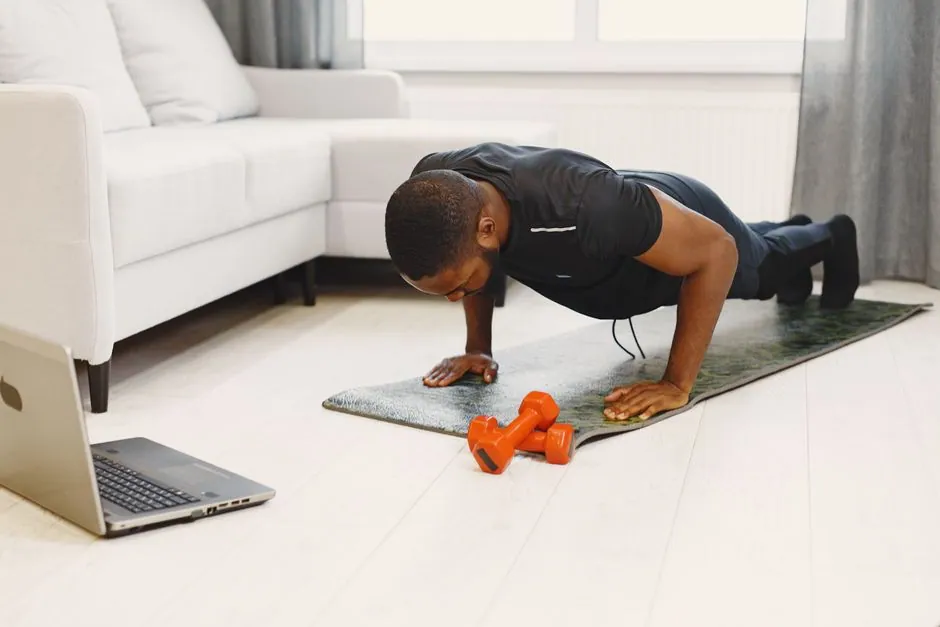
| Day | Exercise | Sets × reps | Rest | Form cue |
|---|---|---|---|---|
| A (Mon) | Bodyweight squat | 3 × 12 | 60 s | Push knees out over your second toe; heels stay flat |
| Incline push-up (hands on table) | 3 × 10 | 60 s | Elbows at 45°, not flared to 90° | |
| Glute bridge | 3 × 15 | 45 s | Squeeze glutes at the top; ribs stay down | |
| Band row or towel row on door handle | 3 × 12 | 60 s | Pull elbow to hip, not to shoulder | |
| Forearm plank | 3 × 25 s | 45 s | Tuck the tailbone; do not let the lower back sag | |
| B (Wed) | Reverse lunge (each leg) | 3 × 8 | 60 s | Step back, drop straight down; front shin vertical |
| Pike push-up or wall press | 3 × 8 | 75 s | Head travels between the hands, not in front | |
| Single-leg glute bridge | 2 × 10 | 45 s | Hips stay level — do not let one side drop | |
| Superman hold | 3 × 20 s | 45 s | Lengthen, don’t crank; look at the floor | |
| Dead bug | 3 × 8 each side | 45 s | Lower back pressed to the floor throughout | |
| C (Fri) | Split squat (each leg) | 3 × 10 | 60 s | Back knee tracks toward the floor, not forward |
| Knee or full push-up | 3 × AMRAP−2 | 75 s | Body moves as one plank from ear to ankle | |
| Hip hinge / good morning | 3 × 12 | 60 s | Push hips back to the wall behind you | |
| Band pull-apart | 3 × 15 | 45 s | Shoulder blades pinch, elbows stay soft | |
| Side plank (each side) | 2 × 20 s | 45 s | Stack the shoulder directly over the elbow |
AMRAP−2 means “as many reps as possible, then stop two short of failure.” ACSM’s 2026 review found that training to momentary failure did not consistently improve outcomes for the average healthy adult — which is good news at home, where nobody is spotting you.

How the plan progresses across four weeks
Progression at home is not about adding kilos. It is about changing leverage, tempo, range and density — in that order.
| Week | Sets/reps change | Difficulty lever | Rest | Weekly hard sets per muscle |
|---|---|---|---|---|
| 1 | As written above | Learn positions; stay 3–4 reps from failure | 45–75 s | ~6 |
| 2 | +2 reps per set | 3-second lowering phase on every rep | 45–75 s | ~7 |
| 3 | Add 1 set to the first two exercises | Reduce leverage: table push-up → floor push-up; squat → tempo squat with 2-second pause | 60–90 s | ~9 |
| 4 | Hold week 3 volume | Density: same work, rest cut by 15 s | 45–75 s | ~10 |
| 5 (deload) | Halve the sets | Easiest variations, no tempo work | Free | ~5 |
Week five is not optional slacking — it is how you get to week nine without a cranky shoulder. Mayo Clinic’s guidance is to rest one full day between exercising each specific muscle group, which the Mon/Wed/Fri layout already builds in.
Who this plan changes for — and who it doesn’t
Home workout plan for men: using a home workout plan to build muscle
The mechanics are identical; the ceiling arrives sooner. Men chasing size will out-grow bodyweight lower-body work in roughly 8–12 weeks because a 75 kg man squatting his own weight is training at well under 50% of his capacity. The fix is not more reps — it is single-leg work (split squats, step-ups onto a sturdy chair) and then a pair of dumbbells. Upper-body pushing has far more runway: the progression from incline → floor → feet-elevated → archer push-up covers most of a year.
Protein matters as much as programming. ICMR-NIN’s 2020 RDA for Indian adults is 0.83 g of protein per kg body weight per day, rising to 1 g/kg on cereal-dominant diets, against a reference body weight of 65 kg for men and 55 kg for women. People training three times a week generally sit at the upper end of that range or above it; if you are vegetarian and training hard, a dietitian-set target is a faster route than guesswork.
Women at home workout plan: what actually changes
Less than the internet suggests. The programme, the rep ranges and the progression are the same — women respond to resistance training with comparable relative strength gains. Two practical adjustments are worth making: relative upper-body strength is typically lower, so expect to stay on incline push-ups longer without treating it as failure; and if you are pregnant, postpartum or managing pelvic-floor symptoms, get clearance before adding plank and loaded hinge work. This is a general-population plan, not medical advice — see a doctor before starting if you have a heart condition, uncontrolled blood pressure, a recent injury or joint surgery.
At home workout plan for beginners: the first 14 days
If you have not trained in a year or more, halve everything above for two weeks: two sessions a week, two sets per exercise, the easiest variation of each. The goal of a beginner home workout plan is not stimulus — it is attendance. Soreness in the first fortnight is normal and fades; sharp joint pain is not, and means you stop. Our beginner workout plan covers the on-ramp in more depth.

Extending it: a home workout plan with dumbbells and bands
Once floor push-ups feel comfortable at 15 reps and squats at 20, bodyweight alone stops driving adaptation. Swap movements rather than rebuilding the plan.
| Bodyweight version | Band upgrade | Dumbbell upgrade | New rep target |
|---|---|---|---|
| Bodyweight squat | Band-around-thigh squat | Goblet squat, 10–16 kg | 3 × 8–10 |
| Glute bridge | Band-resisted hip thrust off the sofa | Dumbbell hip thrust | 3 × 10–12 |
| Incline push-up | Band-resisted floor push-up | Floor press or dumbbell bench on a bench | 3 × 6–10 |
| Towel/door row | Seated band row | Single-arm dumbbell row | 3 × 8–12 |
| Hip hinge | Banded good morning | Romanian deadlift, 2 × 10 kg | 3 × 8–10 |
| Pike push-up | Band overhead press | Standing dumbbell shoulder press | 3 × 6–10 |

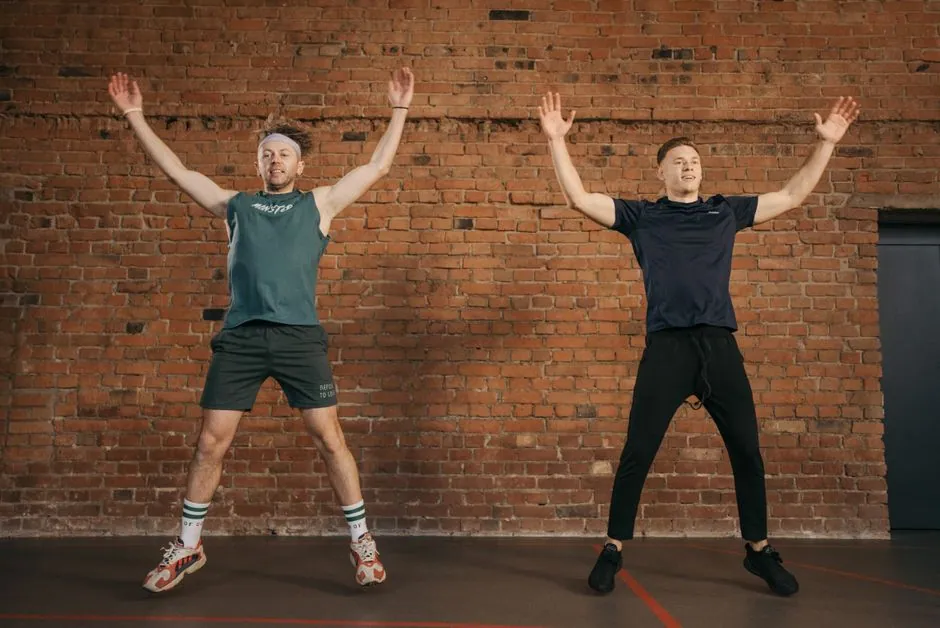
Cardio sits on top, not inside, the strength sessions. The CDC recommends 150 minutes of moderate-intensity activity a week plus 2 days of muscle strengthening, and explicitly notes you can “spread your activity out during the week and break it up into smaller chunks of time.” Two brisk 30-minute walks and one dance or conditioning session covers it. If jumping is off the table because of neighbours, low-impact home conditioning circuits hit the same heart-rate zones without the noise.
Four beliefs about home training that the evidence does not support
“You need a gym to see change.” Contradicted directly by the push-up trial above and by ACSM’s 2026 position stand. What you need is progressive overload, which bodyweight, bands and a sturdy table can supply for months.
“More sweat means a better session.” Sweat measures thermoregulation, not stimulus. A slow tempo squat set that leaves you barely damp does more for your legs than 20 frantic minutes of jumping jacks.
“Daily training beats three days a week.” It does not, at this volume. Muscle adapts during recovery; the 2021 meta-analysis found benefits from higher frequency mainly in people with prior training experience, not beginners.
The home workout plan for weight loss myth
“A home workout plan alone will strip fat.” Three 40-minute sessions a week burn roughly 600–900 kcal total — real, but about a fifth of a weekly deficit needed for meaningful loss. Training protects muscle while a food deficit does the fat loss; the two are not interchangeable. The WHO notes that 31% of adults worldwide — about 1.8 billion people in 2022 — fall short of the recommended 150 minutes of moderate activity a week, so building the habit is the win here, not the calorie number. Anyone with a specific kilo target is better served by an online weight loss trainer who can set the food side alongside the training.
Troubleshooting: when the plan stalls
- Reps stopped climbing for three sessions. You are probably resting too little. Extend rest to 90 seconds on the first two exercises before touching the reps.
- Knees complain in lunges. Shorten the step, slow the descent and reduce depth by a third. Pain that lingers past 24 hours needs a physiotherapist, not a modification.
- You keep missing the third session. Cut to two sessions of 25 minutes and hold that for a month. A plan you complete at 70% beats a plan you abandon at 100%.
- Wrists hurt in push-ups and planks. Move to fists on a mat or push-up handles, and hold forearm planks instead of straight-arm ones.
- Everything feels easy but nothing looks different. You have stopped progressing overload. Move down the difficulty-lever column in the progression table — leverage, then tempo, then density.
Frequently asked questions
How many days a week should a home workout plan run?
Three non-consecutive days is the sweet spot for most people. That delivers roughly 10 hard sets per muscle group per week, which is the volume ACSM’s 2026 position stand associates with muscle growth, while leaving a full recovery day between sessions as Mayo Clinic advises. Two days a week still meets the NHS and CDC minimum for muscle-strengthening activity.
Can I build muscle at home without any equipment?
Yes, for the first several months. An 8-week trial found push-up training produced the same gains in triceps and chest thickness and in bench-press 1RM as barbell bench press at matched load. The limit arrives for the legs first, because a bodyweight squat becomes a light load once you can do 20 clean reps.
How long before I see results from this plan?
Strength and rep performance usually improve within 2–3 weeks. Visible body-composition change generally takes 8–12 weeks and depends heavily on diet. Anyone promising a transformed physique in 30 days is selling something.
Is a resistance band really enough, or do I need dumbbells?
A loop band set covers roughly 80% of what home training needs, particularly pulling work that bodyweight struggles to supply. ACSM’s 2026 review lists elastic bands alongside bodyweight and home routines as producing marked strength and hypertrophy benefits. Dumbbells extend the plan further but are not the entry requirement.
What should I do on the four non-training days?
Walk. Two brisk 30-minute walks plus normal daily movement covers most of the CDC’s 150 weekly minutes of moderate activity. One optional dance or conditioning session can replace a walk. Complete rest on at least one day a week is sensible.
Do I need to warm up, and for how long?
Five to eight minutes. Two minutes of marching or stair-stepping to raise body temperature, then leg swings, hip circles, arm circles and two light sets of the first exercise of the day. Skipping this is the most common reason home sessions end in a tweaked shoulder or hamstring.
Is this plan safe if I am over 50 or returning after an injury?
Often yes, but get clearance first. Start with the two-week beginner on-ramp, use the easiest variation of every movement, and avoid tempo work for the first month. Anyone with a heart condition, uncontrolled blood pressure, a recent surgery or ongoing joint pain should speak to a doctor or physiotherapist before starting.
Can I follow this plan alongside yoga or Zumba?
Yes. Treat them as the conditioning and mobility layer rather than extra strength days. A common weekly shape is strength on Monday, Wednesday and Friday, a yoga session on Tuesday or Sunday, and a dance session on Saturday.
Print the two tables, stick them near your training space, and run week one exactly as written — no additions. If you want the sets, reps and progressions adjusted to your body, your injuries and the floor space you actually have, a 1-on-1 personal training session will build it around you in a single consultation.


