

A crossfit workout at home is not a watered-down version of a class at a box — it is the same three ingredients (constantly varied movement, functional patterns, high relative intensity) squeezed into 4 sq m of floor and whatever kit fits under your bed. The honest catch is that you lose the one thing the research repeatedly flags as protective: a coach watching your reps. This guide gives you the movement standards, the scaling ladders, twelve ready-to-run WODs, a four-week plan and the safety numbers, so you can train hard at home without guessing.
Note on wording: CrossFit® is a registered trademark of CrossFit, LLC. Nothing here is affiliated with or endorsed by them. Throughout, we describe the method as CrossFit-style or high-intensity functional training (HIFT), which is what the peer-reviewed literature calls it.
Can you get a real training effect without a box, a barbell or a rig?
Yes. A 12–20 minute CrossFit-style session done at genuine intensity counts as vigorous activity, and 75 minutes a week of vigorous activity delivers health benefits comparable to 150 minutes of moderate activity, per the NHS adult activity guidelines, which list skipping among its vigorous examples. Four home WODs a week clears that bar.
What you cannot replicate at home is heavy barbell work — cleans, snatches, back squats above bodyweight. That is a real ceiling for absolute strength. Everything else (engine, midline, gymnastics capacity, work rate) responds fine to bodyweight and one or two loaded implements. The CDC asks adults for 150 minutes of moderate or 75 of vigorous aerobic activity plus muscle-strengthening work on 2 or more days a week; a well-built home WOD week covers both columns at once, which is exactly why the format survives outside gyms. Globally, WHO reports that 31% of adults still fall short of those levels — a 15-minute AMRAP in your drawing room is a cheap way not to be one of them.
The nine movements that carry every home session
You do not need forty exercises. Nine patterns, rotated and re-combined, produce almost every home WOD worth doing. Treat the form cue column as non-negotiable — it is the closest thing you have to a coach’s eyes.
| Movement | Practice dose | Rest | Form cue | Scale down | Scale up |
|---|---|---|---|---|---|
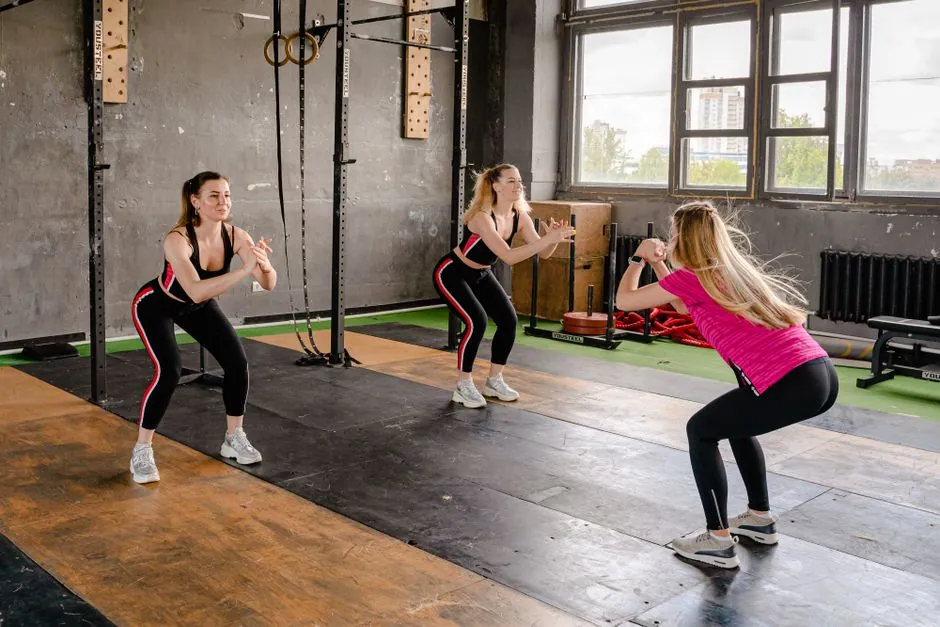
| Air squat | 4 × 15 | 45 s | Hip crease below knee, knees track over toes | Sit to a chair | Jump squat |
| Push-up | 4 × 8–12 | 60 s | Elbows ~45°, ribs down, body moves as one plank | Hands on sofa arm or wall | Feet elevated / deficit |
| Burpee | 5 × 8 | 60 s | Chest and thighs touch floor, full hip extension at the top | Step back, step in, no jump | Burpee over a bag |
| Kettlebell swing (8–16 kg) | 5 × 15 | 60 s | Hinge not squat; the hips throw the bell, arms are ropes | Lighter bell, Russian height | American swing, heavier bell |
| Goblet squat | 4 × 10 | 75 s | Elbows inside knees, heels flat, chest tall | Bodyweight squat | Tempo 3-1-1 |
| Single-arm dumbbell push press | 4 × 8/side | 60 s | Dip 10 cm, drive, finish with biceps by the ear | Strict press, lighter | Devil’s press |
| Skipping / double-under | 6 × 40 s | 40 s | Wrists turn the rope, elbows stay near ribs | Single unders or fast feet | Double-unders unbroken |
| Hollow hold / V-up | 4 × 30 s | 45 s | Lower back glued to floor throughout | Tuck hold | Weighted V-up |
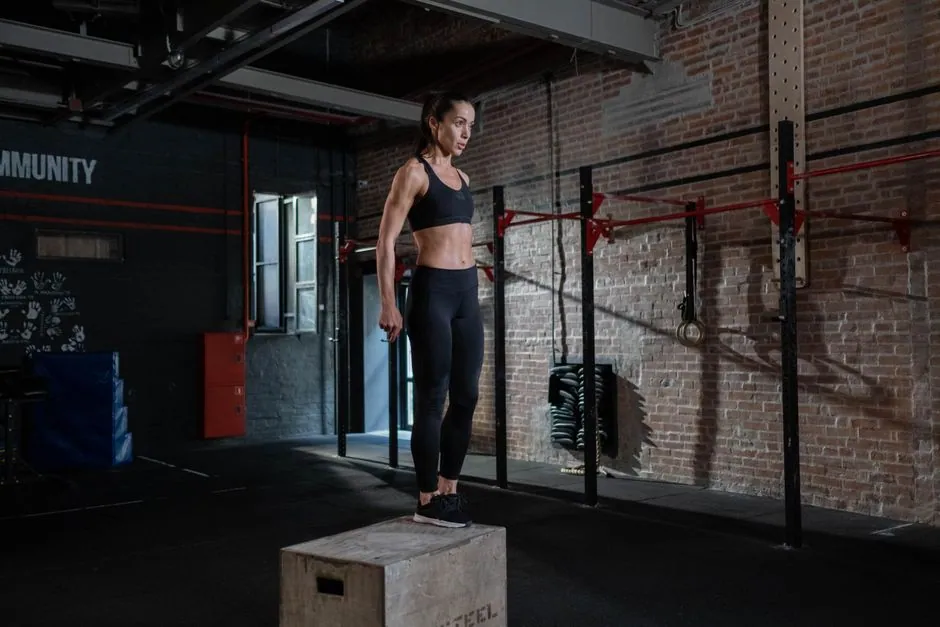
| Step-up or box jump (40–50 cm) | 4 × 10/side | 60 s | Whole foot on the box, stand fully upright | Step-up on a stair | Box jump, step down |
For loading, the ACSM position stand on progression models recommends untrained adults work with loads in the 8–12 repetition-maximum range and train each pattern 2–3 days a week. That is the strength backbone; the WODs sit on top of it, not instead of it.

AMRAP, EMOM, For Time: the three clocks decoded
Nearly every WOD is one of three clocks. Learn them once and any workout you read online becomes instantly usable.
AMRAP workout
AMRAP means As Many Rounds (or Reps) As Possible in a fixed window — typically 8, 12, 15 or 20 minutes. You set a short circuit and repeat it until the timer ends, scoring total rounds plus extra reps. The pacing rule that separates good AMRAPs from blow-ups: pick a round you could sustain for the whole window on your worst day, then hold it.
EMOM workout
EMOM means Every Minute On the Minute. At the top of each minute you perform a prescribed set; whatever time is left is your rest. It is self-regulating — if a set takes 45 seconds you get 15 seconds back, so the work must be sized so you always finish by second 45. EMOMs are the safest home format for beginners because they cap fatigue-driven form decay.
For Time and Tabata
For Time means finish a fixed amount of work as fast as possible, always with a time cap so a bad day does not turn into a 40-minute grind. Tabata is 8 rounds of 20 seconds work and 10 seconds rest, four minutes per movement. Harvard’s Nutrition Source describes a workable beginner interval template of 30 seconds of hard work to 15 seconds of recovery, with intense intervals pushing heart rate to at least 80% of maximum — and it recommends that anyone new to high-intensity interval work start under a qualified coach.
| # | Format | The work | Cap | Scaled version |
|---|---|---|---|---|
| 1 | AMRAP 12 | 10 air squats, 8 push-ups, 6 burpees | 12 min | Incline push-ups; step-back burpees |
| 2 | EMOM 16 | Odd: 12 KB swings. Even: 40 s skipping | 16 min | 10 swings / 30 s skipping |
| 3 | For Time | 50-40-30-20-10 singles + 10-8-6-4-2 burpees | 15 min | Halve the skipping reps |
| 4 | AMRAP 15 | 200 m stair or corridor run, 15 goblet squats | 15 min | 100 m, 10 squats |
| 5 | Tabata | Air squats, then push-ups, then hollow holds | 12 min | One movement only, 4 min |
| 6 | EMOM 20 | Rotate: 10 swings / 8 push press / 12 step-ups / rest | 20 min | Cut each set by 3 reps |
| 7 | For Time | 100 air squats, 75 singles, 50 sit-ups, 25 burpees | 20 min | 60/50/30/15 |
| 8 | AMRAP 20 | 5 push-ups, 10 V-ups, 15 air squats | 20 min | Tuck-ups instead of V-ups |
| 9 | EMOM 12 | Odd: 8 devil’s press. Even: 12 goblet squats | 12 min | 6 dumbbell burpees / 8 squats |
| 10 | For Time | 3 rounds: 400 m run, 21 swings, 12 step-ups | 18 min | 2 rounds, 200 m |
| 11 | AMRAP 8 | 4 burpees, 8 lunges, 12 mountain climbers | 8 min | Step-back burpees |
| 12 | EMOM 10 | Alternate: 30 s hollow hold / 10 single-arm press | 10 min | 20 s tuck hold / 8 press |

A four-week crossfit workout plan for beginners
The plan below is deliberately conservative. Three hard days, one light day, three rest or mobility days in week one, rising to four working days by week four. Treat the strength block as the priority and the WOD as the finisher — reversed, your technique degrades under fatigue, which is precisely when injuries happen.
| Week | Mon | Tue | Wed | Thu | Fri | Sat | Sun |
|---|---|---|---|---|---|---|---|
| 1 | Squat + press 3×10; WOD 1 | Walk 30 min | Hinge + push-up 3×10; WOD 11 | Rest | Full-body 3×10; WOD 5 | Mobility 20 min | Rest |
| 2 | Squat + press 4×10; WOD 2 | Skipping 10 min | Hinge + push-up 4×10; WOD 1 | Rest | Full-body 4×10; WOD 3 | Walk or yoga | Rest |
| 3 | Squat + press 4×8 heavier; WOD 4 | Skipping 12 min | Hinge + push-up 4×8; WOD 8 | Rest | Full-body 4×8; WOD 6 | WOD 12 (light) | Rest |
| 4 | Squat + press 4×8; WOD 9 | Mobility 20 min | Hinge + push-up 4×8; WOD 10 | Rest | Full-body 4×8; WOD 7 (test) | Easy skipping | Rest |
Re-test WOD 7 at the end of week 8 and week 12. A 10–20% improvement in time or rounds over twelve weeks is a realistic, honest target for a beginner training three to four days a week. Anyone promising you a body recomposition timeline in weeks is selling something. If you want the progression audited by a human, our 1-on-1 online personal training coaches review WOD video and adjust loads weekly.
What the injury data actually says about training unsupervised
A systematic review of 25 studies covering 12,079 practitioners, published in The Physician and Sportsmedicine (2022), found a mean injury prevalence of 35.3% and an incidence rate between 0.2 and 18.9 injuries per 1,000 training hours — comparable to weightlifting and powerlifting. The most-affected areas were the shoulder (26%), spine (24%) and knee (18%), and 8.7% of reported injuries needed surgery.
The line that matters most for home training: among the risk factors the review identified was lack of coach supervision, alongside previous injury, higher BMI and competing. A 2020 review in the Journal of Human Kinetics reached the same anatomical conclusion — shoulders, knees and back — while cautioning that 11 of its 12 included studies were of poor methodological quality, so treat all of these numbers as directional rather than precise.
Practically, that converts into three home rules: cap overhead volume (the shoulder is the number-one site), never chase a time through a rounding spine, and film one set a week from the side. Also know the one emergency sign. Exertional rhabdomyolysis is rare but real after a sudden jump in intensity; the CDC lists three symptoms — muscle pain far beyond normal soreness, dark tea- or cola-coloured urine, and unusual weakness — and says to seek treatment immediately. Cleveland Clinic notes symptoms typically appear one to three days after the session and that risk rises when people push hard without adequate rest. Do not “hero WOD” your first week back after a layoff.
Five myths worth correcting before you start
“Every session must leave you on the floor.” No. Intensity is relative to your capacity, and the reason EMOMs exist is to keep quality high. If you cannot hold a conversation of three words at the end, you paced badly.
“Soreness measures a good workout.” Delayed soreness mostly tracks novelty and eccentric load, not adaptation. Times, rounds and reps are the measurement.
“You need a barbell.” You need progressive load. One adjustable dumbbell and a 12 kg kettlebell cover the first year comfortably.
“High intensity is dangerous for older adults.” Not automatically. A Norwegian trial of 1,567 healthy adults averaging 73 years, summarised by Harvard Health, recorded only three adverse events over five years of follow-up. Medical clearance first if you are older or have heart disease, then train.
“More days equals faster progress.” Three to four quality days with full recovery beats six rushed ones, especially without a coach to catch the fatigue.
Kit, ₹ budget, and doing crossfit exercises without equipment
You can run months of training on zero kit. Everything below is optional and listed in the order it earns its money in an Indian home setup. Prices are typical online ranges as of 2026 and will vary by brand and city.
What ₹0 still gets you
Air squats, push-ups, burpees, lunges, hollow holds, mountain climbers, step-ups on a staircase, stair sprints and shadow skipping cover all nine movement patterns except loaded hinging. WODs 1, 5, 7, 8 and 11 in the bank above need nothing but floor space.
| Priority | Item | Typical cost | What it unlocks | Skip it if |
|---|---|---|---|---|
| 1 | Speed rope | ₹250–800 | Singles, double-unders, cheap conditioning | Ceiling under 2.4 m — use fast feet |
| 2 | Kettlebell 8–16 kg | ₹900–2,800 | Swings, goblet squats, carries, snatches | You already own dumbbells |
| 3 | Exercise mat | ₹500–1,500 | Floor work, noise control for flats | Carpeted floor |
| 4 | Adjustable dumbbell pair | ₹2,500–7,000 | Presses, rows, devil’s press, progression | Budget is tight — add later |
| 5 | Sturdy bench or 40 cm box | ₹0–3,000 | Step-ups, box jumps, incline push-ups | A staircase works |
| 6 | Doorway pull-up bar | ₹900–2,500 | Pull-ups, hangs, knee raises | Rented flat, no fixing allowed |
Sticking points: when your WOD times stop improving
Plateaus at home are usually one of four things. Grip fails before the legs do — add 2 × 30 s farmer carries twice a week. You redline in minute one — the fix is pacing practice, not more conditioning: run WOD 8 at a deliberate 80% and compare scores. Skipping trips constantly — rope length is usually wrong; stand on the middle, handles should reach your armpits. Everything stalls at once — that is under-recovery, and the answer is sleep and protein, not another WOD. If nutrition is the bottleneck, an online nutritionist consultation is a faster fix than a new programme. For a slower, non-timed alternative on deload weeks, a structured home workout plan keeps volume without the clock.

Notes for women training CrossFit-style at home
The programming does not change by sex; the starting points and a few practical details do. Most women beginning at home find the upper-body pressing and pulling patterns the limiting factor while lower-body work progresses quickly, so scale push-ups to an incline for longer than you think you need and add hangs before chasing pull-ups. Load the kettlebell honestly — an 8 kg bell is usually too light for swings within a month, and under-loading is the most common reason progress stalls. If you are pregnant, postpartum, or managing pelvic-floor symptoms, high-impact work such as double-unders and box jumps should wait until you have been cleared by your doctor or a physiotherapist, and there is no fitness cost to substituting step-ups and single-unders in the meantime. For structured coaching around those constraints, an online trainer can adjust each WOD rather than you guessing at substitutions.
The benefits you can reasonably expect — and the ones you cannot
Realistic, in twelve weeks of three to four sessions: better work capacity (measurable as WOD scores), improved aerobic fitness, more usable strength in squat, hinge and press, and meaningful adherence because sessions are short. Harvard’s review notes HIIT improved VO₂max more effectively than steady moderate training in people with high blood pressure. Less realistic: large absolute strength gains without heavy barbells, dramatic changes in body composition without matching your nutrition, or Games-style gymnastics skills learned unsupervised. Being plain about that is the difference between a programme you finish and one you abandon in week three. If dance-based conditioning suits you better on low-motivation days, Zumba-style cardio hits the same aerobic column with far less joint stress.
Frequently asked questions
Can you do a CrossFit workout at home with no equipment?
Yes. Air squats, push-ups, burpees, lunges, hollow holds, mountain climbers and stair step-ups cover eight of the nine core movement patterns. Only loaded hinging needs kit. Five of the twelve WODs in this article require nothing but floor space, and a 12-minute AMRAP of squats, push-ups and burpees is a complete session.
How long should a home WOD be?
Most home WODs should run 8 to 20 minutes of working time, plus a 5–10 minute warm-up and a short cool-down. Beginners should sit at the 8–12 minute end for the first month. Anything past 25 minutes at home usually means the intensity has quietly dropped and you are doing long cardio instead.
How many days a week should a beginner train?
Three working days in weeks 1–2, rising to four by week 4, with at least two full rest days. The ACSM position stand recommends 2–3 resistance sessions a week for novices, and CDC guidance asks for muscle-strengthening work on 2 or more days weekly — three quality days clears both.
What is the difference between an AMRAP workout and an EMOM workout?
An AMRAP fixes the time and lets your output vary: do as many rounds as possible in, say, 15 minutes. An EMOM fixes the work and lets your rest vary: a set at the top of every minute, the remainder is recovery. EMOMs are safer for beginners because they cap fatigue; AMRAPs test pacing.
Is high-intensity training at home safe after 40?
For healthy adults, generally yes, with medical clearance first. A Norwegian trial of 1,567 adults averaging 73 years recorded only three exercise-related adverse events across five years. If you have heart disease, uncontrolled blood pressure, diabetes or a previous injury, speak to your doctor before starting and scale impact movements.
Do I really need a coach if I train at home?
Not strictly, but the evidence leans that way. The 2022 systematic review of 12,079 practitioners listed lack of coach supervision among the risk factors associated with injury. If a coach is not an option, film one set per session from the side, keep overhead volume modest, and never add load and speed in the same week.
Will CrossFit-style workouts at home help with fat loss?
They help, but diet does the heavy lifting. A 15-minute WOD burns far fewer calories than most people assume, so the real value is preserved muscle, better appetite regulation and a habit you can keep. Pair four sessions a week with a modest calorie deficit and adequate protein rather than expecting the workouts alone to do it.
Pick one WOD from the bank, film a single set from the side, and compare the score in two weeks. That is the whole method. If you want the loads, scaling and re-tests decided by someone who watches the footage, book a session with a Fitstrot coach and bring your week-one numbers.


