
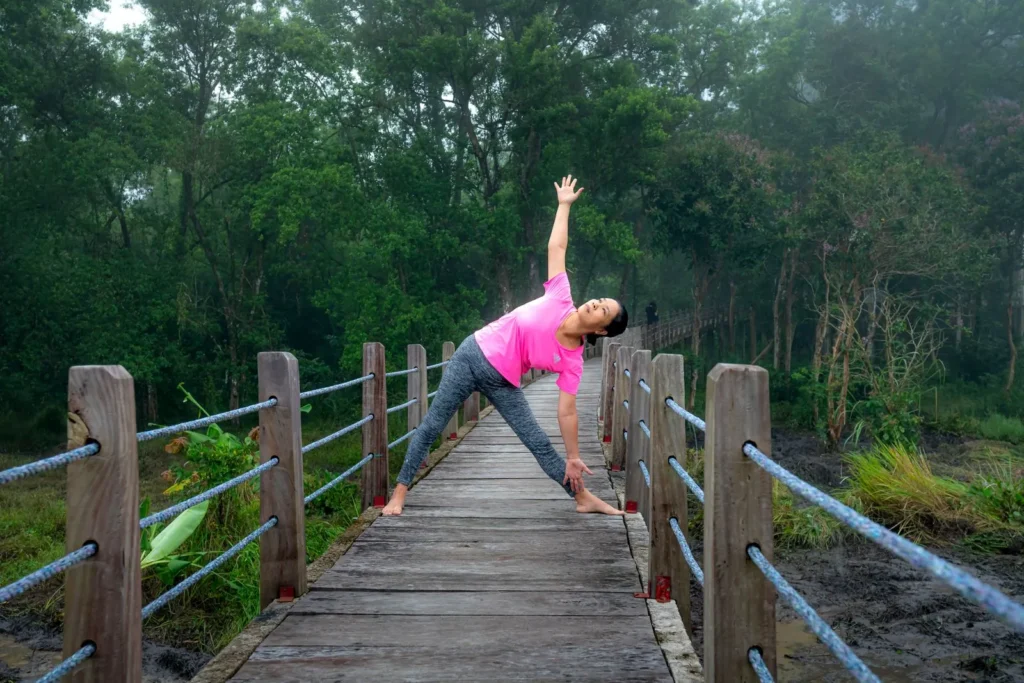
Triangle pose, known in Sanskrit as trikonasana, is a standing yoga posture where you set your feet about a leg-length apart, hinge sideways from the hip over a straight front leg, and reach one hand down while the other arm points to the ceiling. Done well, trikonasana stretches the hamstrings, inner thighs and side body while the legs and core work to hold you steady. Below you will find exact foot positions, an alignment table, fixes, variations and hold times.
What is trikonasana, and why do teachers start with it?
Trikonasana, or utthita trikonasana (extended triangle pose), is a standing sideways bend performed with straight legs set roughly 3.5 to 4 feet apart. The torso hinges from the hip in one flat plane, so one hand lowers toward the shin or a block while the other arm reaches straight up, forming a triangle with the legs.
The name joins utthita (extended), trikona (triangle) and asana (posture). Most classes teach it right after tadasana, because it builds three habits harder poses depend on: hinging at the hip instead of rounding the back, keeping the spine long, and stacking one shoulder over the other. Those habits carry straight into half moon pose, and the pose appears across most styles of yoga.
How do you do trikonasana step by step?
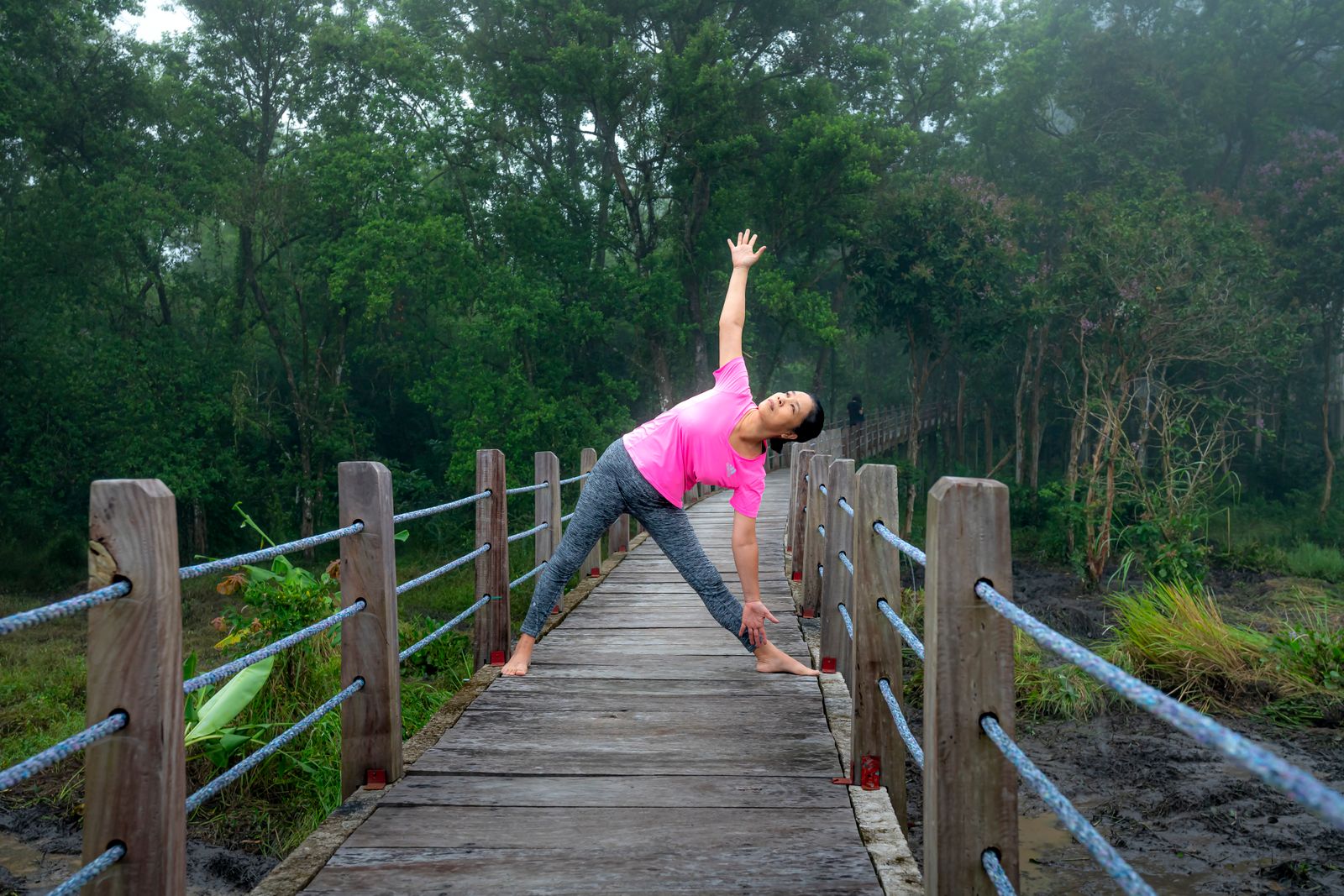
Stand with your feet 3.5 to 4 feet apart, turn the front foot out 90 degrees and the back foot in 15 to 30 degrees, then lift both arms to shoulder height. Hinge sideways from the front hip, rest the lower hand on your shin or a block, reach the top arm up and hold for 30 to 60 seconds.
Here is the full walkthrough for the right side. Repeat everything on the left.
- Set the stance. Start in mountain pose, then step the feet wide. Taller people need the wider end of the range.
- Turn the feet. Right toes point to the short edge of the mat. Left toes turn in slightly, 15 to 30 degrees.
- Line up the heels. The front heel sits in line with the arch of the back foot.
- Lift the arms. Raise them to shoulder height, palms down.
- Lengthen, then hinge. Reach forward through the right fingertips, then tip from the right hip crease with the spine long.
- Place the lower hand. Rest it on the shin, ankle or a block, wherever the chest stays open.
- Raise the top arm. The left arm reaches straight up, stacked over the lower shoulder.
- Soften the front knee. Keep a tiny bend, firm the thigh muscles and press evenly through both feet.
- Choose your gaze. Look up at the top hand if your neck is comfortable. Otherwise look straight ahead or down.
- Hold and exit. Breathe steadily for 30 to 60 seconds, then press into the back foot and rise on an inhale.
If your back heel drifts, set it against a wall. If you cannot reach the shin without rounding, rest your hand on a hardcover book or block outside the front foot.
Trikonasana alignment cheat sheet: what each body part should do
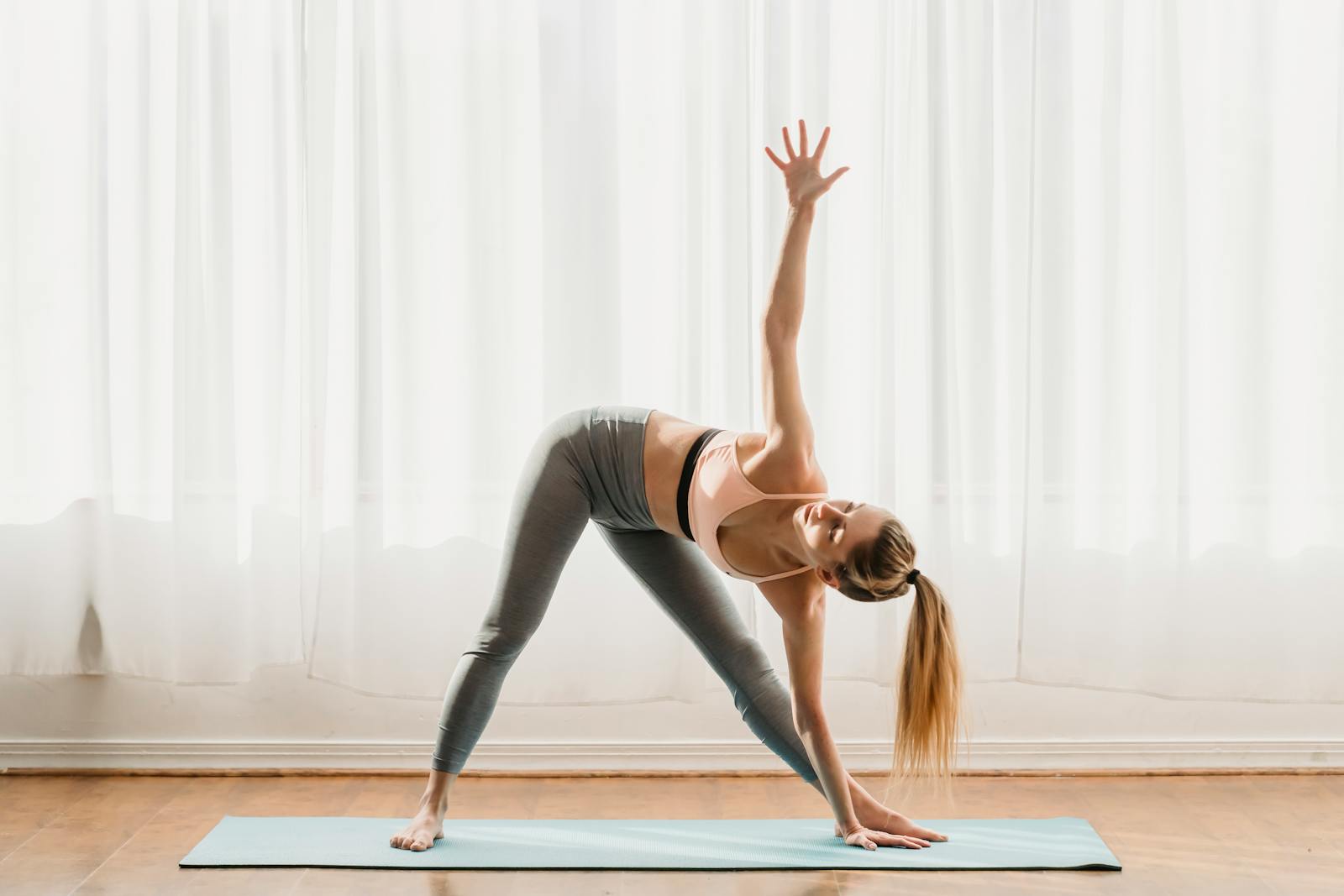
Use this table as a quick mirror check: target position, the usual slip and the smallest fix.
| Body part | Target position | Common slip | Quick fix |
|---|---|---|---|
| Feet | Front toes forward, back foot in 15-30 degrees, front heel in line with back arch | Feet too wide or on a tightrope line | Shorten the stance by a few inches |
| Front knee | Straight but soft, kneecap tracking over the second toe | Locked or pushed back hard | Micro-bend and engage the thigh |
| Hips | Pelvis open toward the long side of the mat | Front hip pushed forward, pelvis rotated to face the floor | Draw the front hip back, lift the back hip slightly |
| Spine | One long line from tailbone to crown | Rounded back or sagging waist | Reach the crown forward before you tip over |
| Lower hand | On shin, ankle or block, no weight dumped into it | Leaning on the leg for support | Lift the fingertips for a breath, then re-set |
| Top arm | Straight up, stacked over the lower shoulder | Drifting forward over the face | Roll the top shoulder back and open the chest |
Myth check: you must touch the floor to do triangle pose properly
The goal is not how low the lower hand gets. It is how long and open the side body stays. A hand on the shin with a flat spine and stacked shoulders is a better triangle than a hand on the floor with a rounded back. Reaching for the floor shortens the side you are trying to stretch. A block raises the floor to where your body is today, and as your hamstrings lengthen over weeks, you lower it.
Troubleshooting a triangle pose that feels wrong
Most discomfort comes from one of five patterns. Find your symptom and try the matching adjustment.
- Pulling behind the front knee. The hamstring is tight or the knee is locked. Bend the knee slightly, shorten the stance and use a block.
- Pinching in the lower back. You are probably rounding to reach down. Keep the chest rotating open and rest the hand higher on the leg. If back discomfort is a regular visitor, our guide to yoga for back pain covers gentler options.
- Wobbling. Press the outer edge of the back foot into the floor, widen the stance a little and set the back heel against a wall.
- Shoulder or neck strain. Rest the top hand on your hip for a few breaths and look forward.
- Feeling stuck in a forward fold. The torso has rotated toward the floor. Stand up, square the hips and tip again with the chest facing the side wall.
A mirror helps, but a teacher watching helps more. At home, an online yoga class with live corrections quickly shows which pattern is yours.
What are the benefits of trikonasana?
Regular trikonasana practice stretches the hamstrings, inner thighs, chest and side body while strengthening the quadriceps, ankles and obliques. Held for 30 to 60 seconds per side, it also builds balance and body awareness. Benefits depend on consistency and good alignment, and the pose works best alongside other postures rather than as a standalone fix.
- Leg and hip flexibility. The wide stance lengthens the back-leg hamstring and both inner thighs at once.
- Side-body and chest opening. The stacked arms stretch the ribcage muscles and chest on the reaching side.
- Leg and ankle strength. Holding a wide stance trains the quadriceps, calves and the small stabilisers around the ankle.
- Sideways spinal mobility. Daily life seldom asks you to bend sideways.
- Core engagement. The obliques on the lower side brace so the torso does not sag.
It can ease the hip and side stiffness of long desk hours, though results vary and no single pose changes posture alone. It slots naturally into Surya Namaskar-based warm-ups, and our overview of the benefits of yoga shows where it sits in a wider routine.
Trikonasana variations compared
You do not have to pick the classic version. This table shows how the main variations differ in hand position, who they suit and how demanding they are.
| Variation | Hand position | Best for | Difficulty |
|---|---|---|---|
| Block or book supported | Lower hand on a block placed outside the front foot | Beginners, tight hamstrings, desk workers | Easy |
| Wall-supported | Back and hips lightly against a wall | Balance work, learning to keep the hips open | Easy |
| Chair triangle | Lower hand on the seat of a sturdy chair | Limited mobility, seniors, recovering from time off | Easy |
| Classic utthita trikonasana | Hand on shin or ankle, top arm vertical | Most practitioners once alignment is steady | Moderate |
| Parivrtta trikonasana (revolved) | Opposite hand to the front foot, with a twist | Experienced students with good balance and hamstring length | Challenging |
Move to the revolved version only when the classic pose feels steady on both sides. For balance practice between rounds, Vrksasana (tree pose) is a good partner.
Trikonasana vs parsvakonasana: what is the difference?
In trikonasana the front leg stays straight and the body forms a long diagonal from the back foot to the top fingertips. In parsvakonasana (extended side angle) the front knee bends to about 90 degrees and the lower arm rests on the thigh or floor, creating a deeper, more demanding stretch through the hip and side body.
Because the straight-leg version is gentler on the knees, teachers sequence trikonasana first and extended side angle second.
Who should modify or skip triangle pose?
Triangle pose suits most healthy adults, but some people should shorten the stance, use props or skip it. These groups should adjust it, and anyone who feels sharp pain, as opposed to a stretch, should stop at once and rest.
- Neck problems or dizziness: keep the head neutral and look forward instead of up.
- Low blood pressure or migraines: avoid turning the gaze upward and rise slowly at the end.
- Recent hip, knee or lower back injury: shorten the stance, use a wall and a block, or practise the chair version.
- Pregnancy: use a wider stance with back support and practise under a qualified prenatal instructor, especially in later trimesters.
- Seniors or anyone returning after a long break: start with the chair version and short holds.
If you have a diagnosed condition affecting your spine, joints, heart or blood pressure, check with your doctor before adding standing poses to your routine.
How long should you hold trikonasana, and where does it fit in a sequence?
Most people hold trikonasana for 30 to 60 seconds per side, for two to three rounds. Beginners can start at 15 to 20 seconds while they learn the alignment. In a restorative or yin-style class, a well-supported version may be held two to three minutes with props.
| Level | Hold per side | Rounds | Breaths per hold | Support |
|---|---|---|---|---|
| First weeks | 15-20 seconds | 2 | 3-4 | Block or wall |
| Building steadiness | 30-40 seconds | 2-3 | 5-6 | Block as needed |
| Established practice | 45-60 seconds | 2-3 | 6-8 | Optional |
| Supported, restorative style | 2-3 minutes | 1 | Slow, unforced | Block, chair or wall |
Place the pose in the standing section, after a few sun salutations and before deeper backbends or seated poses, since practising it cold raises the chance of straining a hamstring. A typical order runs from sun salutations into triangle, extended side angle and warrior II, then balance poses and a seated cool-down. Slower Hatha yoga classes hold it longer with detailed cues, while Vinyasa yoga flows through it in time with the breath.
What breathing pattern works best in triangle pose?
Breathe slowly through the nose: inhale as the arms rise to shoulder height, exhale as you hinge into the pose, then take five to eight smooth breaths in the hold. Use each inhale to lengthen the spine slightly and each exhale to soften into the stretch without forcing it.
Holding your breath tightens the neck and shoulders. If your breathing gets short, back out a little. Triangle pose is one of many yoga poses where breath and movement are paired, and learning that rhythm here carries over to the rest.
Questions people ask about trikonasana
Is trikonasana good for beginners?
Yes. It is taught in most introductory classes, and its main challenge is alignment rather than strength or extreme flexibility. Beginners do best with a block or book under the lower hand, a short stance and holds of 15 to 20 seconds, focusing on keeping the torso in one flat plane.
What does trikonasana mean in Sanskrit?
Utthita trikonasana joins utthita (extended), trikona (triangle) and asana (posture or seat), so the full name means extended triangle pose. It refers to the triangle formed by your legs and the line of your extended arm.
Can trikonasana help with back pain?
It can ease stiffness by lengthening the hamstrings and building core and leg support, both of which relate to everyday back discomfort. It is not a treatment, though. If you have an injury or ongoing pain, use a shorter stance with support and speak to a doctor or qualified teacher first.
How is trikonasana different from parivrtta trikonasana?
Classic trikonasana is a side bend with the same-side hand reaching toward the front foot and the chest opening sideways. Parivrtta trikonasana (revolved triangle) adds a twist, sending the opposite hand toward the front foot, which asks for more hamstring length, balance and core control.
Do you need props for trikonasana?
Props are optional but useful. A yoga block, or a sturdy hardcover book, placed outside the front foot lets you keep a long spine without straining toward the floor. A wall behind the back heel and hips adds stability while you are still learning the pose.
Next step: triangle pose is much easier to correct with someone watching. Book an online yoga class with Fitstrot and have your trikonasana checked live, side by side, in your first session.


