
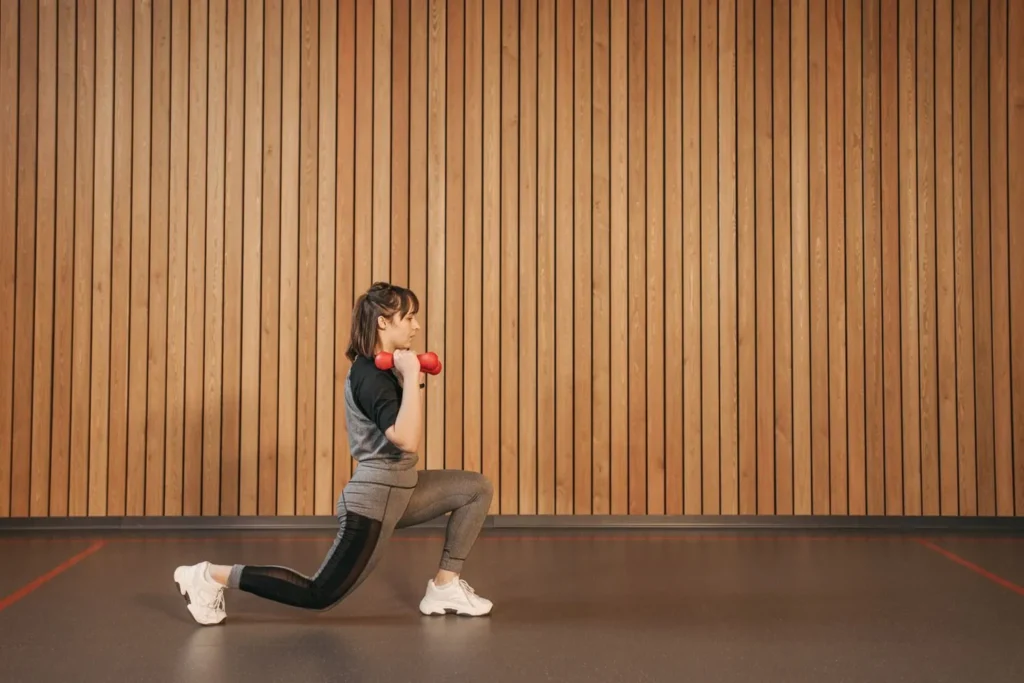
Good thigh workouts train four muscle groups, not one: the quadriceps at the front, the hamstrings at the back, and the adductors and abductors on the inner and outer thigh. Most people only squat, then wonder why their knees, hips or shape never change. This guide gives you the best thigh exercises, exact sets and reps, a weekly plan, a home version and fixes for the usual problems.
What muscles do thigh workouts train?
Thigh workouts train the quadriceps (front, straightens the knee), the hamstrings (back, bend the knee and extend the hip), the adductors (inner thigh, pull the leg inward) and the abductors (outer thigh and glute medius, move the leg outward). A balanced session hits all four, with the glutes helping on most lifts.
Each group needs a different kind of movement, which is why a squat-only routine leaves gaps:
- Quadriceps: squats, leg press, lunges, leg extensions. Four muscles share the job, so they respond well to heavy and moderate work alike.
- Hamstrings: hip hinges such as Romanian deadlifts and hip thrusts, plus leg curls. They work hardest when the hips move back, not when the knees move forward.
- Adductors (inner thigh): sumo squats, cable or machine adduction, Copenhagen planks. They stabilise the pelvis every time you walk or climb stairs.
- Abductors (outer thigh): band walks, side-lying raises, cable abduction. Weak abductors show up as a hip that drops when you stand on one leg.
If the inner thigh is your priority, our dedicated inner thigh workout guide goes deeper on adductor exercises. For the front of the thigh alone, see these quad workouts.
The best thigh exercises at a glance
This is the table to screenshot. It lists the thigh strengthening exercises worth building a session around, with a working rep range, rest time and the one form cue that matters most.
| Exercise | Main target | Sets x reps | Rest | Form cue |
|---|---|---|---|---|
| Back or goblet squat | Quads, glutes | 3-4 x 6-10 | 90-120 sec | Knees track over toes, chest tall |
| Romanian deadlift | Hamstrings, glutes | 3 x 8-10 | 90 sec | Push hips back, soft knees, flat back |
| Reverse or walking lunge | Quads, glutes | 3 x 8-10 per leg | 75 sec | Short controlled steps, torso upright |
| Bulgarian split squat | Quads, glutes, adductors | 3 x 8-12 per leg | 75 sec | Front foot far enough ahead that the shin stays near vertical |
| Cable or machine adduction | Inner thigh | 3 x 12-15 | 45 sec | Slow return, no swinging |
| Cable abduction or band walk | Outer thigh, glute medius | 3 x 12-15 | 45 sec | Keep toes forward, hips level |
| Lying or seated leg curl | Hamstrings | 3 x 10-12 | 60 sec | Squeeze at the top, lower for 2-3 seconds |
You do not need every row in every session. Pick one quad-dominant lift, one hinge, one single-leg move and one inner or outer thigh exercise, and you have a complete plan.
Myth check: spot reduction, bulky legs and light weights
No exercise removes fat from one body part, so thigh workouts cannot spot-reduce the thighs. They build and shape the muscle underneath, and fat loss across the whole body comes from a sustained calorie deficit, which is why thighs may look leaner only after weeks of both training and eating well.
Three other myths are worth clearing up:
- “Lifting will make my thighs bulky.” Large muscle growth takes years of heavy, deliberate training and a calorie surplus. For most women, a few sessions a week with moderate weights firms and strengthens the thigh rather than enlarging it dramatically.
- “Light weights and endless reps tone best.” Muscle responds to effort. A set that ends two or three reps before failure builds more than 40 easy reps.
- “Squats alone cover the whole thigh.” They barely load the hamstrings through their full range and give the inner and outer thigh only a small share of the work.
How do you build a complete thigh workout?
Build a thigh workout in five steps: warm up for 5-8 minutes, start with a heavy compound lift, add a hip hinge, then a single-leg move, and finish with inner and outer thigh isolation. A full session takes about 50-60 minutes and totals roughly 15-18 working sets.
Here is the order walked through, with the reasoning:
- Warm up. Five minutes of brisk walking or cycling, then bodyweight squats, hip circles and a few light reps of your first lift. Cold knees and stiff hips are where most gym tweaks start.
- Squat pattern first. You are freshest now, so do the heaviest, most technical lift here. Goblet squats are a safe starting point if you are new.
- Hip hinge second. Romanian deadlifts load the hamstrings and glutes. Keep the bar close to your legs and stop when your hamstrings feel a strong stretch, usually just below the knee.
- Single-leg work third. Lunges or split squats expose left-right differences that two-leg lifts hide.
- Isolation last. Adduction, abduction and curls need less energy, so they fit at the end when you are tired.

If you want a full lower-body routine in a gym setting, our leg workout for women at the gym and the leg day workout for men lay out complete sessions. A simple weekly structure looks like this:
| Day | Focus | Main work | Time |
|---|---|---|---|
| Monday | Thigh day A (quad focus) | Squat, split squat, leg extension, adduction | 50-60 min |
| Tuesday | Rest or walk | 30 minutes easy walking | 30 min |
| Wednesday | Upper body or yoga | Non-thigh work, light stretching | 40-45 min |
| Thursday | Thigh day B (hinge focus) | Romanian deadlift, hip thrust, leg curl, abduction | 50-60 min |
| Friday | Rest | Mobility and easy walking | 20-30 min |
| Saturday | Optional full-body or Zumba | Light legs only if they feel fresh | 40-45 min |
| Sunday | Rest | Full recovery | – |
How often should you do thigh workouts?
Two thigh sessions a week suits most people, with at least 48 hours between them. Three sessions works if each is shorter. Training thighs once a week still builds strength, but you will progress more slowly because each muscle gets only one weekly signal to grow.
Do not use soreness as your guide. Soreness fades as your body adapts even while training stays effective, and a very sore thigh is not proof of a good session. Track the weight and reps instead. If you can add one rep or a small amount of weight over a few weeks, the plan is working.
Can you do thigh workouts at home?
Yes. A good thigh workout at home needs only bodyweight, a resistance band and a sturdy chair or step. Squats, lunges, glute bridges, single-leg Romanian deadlifts and band walks train all four thigh groups. Progress by slowing the tempo, adding pauses or moving to single-leg versions.
Bodyweight work stops feeling hard quickly, so plan the progression in advance:
| Level | Quads | Hamstrings | Inner and outer thigh | Reps and rest |
|---|---|---|---|---|
| Week 1-3 | Chair squat | Glute bridge | Side-lying leg raise | 3 x 12-15, 45 sec |
| Week 4-6 | Bodyweight squat with 3-second lowering | Single-leg glute bridge | Banded lateral walk | 3 x 10-12, 60 sec |
| Week 7-10 | Reverse lunge or split squat | Single-leg Romanian deadlift | Sumo squat with band, Copenhagen plank (short) | 3-4 x 8-10 per leg, 60-75 sec |
| Week 11+ | Backpack-loaded split squat | Slider or towel leg curl | Banded abduction with pause | 3-4 x 8-12 per leg, 75 sec |
A backpack filled with books is a cheap way to add load. If you want structure around this, our guide to online workouts explains how guided home training works.
Troubleshooting: why your thigh workouts are not working
Most stalled thigh training traces back to a handful of fixable problems. Check these before changing your whole plan:
- Your knees hurt when you squat. Reduce depth, slow the lowering phase and keep your heels planted. Sharp or persistent pain is a reason to stop and see a physiotherapist or doctor, not to push through.
- You only feel your quads. You are probably missing the hinge. Add Romanian deadlifts and hip thrusts, and check that your hamstrings get roughly as many weekly sets as your quads.
- One side is weaker. Start every single-leg set with the weaker leg and match the same reps on the stronger side. If your hip drops when you stand on one leg, add band walks and side-lying raises.
- You never add weight. If your reps and load have stayed identical for a month, you are exercising, not training. Add one rep a week until you hit the top of the range, then increase the load a little.
- Your thighs feel tired but not worked. Too many easy reps. Choose a weight where the last two reps are slow and difficult but still clean.
- You cannot recover. Poor sleep, low protein and very low calories all slow recovery. Aim for 7-8 hours of sleep and include a protein source such as dal, paneer, curd, eggs or chicken at each main meal.
Thigh workouts for women, men and beginners
The movements are the same for everyone, but priorities and starting points differ. Use these notes to adjust the plan above.
- Thigh workout for women: Give glutes, hamstrings and the outer thigh as many sets as the quads, and do not shy away from heavy loads. Strength training also supports bone density, which matters more after 35-40. Our workouts for women page shows how to fit thighs into a full week.
- Thigh workout for men: Men often over-train quads and skip hinges and inner thigh work. Add Romanian deadlifts, split squats and adduction to balance a squat-heavy routine.
- Beginners: Start with two days a week, bodyweight or light dumbbells, two or three exercises per session and 2 sets each. Learn the squat and hinge patterns before adding weight.
- Anyone returning from injury or with long-standing knee, hip or back problems: Get cleared by a doctor or physiotherapist first and choose pain-free ranges of motion.
Sleep, eating enough protein and walking daily matter as much as the exercises. A brisk 6,000-8,000 step day alongside two thigh sessions is a realistic, sustainable base for most people.
Getting a thigh plan built around you
Sets, reps and exercise choice depend on your strength, injury history and goal. A coach can watch your form on video, adjust the load every week and fix the weak side. That is what our 1-on-1 personal training does. If your main goal is fat loss, an online weight loss trainer can pair thigh training with a realistic eating plan.
Frequently asked questions
What is the best thigh workout?
The best thigh workout combines a squat pattern (squat or leg press), a hip hinge (Romanian deadlift), a single-leg move (split squat or lunge) and inner and outer thigh work (adduction and abduction). Do 3 sets of 8-12 reps for most exercises, twice a week, and add load slowly.
Can I do thigh workouts at home without equipment?
Yes. Chair squats, lunges, glute bridges, single-leg deadlifts and side-lying raises train all thigh muscles without equipment. Once they feel easy, slow the tempo, add pauses, use a resistance band or a loaded backpack, and move to single-leg versions for more challenge.
How long does it take to see results from thigh workouts?
Most people feel stronger within 3-4 weeks, as nerves learn the movements. Visible shape changes usually take about 8-12 weeks of consistent training twice a week with enough protein and sleep. Fat loss around the thighs depends on overall calorie balance and varies from person to person.
Are thigh workouts safe if I have knee pain?
It depends on the cause. Mild discomfort often improves with strengthening, shallower squats and slower lowering. Sharp pain, swelling, clicking with pain or giving way is a reason to pause and see a doctor or physiotherapist before continuing. Never push through sharp joint pain.
Will thigh workouts make my thighs bigger?
Not dramatically for most people. Significant size gain needs years of heavy training and a calorie surplus. In the short term, thigh workouts firm the muscle and improve strength and shape, and any size change depends on your diet and body fat.
Next step: Pick two thigh days this week, write down every weight and rep, and ask a Fitstrot coach to check your squat form on video.


