

A leg day workout for men works best when it combines one heavy squat, one hip hinge, one single-leg lift, one machine move for the quads, one curl for the hamstrings and direct calf work, all finished inside 60 to 75 minutes. Below is the full session with sets, reps, rest and form cues, a lighter second session, and fixes for the knee, back and soreness problems that derail most lifters.
What Does a Good Leg Day Workout for Men Include?
A good leg day for men trains quads, hamstrings, glutes and calves: a heavy squat (4 x 5-6), Romanian deadlift (3 x 8-10), lunge (3 x 10 per leg), leg press (3 x 10-12), leg curl (3 x 12-15) and calf raises (4 x 12-15), resting 60 seconds to 3 minutes.
| Exercise | Sets x Reps | Rest | Form cue |
|---|---|---|---|
| Barbell back squat | 4 x 5-6 | 2-3 min | Brace your stomach, knees track over toes, hips and chest rise together |
| Romanian deadlift | 3 x 8-10 | 2 min | Push hips back, soft knees, bar slides down the thighs, flat back |
| Dumbbell walking lunge | 3 x 10-12 per leg | 90 sec | Long stride, torso tall, back knee kisses the floor lightly |
| Leg press | 3 x 10-12 | 90 sec | Feet shoulder-width, lower back stays on the pad, stop short of locking out |
| Lying leg curl | 3 x 12-15 | 60 sec | Hips pinned to the bench, 2 seconds up, 3 seconds down |
| Standing calf raise | 4 x 12-15 | 60 sec | Full stretch at the bottom, pause for 1 second at the top |
The order matters. Squats go first because they are the most demanding lift and need the freshest legs and the most focus. The hinge comes second so your hamstrings and glutes get heavy work, which many men under-train compared with their quads. Single-leg work, the press and the isolation moves then add volume without asking much more of your lower back.
Warm up for 8 to 10 minutes before the first working set: a few minutes of cycling or brisk walking, some hip and ankle mobility, then 3 or 4 ramp-up sets of squats with an empty 20 kg bar rising towards your working weight. If you want core work in the same visit, our legs and abs workout shows how to pair the two without wrecking either.
Form Cues That Matter on the Big Three
Most leg day problems are form problems in disguise. These cues cover the three lifts that decide how the session goes.
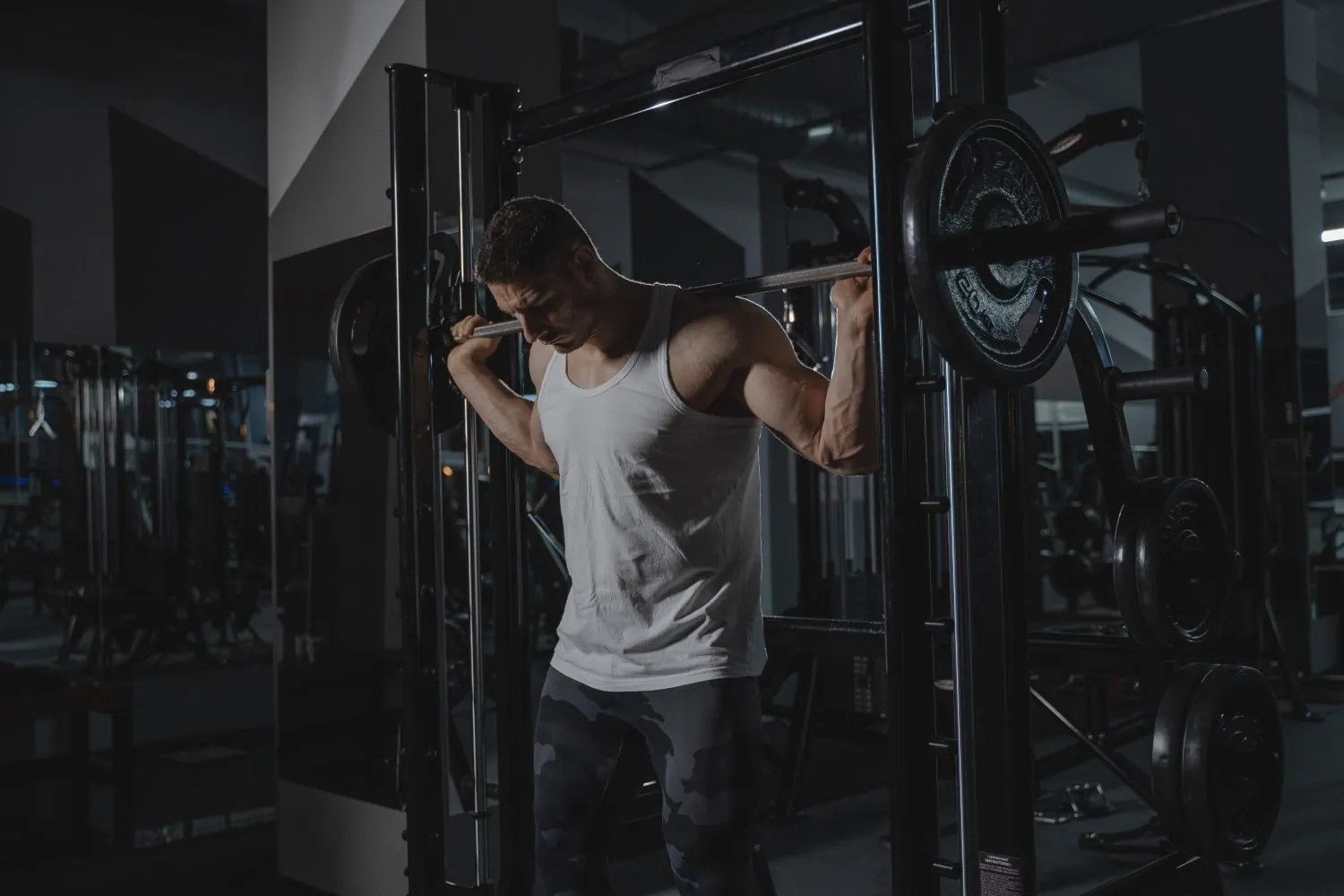
Back squat. Set the bar across your upper back, not your neck. Take a big breath into your belly, tighten your midsection, and sit between your hips rather than folding forward. Go as deep as you can while your lower back stays flat and your heels stay down. Drive up through the whole foot and keep your knees pointing the way your toes point.
Romanian deadlift. This is a hip hinge, not a squat. Start standing with the bar at your thighs, bend the knees slightly and send your hips backwards until you feel a firm stretch in the hamstrings, usually around mid-shin. Keep the bar touching your legs the whole way. Stand by squeezing your glutes, not by yanking with your back.
Walking lunge. Take a stride long enough that your front shin stays near vertical at the bottom. Press through the front heel, keep your torso upright, and avoid letting the front knee cave inwards. If balance is shaky, swap to a split squat, where your feet stay planted.
How Often Should Men Train Legs?
Most men do well training legs twice a week, with a heavy session of 4 to 6 reps on the main lift and a lighter volume session of 8 to 15 reps, spaced at least 48 to 72 hours apart. Once a week maintains strength but grows legs slowly. Three times a week is rarely worth the recovery cost.
| Session | Focus | Main lifts | Sets x Reps |
|---|---|---|---|
| Leg Day A (heavy) | Strength | Back squat, Romanian deadlift | 4 x 5-6 and 3 x 8-10 |
| Leg Day A (support) | Single leg and calves | Walking lunge, leg curl, calf raise | 3 x 10-12, 3 x 12-15, 4 x 12-15 |
| Leg Day B (volume) | Muscle size | Leg press, hack squat or goblet squat | 3-4 x 10-15 |
| Leg Day B (support) | Hamstrings and calves | Seated leg curl, hip thrust or glute bridge, seated calf raise | 3 x 12-15, 3 x 10-12, 3 x 15-20 |
Slot the two sessions into your week so they are separated by at least two other days. A split such as push, pull, legs, rest, then upper body, legs works well; see our workout plan for men and the workout schedule for men for full weeks. If your chest and shoulders get their own day, our push day workout fits neatly before legs.
Myth: Heavy Squats Alone Are Enough for Big Legs
Squats are a great anchor, but they are not the whole job. A squat leans heavily on the quads and glutes, while the hamstrings, calves and inner thighs get less direct work. Men who only squat tend to end up with strong fronts, weak backs of the legs, and a higher chance of knee and hip niggles.
The fix is simple: add a hinge (Romanian deadlift), a single-leg movement (lunge or split squat) and direct hamstring and calf work every week. That balance looks better, lifts better and holds up under heavier training.
A second myth is that soreness proves the session worked. Soreness mostly tells you the movements were new or the volume jumped. Progress shows up in your logbook as more weight or cleaner reps over weeks.
How Many Sets Does a Leg Day Need?
Most men grow well on roughly 10 to 16 hard sets per week for quads and a similar number for hamstrings and glutes combined, spread across two sessions. That means about 6 to 8 quad-focused sets and 6 to 8 hamstring and glute sets per leg day, with calves on top at 6 to 10 weekly sets.
A hard set ends with 1 to 3 reps left in the tank. Stopping sets far short of that wastes time, and grinding to failure on every set makes the next session worse. Start at the low end of the range, and add a set only when your weights and reps have stopped climbing for two or three weeks.
Progression Walkthrough: Eight Weeks of Leg Days
Use a simple double progression. Pick a rep range, such as 8 to 10 on Romanian deadlifts. Stay at one weight until you hit the top of the range on every set with good form, then add the smallest weight jump available and drop back to the bottom of the range.
- Weeks 1 to 2: Learn the movements at moderate loads. Leave 3 reps in reserve on every set and log everything.
- Weeks 3 to 5: Add 2.5 kg to the squat or the hinge whenever you complete all sets and reps cleanly. Accessory lifts follow the double progression above.
- Week 6: Hold the weights and focus on pauses, tempo and depth. This is a small step back to let tendons and joints catch up.
- Weeks 7 to 8: Push for your best top set on squats at 5 reps with 1 to 2 reps in reserve, then reduce volume by a third in week 9 and start again heavier.
Keep a written or phone log of weight, sets, reps and how the set felt. If you are not recording it, you are guessing.
Troubleshooting: When Knees, Back or Hips Complain
Pain during a lift is information. Before changing the whole programme, match what you feel to the likely cause below. These are general training fixes, not a diagnosis.
| Problem | Likely cause | Fix to try |
|---|---|---|
| Knees ache at the bottom of squats | Heels lifting, knees collapsing inwards, or too much weight too fast | Raise heels on small plates, push knees out, drop load by 10-15 percent |
| Lower back rounds in the squat | Hips tuck under at depth, weak bracing | Stop 2-3 cm higher, brace harder, add pause squats with a lighter bar |
| Lower back tires on Romanian deadlifts | Bar drifts away from the legs, reaching too low | Keep the bar on the thighs, stop at mid-shin, use lighter loads |
| Squat stuck for weeks | Too little recovery or no progression plan | Sleep 7-8 hours, eat enough protein, use double progression, deload once |
| Heavy soreness for 4-5 days | Volume jumped too quickly | Cut sets by a third next week and rebuild slowly |
| Cramping calves | Low fluids or electrolytes, high fatigue | Drink water through the session, stretch calves between sets |
See your doctor or a physiotherapist if you have sharp or shooting pain, joint swelling, pain that continues at rest or for more than a few days, numbness or tingling down the leg, or a previous knee, hip or back injury. Do not train through those symptoms. Once you are cleared, the exercises can usually be adapted instead of dropped.
For what to do in the days after a hard session, our guide to the after leg day workout covers walking, mobility and recovery.
Leg Day for Different Men and Different Gyms
Beginners. Start with goblet squats, hip bridges, split squats and leg curls at light loads, 2 to 3 sets of 10 to 12, once or twice a week. Add the barbell squat after a few weeks of clean reps.
Desk workers. Long sitting tightens hips and calves. Spend an extra few minutes on hip flexor and ankle mobility before squatting, and use a slightly higher heel or box squat while mobility improves.
Men over 40. Same exercises, but longer warm-ups, one or two reps in reserve rather than failure, and more weeks between maximal attempts. Machines like the leg press and curl give heavy stimulus with less balance demand.
Crowded or basic gyms. No free squat rack? Use the Smith machine squat, hack squat or leg press as your anchor, with dumbbell Romanian deadlifts and split squats. For training without a gym, see our leg day workout at home, and our workout schedule for men at home for a full week. Women lifters can find a parallel plan in our leg workout for women.
Food matters too. Many men eat about 1.6 to 2 grams of protein per kg of body weight daily to support muscle repair, which is roughly 110 to 140 g for a 70 kg man. Dal, curd, paneer, eggs, chicken, soya and fish all count, and a plate with carbohydrates such as rice, roti or poha about an hour before training keeps your legs fuelled. A nutritionist consultation can turn those ranges into a daily Indian meal plan that suits your budget and preferences.
Frequently Asked Questions
What is a good leg day workout for men?
A good leg day workout for men includes a back squat, a Romanian deadlift, a lunge or split squat, a leg press, a leg curl and calf raises. Do 3 to 4 sets of each, in the 5 to 15 rep range, with 60 seconds to 3 minutes of rest. The session should take about 60 to 75 minutes.
How often should men train legs?
Twice a week suits most men: one heavy session at 4 to 6 reps on the main lifts, and one lighter volume session at 8 to 15 reps. Keep at least two days between them. Once a week maintains strength but progress is slower, and three sessions usually costs more recovery than it returns.
How many exercises should a leg day have?
Five to six exercises are enough for most men: one squat pattern, one hinge, one single-leg move, one machine or isolation move for the quads or hamstrings, and one calf move. More than that usually adds fatigue without adding useful work. Focus on adding weight or reps over time instead.
Can beginners follow this leg day workout?
Yes, with lighter loads and fewer sets. Beginners can use goblet squats, split squats and hip bridges for 2 to 3 sets of 10 to 12 reps, learning the form before adding a barbell. Build volume over several weeks, and see a trainer or doctor first if you have any joint injury.
Why does my lower back hurt after leg day?
Mild tiredness in the lower back after heavy squats and deadlifts is common, but sharp pain is not. Usual causes are rounding at the bottom, a bar drifting away from the body, or too much load too soon. Reduce the weight, tighten your bracing, and see a doctor if pain persists.
If you want a leg day built around your own gym access, injury history and schedule, book a session with a coach through our 1-on-1 personal training and we will build and adjust your plan week by week.


