
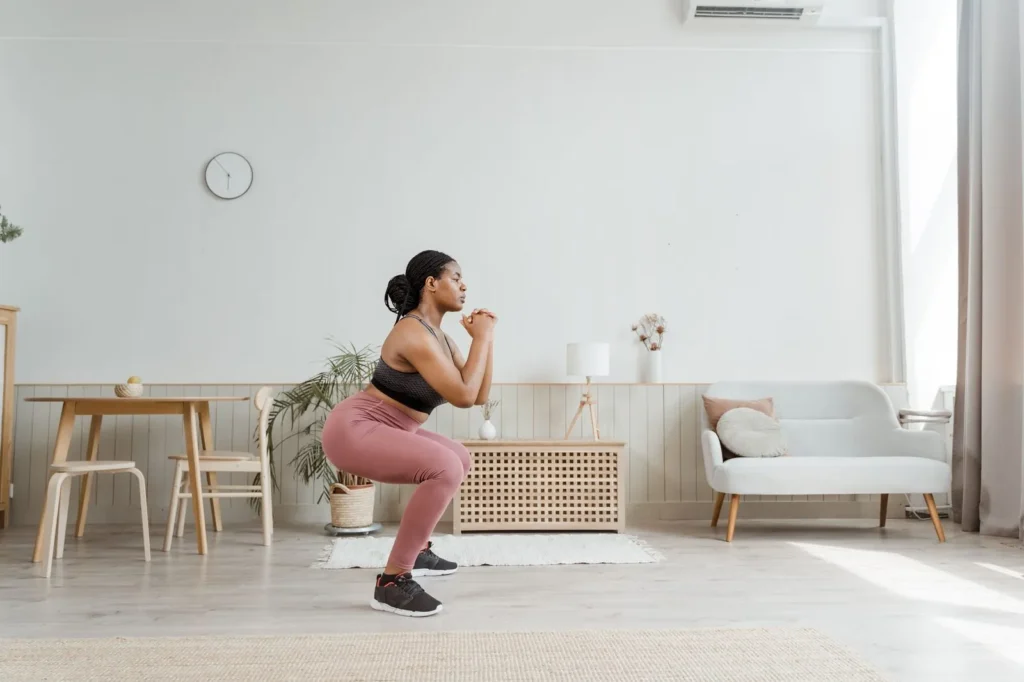
A leg day workout at home works when it covers three patterns: a squat, a hip hinge and a single-leg move. You can do all of it with bodyweight, a sturdy chair and a backpack, in about 35 to 45 minutes. This guide gives you a full session with sets, reps, rest and form cues, a way to make it harder every week, and fixes for the problems that stall most people.
What should a leg day workout at home include?
A good leg day workout at home includes one squat movement for the quads, one hip hinge for the hamstrings and glutes, one single-leg exercise for balance, and one calf exercise. Do 4 to 6 exercises, 3 to 4 sets each, with 30 to 60 seconds of rest. That takes roughly 35 to 45 minutes including warm-up.
Most people at home do only squats and wonder why their legs feel lopsided or their knees complain. The front of the thigh (quadriceps) is only one part of the picture. The back of the thigh (hamstrings), the glutes and the calves need their own work, and the hinge pattern is the one that usually gets skipped. Cover all three patterns and you have a complete session, whatever equipment you own.
Equipment is optional. A mat, a sturdy chair or low stool, a wall and a school bag you can load with books are enough for the first few months. A resistance band or a pair of dumbbells helps later, but you do not need to buy anything on day one.
The full session: exercises, sets, reps and form cues
This is the session we would hand a beginner or intermediate trainee with no equipment. Do it in the order shown, because the hardest, most technical moves come first while you are fresh.
| Order | Exercise | Sets x reps | Rest | Form cue |
|---|---|---|---|---|
| 1 | Bodyweight squat, 3-second lowering | 4 x 15-20 | 45 sec | Feet shoulder-width, heels down, knees track over toes |
| 2 | Reverse lunge, alternating legs | 3 x 10-12 per leg | 45 sec | Step back, torso tall, front shin close to vertical |
| 3 | Single-leg Romanian deadlift | 3 x 8-10 per leg | 45 sec | Soft knee, hinge from the hips, back flat |
| 4 | Glute bridge with 2-second squeeze | 3 x 15-20 | 30 sec | Drive through heels, ribs down, no arching |
| 5 | Wall sit | 3 x 30-45 sec | 30 sec | Thighs parallel to floor, back flat on the wall |
| 6 | Calf raise off a step | 3 x 15-20 | 30 sec | Full stretch at the bottom, pause at the top |
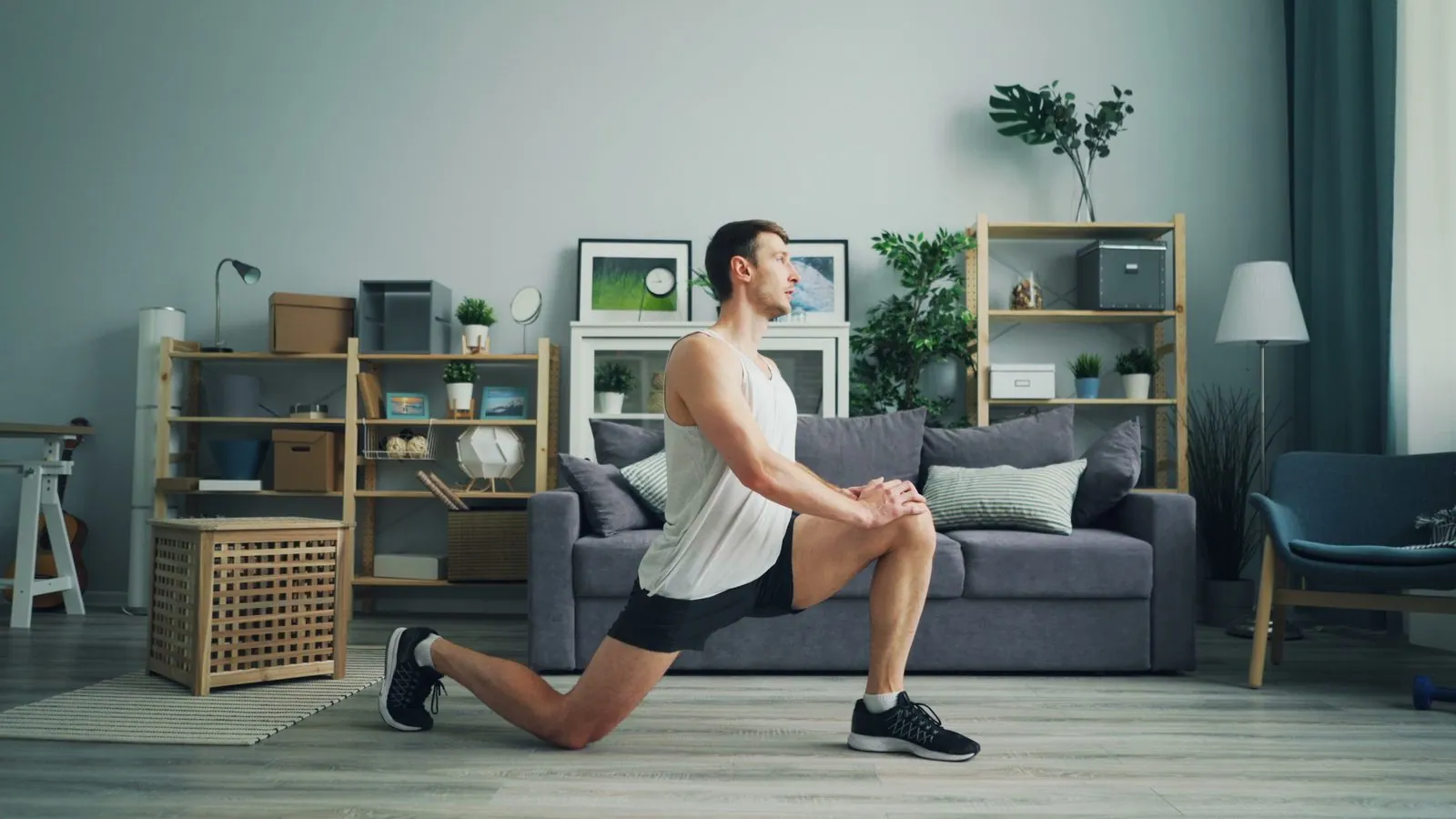
Pick a pace where the last two reps of each set feel hard but your form stays clean. If you finish a set and feel you could have done ten more, slow the lowering down or move to a harder variation (covered below). Total working time is about 25 minutes, so the warm-up and rest periods make up the rest.
How to run the session, step by step
Warm up for 5 minutes. March on the spot for a minute, then do 10 hip circles each way, 10 slow bodyweight squats, 10 leg swings per leg and 10 glute bridges. You want warm hips and ankles, not tired legs.
Use tempo as your weight. Without a barbell, the lowering phase is your resistance. Take three full seconds to go down on squats and lunges, pause for a beat at the bottom, then stand up at normal speed. Slow lowering is the simplest way to make bodyweight work feel heavy.
Keep one or two reps in reserve on early sets. Go close to failure only on the last set of each exercise. Grinding every set to exhaustion leaves you too tired for the later exercises and sore for the wrong reasons.
Breathe out as you stand up. Hold your core gently braced throughout. If your lower back takes over during single-leg RDLs, shorten the range and put a hand on a wall for balance.
Finish with 3 to 5 minutes of easy stretching. Hold each stretch for 20 to 30 seconds: quads, hamstrings, calves and hip flexors. For what to do in the two days afterwards, see our guide on the after leg day workout.
How do you make leg day harder without weights?
To make a home leg workout harder without weights, change the exercise before you add reps: slow the lowering to 3 to 4 seconds, add a 2-second pause at the bottom, then move to single-leg versions. Add load with a backpack once you can do 25 to 30 clean reps. Progress one variable at a time.
Bodyweight training stops feeling hard faster than people expect, usually within four to eight weeks. The answer is not 100 reps of the same squat. It is a harder variation that brings your rep range back down to 8 to 15.
| Movement | Level 1 (start here) | Level 2 | Level 3 |
|---|---|---|---|
| Squat | Bodyweight squat to a chair | Tempo squat with a 2-second pause | Backpack squat or Bulgarian split squat |
| Lunge | Reverse lunge holding a wall | Reverse lunge, front foot on a low step | Backpack walking lunge |
| Hinge | Glute bridge | Single-leg glute bridge | Single-leg RDL with a backpack |
| Calves | Two-leg calf raise on the floor | Two-leg raise off a step | Single-leg raise off a step |
| Static hold | Wall sit 20-30 sec | Wall sit 45-60 sec | Single-leg wall sit or loaded wall sit |
Move up a level when you can hit the top of the rep range on every set with clean form for two sessions in a row. A school bag with 5 to 10 kg of books is a perfectly good load to start with. Hold it against your chest for squats or wear it on your back for lunges, and keep the weight snug so it does not swing.
Myth check: can leg day burn fat off your thighs?
Training your legs does not burn fat from your legs specifically. Your body takes fat from all over, in an order set mostly by genetics, whichever exercise you do. What leg training does is build muscle underneath, so your legs look firmer as overall body fat comes down through a sustained calorie deficit and enough protein.
That means a home leg day is a strength session, not a fat-burning gimmick. It raises your daily energy use a little, builds muscle that you want to keep while losing weight, and makes everyday movement easier. Anyone promising a thigh-only fat burn from a 10-minute routine is selling something that does not work. If weight loss is the main goal, pair your legs sessions with sensible eating and a daily walk, and get a plan built around your routine and food habits, as our online weight loss trainer programme does.
Which leg day schedule suits you: beginner, intermediate or busy?
Most people do best training legs two to three times per week with at least one rest day between sessions. Beginners can start with two sessions of about 30 minutes. Trainees with a few months behind them can use three shorter sessions that rotate emphasis between quads, hinge and glutes.
| Who | Leg days per week | Session length | Example split |
|---|---|---|---|
| Complete beginner | 2 | 25-30 min | Mon: full session at Level 1. Thu: same session, add 2 reps per set |
| Beginner after 6-8 weeks | 2-3 | 35-40 min | Mon: squat and lunge focus. Thu: hinge and glute focus. Optional Sat: short mixed session |
| Intermediate | 3 | 35-45 min | Mon: squat focus with backpack. Wed: single-leg and hinge. Sat: full session at Level 2-3 |
| Short on time | 3 | 15-20 min | Squat, reverse lunge and glute bridge as a circuit, 3 rounds, 30 sec rest between rounds |
The same exercises suit men and women. The usual difference is emphasis, not content: many women add extra glute work (bridges, banded side steps, single-leg bridges) and many men chase quad strength. If you also train at a gym and want a heavier plan, our leg day workout for men covers barbell and machine work. Plan your leg days around upper-body training so you are not doing heavy legs the day before a long run or a sport session.
Troubleshooting: knee pain, soreness and stalled progress
My knees hurt during squats or lunges. First check the basics. Keep your heels flat, let your knees track in line with your toes, and shorten the range until it is pain-free. Slower lowering often helps because it removes the bounce. Sharp pain, swelling, clicking with pain, or pain that is still there the next day is a reason to stop and see a doctor or physiotherapist, not to push through.
My legs are very sore for days. Soreness after a new session is normal. It usually peaks at 24 to 48 hours and fades within three to four days. Walk, stretch gently and eat enough protein and fluids. If a session leaves you unable to walk down stairs comfortably, you did too much, so cut sets by a third next time.
My glutes do not feel anything. Slow down the bridges and single-leg RDLs, squeeze at the top for two seconds, and shorten the range if your lower back is doing the work. Placing your hands on your hips to feel the squeeze can help.
I have stopped progressing. Check whether your sets are still hard. If you finish with plenty left, move up a level in the progression table. Also check sleep and food: six hours of sleep and a light dinner will limit any plan. Aim for roughly 0.8 to 1.2 g of protein per kg of body weight daily if you are training regularly, from dal, curd, paneer, eggs, chicken or soy, or whatever suits your diet.
I get bored. Swap one exercise for a similar one every four to six weeks, for example a sumo squat for the regular squat, or a side lunge for the reverse lunge. Keep the pattern, change the movement. For what to eat and how to recover after tougher sessions, read our after leg workout guide.
Frequently asked questions
Can you build muscle with a leg day workout at home?
Yes, especially in the first six to twelve months of training. Muscles grow when they are worked hard enough to be challenged, and bodyweight with slow tempo, single-leg work and a loaded backpack can do that. Progress eventually slows compared with heavy gym lifting, but a home routine builds real strength and size if you keep progressing and eat enough protein.
How long should a leg day workout at home take?
A full session takes about 35 to 45 minutes, including a 5-minute warm-up and a few minutes of stretching. A short version with three exercises done as a circuit takes 15 to 20 minutes. Quality matters more than duration, so stop when your form breaks down.
How many times a week should I do leg day at home?
Two to three times a week is enough for most people, with at least one rest day between sessions. Complete beginners should start with two. Train a third day only if you recover well, your soreness has settled before the next session and your sets are still getting stronger.
Is it okay to do leg day every day?
Not at full effort. Muscles need roughly 48 hours between hard sessions to recover and adapt, so daily leg training usually leads to fatigue and sore joints rather than faster results. If you want to move daily, use easy walking, stretching or yoga on off days and keep hard leg work to two or three days.
What if I only have 15 minutes for a leg day workout at home?
Do a circuit of 12 to 15 bodyweight squats, 8 to 10 reverse lunges per leg and 15 glute bridges, resting 30 seconds between rounds, for three to four rounds. It will not replace a full session, but it keeps the habit going and still trains the squat, lunge and hinge patterns.
Want someone to set your sets, reps and progressions for your body and your schedule? Book a 1-on-1 session and our trainer will build and adjust your home leg plan each week through 1-on-1 personal training.


