
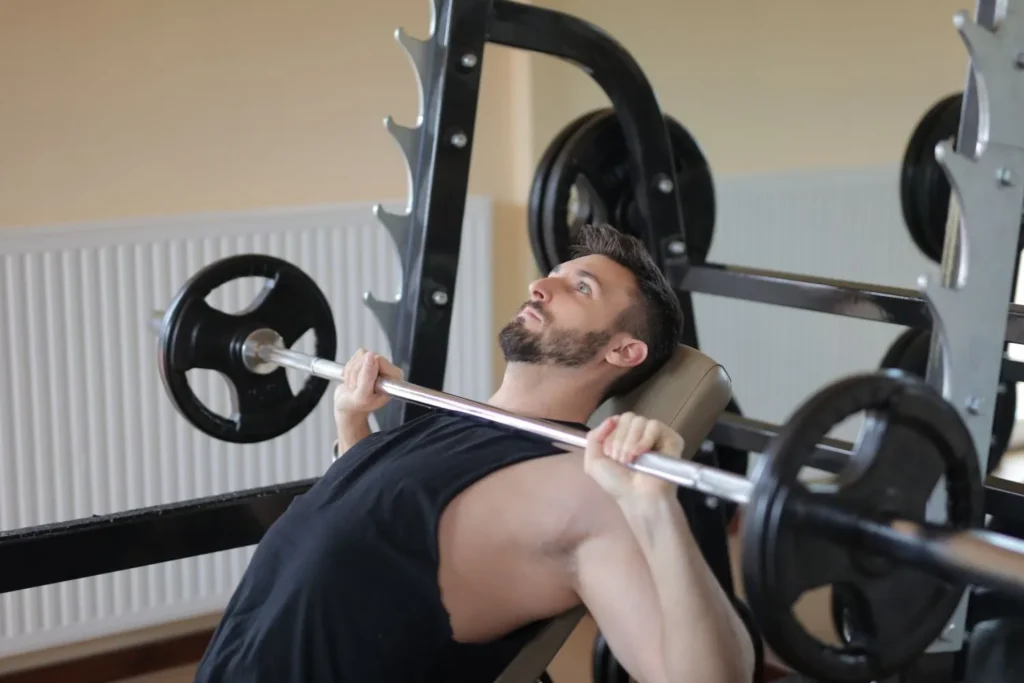
A push day workout trains every muscle that presses weight away from your body: chest, shoulders and triceps, all in one session. Done well, it takes about 60 to 75 minutes including warm-up, uses six to eight exercises, and puts the heaviest lift first while you are fresh. This guide gives you the full push day exercises list with sets, reps, rest and form cues, a gentler version for beginners, fixes for common problems, and a clear way to progress without hurting your shoulders.
What is a push day, and which muscles does it train?
A push day is a training session built around pressing movements. It works the pectorals (chest), the three heads of the deltoid (shoulders) and the triceps, because these muscles fire together on every press. Grouping them lets you hit each one directly and then give them 48 to 72 hours to recover.
- Chest (pectoralis major): does most of the work in flat and incline presses and flyes. It goes first because it is the biggest muscle in the group.
- Shoulders (deltoids): presses hit the front head hard, but the side head grows best with lateral raises, so push day needs both.
- Triceps: they assist on every press already, so they need only a few direct sets at the end.
Push day is the companion to a pull day workout, which trains back and biceps with pulling patterns. One session moves weight away from you, the other brings it toward you, so pairing them keeps your upper body balanced and your joints happier.
The complete push day workout (sets, reps, rest and form cues)
This is the session we would hand an intermediate lifter with a few months of gym consistency. Warm up first (see the walkthrough below), then work through the table in order, heavy compound lifts first and isolation work last.
| Exercise | Sets | Reps | Rest | Main form cue |
|---|---|---|---|---|
| Barbell bench press | 4 | 5-8 | 2-3 min | Shoulder blades pinched down and back, feet planted, bar touches mid-chest, elbows about 45 degrees from the body |
| Seated overhead press (dumbbell or barbell) | 3 | 6-10 | 2 min | Ribs down, glutes tight, press in a straight line and finish with the bar over your ears |
| Incline dumbbell press | 3 | 8-10 | 90 sec – 2 min | Bench at a low incline, lower until elbows are just below the bench, do not flare wide |
| Cable fly or pec deck | 2 | 12-15 | 60-90 sec | Soft elbows, hug a barrel, feel the stretch without letting the shoulders roll forward |
| Dumbbell lateral raise | 3 | 12-20 | 60-90 sec | Light weight, lead with the elbows, stop at shoulder height, no swinging |
| Parallel-bar dips (or bench dips) | 3 | 8-12 | 90 sec | Lean slightly forward for chest, stay upright for triceps, lower only until upper arms are parallel to the floor |
| Triceps rope pushdown | 3 | 10-15 | 60 sec | Elbows pinned to your sides, split the rope at the bottom, control the way up |
That is seven exercises and about 21 working sets, which is a solid dose for one session without drifting into junk volume.

How to run the session, step by step
The order and the warm-up matter as much as the exercise list. Here is how we walk clients through it.
- Warm up for 8 to 10 minutes. Start with 3 to 5 minutes of light cardio, then do arm circles, band pull-aparts (15 reps) and 10 slow push-ups. Finish with two ramp-up sets of bench press: about 50 percent of your working weight for 8 reps, then about 70 percent for 4 reps.
- Do the first lift fresh. The bench press gets your best energy and your longest rest. Leave one or two reps in reserve on the early sets.
- Move to the overhead press. If your lower back arches hard, lower the weight rather than leaning back.
- Add the incline and fly work. These build the upper chest and add stretch under load.
- Finish with side delts, dips and triceps. By now your triceps are already tired, so a few focused sets are enough.
- Cool down for 3 to 5 minutes. Walk, then hold a gentle doorway chest stretch for 20 to 30 seconds per side.
How many exercises, sets and reps should a push day have?
A push day should have 6 to 8 exercises and about 16 to 22 working sets in total: roughly 8 to 10 for chest, 5 to 8 for shoulders and 3 to 5 for triceps. Use 5 to 8 reps on heavy compound lifts and 12 to 15 or more on isolation moves, resting 1 to 3 minutes.
Chest gets the most sets because it is the largest muscle, while triceps get the fewest because every press already works them. Going past eight exercises usually adds tiredness, not progress.
Beginner push day workout: a safe four-week start
If you are new to lifting, you do not need seven exercises or a heavy barbell. Begin with five simple moves, and let your tendons catch up with your muscles. Use machines or light dumbbells, stop each set with 2 to 3 reps still in the tank, and train push day once or twice a week with at least two days between sessions.
| Week | Plan for each of the 5 exercises* | Effort | What to focus on |
|---|---|---|---|
| 1 | 2 sets of 10-12 | Easy, 3+ reps left | Learn the movements with very light weight |
| 2 | 2 sets of 10-12, add 1 set to the first two exercises | Moderate, 2-3 reps left | Smooth tempo, about 2 seconds down |
| 3 | 3 sets of 8-12 | Moderate, 2 reps left | Add a little weight only if every rep looked clean |
| 4 | 3 sets of 8-12 | Moderately hard, 1-2 reps left | Add weight on the exercises where you hit 12 reps on all sets |
*Machine or dumbbell chest press, incline push-up or dumbbell shoulder press, dumbbell lateral raise, cable fly or pec deck, and rope pushdown. If a full push-up is not possible yet, raise your hands on a bench or wall; our guide to a push-up workout at home shows the progression from wall to floor.
To progress, use double progression: stay at the same weight until you hit the top of the rep range on every set with good form, then add the smallest jump available, about 1 to 2 kg per dumbbell or 2.5 kg on a barbell. If the reps fall apart, go back one step.
Myth check: two push day beliefs that waste your time
Myth 1: “If you are not sore, it did not work.” Soreness mostly reflects novelty, not quality. As your body adapts, you will be less sore for the same effective session. Chasing soreness pushes you to add junk sets and ruins the next workout.
Myth 2: “Every set must go to failure.” Failure on heavy presses piles stress onto the shoulders and elbows for little extra growth. Leave one or two reps in reserve on most sets and save near-failure for the last set of an exercise, if at all.
Troubleshooting: what to do when push day goes wrong
- Pinching at the front of the shoulder on bench or dips. Tuck your elbows to about 45 degrees, shorten the range slightly, and swap barbell work for dumbbells or a neutral-grip machine press for a few weeks. If the pain stays sharp or continues past a week or two, see a doctor or physiotherapist.
- Bench press stuck for weeks. Check sleep (aim for 7 to 9 hours), protein and total food, then add a set or two of triceps work and drop your rep range slightly. Small plates, like 1.25 kg, help when a normal jump is too big.
- Elbows or wrists ache. Lower the load on pushdowns and dips, keep wrists stacked over forearms, and cut the dips if bar-style dips irritate your shoulders.
- Cannot feel the chest working. Slow the lowering phase to 2 to 3 seconds, pause briefly at the bottom and lighten the load.
See your doctor first if you have a past shoulder, elbow or wrist injury, ongoing joint pain, chest pain, dizziness or high blood pressure, and stop any exercise that causes sharp pain. This guide is general education and not medical advice.
How to adjust push day for your situation
Desk workers with rounded shoulders. Add 2 sets of band pull-aparts or rear-delt work on pull day, press with your shoulder blades set, and spend a minute on chest stretches.
Women lifting for strength and shape. The same plan works; use the lower end of the weight ranges and the higher end of the rep ranges until the form is automatic.
Home trainers. With a pair of adjustable dumbbells and a bench or sturdy chair, you can run floor press, overhead press, lateral raise and bench dips. Pair it with our leg day workout at home for a full week.
Vegetarians. Muscle needs protein, so aim for roughly 1.2 to 1.6 g per kg of body weight daily from dal, paneer, curd, soya, sprouts, eggs if you eat them and whey if needed. If you are unsure how to hit that on an Indian diet, an online nutritionist consultation can map it to your meals.
Where does push day fit in your weekly schedule?
Push day fits into a weekly plan once or twice, depending on how many days you train. Three-day lifters usually run it once, four-to-six-day lifters twice, always with one or two days between push sessions so chest, shoulders and triceps recover for 48 to 72 hours.
| Training days per week | Sample layout | Push frequency |
|---|---|---|
| 3 days | Push, Pull, Legs (with rest days between) | 1x per week |
| 4 days | Push, Pull, rest, Legs, Upper (push-focused) | About 1.5x per week |
| 6 days | Push, Pull, Legs, Push, Pull, Legs | 2x per week |
You will find the full breakdown in our PPL workout guide, the six-day layout in the 6 day workout split, and a seven-day option in our 7 day workout plan. If you prefer one muscle per day with more volume in each session, a bro split workout is a fair alternative. PPL suits people who train three to six days; a bro split suits fewer, longer sessions.
One quick note on push day versus chest day: chest day gives the pecs more volume in one sitting, while push day trains chest, shoulders and triceps together so each is hit twice a week on a six-day plan. For most people, that extra frequency is worth more than the extra chest sets.
Get a push day built around your shoulders and schedule
A template cannot see your shoulder mobility, your recovery or why your press has stalled. With 1-on-1 personal training at Fitstrot, a coach builds your push, pull and leg days around your body and adjusts them every week. Book a session and bring your current routine.
Frequently asked questions about push day
What is a push day workout?
A push day workout is a session that trains the chest, shoulders and triceps together, because all three work during pressing movements like the bench press and overhead press. It is one part of a push, pull and legs split, paired with a pull day for back and biceps and a leg day for the lower body.
How long should a push day workout take?
A push day workout should take about 60 to 75 minutes including an 8 to 10 minute warm-up. Beginners can finish in 45 to 60 minutes with five exercises. If your sessions run past 90 minutes, you are probably resting too long, doing too many exercises or checking your phone between sets.
Can beginners do a push day workout?
Yes. Beginners can do a push day with five simple exercises, 2 to 3 sets each and light weights, stopping every set with 2 to 3 reps in reserve. Use machines or dumbbells, learn the form first and add weight slowly. If you have a shoulder or elbow injury, check with your doctor before starting.
How many days a week should I do push day?
Do push day once or twice a week, leaving at least 48 hours between sessions. Three- or four-day lifters usually do it once, while a six-day push, pull and legs split repeats it twice. More than twice a week rarely helps and increases the chance of shoulder and elbow overuse.
Should I do push day and pull day back to back?
You can, because push and pull sessions use mostly different muscles. Beginners usually feel better with a rest day or leg day between them, since two hard upper-body sessions in a row can leave you tired. Experienced lifters who sleep well can run them back to back.


