
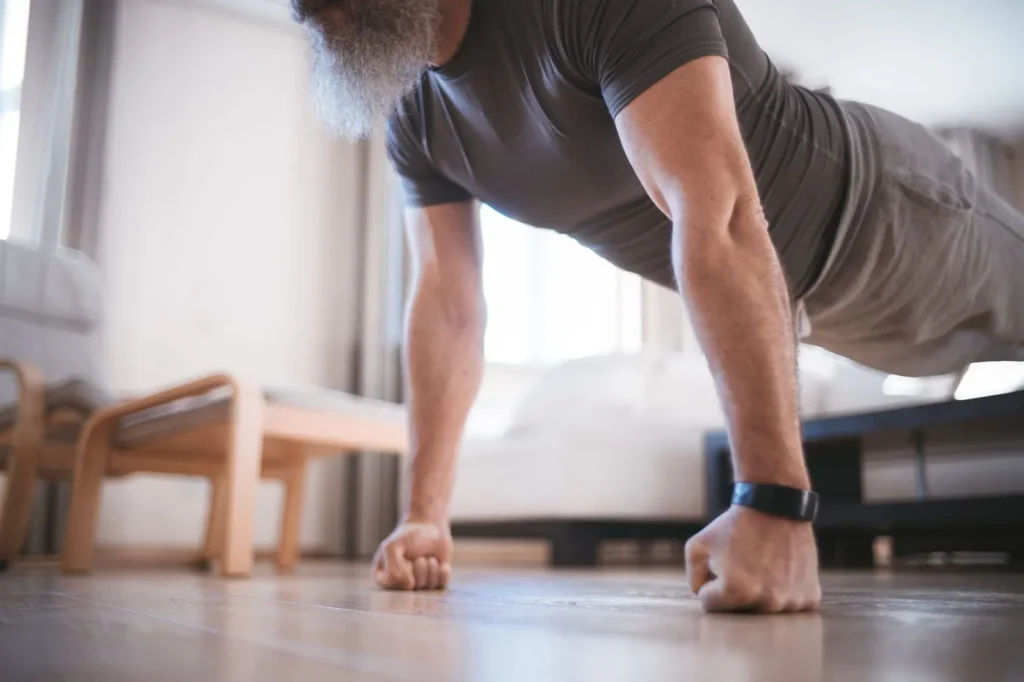
A push up workout at home needs only floor space, about 20 minutes and a plan that makes the exercise harder over time. Most people fail at the plan, not the push up: they do the same sets of the same variation for months and wonder why nothing changes. Below you get the variations ranked from easy to hard, a 4-week schedule with sets, reps and rest, form cues, and fixes for when progress stalls. Everything works with a chair, a sturdy table edge or a stair step.
How Do You Build a Push Up Workout at Home?
Pick one push up variation you can do for 8 to 12 clean reps, do 3 sets with 60 to 90 seconds of rest, and stop each set with 2 reps left in the tank. Train 2 to 3 days a week, and move to a harder variation once you hit the top of the rep range on every set.
That is the whole principle: control the lever, not the rep count. In a gym you add plates. At home you change body angle, hand position, tempo or leverage. A standard push up asks you to push roughly two-thirds of your body weight, an incline push up asks for noticeably less, and a decline push up asks for more. Moving along that scale is how a bodyweight session keeps getting harder.
Warm up before you start. Spend 3 to 5 minutes on arm circles, shoulder rolls, cat-cow, a few slow incline push ups and a 20-second plank. If you want a fuller routine, our guide to a warm up before workout covers what to do and what to skip. Going cold from a desk chair to the floor is a common way to irritate a shoulder.
Push Up Variations Ranked From Easiest to Hardest
These six variations cover almost everything you need at home. Start at the level where you can finish every set with good form, then use the “move up when” column as your trigger to progress.
| Variation | Setup | Mainly works | Move up when |
|---|---|---|---|
| Wall push up | Hands on a wall, feet 2 feet back | Chest, front shoulders | 3 x 15 with a slow lowering phase |
| Incline push up | Hands on a table edge, chair or stair | Chest, triceps | 3 x 12 at a low surface |
| Knee push up | Knees on a mat, straight line from knees to head | Chest, triceps, core | 3 x 12 without the hips dropping |
| Standard push up | Hands just wider than shoulders | Chest, shoulders, triceps | 3 x 12 with a full range |
| Diamond (close-grip) push up | Thumbs and index fingers nearly touching | Triceps, inner chest | 3 x 10, no elbow or wrist pain |
| Decline push up | Feet on a chair or step | Upper chest, shoulders | 3 x 12, then add a slow 3-second lowering |
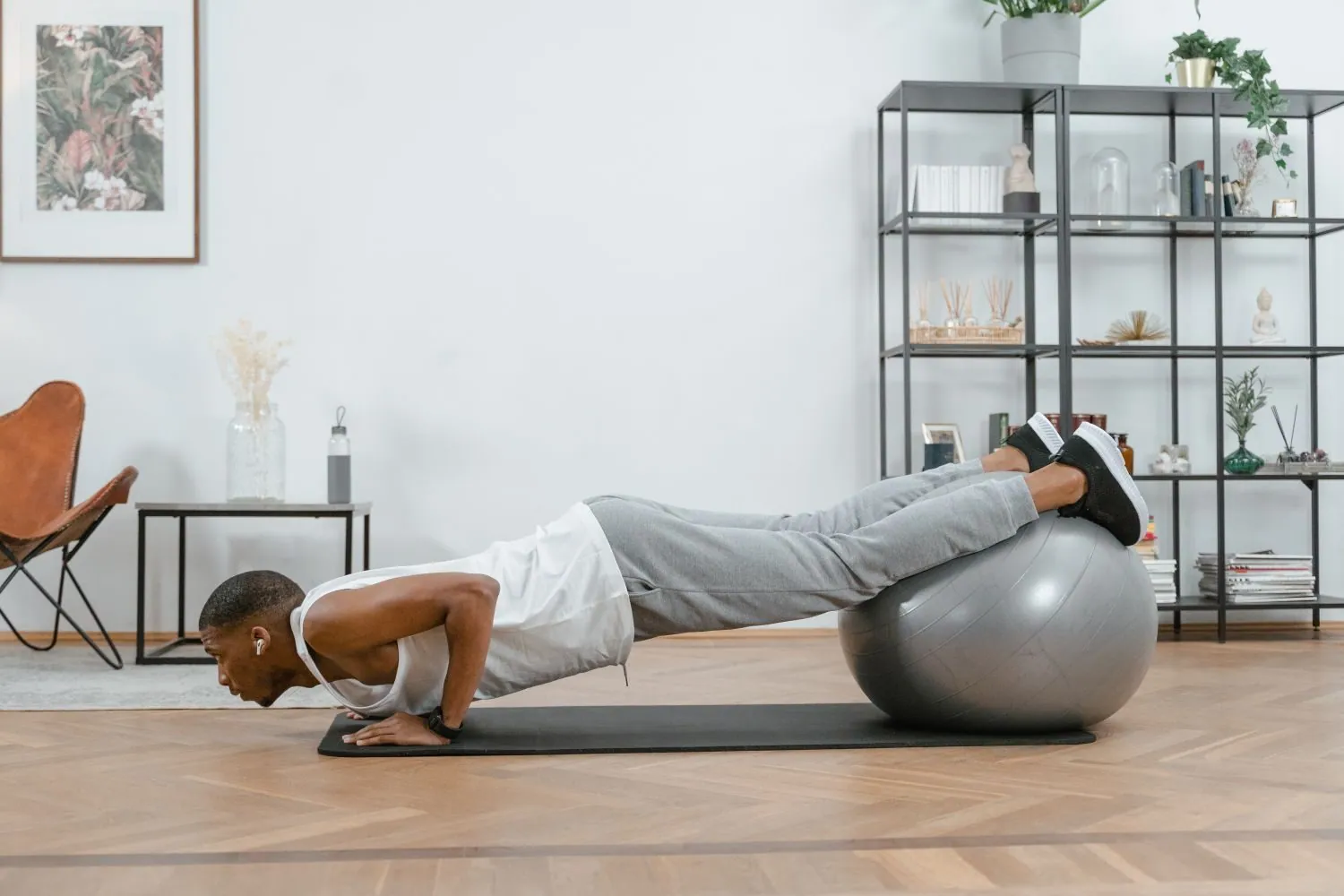
A decline push up on a stable chair is the safer place to start. A stability ball, as in the photo above, adds balance demand and is best kept for when you are already comfortable with the decline on a flat surface.
How to Do a Push Up Properly, Step by Step
Good form makes a push up a chest, shoulder and triceps exercise instead of a sagging, shoulder-straining one. Follow this sequence for every rep, on any variation.
- Set your hands. Place them slightly wider than your shoulders, fingers spread, with your wrists under or just in front of your shoulders.
- Build one straight line. From head to heels (or head to knees), squeeze your glutes and brace your stomach as if expecting a light punch. The hips should neither sag nor pike up.
- Lower in about 2 to 3 seconds. Let your elbows travel back at roughly 30 to 45 degrees from your ribs, not flared straight out to the sides like a “T”.
- Touch down close. Bring your chest to within a fist’s width of the floor, or touch it lightly, with your neck in line with your spine. Look at a spot just ahead of your hands.
- Press the floor away. Push until your arms are straight, then spread your shoulder blades slightly at the top. Breathe in on the way down and out on the way up.
Filming one set from the side with your phone is the fastest way to spot sagging hips or a dipping head.
Your 4-Week Push Up Workout at Home Plan
This plan assumes you can currently do about 8 standard push ups with good form. If you cannot, use the ladder in the beginner section further down and run this schedule on your starting level. Each training day takes 20 to 25 minutes after warming up.
| Week | Day 1 | Day 2 | Day 3 | Rest |
|---|---|---|---|---|
| Week 1 | Standard 3 x 8, incline 2 x 12 | Diamond 3 x 6, standard 2 x 8 | Decline 3 x 6, incline 2 x 12 | 60-90 sec between sets, off day between sessions |
| Week 2 | Standard 3 x 10, incline 2 x 15 | Diamond 3 x 8, standard 2 x 10 | Decline 3 x 8, incline 2 x 15 | 60-90 sec |
| Week 3 | Standard 4 x 8 with a 3-second lowering | Diamond 3 x 10, standard 3 x 10 | Decline 3 x 10, incline 2 x 15 | 60-75 sec |
| Week 4 | Standard 4 x 10 with a 3-second lowering | Diamond 4 x 8, standard 2 x 12 | Decline 4 x 8, wall or incline finisher to near failure | 60 sec, then retest |
At the end of week 4, rest one full day and do a single set of standard push ups to a clean stop, with no sagging and no half reps. Write the number down. Compare it with week 1 and you have a real measure of progress. Then restart the plan with the next harder variation or add one set to each exercise.
Push Ups Only Work Your Chest, and Other Myths
A push up trains far more than the chest. It is a full upper body press that also asks your core, glutes and the muscles around your shoulder blades to hold a plank at the same time. Three myths are worth clearing up.
- Myth: wide hands build a bigger chest. Slightly wider than shoulder width is fine, but very wide hands load the shoulder joint without much extra benefit. Keep your hands just outside your shoulders.
- Myth: push ups cannot build muscle. They can, especially if you are new to training. Muscle responds to hard sets taken close to failure, and a decline or slow-tempo push up gets hard quickly. The ceiling arrives later, when you can do 25 or more clean reps.
- Myth: more reps every day is better. Daily high-rep sets mostly build fatigue and sore elbows. Muscle grows during recovery, so 2 to 3 well-planned sessions beat 7 casual ones.
Push ups also will not spot-reduce chest or arm fat. Fat loss depends on your overall food intake and activity, while push ups build the muscle underneath.
Troubleshooting: Why Your Push Ups Are Stuck
When push up numbers stop rising for three or more weeks, the cause is usually one of a handful of fixable problems. Find your symptom below.
- Reps stuck at the same number. You are probably repeating the same session with the same effort. Add one rep per set each week, slow the lowering phase to 3 seconds, or shift to a harder angle.
- Shoulders pinch or feel sore at the front. Bring your elbows closer to your ribs and check that your hands are not too wide. Stay off the decline variation until the shoulders feel normal.
- Wrists hurt. Spread your fingers and press through the whole palm. Try push ups on fists or a pair of sturdy dumbbell handles to keep the wrist straight.
- Lower back aches. Your hips are sagging. Squeeze your glutes harder, shorten the set, or drop to the knee version until you can hold the line.
- You fail early in the set. Rest may be too short. Take 90 seconds between sets for the first two weeks.
Pain that is sharp, one-sided, or still present the next morning is a reason to stop and get it checked by a doctor or physiotherapist, not to push through.
What If You Cannot Do a Full Push Up Yet?
Most beginners, including many adults who have never trained, cannot do a full push up on day one. This is normal, not a sign of weakness. Use a ladder: work at the level where you can finish 3 sets of 8 clean reps, and move up when 3 x 12 feels comfortable.
| Level | Exercise | Sets x reps | Rest | Form cue |
|---|---|---|---|---|
| 1 | Wall push up | 3 x 10-15 | 45 sec | Body in one straight line, slow lowering |
| 2 | High incline (table edge) | 3 x 8-12 | 60 sec | Elbows about 45 degrees, chest to the edge |
| 3 | Low incline (stair or sofa seat) | 3 x 8-12 | 60 sec | Squeeze glutes, do not sag |
| 4 | Knee push up or slow negatives | 3 x 6-10 | 60-90 sec | Lower for 4 seconds, return up fresh |
| 5 | Standard push up | 3 x 5-8 | 90 sec | Full range, stop one rep before form breaks |
Women, older adults and desk workers can all build up steadily on the incline route, because a higher surface reduces the load while the movement pattern stays the same. If your shoulders or wrists have had an injury before, ask your doctor before starting.
How Often Should You Do a Push Up Workout at Home?
Two to three sessions per week, with at least one rest day between them, works for most people. Each session needs roughly 8 to 12 hard sets of push ups and their variations. If you add other training, space your pressing days so the same muscles are not worked on consecutive days.
If you already follow a split, this routine slots into the pressing day of a push pull legs workout, and gym trainees can pair it with a full push day workout on a separate day. Track the variation, sets and reps in a notebook, because the number you wrote last week is the one to beat. For your pulling, legs and core on the other days, our home workout guide shows how to complete the week without equipment.
Is a Push Up Workout at Home Enough on Its Own?
Push ups are enough to build real pressing strength and some visible chest, shoulder and triceps development, especially in the first 6 to 12 months of training. They are not enough for a balanced body. Push ups barely train your back or legs, and your own body weight eventually caps how hard the exercise can get.
If you want your plan built around your starting point, a goal such as fat loss or strength, and the equipment you actually own, our 1-on-1 personal training sessions are done online with a coach who checks your form and adjusts the progressions for you. Book a session and start with your current push up max.
Push Up Workout Questions, Answered
How many push ups should I do a day for beginners?
Beginners do not need a daily target. Aim for 3 sets of 5 to 10 clean reps on a variation you can control, on 2 to 3 non-consecutive days a week. Stop each set with 2 reps left. A daily number is less useful than steadily raising reps or difficulty week to week.
Can push ups alone build a bigger chest?
Yes, up to a point. Push ups can build visible chest, shoulder and triceps size for beginners, especially with decline and slow-tempo variations. Over time, bodyweight stops being heavy enough, so adding a backpack with books, resistance bands or gym work helps when progress slows.
Are knee push ups useful?
They are useful as a stepping stone. Knee push ups cut the load, so you can train the movement with good form while building toward full ones. Keep a straight line from knees to head, and move on to incline or standard push ups once you can do 3 sets of 12.
How long does it take to see results from push ups?
Most people notice they can do more reps within 2 to 4 weeks, mainly from better technique and nerve adaptation. Visible muscle change usually takes 8 to 12 weeks of consistent training with enough protein and sleep. Results vary with age, diet and starting point, so nothing is guaranteed.
Do I need equipment for a push up workout at home?
No equipment is required. A wall, a stair step or a sturdy chair covers the incline and decline variations, and a folded towel or yoga mat protects your knees and palms. Later, resistance bands or a loaded backpack can add difficulty, but you can train effectively without buying anything.


