

The best quad workouts are training sessions built around exercises that load the four muscles on the front of your thigh. A good one fits in 45 to 60 minutes: one heavy squat pattern, one leg press or lunge variation, and one isolation finisher such as the leg extension. Below you get the exercises, a full gym session, a version for home, and a weekly schedule, along with straight talk on what each approach can and cannot do for your legs.
What Do Quad Workouts Actually Train?
Quad workouts train the quadriceps femoris, a group of four muscles that straighten your knee and power squatting, climbing stairs, running and jumping. Three of the four cross only the knee, while the rectus femoris also crosses the hip, so it helps lift your thigh. Every good session loads all four together.
The four parts are the rectus femoris (front and centre), vastus lateralis (outer thigh), vastus medialis (the teardrop just above the knee) and vastus intermedius (deep, under the rectus). You cannot see or feel the last one, but it does a large share of the work in every squat.
Quads rarely work alone. Glutes, hamstrings, calves and your trunk all join in, which is why a strong quad day also builds general lower-body strength. For the wider picture of the whole upper leg, our thigh workouts guide covers the front, back and inner thigh together.
Which Quad Exercises Are Worth Your Time?
The best quad exercises are the squat, front squat, leg press, Bulgarian split squat, walking lunge, step-up and leg extension. Compound lifts give the most strength per minute, single-leg work fixes left-right gaps, and the leg extension finishes the muscle with very little fatigue elsewhere. Pick one or two from each group.
| Exercise | Sets x reps | Rest | One form cue |
|---|---|---|---|
| Back squat | 3-4 x 5-8 | 2-3 min | Knees track over the middle toes, chest tall |
| Front squat or goblet squat | 3 x 8-10 | 90-120 sec | Elbows up, stay upright, sit straight down |
| Leg press | 3 x 10-12 | 90 sec | Lower back stays flat on the pad, do not lock the knees |
| Bulgarian split squat | 3 x 8-10 per leg | 75 sec | Front foot far enough forward that the shin stays near vertical |
| Walking lunge | 2-3 x 10 per leg | 90 sec | Short, controlled steps, torso upright |
| Step-up | 3 x 10 per leg | 60-75 sec | Push through the front heel, lower for 2-3 seconds |
| Leg extension | 3 x 12-15 | 60 sec | Pause one second at the top, lower slowly |
Why this order? Heavy compound lifts need your freshest legs and the most focus, so they go first. Leg extensions go last because the movement is simple and you can push it hard with tired legs without much technical risk. If you want more combinations to rotate through, our leg workouts at the gym article lays out additional gym options.
A Full Gym Quad Session, Start to Finish
This is the session we would hand an intermediate lifter with access to a rack and a leg press. It takes roughly 50 to 60 minutes including warm-up. Begin with five minutes of easy cycling or brisk walking, then do two light warm-up sets of the first lift before your working sets.
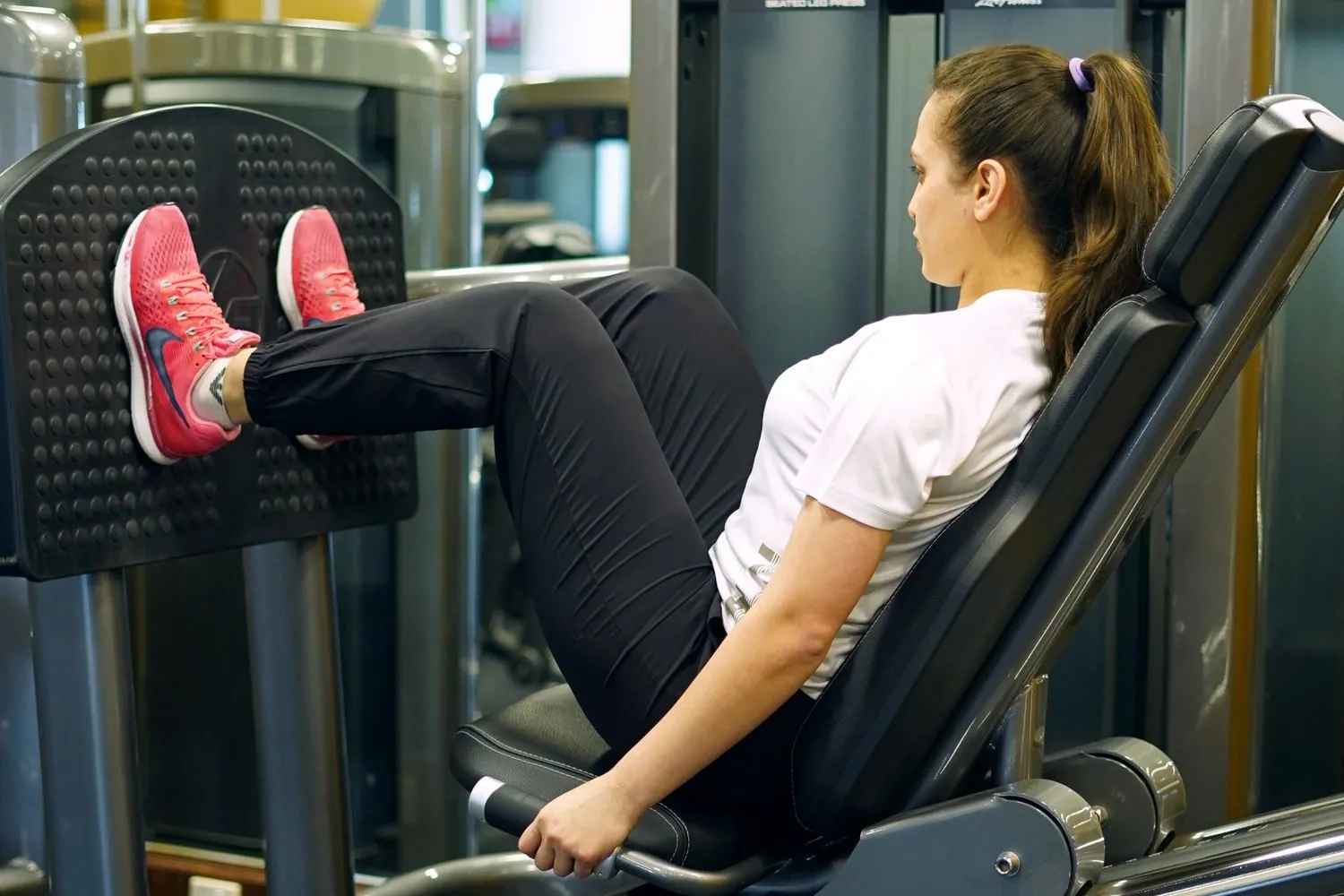
| Order | Exercise | Working sets | Reps | Effort guide |
|---|---|---|---|---|
| 1 | Back squat | 4 | 6-8 | Leave 1-2 reps in reserve |
| 2 | Leg press | 3 | 10-12 | Last 2 reps slow, 1 rep in reserve |
| 3 | Bulgarian split squat | 3 | 8-10 per leg | Moderate load, controlled lowering |
| 4 | Walking lunge | 2 | 10 per leg | Bodyweight or light dumbbells |
| 5 | Leg extension | 3 | 12-15 | Last set close to failure |
| 6 | Standing calf raise | 3 | 15-20 | Full stretch at the bottom |
That adds up to about 18 hard sets for the legs, which is the top end of what most people should do in a single session. If you are returning after a break, cut the loads by 10 to 15 percent in week one and drop one set from each lift. Progress by adding a rep or two each week before you add weight.
Myth: You Can Target the Inner or Outer Quad
You cannot switch one quad muscle off and train another alone. Foot position and stance width shift the emphasis slightly, but every squat, lunge and leg press works all four heads together. Real changes in thigh shape come from months of consistent volume, not from one special variation.
That said, small tweaks are worth knowing. A narrower stance with toes pointing forward asks a little more of the outer quad, and a wider stance with toes turned out 15 to 30 degrees leans on the inner quad and adductors. Use these as variety across the month, not as a promise of spot-training.
The same logic applies to ads promising a sculpted teardrop in two weeks. Muscle grows slowly, and visible definition also depends on your body-fat level, which diet and total activity control, not one exercise.
How Do You Do Quad Workouts at Home?
You can build quad strength at home with bodyweight squats, split squats, step-ups and wall sits, using slower lowering, longer sets and single-leg variations in place of heavy weights. Aim for 3 to 4 exercises, 3 sets each, and add 1 to 2 reps per set weekly before adding any external load.
No rack is needed, and most Indian homes already have the equipment: a sturdy stool or the bottom stairs for step-ups, a wall for wall sits, and a backpack filled with books or a water can as your load. Here is a simple progression you can run for four weeks.
| Week | Main moves | Sets x reps or time | How to make it harder |
|---|---|---|---|
| 1 | Bodyweight squat, split squat, wall sit | 3 x 15, 3 x 8 per leg, 3 x 30 sec | 3-second lowering phase |
| 2 | Same moves plus step-up | 3 x 18, 3 x 10 per leg, 3 x 40 sec | Add a 1-second pause at the bottom |
| 3 | Backpack goblet squat, rear-foot-elevated split squat, step-up | 3 x 12, 3 x 10 per leg, 3 x 12 per leg | Load the backpack with 5-8 kg |
| 4 | Same as week 3, add wall sit finisher | 4 x 12, 3 x 12 per leg, 1 x 60 sec | Add a rep to every set or slow the tempo |
If you want structure for the whole week, our online workouts article shows how to set up a training week from your living room. Yoga poses such as chair pose (utkatasana) also load the quads and make a good low-impact add-on on rest days, and you can learn them in our online yoga classes.
Troubleshooting: Knee Pain, Slow Progress and Endless Soreness
Most quad-training problems trace back to a handful of fixable habits. Here are the three we hear about most, with a practical response for each.
My knees hurt when I squat
First check depth and load. Many people go heavier than their technique can handle. Drop the weight by 20 percent, slow the lowering phase to three seconds, and keep your heels planted. Box squats to a bench and leg presses with a limited range can also help while things settle. Pain that is sharp, swollen or lasts more than a few days needs a doctor or physiotherapist, not a workaround.
My quads are not growing
The usual causes are inconsistent loads, too few hard sets, and low protein or sleep. Write your numbers down and aim to beat last week by one rep. Roughly 8 to 16 hard sets of quad work per week suits most people, and eating around 1.2 to 1.6 g of protein per kg of bodyweight daily from dal, paneer, curd, eggs, chicken or soy supports recovery. A dietitian consultation can fit those numbers to your food habits.
I am sore for four days after every session
Extreme soreness is not proof of a good workout. It usually means you added too much new volume too quickly, especially lowering-heavy work like lunges and step-ups. Cut sets by a third for a week, walk daily to promote blood flow, and build back up gradually. Soreness fades quickly once the body adapts to the routine.
How Often Should You Train Quads?
Most people should train quads two to three times a week with at least 48 hours between hard sessions. Beginners do well on two moderate sessions, intermediates on two or three, and advanced lifters often settle on two heavy sessions plus lighter work. More is not better if recovery lags.
As a guide, beginners (0 to 6 months) do two full-body days with 6 to 8 hard quad sets each, intermediates do two or three sessions of 8 to 12 sets, and advanced lifters do two sessions of 10 to 16 sets, one heavy and one built around volume and single-leg work. That is only a starting point. Sleep, work stress and how much you walk or run all change how many hard sessions you can recover from. Quad work also fits naturally into a push pull legs workout, where leg day covers quads, hamstrings, glutes and calves and repeats once or twice a week.
Quad Workouts for Women, Men and Beginners
The same exercises work for everyone, because quads respond to load and effort rather than gender. What differs is where you start, what you want from training and how fast you add weight.
For women: lifting heavy legs will not make you bulky. Women build muscle far more slowly than men, and what you will mostly notice is firmer thighs, stronger knees and easier stairs. Start with goblet squats, leg presses and step-ups, and see our workouts for women guide for a full-body plan around them.
For men: the common mistake is chasing upper-body numbers while leg day gets skipped or rushed. Treat the squat as a main lift, add Bulgarian split squats for balance, and look at workouts for men to slot leg day into a full week.
For beginners: spend your first four to six weeks on bodyweight squats, box squats and leg presses with light weight. Learn to control the lowering phase before you load a bar. Technique that is solid at 20 kg is far more useful than shaky technique at 60 kg.
Also be honest about goals. Quad workouts build strength and muscle, but they will not burn fat only from your thighs. If fat loss is the aim, pair training with a calorie deficit and daily movement, and ask about our online weight loss trainer programme.
Get a Quad Plan Built Around Your Knees and Schedule
Book a 1-on-1 personal training session with Fitstrot, and a coach will set your exercises, sets and loads around your equipment, schedule and knee history, then adjust week by week.
Frequently Asked Questions
What are quad workouts?
Quad workouts are sessions built around exercises that load the quadriceps, the four muscles on the front of your thigh. They usually combine compound lifts such as squats and leg presses with single-leg work and an isolation move such as leg extensions, for 3 to 5 exercises and roughly 10 to 16 hard sets.
How many quad exercises should I do per session?
Three to five is enough for most people. Start with one heavy compound lift, add one single-leg or machine movement, and finish with an isolation exercise such as leg extensions. More than about 18 hard sets in a session usually adds fatigue without extra benefit.
Can you do quad workouts every day?
It is not a good idea to train quads hard every day. Muscles need about 48 hours to recover from a tough session, and training through that fatigue usually leads to poor form and slower progress. Light walking or yoga on off days is fine.
Can I build strong quads without a gym?
Yes. Bodyweight squats, split squats, step-ups and wall sits build real strength when you slow the lowering phase, add reps weekly and later load a backpack. Home training works best for beginners and anyone who trains consistently, though heavier lifters will eventually want barbells or machines.
Do quad workouts help with knee pain?
Often yes, because stronger quads support the knee through its full range of motion. But poor form or too much weight too soon can aggravate an existing problem. If you have swelling, locking or sharp pain, see a doctor or physiotherapist before loading the joint.


