

Mudras are hand gestures used in yoga and meditation, and the usual claim about mudras and benefits is simple: holding a steady, deliberate hand position gives the mind an anchor, which many people find calming and focusing. The finer claims, such as healing a specific organ, come from tradition rather than clinical trials. This guide gives you a plain mudra chart, step-by-step instructions, honest benefit wording and a short routine you can try today.
What are mudras, and what are their benefits?
A mudra is a Sanskrit word often translated as “seal” or “gesture”. Hand mudras (hasta mudras) join or fold specific fingers while you breathe or meditate. Practitioners commonly report feeling calmer and more focused. Research on hand mudras specifically is limited, so treat benefits as traditional and personal, not proven medical effects.
It helps to separate three kinds of claims you will meet online:
- Reasonable and low-risk: A mudra gives your attention a small task, slows the breath and makes a good partner for meditation.
- Traditional: Each gesture is linked to an element and a set of qualities in yogic philosophy. It is a way of thinking about practice, not a laboratory finding.
- Overreach: Claims that a mudra cures diabetes, thyroid problems or blood pressure. No hand gesture replaces medical care.
If you want the wider picture first, our overview of the benefits of yoga puts mudras in context, and our page on yoga mudra covers the full-body gesture of the same name.
Mudra chart: which fingers go where?
Here is a quick reference for ten common mudras, listing finger positions and the traditional intention behind each. Wording is deliberately cautious: these are traditional associations, not medical treatments. Start each for about 5 minutes and build slowly.
| Mudra | Hand position | Palms | Traditional intention | Starting time |
|---|---|---|---|---|
| Gyan (jnana) | Index fingertip touches thumb tip, other three extended | Up | Focus, calm, clarity | 5 to 10 min |
| Prana | Ring and little fingertips touch thumb tip | Up | Vitality, steadiness | 5 to 10 min |
| Apana | Middle and ring fingertips touch thumb tip | Up | Settling, “downward” energy | 5 to 10 min |
| Vayu | Index finger folded to base of thumb, thumb gently over it | Up | Settling a restless, airy feeling | 5 to 10 min |
| Prithvi | Ring fingertip touches thumb tip | Up | Grounding, stability | 5 to 10 min |
| Shunya | Middle finger folded down, thumb gently over it | Up | Quiet, “emptiness” | 3 to 5 min |
| Surya | Ring finger folded down, thumb gently over it | Up | Warmth, energy | 3 to 5 min |
| Varun | Little fingertip touches thumb tip | Up | Fluidity, softness | 5 min |
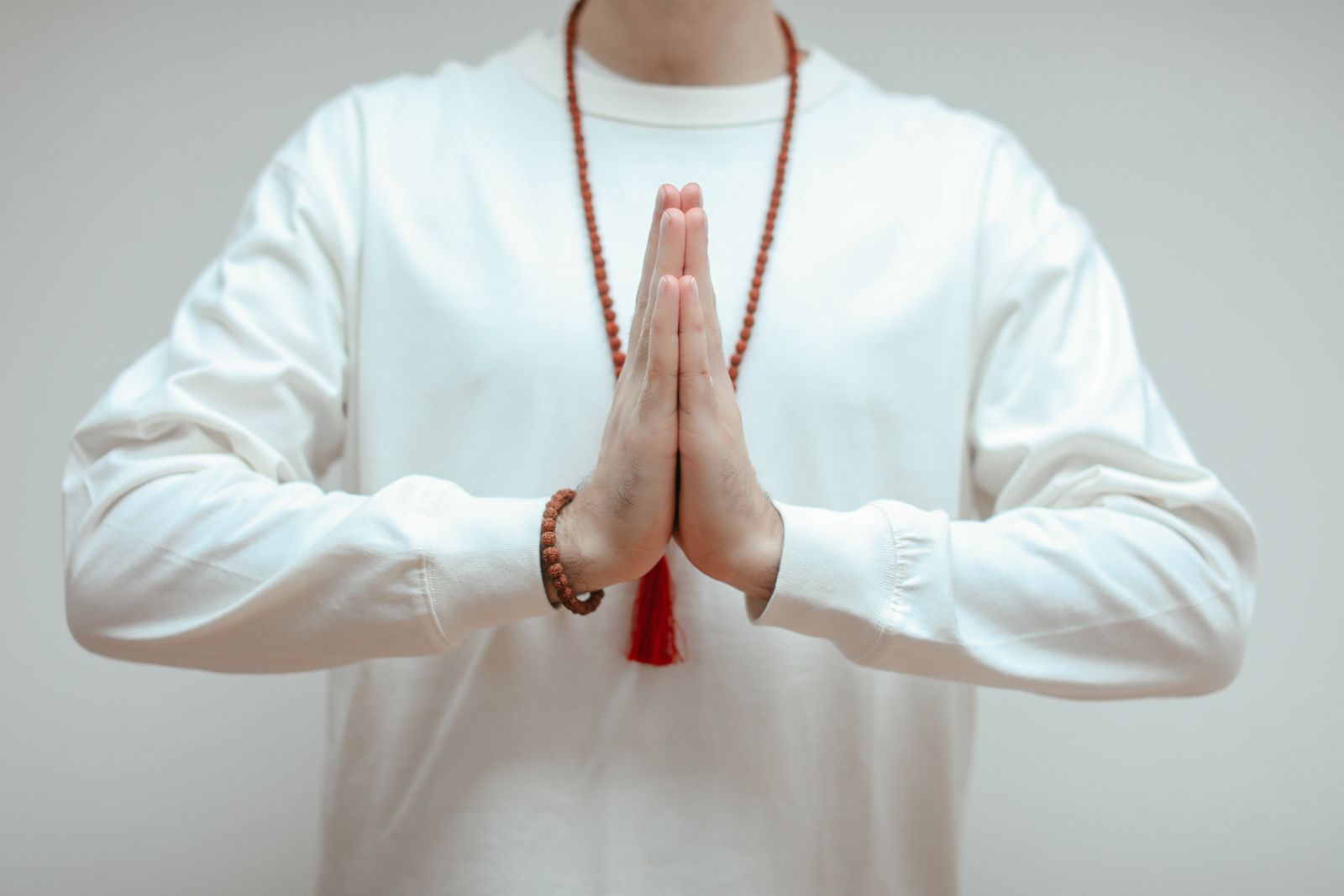
| Anjali | Palms pressed together at the chest | Together | Respect, centring | 1 to 3 min |
| Dhyana | Right hand over left in the lap, thumbs touching | Up | Stillness for meditation | 5 to 15 min |
Different schools describe small variations, such as palms up or down, or which hand goes on top. If your teacher shows a different version, follow their instruction. For a deeper look at the most popular one, see our page on gyan mudra, and for the folded-finger gesture, see vayu mudra.
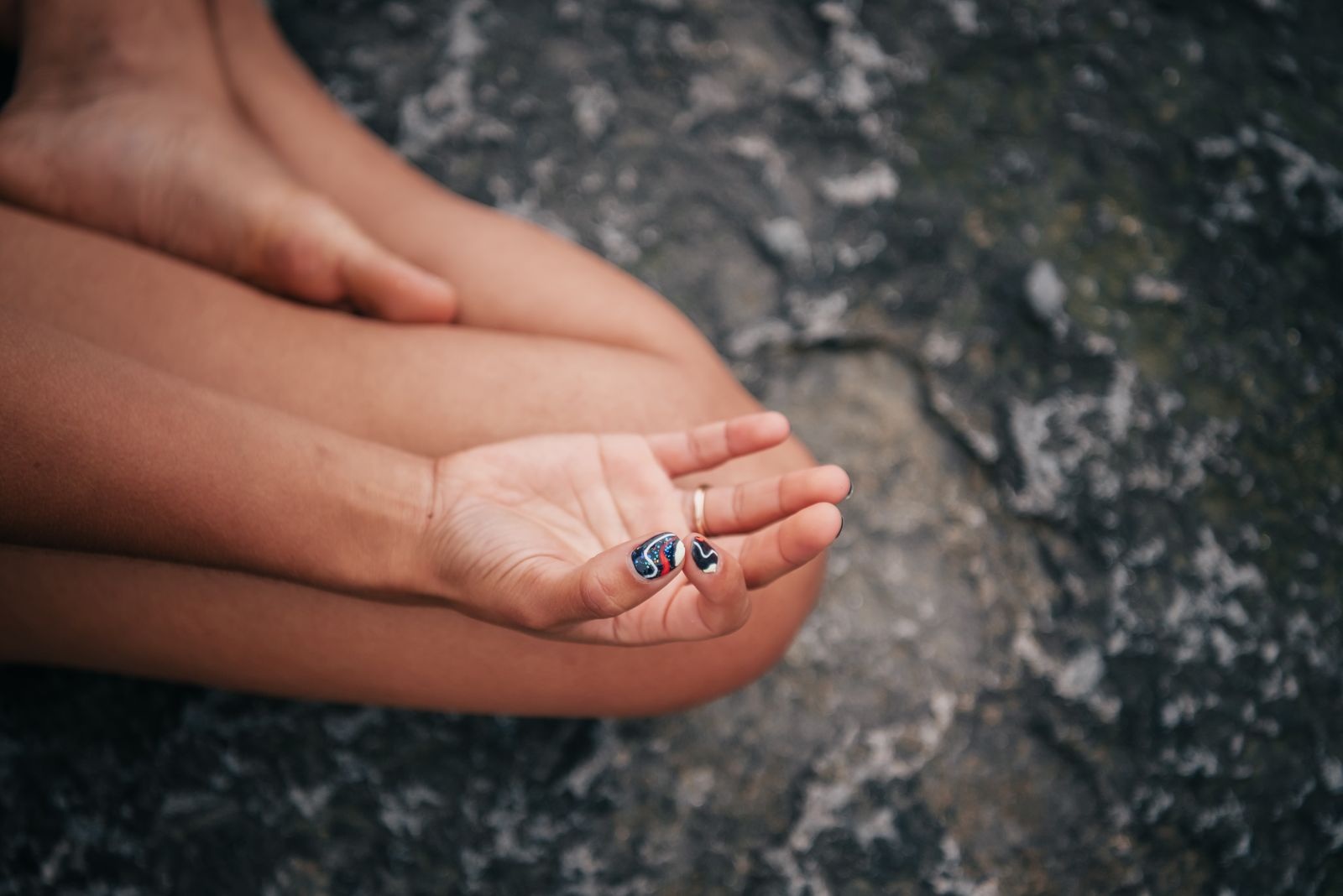
Which finger stands for which element?
In traditional yogic thinking, each finger is linked to one of five elements: the thumb to fire, the index finger to air, the middle finger to space, the ring finger to earth and the little finger to water. Touching a fingertip to the thumb is said to bring that quality into focus. This is a symbolic framework, not an anatomical fact.
| Finger | Element | Sanskrit | Quality associated in tradition |
|---|---|---|---|
| Thumb | Fire | Agni | Energy, willpower |
| Index | Air | Vayu | Movement, thought |
| Middle | Space | Akasha | Openness, awareness |
| Ring | Earth | Prithvi | Stability, grounding |
| Little | Water | Jala | Flow, softness |
You do not need to believe in the model to benefit from the practice. Many people simply enjoy the discipline of a precise, quiet gesture, and use the element names as a memory aid for the chart above.
How do you practise a mudra step by step?
Sit comfortably with a tall spine, rest your hands on your knees, form the gesture with light fingertip contact, breathe slowly through the nose, and hold for 5 to 10 minutes. Keep your shoulders, jaw and fingers soft. If your attention drifts, return to the touch of your fingertips.
- Choose a seat. A chair works well. On the floor, sukhasana with a folded blanket under the hips keeps the knees comfortable.
- Lengthen the spine. Imagine a thread lifting the crown of your head. Slouching squeezes the breath.
- Place the hands. Rest the backs of the hands on the thighs. Palms up is the common default, but follow your teacher where they differ.
- Form the mudra gently. Touch fingertips with the lightest pressure, as if holding a feather. The extended fingers stay long but relaxed.
- Breathe evenly. Try inhaling for about 4 counts and exhaling for about 6. Do not strain or hold your breath.
- Hold and notice. Stay for 5 minutes, observing the touch of the fingers and the breath. Add a minute or two each week.
- Release slowly. Let the hands open, shake them out and take a few normal breaths before standing.
New to sitting still? Our guide to meditation for beginners shows how to build the habit in small steps.
Do mudras really work? Myths worth dropping
Mudras can help you settle and focus, but they are not a medical treatment. Their benefits are mostly about attention and calm, backed by tradition rather than strong clinical research. Be sceptical of any page that promises fast cures. Here are the myths worth dropping first.
- Myth: A mudra can replace medication. It cannot. Never stop or change medicine because of a gesture.
- Myth: Longer is always better. Pressing hard or holding for an hour can tire the thumb joint. Gentle and regular wins over long and forced.
- Myth: Each mudra fixes one disease. Traditional associations are broad and symbolic. They are not diagnoses or prescriptions.
- Myth: You must sit in lotus pose. You can do a mudra on a chair, on a bench or even standing in a queue.
- Myth: Results come in days. Any effect is subtle and builds with regular practice, so judge after a few weeks of steady use, not one session.
Which mudra should you try for your situation?
Match the gesture to what you are doing, not to a promise of results. Gyan mudra suits seated meditation, prithvi suits a grounding start to the morning, and anjali suits a quick reset during a busy day. Try one mudra for a week, then change one thing at a time.
| Situation | Mudra to try | Pair it with | Time |
|---|---|---|---|
| Starting a meditation sitting | Gyan or dhyana | Slow nose breathing, counting breaths | 5 to 10 min |
| Slow morning, low energy | Prana or surya | 10 relaxed breaths by a window | 5 min |
| Restless mind in the evening | Vayu or varun | Longer exhales, dim lights | 5 to 10 min |
| Feeling scattered at the desk | Anjali, then gyan | 3 slow breaths, shoulders down | 2 to 3 min |
| Heavy feeling after a big meal | Apana, seated upright | A gentle walk afterwards | 5 min |
| Wanting grounding before a stressful day | Prithvi | Feet flat on the floor | 5 min |
For digestion-related discomfort, a mudra is only a small supportive habit. Our guide to yoga for digestion covers gentle postures, and persistent symptoms need a doctor, not a gesture.
Why does my mudra feel awkward, or do nothing?
Most problems come from pressing too hard, sitting poorly or expecting too much too soon. Loosen the contact, support your seat, shorten the time and give it a few weeks. If a finger or thumb hurts, stop and shake the hands out.
- Fingers tire or cramp: You are pressing too firmly. Use feather-light contact and cut the session to 3 minutes.
- Mind keeps wandering: That is normal. Count ten breaths, then start again. The wandering is the practice.
- Back aches: Move to a chair or place a cushion under the hips. The mudra is not worth a sore spine.
- Feel nothing: Subtle is not the same as useless. Keep notes for two weeks on mood and focus before and after sessions.
- Thumb joint ache or stiff hands: Rest, reduce the time and consider choosing a mudra that needs less pressing, such as dhyana.
- Dizzy or breathless: You are probably forcing the breath. Return to ordinary breathing.
Who should be careful with mudras?
Mudras are gentle, so most healthy adults, teens and older adults can try them. Be more careful if you have arthritis, finger injuries, a medical condition or are pregnant: keep the contact light, limit holds and speak with your doctor about any health concern. Children do best with one or two minutes at a time.
- Arthritis or hand injury: Choose gestures that do not require folding fingers, such as dhyana or anjali, and stay gentle.
- Pregnancy: Hand mudras are generally gentle, but check with your doctor, especially if you are combining them with breathing practices.
- Medical conditions: See your doctor or a registered professional for any ongoing symptom such as pain, breathlessness, dizziness or persistent digestive trouble. Use mudras only as a complement, and never change medication on your own.
- Anxiety or low mood: A calming habit can help day to day, but it is not a treatment. Seek professional support if symptoms persist.
How do you build a 10-minute daily mudra routine?
Take two minutes to settle, five minutes in one mudra with slow breathing, and three minutes of quiet sitting or a gratitude moment. Do it at the same time daily, such as after brushing your teeth. Stay with one mudra for a week before adding another.
- Minutes 1 to 2: Sit, close your eyes and take five slow breaths with hands in your lap.
- Minutes 3 to 7: Form gyan or prana mudra and breathe in about 4 counts, out about 6.
- Minutes 8 to 10: Release the gesture, bring palms together in anjali for three breaths and sit quietly.
Once the routine feels natural, explore how it fits into your wider practice by reading about the types of yoga, or see how a guided session is run in online yoga classes.
Frequently asked questions
What is the most commonly practised mudra?
Gyan mudra, where the index fingertip touches the thumb tip, is the most widely used, especially for seated meditation. It is gentle and suits beginners. Other popular choices include prana, apana and anjali mudra, depending on whether you want focus, steadiness or a quick reset.
How long should I hold a mudra each day?
Beginners can start with 5 to 10 minutes once or twice a day, adding a minute or two weekly. Short sessions of 2 to 3 minutes are fine at a desk. Stop if your fingers ache, and avoid forcing long holds.
Can mudras cure diseases?
No. Mudras are a traditional complementary practice for calm and focus, and there is little clinical evidence that they treat disease. Do not use them in place of medical care, and see your doctor for any ongoing symptom or condition.
Do I need to meditate to practise mudras?
No. Mudras are most often paired with meditation or slow breathing, but you can hold one briefly during a commute, a work break or before sleep. The calming effect is usually stronger when you also breathe slowly and stay still.
Is it safe for beginners and older adults to practise mudras?
Yes for most people, because mudras are gentle finger positions with no exertion. Use light contact and short holds. If you have arthritis, a finger injury or a medical condition, choose simple gestures and check with your doctor first.
Want to learn mudras with breathing and meditation under a trainer’s guidance? Join a live session through Fitstrot’s online yoga classes and build a steady daily habit.


