
If you are wondering how to do yoga without a teacher, a class or any flexibility, the short version is this: pick a quiet spot, sit or stand tall, breathe slowly through your nose, and move into one simple pose at a time, holding each for about five to eight breaths. That is enough to begin. This guide walks through a first session minute by minute, the alignment cues that protect your joints, what to change when a pose feels wrong, and who should check with a doctor first.
How Do You Do Yoga in Your First 15 Minutes?
A beginner yoga session fits in 15 minutes: about 2 minutes of seated breathing, 3 minutes of Cat-Cow to warm the spine, 7 minutes of simple standing and floor poses held for 5 to 8 breaths each, and 3 minutes of lying rest. Move slowly, keep breathing through the nose, and stop before any sharp pain.
| Minutes | What you do | How to do it | What to notice |
|---|---|---|---|
| 0-2 | Easy seated breathing | Sit on a folded blanket, shins loosely crossed, hands on knees, spine tall | Inhale and exhale feel about equal in length |
| 2-5 | Cat-Cow | Hands under shoulders, knees under hips. Inhale to arch gently, exhale to round. Do 6 to 8 rounds | Movement follows the breath, not the other way round |
| 5-7 | Mountain Pose | Feet hip-width apart, weight even across both feet, shoulders soft. Hold 5 to 8 breaths | Ribs stacked over hips, no leaning back |
| 7-9 | Forward fold with bent knees | Hinge from the hips, keep knees soft, rest hands on thighs or shins | A mild stretch in the back of the thighs |
| 9-12 | Child’s Pose | Knees wide, hips back toward heels, forehead on the mat or a folded towel. Stay 8 to 10 breaths | Breath moving into the back of the ribs |
| 12-15 | Rest on your back (Savasana) | Legs long, arms slightly away from the body, palms up, eyes closed | Let the breath go natural; roll to one side before sitting up |
This is yoga for beginners step by step: repeat the sequence three days a week for a fortnight before adding anything new. If you want a week-by-week plan, our guide on how to start yoga lays out a gentle first month.
What You Need Before You Roll Out the Mat
Very little. A non-slip floor space of roughly 2 m by 1 m, a mat about 4 to 6 mm thick (or a folded dari or thin blanket on a rug), and clothes that let you bend and breathe freely. Keep a cotton dupatta or belt, a thick book and a folded blanket nearby as stand-in props. Practise when your stomach is comfortable: leave about two to three hours after a full meal, or have a small snack 30 to 60 minutes earlier. Setting up a corner you can reuse makes the habit easier, and our guide to yoga at home shows how.
How Do You Do Yoga Poses Correctly?
Do yoga poses correctly by stacking your joints, keeping the breath smooth and moving slowly. Knees track over ankles, wrists sit under shoulders, and the spine stays long rather than collapsing. If you cannot breathe evenly through your nose, the pose is too deep for today, so ease off until the breath settles.
Alignment. Think of safe positions rather than pretty ones. In a lunge the front knee stays above the ankle. On hands and knees the wrists stay under the shoulders. In a forward fold the movement comes from the hips, not from rounding the lower back.
Breath. Use the talk test: you should be able to breathe steadily, even if you could not chat. Holding your breath or gasping means you have gone too far.
Pace. Move slowly enough that you could stop at any moment without wobbling.
| Pose | Key alignment cue | Easier version | Adjust or skip if |
|---|---|---|---|
| Mountain Pose | Weight even on both feet, knees soft, crown of head lifting | Stand with your back against a wall | You feel light-headed: sit on a chair instead |
| Cat-Cow | Wrists under shoulders, knees under hips, small smooth range | Forearms down, blanket under the knees | Wrists or knees hurt: use the forearm version, or skip |
| Forward fold | Hinge at the hips, knees bent, neck relaxed | Hands on a chair seat or thighs | You have a disc problem, osteoporosis or eye-pressure concerns: ask your doctor first |
| Child’s Pose | Knees wide, hips back, forehead supported | Rolled blanket between thighs and calves | Knees pinch or you are pregnant: keep knees wide and prop the torso |
| Low lunge | Front knee above ankle, back knee padded, torso tall | Hands on books beside the front foot | Knee pain: pad the knee more or leave the pose out |
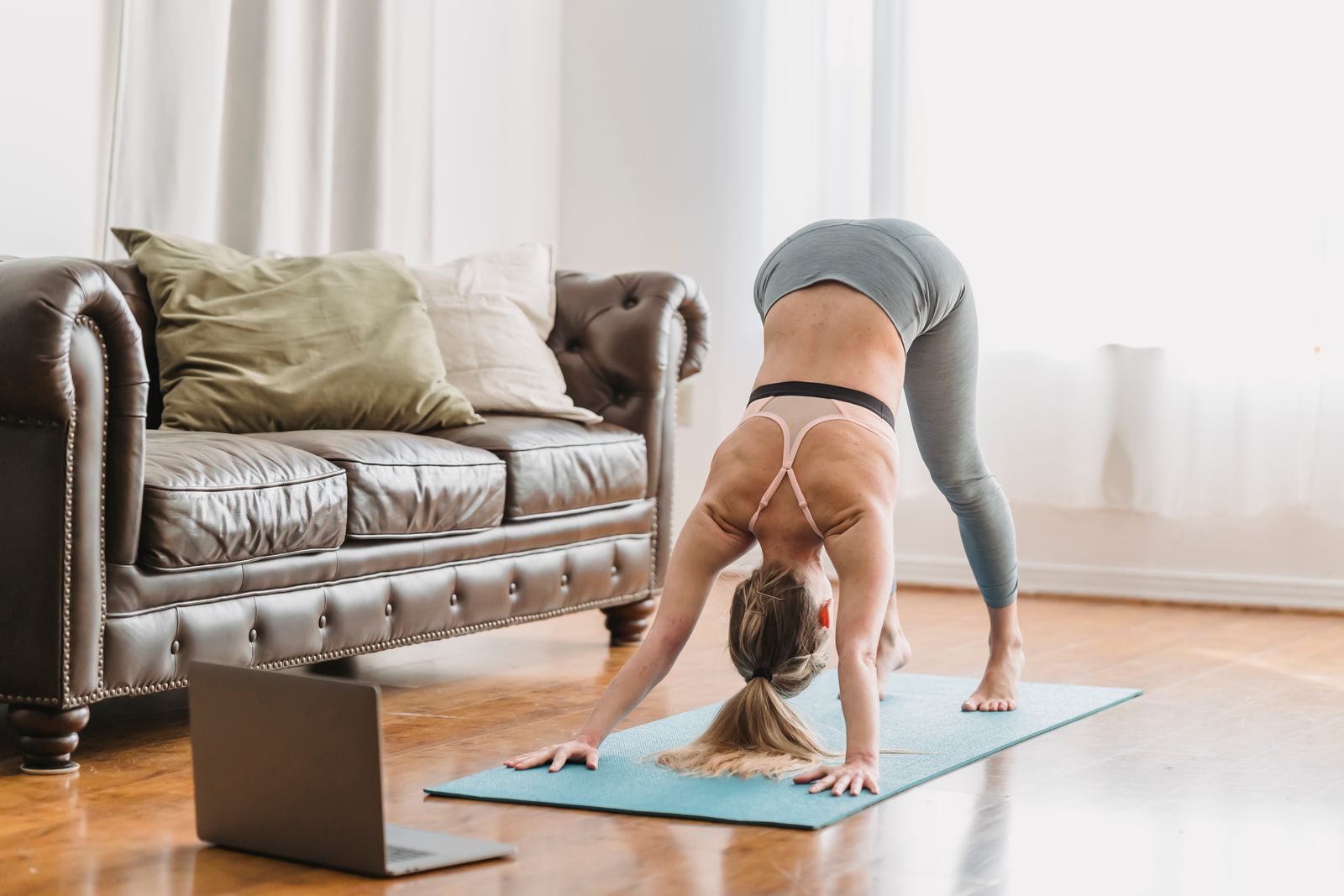
| Downward Dog | Hands shoulder-width, long spine, heels free to lift | Hands on a wall or kitchen counter, knees bent | Wrist pain, high blood pressure or eye-pressure concerns: use the wall version |
Myth: You Have to Be Flexible to Do Yoga
Flexibility is something yoga can build gradually, not a ticket to enter. Tight hamstrings, stiff hips and a desk-bound back are exactly why many people begin. Learning how to do yoga stretches with a stiff body simply means using props and bending your knees without apology.
- Cannot reach the floor in a forward fold? Rest your hands on your shins, a chair or a stack of books.
- Cannot sit cross-legged? Sit on a folded blanket so the hips sit higher than the knees, or sit on a chair.
- Cannot clasp your hands behind you? Hold a dupatta or belt between them.
Experienced practitioners keep using props for years because they add precision. Consistency matters more than depth: fifteen minutes three times a week usually does more for comfort and range of motion than one forced hour, though how quickly changes appear differs from person to person.
How Do You Breathe While Doing Yoga?
Breathe in and out through your nose at an even pace, roughly 3 to 4 seconds each way, and never hold your breath during effort. In most poses, inhale as you lengthen or open and exhale as you fold or release. If the breath turns ragged, ease the pose back.
That is all a beginner needs. Fancier techniques, such as loud throat breathing or breath holds, can wait until a qualified teacher can watch you, because holding the breath raises tension and does not suit everyone. A quick check partway through any pose: are your shoulders creeping up and is your jaw tight? Exhale, soften both, and carry on.
What to Do When a Pose Feels Wrong
Mild effort and a gentle stretching sensation are normal. Sharp, pinching, burning, shooting or tingling sensations are not, and the right response is to back out of the pose slowly rather than push through. Use this table to troubleshoot the most common problems.
| What you feel | Likely cause | Quick fix |
|---|---|---|
| Ache in the wrists | Too much weight on the hands, wrists bent sharply | Spread the fingers, press through the whole palm, or drop to forearms or fists |
| Pinching at the front of the knee | Kneeling on a hard surface, or the knee bent too deeply | Pad the knee with a folded blanket, sit back less far, or choose a standing pose |
| Lower back rounding in a fold | Tight hamstrings, hinging from the waist | Bend the knees generously and rest hands higher on a chair or thighs |
| Wobbling in balance poses | Rushing, eyes moving around | Fix your gaze on one spot, keep the toes of the lifted foot on the floor, stay near a wall |
| Tension in the neck and shoulders | Shoulders hiked up, breath held | Exhale, slide shoulder blades down the back, shorten the hold |
| Dizziness when standing up | Rising too fast after a fold or long rest | Come up slowly, pause, and sit if the feeling continues |
If the same pain returns session after session, stop that pose and see a doctor or physiotherapist. Our articles on yoga for back pain and yoga for knee pain cover gentler options once you have had advice.
Who Should Check With a Doctor Before Doing Yoga?
Check with a doctor or physiotherapist first if you are pregnant, have high blood pressure, glaucoma, a herniated disc, osteoporosis, a recent surgery, or an injury that is still painful. Most people can still practise with changes, but deep forward folds, long inversions and strong twists may need adjusting or leaving out.
- Pregnancy: avoid deep twists, lying flat on your back for long stretches in later months, and pressing on the belly. Choose a teacher trained in prenatal yoga.
- High blood pressure: keep the breath smooth, avoid breath holds, and do not keep the head below the heart for long without medical advice. Never change or skip medication because of yoga.
- Glaucoma or eye-pressure problems: avoid long head-down poses unless your eye doctor agrees.
- Disc problems or osteoporosis: avoid deep forward folds and strong twists with a rounded spine until you have clear guidance.
- Recent surgery or acute pain: wait for clearance first.
Stop and seek medical help if you get chest pain, severe breathlessness, fainting, sudden numbness or sharp pain that does not settle. Yoga is a supportive practice, not a treatment, and it should sit alongside whatever your doctor advises.
How Do You Do Yoga at Home Without a Teacher?
At home, keep each session to 10 to 20 minutes, repeat the same four to six poses for two weeks, and check your alignment against a wall or a short phone video. Add one new pose only when the current ones feel steady and calm.
A wall is a free coach: stand with your heels, hips and shoulder blades near it and you quickly feel whether you are leaning or arching. Filming a minute of your practice often shows more than a mirror. When you want real-time corrections on posture and breath, online yoga classes with live cues fill the gap that a video cannot.
How Often and for How Long Should a Beginner Practise?
Beginners do well with 10 to 20 minutes, three to four days a week, rather than one long session. Fifteen minutes three times a week adds up to about 45 minutes, enough to build the habit and learn the poses. Longer 45 to 60 minute classes can wait until the basics feel steady.
Many people find mornings easiest because nothing else has claimed the time yet, and our morning yoga routine is built for stiff, sleepy bodies. As you settle in, try different styles to see what suits you: slower, held postures in hatha yoga, flowing movement in vinyasa yoga, or fully supported rest in restorative yoga. Our overview of types of yoga compares them, and the benefits of yoga guide explains what regular practice may help with, without overpromising.
Can Children Do Yoga the Same Way?
Children can try yoga in shorter, playful sessions of 10 to 15 minutes, using animal-style poses and breathing games rather than long holds. An adult should keep the space clear and watch for safety, not for perfect shapes. Keep it fun rather than forcing flexibility. For age-wise sequences, see yoga for kids.
Quick Answers About How to Do Yoga
Do I need a yoga mat to start?
No. A mat gives grip and cushioning, but a folded blanket or dari on a non-slip floor works for the first weeks. Avoid practising on bare tiles or polished floors where hands and feet can slide, and buy a mat of about 4 to 6 mm once you know you will continue.
How many breaths should I hold each pose?
Five to eight slow breaths is a good range for most beginner poses, which is roughly 30 to 45 seconds. Restful poses like Child’s Pose can last 8 to 10 breaths. Shorten the hold whenever your breath turns uneven or the pose starts to hurt.
Is it normal to feel sore or dizzy after yoga?
Mild muscle tiredness a day later is common when you are new, and it should ease within a couple of days. Dizziness is a sign to slow down: come up gradually, sip water, and sit down. Chest pain, fainting or lasting pain needs medical attention.
Can I do yoga on an empty stomach?
Yes, if you feel comfortable. Some people prefer a light practice before breakfast, while others feel weak and do better with a banana or a few soaked almonds about 30 to 60 minutes before. Avoid practising straight after a heavy meal.
How many days a week should a beginner do yoga?
Three days a week is a sensible start, with a rest day in between, rising to four or five short sessions as it starts to feel natural. Short, regular sessions are easier to sustain than occasional long ones.
Next step: book a beginner session with FitStrot online yoga classes and have an instructor check your alignment and breathing live.


