
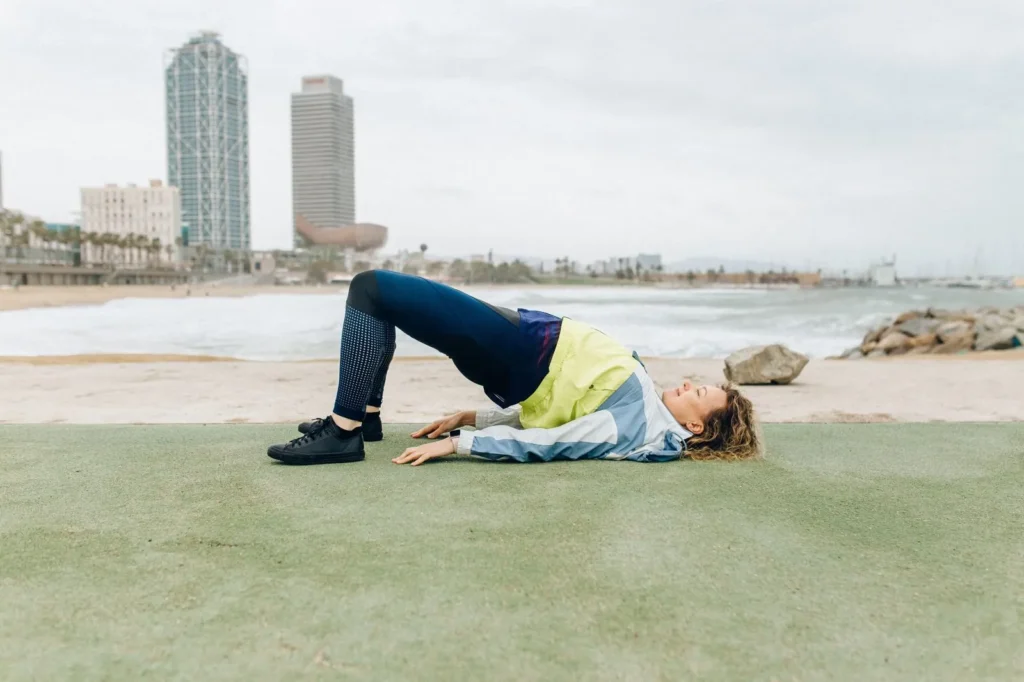
Good hip workouts train the muscles that move and steady your pelvis: the glutes, the side-of-hip abductors, the hip flexors and the inner-thigh adductors. Done well, hip workouts build strength and shape, loosen the stiffness that comes from sitting at a desk for eight hours, and make stairs, squats and running feel easier. Below you get a 35-minute session, form cues for each move, a weekly schedule, home swaps using things you already own, and fixes for when progress stalls.
Which muscles do hip workouts train?
Hip workouts train four groups: the glutes (maximus, medius and minimus), which extend and stabilise the hip; the hip flexors at the front, which lift the thigh; the adductors on the inner thigh; and the small deep rotators under the glutes. A balanced session works the glutes hardest and keeps the other three strong and mobile.
A simple way to plan your training is to remember that the hip has three jobs, and a complete session gives each one a turn:
- Extension (glute maximus): driving the thigh back, as in hip thrusts, hinges and lunges. This is your biggest and strongest hip muscle. If you want to go deeper on it alone, our glutes workout guide covers programming for that muscle in detail.
- Abduction and rotation (glute medius, minimus, deep rotators): moving the leg out to the side and keeping your knee from collapsing inward when you stand on one leg.
- Flexion and adduction (hip flexors, adductors): lifting the knee and pulling the leg back toward the midline. These tighten up with long sitting, so they need mobility as much as strength.
A 35-minute hip workout you can follow today
This session needs one pair of dumbbells (or a loaded backpack), a mini resistance band and a mat. It takes about 35 minutes including a 5-minute warm-up of leg swings, bodyweight glute bridges and a few slow hip circles. Do the exercises in the order shown, and push hardest on the heavy lifts in the middle.
| Order | Exercise | Sets | Reps | Rest | Main target |
|---|---|---|---|---|---|
| 1 | Banded lateral walk | 2 | 12 steps each way | 30 sec | Glute medius (activation) |
| 2 | Dumbbell or barbell hip thrust | 4 | 8-12 | 90 sec | Glute maximus |
| 3 | Bulgarian split squat | 3 | 8-10 per leg | 60 sec | Glutes, quads, stabilisers |
| 4 | Romanian deadlift | 3 | 10-12 | 75 sec | Glutes, hamstrings |
| 5 | Side-lying leg raise | 3 | 15 per side | 30 sec | Glute medius and minimus |
| 6 | Banded clamshell | 2 | 15-20 per side | 30 sec | Deep rotators |
| 7 | Half-kneeling hip flexor stretch | 2 | 30 sec per side | None | Hip flexors |
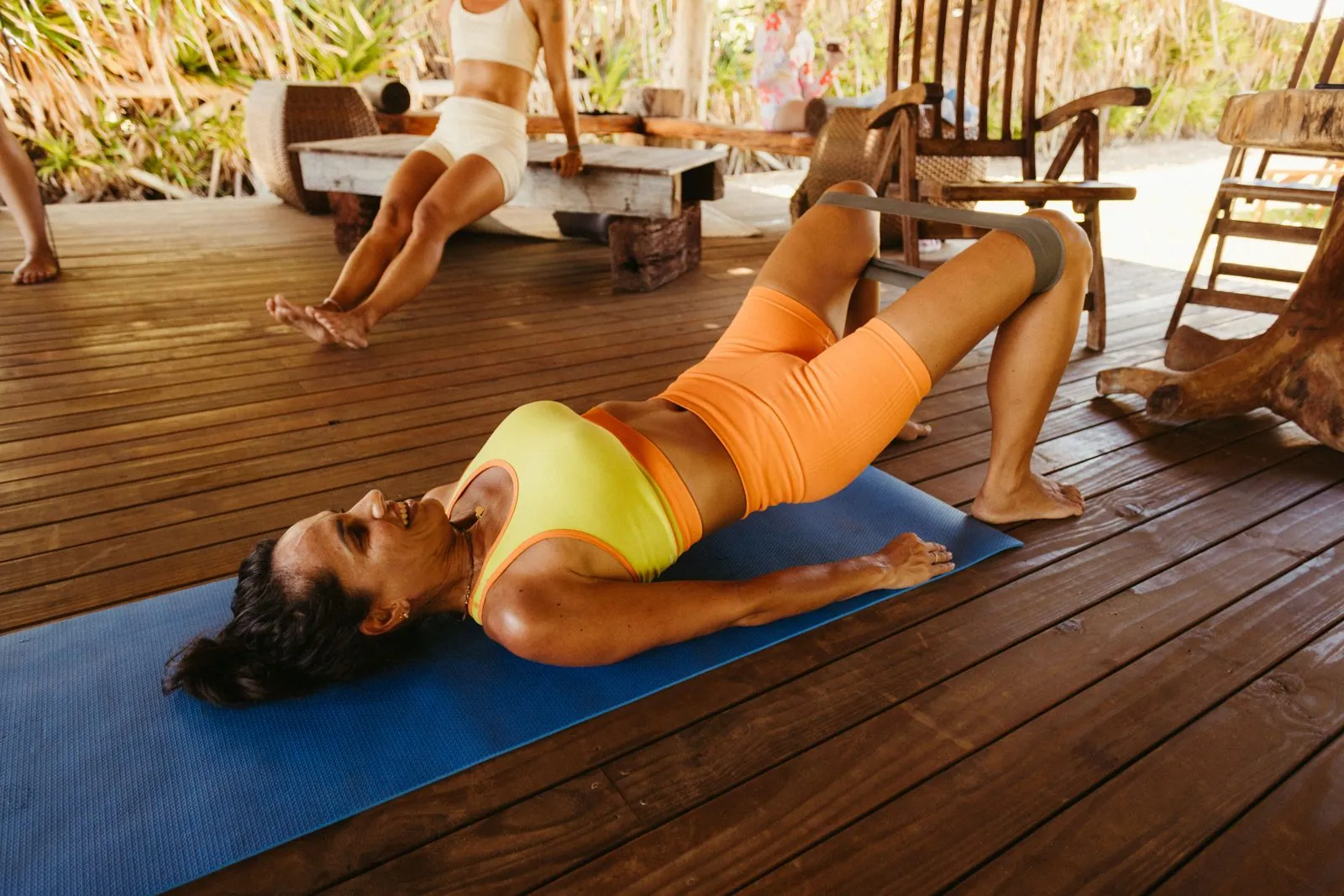
Treat the band walk as a primer, not a max-effort set. Stop each heavy set one or two reps before you would fail, and add a little weight or one rep whenever you hit the top of the range on every set. The hip thrust is the anchor of the session, and our hip thrust workout guide goes through setup, bar padding and loading in more depth.
How do you do each exercise properly?
The table below gives the setup, the one cue that matters most, and the mistake we see most often on each move.
| Exercise | Setup | Key form cue | Common fault |
|---|---|---|---|
| Hip thrust | Upper back on a bench or sturdy sofa edge, feet flat, knees about 90 degrees at the top | Tuck the chin and ribs down, squeeze the glutes at the top for 1-2 seconds | Arching the lower back to get higher |
| Banded lateral walk | Band just above the knees, quarter-squat position | Keep toes forward and take small steps | Leaning the torso sideways |
| Bulgarian split squat | Back foot on a bench, front foot about 2 feet ahead | Lean the chest slightly forward to bring in more glute | Front foot too close, so the knee shoots forward |
| Romanian deadlift | Soft knees, weights close to the thighs | Push the hips back, stop when the hamstrings stretch | Rounding the back or bending the knees too much |
| Side-lying leg raise | Hips stacked, bottom knee bent for balance | Lift the top leg slightly behind the body, toes level or turned slightly down | Rolling the pelvis backward |
| Clamshell | Knees bent, feet together, band above the knees | Open the top knee without moving the pelvis | Using momentum and rocking |
If you fix one thing, fix the pelvis: when it rolls or rocks to help the leg move, the glute stops working.
Myth check: can hip workouts burn fat from your hips?
No. Spot reduction does not work, because your body decides where fat comes off based on genetics, hormones and overall energy balance, not on which muscle you just trained. Hip workouts build the muscle beneath the fat, while fat loss comes from a modest calorie deficit of roughly 300 to 500 kcal a day, held for weeks.
That does not make hip training pointless. Stronger glutes and hip stabilisers change how your hips look, how you move and how much you can lift elsewhere, and they help protect muscle while you lose weight. The honest version of the plan is: train hips two or three times a week for strength, eat enough protein (roughly 1.2 to 1.6 g per kg of body weight is a common range for active adults), and let a steady deficit handle the fat.
If your main goal is weight loss, a coach who looks at your food and training together will get you further than any single exercise. Our online weight loss trainer programme does exactly that, and it will tell you plainly if a target is unrealistic.
How often should you train your hips?
Two to three hip sessions a week works for most people, with at least 48 hours between heavy sessions. Glutes recover faster than many muscle groups, so a lighter third session is fine, but daily heavy training usually brings nagging hip flexor tightness without extra progress.
Here is a weekly layout that keeps heavy and light days apart:
| Day | Session | Time | Notes |
|---|---|---|---|
| Monday | Heavy hip day A: thrust, split squat, RDL, side work | 35-40 min | Add weight when all sets hit the top reps |
| Tuesday | Upper body or a brisk 30-minute walk | 30 min | Keep the hips fresh |
| Wednesday | Light activation and mobility: bridges, fire hydrants, clamshells, stretches | 20 min | Easy effort, no failure |
| Thursday | Rest or gentle yoga | 20-30 min | Good for hip flexor length |
| Friday | Heavy hip day B: thrust, step-ups, single-leg RDL, band walks | 35-40 min | Change exercise order from Monday |
| Saturday | Easy walk, cycling or dance | 30-45 min | Optional |
| Sunday | Full rest | – | Sleep and eat well |
If hips are one part of a wider plan, fold two or three hip accessories into your existing leg days instead. Our quad workouts and thigh workouts pages show how to share volume so you do not overload the same muscles twice in a day.
Can you do hip workouts at home without a gym?
Yes. A mini band, one pair of dumbbells and your body weight cover most hip exercises, and beginners often do better starting at home. Three 30-minute home sessions a week beat one perfect gym session you keep skipping. The limit is heavy loading, so plan to add weight gradually.
These swaps use what most Indian homes already have:
- Hip thrust: shoulders on a sturdy sofa edge or bed side (wedge it against a wall), with a backpack of books or a filled 5-litre water can (about 5 kg) on your hips.
- Bulgarian split squat: back foot on a chair or low stool, holding a loaded bag at your chest.
- Romanian deadlift: two filled water bottles or a heavy bag held close to the thighs.
- Band walks and clamshells: a mini loop band, or no band at all, slowing the tempo to 3 seconds per rep.
- Fire hydrants and side-lying raises: bodyweight only, higher reps (15-20).
Once bodyweight sets feel easy at 20 reps, the next step is more load, not more reps. Our online workouts guide shows how to structure training at home.
Hip workouts for women, men and desk workers
The exercises are broadly the same for everyone, but the emphasis changes with the goal and the lifestyle.
- Women: many women want firmer, stronger glutes and hips, which means prioritising heavier thrusts, RDLs and lateral work over endless bodyweight reps. Our glute workouts for women page and the wider workouts for women guide lay out volume across the week.
- Men: men often squat and deadlift but skip single-leg and side-hip work, which shows up as knee wobble and a stalled lower body. Add split squats and band or cable abduction, then fit them into a programme from our workouts for men guide.
- Desk workers: if you sit for most of the day, begin each session with the hip flexor stretch and glute bridges. Stiff hip flexors make it harder for the glutes to switch on. Gentle online yoga classes pair well with strength work.
Why are your hip workouts not working?
Most stalled hip workouts come down to four causes: no progressive overload, poor glute activation, too little recovery, and too little food or sleep. Fix them in that order. Add weight or reps every one to two weeks and slow each rep down.
- Only bodyweight reps for months. Clamshells and band walks are good for activation, but they rarely build noticeable size alone. Add resistance steadily.
- Skipping side-hip work. If you only train extension, the outer hip lags and the knees may drift inward.
- Chasing the burn. Soreness is not progress. Log weight and reps, and beat last week’s numbers.
- Feeling everything in the quads or lower back. Lower the load, shorten the range slightly and squeeze the glutes at the top of each rep. Move to a flatter foot position if your quads take over.
- Under-eating. Dal, paneer, eggs, curd, sprouts, chicken or fish at each main meal make your protein target far easier to hit.
Not sure which of these applies to you? A coach watching your form on video for one session will usually spot it within minutes, which is what our 1-on-1 personal training sessions are built around.
When should you see a doctor before doing hip workouts?
Normal muscle soreness is dull, spread across the muscle, and fades in 24 to 72 hours. Stop and get advice if you feel sharp pain in the groin or front of the hip, catching or locking, pain at night or at rest, numbness or tingling down the leg, or pain after a fall.
See a doctor or physiotherapist before starting if you have had a hip replacement or fracture, have been diagnosed with arthritis or a labral tear, or are pregnant or recently postpartum. Hip pain is not something to push through, and a professional can tell you which of the moves above to adjust or skip. None of the results in this guide are guaranteed, since progress depends on training history, food, sleep and genetics.
Frequently asked questions
What are the best hip workouts for beginners?
Start with bodyweight glute bridges, clamshells, fire hydrants and side-lying leg raises, 2 sets of 12 to 15 reps, twice a week. After two to three weeks, add a dumbbell hip thrust, a supported split squat and a Romanian deadlift with light weights. Master the movement first, then add load.
How many days a week should you do hip workouts?
Two to three days a week is enough for most people, with at least 48 hours between heavy sessions. If you train a third day, keep it light, with activation and mobility work only. Training the same muscles hard every day usually adds fatigue and hip flexor tightness rather than faster results.
Can hip workouts make your hips wider?
Building the glutes and outer hip muscles can add some roundness and fullness around the hips, but your bone structure does not change. How much visible change you get depends on genetics, how much muscle you add and your body fat level. Expect gradual shaping over several months, not a sudden change.
How long do hip workouts take to show results?
Most people feel stronger and notice better muscle activation within 2 to 4 weeks. Visible shape changes usually take about 8 to 12 weeks of consistent training two to three times a week, with enough protein and sleep. Results vary from person to person, so track weights and photos rather than relying on the mirror alone.
Are hip workouts good for stiff hips from sitting?
Yes, for general stiffness from long sitting. Glute strengthening, hip flexor stretches and gentle mobility work all help, and short movement breaks every hour add to the effect. If the stiffness comes with sharp pain, swelling or reduced movement, see a doctor or physiotherapist before continuing.
Want someone to check your hip thrust depth and set your weights each week? Book a 1-on-1 personal training session with a Fitstrot coach and bring this plan along.


