
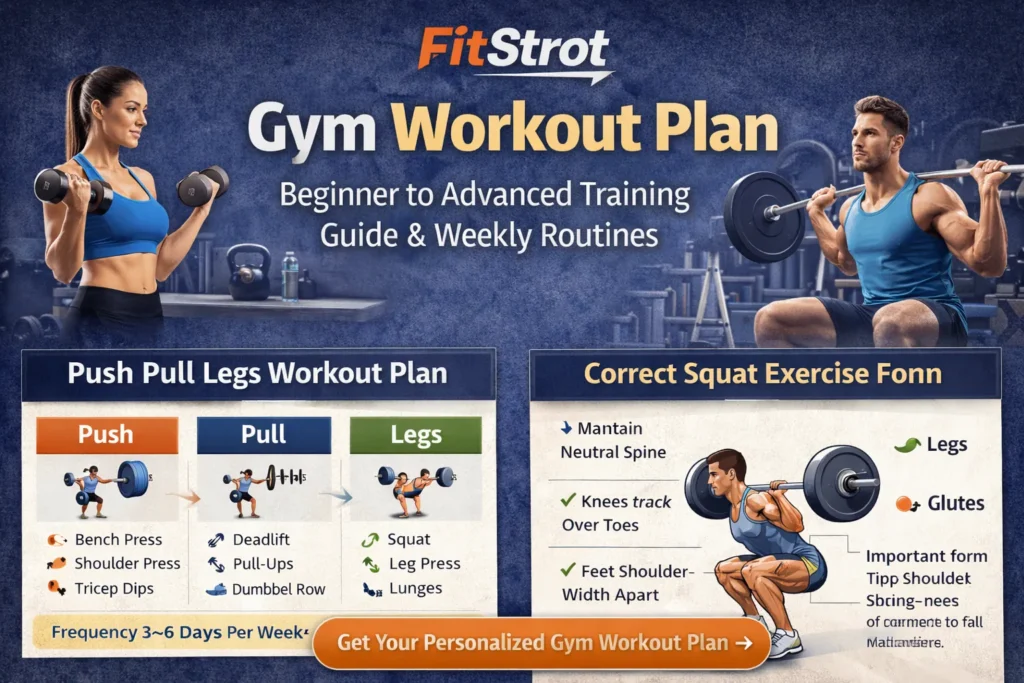
A good gym workout plan tells you which exercises to do, how many sets and reps to aim for, how often to train and when to add weight. Without those four things, most people drift between random machines and stall within weeks. This guide gives you ready-to-use templates for beginner, intermediate and advanced lifters, with sets, reps, rest times and form cues, so you can pick one and start this week.
What makes a gym workout plan actually work?
A gym workout plan works when it applies progressive overload, trains each muscle about twice a week, and fits your recovery. For muscle growth, most people do well on roughly 10 to 20 hard sets per muscle per week, split across two sessions, and add weight or reps gradually.
Everything else is detail. Fancy splits, trending exercises and new apps matter far less than turning up three to five times a week, lifting with decent form and writing down what you lifted so next week can be slightly better. Beginners need less volume, often 6 to 10 sets per muscle weekly, because their bodies respond quickly to almost any sensible stimulus.
A plan also has to survive real life: a 9 to 6 job, a crowded gym at 7 pm, dal-chawal dinners and the occasional missed week. The templates below are built with that in mind.
Which gym workout plan fits your level?
Pick your template by training age, not by ambition. Beginners with under six months of lifting suit three full-body days a week, intermediates with six to 24 months suit a four-day upper/lower split, and advanced lifters with two or more years can handle five or six days of push, pull and legs.
| Level | Lifting experience | Days per week | Split | Session length | Main aim |
|---|---|---|---|---|---|
| Beginner | 0 to 6 months | 3 | Full body | 45 to 60 min | Learn the lifts, build the habit |
| Intermediate | 6 to 24 months | 4 | Upper / lower | 60 to 70 min | Add load and weekly volume |
| Advanced | 2+ years | 5 to 6 | Push / pull / legs | 60 to 80 min | Volume cycling, weak points |
| Returning after a long break | Any, but 2+ months off | 3 | Full body | 45 min | Rebuild at about 60% of old weights |
If you are unsure, start one level lower than you think. Finishing sessions feeling you could have done one more set is a sign you chose well. For a plan built around your own body and schedule, see our guide to a personalized workout plan.

Beginner template: three full-body days
Train on alternate days, for example Monday, Wednesday and Friday, and repeat the same session each time. Use weights that leave two to three reps in reserve for the first two weeks. Learning clean movement matters more than the number on the bar.
| Exercise | Sets x reps | Rest | Form cue |
|---|---|---|---|
| Goblet squat or leg press | 3 x 10 | 90 sec | Chest up, knees track over toes |
| Dumbbell or machine chest press | 3 x 10 | 90 sec | Shoulder blades back, wrists stacked over elbows |
| Lat pulldown | 3 x 12 | 75 sec | Pull elbows to ribs, no swinging |
| Dumbbell Romanian deadlift | 3 x 10 | 90 sec | Hips back, back flat, weights close to legs |
| Dumbbell shoulder press | 3 x 10 | 90 sec | Ribs down, avoid arching the lower back |
| Plank | 3 x 20 to 40 sec | 45 sec | Squeeze glutes, keep a straight line |
Start every session with 5 minutes of light cardio and a few lighter warm-up sets of your first exercise. The whole session should take 45 to 60 minutes. Increase reps first, and once you can hit the top of the range on every set, add the smallest weight jump available, usually 1 to 2.5 kg.
Intermediate template: four-day upper/lower
An upper/lower split trains each muscle twice a week, the sweet spot for most people, while giving three rest days. Run it as Monday, Tuesday, Thursday and Friday, and keep Wednesday and the weekend for walking, stretching or an easy cardio session.
| Day | Session | Exercises (sets x reps) |
|---|---|---|
| Monday | Upper A (strength) | Bench press 4 x 6-8, seated cable row 4 x 8-10, overhead press 3 x 8-10, lat pulldown 3 x 10-12, triceps pushdown 3 x 12, biceps curl 3 x 12 |
| Tuesday | Lower A (strength) | Back squat 4 x 6-8, Romanian deadlift 3 x 8-10, leg press 3 x 10-12, leg curl 3 x 12, standing calf raise 4 x 12-15 |
| Thursday | Upper B (volume) | Incline dumbbell press 3 x 8-10, pull-up or assisted pull-up 3 x 6-10, lateral raise 3 x 12-15, chest-supported row 3 x 10-12, face pull 3 x 15, hammer curl 2 x 12 |
| Friday | Lower B (volume) | Trap-bar or conventional deadlift 3 x 5, walking lunge 3 x 10 per leg, leg extension 3 x 12-15, hip thrust 3 x 10, seated calf raise 3 x 15, hanging knee raise 3 x 10-12 |
Rest 2 to 3 minutes after the heavy compound lifts and 60 to 90 seconds after the rest. If you only have 45 minutes, drop the last accessory in each session rather than rushing everything.
Advanced template: push, pull, legs
Advanced lifters tolerate more weekly volume, so a push-pull-legs structure spreads it across five or six days. A common version runs push, pull, legs, then repeats with a lighter second round, and it is built to be rotated rather than run unchanged all year.
- Push (chest, shoulders, triceps): one heavy day at 5 to 8 reps and one pump-focused day at 10 to 15 reps.
- Pull (back, rear delts, biceps): vertical and horizontal pulls on both days, with deadlift variations kept on only one.
- Legs (quads, hamstrings, glutes, calves): squat pattern on one day, hinge pattern on the other.
- Weak-point work: add 2 to 4 extra sets for the one muscle that lags, not for everything.
Plan a lighter deload week roughly every 6 to 8 weeks, cutting sets by about a third and keeping loads moderate. Our guide to the weekly gym workout plan and the 7 day gym workout plan show how to fit these sessions into a calendar.

A warm-up that takes eight minutes
Skipping the warm-up is the easiest way to feel stiff and lift worse. This routine works before any template above:
- 2 to 3 minutes of easy cardio on the cross-trainer, bike or treadmill until you feel slightly warm.
- Dynamic mobility for 2 minutes: arm circles, hip circles, bodyweight squats and cat-cows.
- Two to three ramp-up sets of your first exercise, such as an empty bar, then about half your working weight, then about 75%.
Save long static stretching for after the session, when muscles are warm.
Myth check: what gym plans get wrong
- “Train every day for faster results.” Muscle is built during recovery. Most people progress better on three to five sessions than seven.
- “Change your routine every two weeks to confuse the muscle.” Muscles respond to progressive overload, not surprise. Stay with a plan for 8 to 12 weeks before swapping.
- “Soreness means a good workout.” Soreness is common when you start but is a poor measure of progress. Logged lifts are better.
- “Women should lift light and high-rep.” The same principles apply to everyone. Goals decide the plan, not gender. See our gym workout plan for women for specifics.
- “Cardio kills muscle.” Moderate cardio sits comfortably alongside lifting, as shown in our gym cardio workout plan.
How do you progress from week to week?
Use double progression: pick a rep range such as 8 to 12, stay at one weight until you hit 12 reps on every set, then add 1 to 2.5 kg and drop back to 8 reps. Log every session. Take a lighter deload week roughly every 6 to 8 weeks.
A simple weekly routine keeps this honest:
- Write the target before you start. Note last week’s weights and reps beside each exercise, and aim to beat one of them.
- Stop sets 1 to 3 reps before failure. Save true failure for the last set of an isolation exercise, if at all.
- Review every four weeks. If the main lifts have not moved in three weeks, check sleep, food and technique before changing the plan.
Troubleshooting: when the plan stops working
- Lifts are stuck. Eat enough protein and calories, sleep 7 to 9 hours, and try smaller weight jumps using 1 kg plates or an extra rep.
- Joints ache. Swap the barbell version for a dumbbell, machine or cable variation, and lower the load. Sharp or persistent pain needs a physiotherapist or doctor, not another warm-up set.
- Not enough time. Train three days instead of five, and keep the compound lifts. Short and consistent beats long and occasional.
- Equipment is taken. The 7 pm rush is real. Pair two exercises as a superset, or swap to an equivalent machine or dumbbell.
- Motivation dips. Reduce to the beginner template for two weeks rather than skipping altogether.
Food and recovery behind your plan
Training only pays off if recovery keeps up. Aim for roughly 1.6 to 2.2 g of protein per kg of body weight if you are lifting to build muscle, which for a 70 kg person is around 110 to 155 g a day. Indian sources include dal, curd, paneer, eggs, soy chunks, chicken, fish and whey if you need it. Sleep 7 to 9 hours and drink water through the day.
If you want sample meals matched to training days, read our gym workout diet plan, or book an online nutritionist consultation for meals built around your food habits and any medical conditions.
Frequently asked questions about gym workout plans
How many days a week should I follow a gym workout plan?
Most people do well on three to five days a week. Beginners can start with three full-body days, intermediates with four, and advanced lifters with five or six if sleep and food support it. Rest days are part of the plan.
How long before I see results from a gym workout plan?
Strength usually improves within two to four weeks, while visible changes in shape often take 8 to 12 weeks of steady training and eating. Results vary with sleep, food, starting point and consistency, so judge progress by logged lifts and photos.
Should beginners follow a full-body or split routine?
Beginners generally do best with three full-body sessions a week, because each movement is practised more often and recovery is easy. Move to an upper/lower split once progress slows after about six months.
How long should a gym session last?
Most sessions work well at 45 to 75 minutes including warm-up. Longer is not better. If a workout regularly passes 90 minutes, you likely have too many exercises, too long rests or too much chatting between sets.
Do I need a personal trainer to follow a gym workout plan?
No, but a trainer helps with form, load selection and adjusting for injuries or a busy schedule. If you are new or unsure, a few guided sessions can save months of trial and error.
Next step
Choose one template above and run it for 8 weeks, logging every set. If you would rather have the plan built around your goals, schedule and equipment, book 1-on-1 personal training with a Fitstrot coach.


