
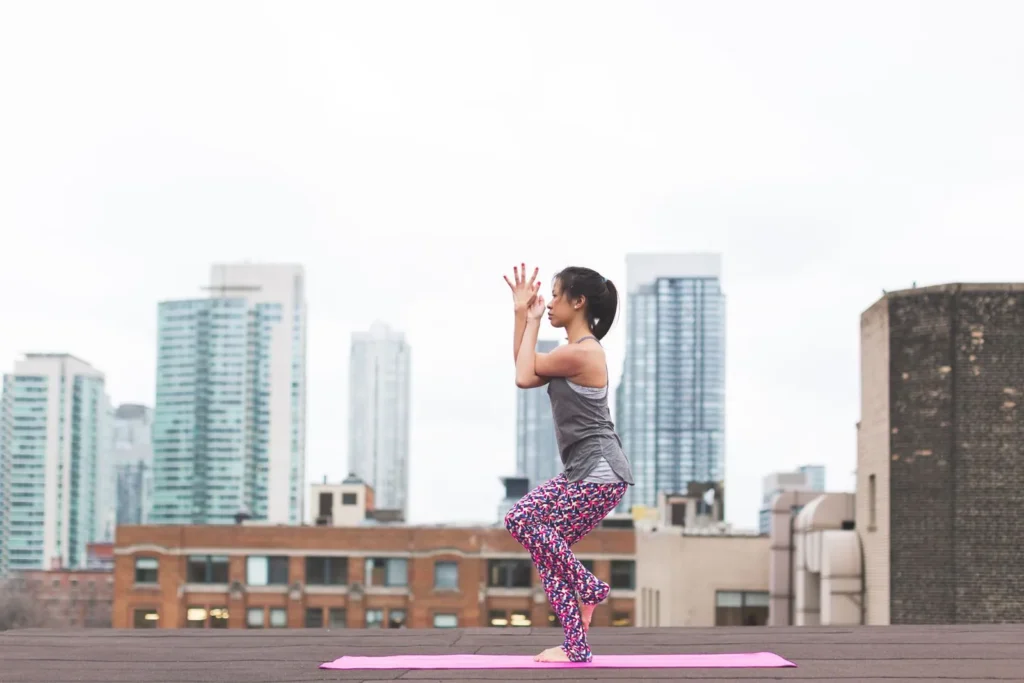
Eagle pose, or garudasana, is a standing balance in which you cross one thigh over the other, wrap your arms in front of your chest and hold for a few steady breaths. It is just two simple wraps, one for the legs and one for the arms, stacked on a single standing leg. This guide gives you the exact alignment cues, three easier versions you can start with today, the common mistakes that cause wobbling, realistic hold times, and who should skip or adapt the pose.
What Is Garudasana and What Does the Name Mean?
Garudasana is Sanskrit for eagle pose: garuda is the mythical king of birds in Hindu tradition and asana means posture or seat. In practice it is a one-legged standing balance with crossed legs and wrapped arms, usually held for 5 to 8 breaths per side, that trains balance, hip and shoulder mobility and steady focus.
In Hindu stories Garuda is the vehicle of Vishnu, known for sharp eyesight and speed, and the pose borrows that image: a compact shape balanced on one point with a fixed gaze. The forearms in front of the face are often said to resemble a beak, hence the name “eagle arms”.
How Do You Do Garudasana Step by Step?
To do garudasana, stand tall with feet hip-width apart, bend your knees slightly, shift weight onto the right foot, cross the left thigh over the right, then cross the arms with the right elbow under the left, wrap the forearms, lift the elbows to shoulder height and hold 5 to 8 breaths before switching sides.
- Set up in mountain pose. Stand with feet hip-width apart and weight even across both feet. If this base feels shaky, spend a week on tadasana first.
- Sit back and bend. Soften both knees as if you were about to sit on a low stool.
- Shift and lift. Move your weight onto the right foot and lift the left leg. Keep the standing knee pointing in line with the second toe.
- Cross the thigh. Bring the left thigh over the right, as high up as your hips allow. If the foot reaches, hook the left toes behind the right calf. If not, leave it hanging or tap the toes on the floor.
- Wrap the arms. Extend both arms forward, cross the right arm under the left at the elbows, bend the elbows and twist the forearms so the palms, or the backs of the hands, meet.
- Lift and lengthen. Raise the elbows to roughly shoulder height, draw the shoulder blades apart and down, and keep the chest tall.
- Fix your gaze. Look softly at one still point a few feet ahead, a steady gaze point known as drishti, and breathe through the nose.
- Unwind and repeat. Release the arms first, then the leg, pause in standing, and take the other side for the same number of breaths.
Eagle Pose Alignment Cues at a Glance
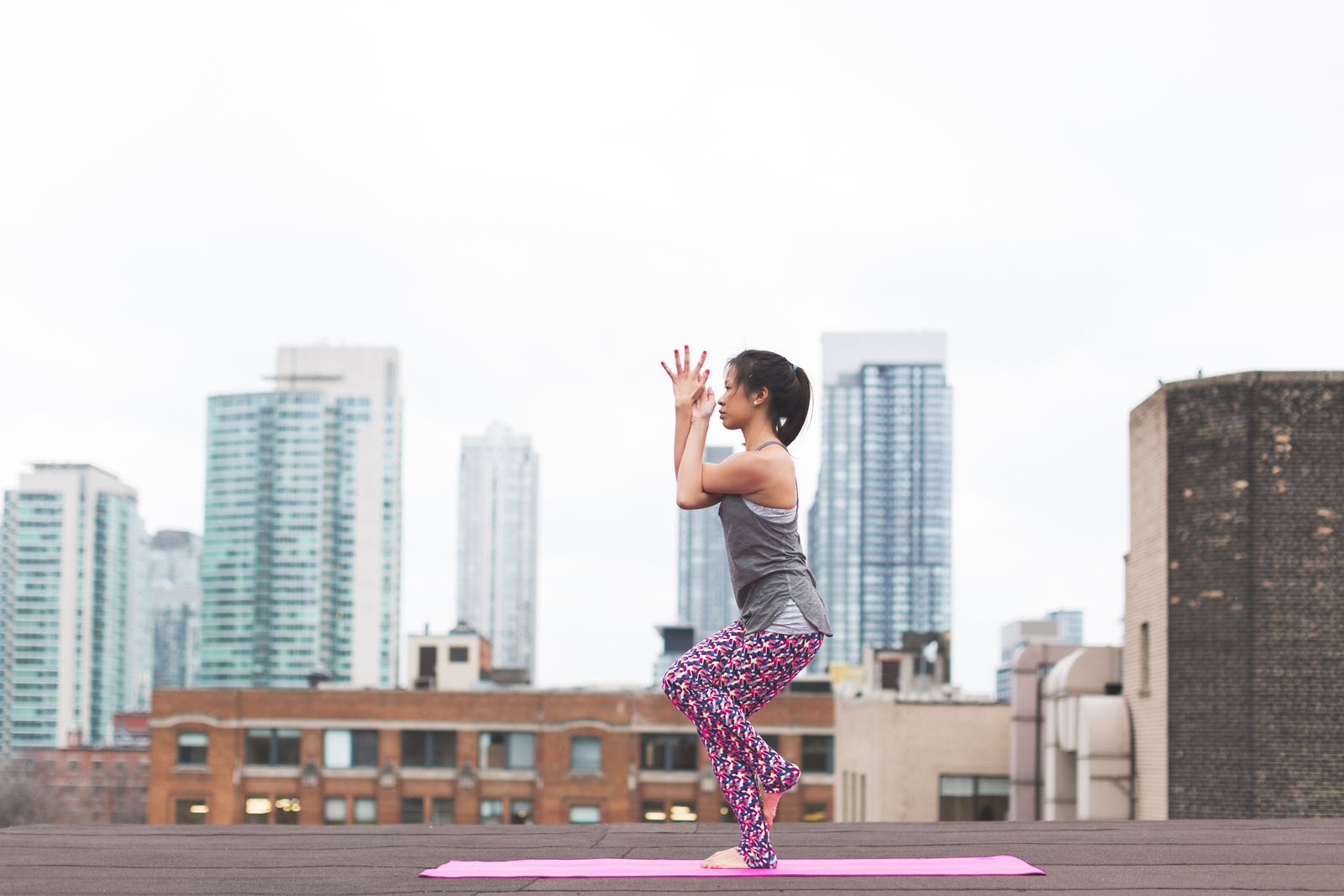
Good eagle pose alignment comes down to six checkpoints: a soft standing knee, hips facing forward, a tall spine, elbows at shoulder height, shoulders away from the ears, and an even breath. Use the table below as a quick checklist while you practise in front of a mirror.
| Body part | Cue to follow | What it prevents |
|---|---|---|
| Standing foot | Press evenly through the big toe, little toe and both sides of the heel | Rolling onto the inner arch and collapsing the ankle |
| Standing knee | Keep a small bend, tracking over the second toe | Locking or twisting the knee under load |
| Hips | Square both hip points towards the front of the mat | Swinging the hip out and losing balance |
| Crossed leg | Cross high on the thigh, keep the foot flexed if it hooks | Dangling weight that drags the pelvis sideways |
| Spine and ribs | Lengthen up through the crown, ribs stacked over the pelvis | Hunching forward to force the arms together |
| Elbows | Lift to shoulder height, fingertips towards the ceiling | Sinking arms that strain the neck |
| Shoulders | Draw the blades apart and slightly down the back | Shrugging towards the ears |
| Breath and gaze | Slow nasal breaths, eyes on one still point | Holding the breath and darting eyes that unsettle balance |
Common Garudasana Mistakes and How to Fix Them
Most wobbles in eagle pose trace back to four habits. Fixing them usually matters more than getting the wrap deeper.
- Locked or collapsing standing knee. A straight, locked knee makes you stiff and a collapsing one rolls the foot inward. Keep a gentle bend and press the foot evenly into the floor.
- Shoulders creeping up. The arm wrap pulls the shoulders towards the ears. Lift the elbows, then deliberately slide the shoulder blades down your back.
- Rounding the upper back to join the palms. If the palms will not meet, touch the backs of the hands or hold opposite shoulders instead. A tall spine with a smaller wrap beats a hunched full wrap.
- Holding the breath. Breathe slowly through the nose and count each breath, which also keeps the hold honest.
If you feel sharp pain in the knee, ankle, elbow or shoulder, that is not a stretch. Come out of the pose slowly.
Garudasana Modifications: Seated, Wall, Toe-Tap and Arm-Only
If the full pose is out of reach, use one of four simpler versions: a seated eagle on a chair, a wall-supported eagle, a toe-tap eagle with the lifted toes on the floor, or arm-only eagle while standing on both feet. Each keeps the shape but cuts the balance or flexibility demand.
| Version | How to do it | Best for | Suggested hold |
|---|---|---|---|
| Seated eagle | Sit tall on a sturdy chair, cross one thigh over the other with both feet supported, then wrap the arms | Beginners, low balance confidence, desk workers | 5 to 8 breaths per side |
| Wall eagle | Stand an arm’s length from a wall, rest the shoulder or one hand lightly on it, cross the leg and wrap the free arm or both arms | People who wobble, those building confidence | 3 to 6 breaths per side |
| Toe-tap leg | Cross the thigh over but keep the lifted toes touching the floor beside the standing foot, no calf hook | Tight hips, short legs, first attempts | 4 to 6 breaths per side |
| Arm-only eagle | Stand on both feet with knees soft, or sit cross-legged, and do only the arm wrap | Tight shoulders, leg or ankle discomfort | 5 to 8 breaths per side |
| Full eagle | Crossed thigh with the foot hooked behind the calf and full arm wrap | Comfortable with the versions above | 5 to 8 breaths per side |
A sensible progression is seated eagle, then wall eagle, then toe-tap, then the full pose over several weeks. Move on once you can hold the current version with relaxed shoulders and steady breath.
How Long Should You Hold Eagle Pose?
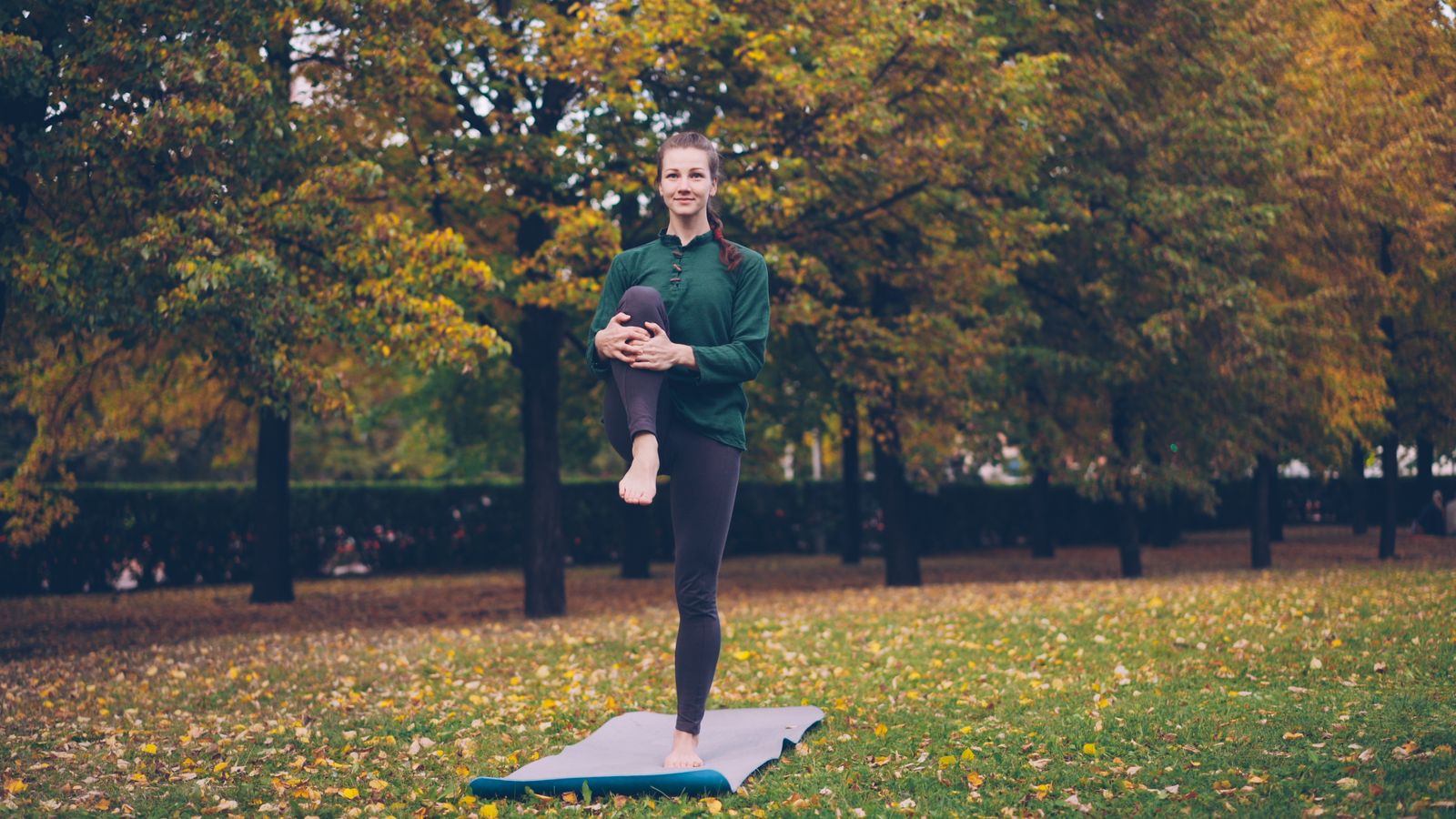
Hold eagle pose for about 5 to 8 slow breaths per side, which is roughly 20 to 30 seconds. Beginners can start with 3 to 5 breaths, around 10 to 15 seconds. Holding much longer rarely adds value and mainly tires the standing leg, so repeat the pose on both sides with good form instead.
| Level | Breaths per side | Approx. time | Rounds |
|---|---|---|---|
| First week | 3 to 5 | 10 to 15 seconds | 1 to 2 per side |
| Weeks 2 to 4 | 5 to 6 | 20 seconds | 2 per side |
| Regular practice | 5 to 8 | 20 to 30 seconds | 2 to 3 per side |
Always take both sides, and rest in standing for two or three breaths between rounds.
Myth: You Need to Be Flexible to Do Eagle Pose
You do not need to be flexible to start. The full wrap needs some hip and shoulder mobility, but the modifications above exist precisely so you can build it gradually. What the pose really asks for is patience and a steady gaze. Judge yourself by the steadiness of your balance and breath, not by whether the foot hooks behind the calf.
Who Should Avoid or Modify Garudasana?
Skip or adapt garudasana if you have a current knee, ankle, elbow or shoulder injury, or if you get vertigo or dizziness. The pose loads the standing knee and ankle and wraps the shoulders and elbows tightly, so a seated or wall version is the safer start.
- Knee or ankle injury or instability. Use the seated version with both feet on the floor, or skip the leg cross entirely.
- Elbow or shoulder injury. Do the legs only and keep the arms in a gentle hug or by the sides, or avoid the arm wrap while you recover.
- Vertigo, dizziness or balance problems. Practise only seated or next to a wall, and stop if you feel light-headed.
- Pregnancy or low blood pressure. Keep the leg cross shallow or skip it, move slowly and stay near a wall or chair.
Garudasana is a movement practice, not a treatment. If you have a medical condition, recent surgery, ongoing joint pain or any doubt about whether the pose suits you, see your doctor or physiotherapist before trying it, and tell your yoga teacher about it. If you are looking at a back-friendly routine, our guide to yoga for back pain is a gentler place to begin.
Which Muscles Does Eagle Pose Work, and What Are the Benefits?
Eagle pose works the standing leg’s quadriceps, glutes and calves, stretches the outer hip and upper back, and engages the deep core. Regular practice is commonly used to build balance, ankle and knee control, shoulder mobility and concentration, and is a useful complement to other benefits of yoga.
- Balance and ankle stability. One-legged holds make the small muscles around the ankle, knee and hip work together.
- Shoulder and upper-back mobility. The arm wrap stretches the muscles between the shoulder blades, which often feel tight after long hours at a laptop.
- Leg strength. The standing leg holds the body isometrically, much like a stationary single-leg squat.
- Focus. Because the body wobbles when attention drifts, the pose gives immediate feedback and is often used as a short moving meditation, a theme explored in yoga for mental health.
These are practice effects, not guaranteed outcomes, and they vary from person to person.
Where Does Garudasana Fit in a Yoga Sequence?
Place garudasana in the standing section of a class, after warming up. A few rounds of surya namaskar loosen the hips, shoulders and ankles, which makes the wrap easier to find.
A simple order that works in hatha yoga and flowing vinyasa yoga classes is: mountain pose, sun salutations, vrksasana (tree pose) on each side, then garudasana on each side, followed by a forward fold or a gentle seated stretch. Tree pose asks only the legs to balance, so it is a natural step before the extra wrap of the eagle. For the wider family of postures, see our overview of yoga poses and the different types of yoga.
Frequently Asked Questions About Garudasana
Is garudasana an easy or hard pose?
Garudasana is a moderate pose. It needs more balance and hip and shoulder mobility than mountain pose or tree pose, but no arm-balance strength. With a few weeks of regular practice most people find a workable version, and the seated, wall and toe-tap options make it approachable from day one.
How long should you hold Eagle Pose?
Hold eagle pose for about 5 to 8 slow breaths per side, roughly 20 to 30 seconds. Beginners can begin with 3 to 5 breaths. Repeating two or three rounds on each side with good form is better than one long, tiring hold.
Why is it called Eagle Pose?
The name comes from Garuda, the mythical king of birds in Hindu tradition and the vehicle of Vishnu. The folded arms near the face are often compared to a beak or folded wings, and the pose’s need for sharp, steady focus echoes the keen-eyed qualities attributed to Garuda.
Is garudasana safe if you have knee pain?
Not always. The pose places the knee under weight in a twisted position, so with knee pain or an injury it is better to use the seated or toe-tap version, or skip the leg cross. Avoid any sharp pain and check with your doctor or physiotherapist before practising it.
What is the difference between garudasana and vrksasana?
Vrksasana, or tree pose, balances on one leg with the other foot resting against the standing leg while the arms stay free. Garudasana wraps both the legs and the arms at once, which makes it the harder of the two and a good next step after tree pose.
Try Eagle Pose With a Live Teacher
If you want your alignment checked and your modifications chosen for your body, book a session in Fitstrot’s online yoga classes and bring garudasana to your next class. You can also browse our guide to online yoga classes to see what a typical session looks like.


