
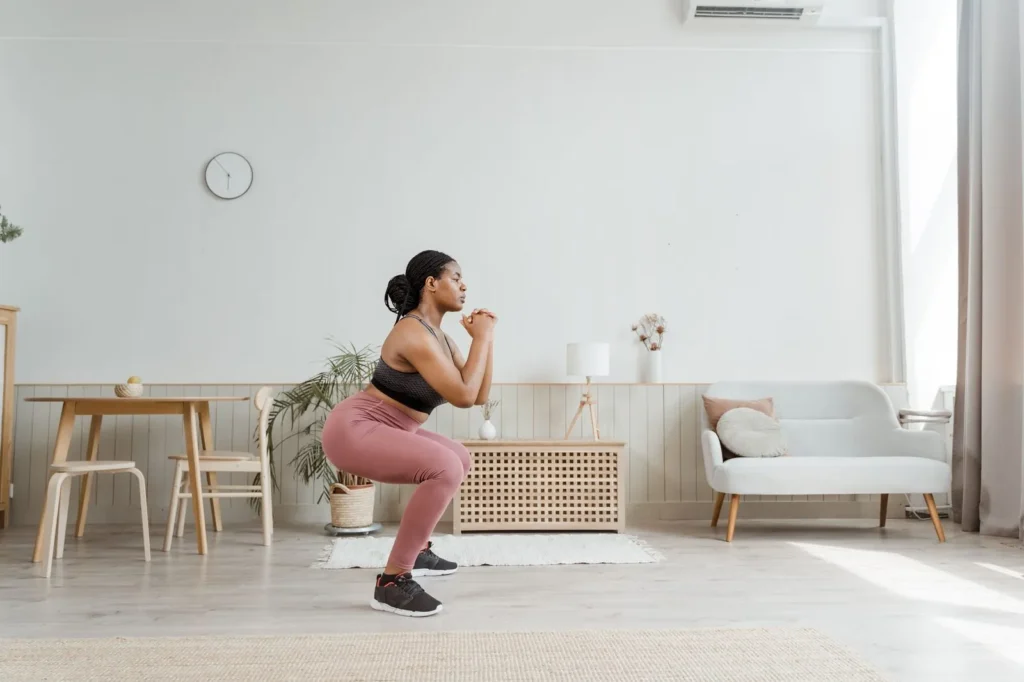
The best at home workouts for beginners are deliberately boring: three short sessions a week, the same five bodyweight moves, and one small improvement at a time. No equipment, no jumping, no 60-minute marathons. This guide gives you a four-week programme with exact sets, reps, rest times and form cues, so you always know what to do when you roll out the mat.
It is written for adults starting from little or no regular exercise. If you have a medical condition, are pregnant or postnatal, or are recovering from an injury, read the “check first” section near the end before you begin.
How many days a week should beginners work out at home?
Three non-consecutive days a week, such as Monday, Wednesday and Friday, is the best starting point for most beginners. Each session should take 20 to 30 minutes including a five-minute warm-up, with at least one full rest day in between. That gives muscles and joints time to adapt without leaving you too sore to continue.
Why not five or six days? The early weeks are about learning movement patterns and building a routine, and a plan you abandon on day ten does nothing for you. Three sessions are enough to improve, and they fit around a workday, a commute or a family. Once three days feel easy and you recover well, usually around week five or six, you can add a fourth short session or a brisk walk.
Do you need equipment to start working out at home?
No. For the first four weeks, your body weight, a sturdy chair, a table or kitchen counter and a mat or folded blanket are enough. Dumbbells become useful around week five, once your bodyweight sets feel easy. Until then, equipment will not fix the real beginner problem, which is learning clean movement and turning up consistently.
Check that anything you lean on is stable: a heavy dining table, a fixed kitchen counter or a wall. Avoid rolling chairs and wobbly stools. A well-built bodyweight workout can carry you through roughly the first six to eight weeks. When it stops challenging you, a pair of light dumbbells, around 2 to 5 kg each, is the most useful first purchase, and our home dumbbell workout guide shows how to use them. Until then, a backpack with a few books makes a decent stand-in load.
The 4-week plan at a glance
Do the same full-body session three times a week. Only the volume and difficulty change from week to week, which keeps the plan simple enough to follow without checking your phone every minute.
| Week | Sessions | Sets x reps | Rest between sets | Session length | Main focus |
|---|---|---|---|---|---|
| 1 | 3 | 2 x 8-10 (plank 15-20 sec) | 60-90 sec | About 20 min | Learn the five moves, stop each set with 2-3 reps left |
| 2 | 3 | 3 x 8-10 | 60-75 sec | About 25 min | Add a third set and a supported reverse lunge |
| 3 | 3 | 3 x 10-12 | About 60 sec | 25-30 min | Lower slowly for 3 seconds, try harder variations where moves feel easy |
| 4 | 3 | 3 x 12-15 (plank 30-40 sec) | 45-60 sec | About 30 min | Retest your day-one reps and add an easy 15-20 minute walk on one rest day |
What will four weeks give you? Realistically: moves that feel less awkward, a few more reps on every exercise, steadier knees and a routine that survives a busy week. Changes in body shape or weight vary a lot between people and depend on food, sleep and consistency, so be wary of any promise of guaranteed results in a month. Judge the month by what you can do on day 28 that you could not do on day 1.
Week 1 session, move by move
Spend five minutes warming up before every session: march on the spot for one minute, do ten arm circles each way, ten slow hip circles each way, eight cat-cow reps on hands and knees, and five half squats. You should feel warm and loose, not tired. Then work through the five moves below in order.
| Move | Week 1 sets x reps | Rest | Form cue |
|---|---|---|---|
| Chair sit-to-stand squat | 2 x 8-10 | 60-90 sec | Feet shoulder-width apart, hips back, knees track over your toes, chest up |
| Incline push-up (hands on a heavy table or counter) | 2 x 6-10 | 60-90 sec | Head to heels in one straight line, elbows about 45 degrees from your ribs |
| Glute bridge | 2 x 10-12 | 60 sec | Press through your heels, squeeze at the top, keep ribs down so the lower back does not arch |
| Bird dog | 2 x 6-8 per side | 60 sec | Keep hips level, reach long rather than high, move slowly |
| Incline plank | 2 x 15-20 sec | 60 sec | Tuck the tailbone slightly, tighten glutes, keep breathing |
Use a tempo of about two seconds down and one second up. Stop a set when your form slips, even if you have not reached the target reps. A good beginner set ends with two or three reps in reserve: you could have done more, but you chose clean reps over tired ones.
How do you progress at home without buying equipment?
Change one variable at a time: add a third set, add two reps, slow the lowering phase to three seconds, or move to a harder variation such as a lower incline for push-ups. Raise only one per week. Move up when every set feels like a 7 out of 10 effort or easier, with good form.
| Move | Weeks 1-2 version | Weeks 3-4 version | Move up when |
|---|---|---|---|
| Squat | Chair sit-to-stand | Bodyweight squat with a 3-second lowering phase | You get 3 x 12 with steady knees |
| Push | Hands on a counter or table | Hands on a low, sturdy step, then knee push-ups on the floor | You get 3 x 12 at your current height |
| Hip hinge | Glute bridge | Glute bridge with a 2-second hold at the top | You get 3 x 15 with no lower-back strain |
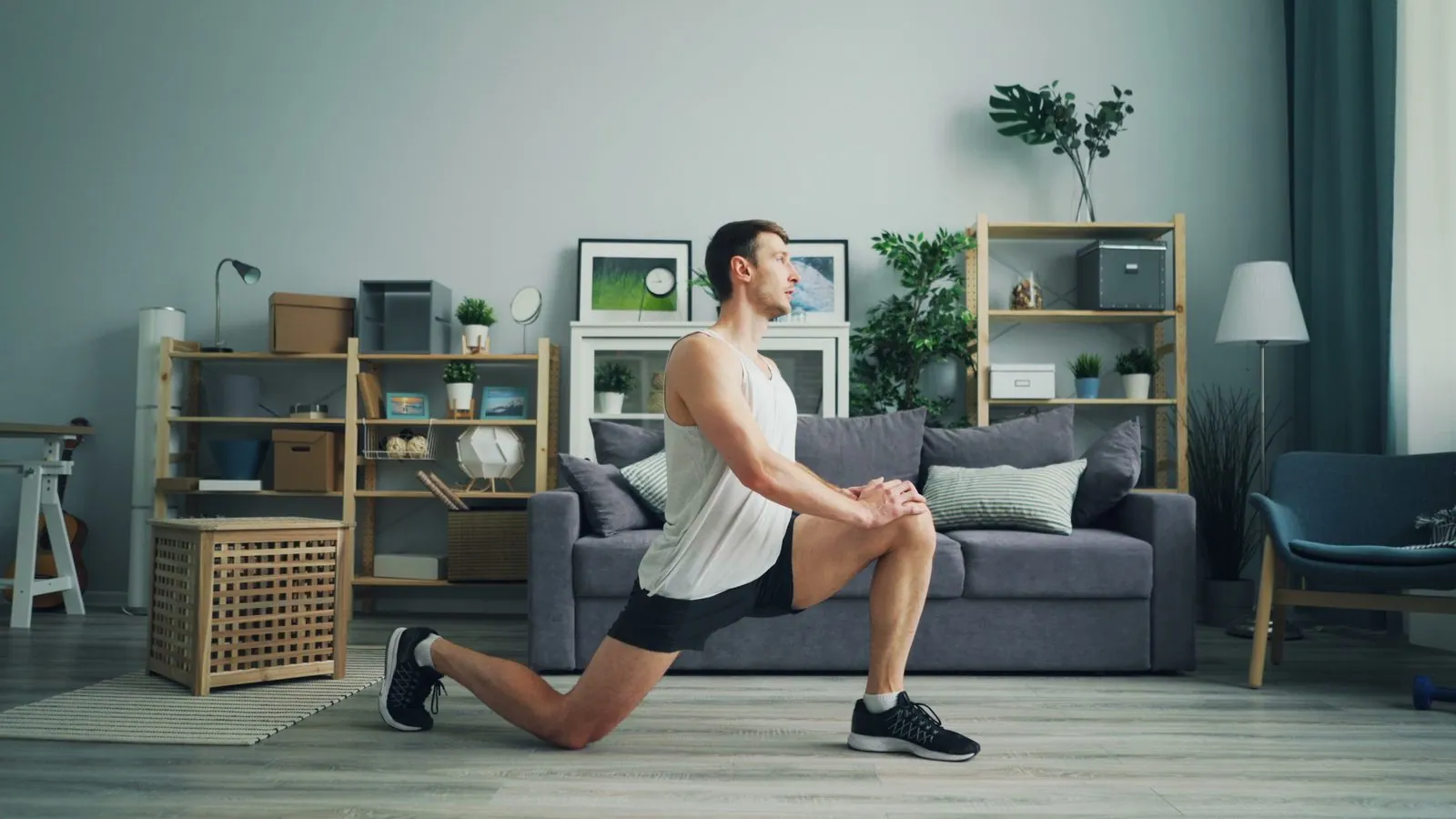
| Single leg | Reverse lunge holding a wall or chair | Unsupported reverse lunge or low step-up | You get 2 x 10 per leg without wobbling |
| Core | Incline plank, bird dog | Forearm plank (knees down if needed), bird dog with a 2-second pause | You hold 30-40 sec with no sagging hips |
From week two, the lower-body work gets a single-leg move. Hold a wall or chair for balance at first, and keep your front knee stacked over your ankle.
How much rest do beginners need between sets and sessions?
Rest 60 to 90 seconds between sets and at least 48 hours between sessions. Short rests keep a 25-minute workout efficient, while the 48-hour gap lets your muscles recover and rebuild. On rest days, walk or stretch gently instead of adding another hard session. Recovery is where the adaptation you are training for actually happens.
A simple check for set rest: you should be able to speak a short sentence before starting the next set. If you cannot, take another 15 to 30 seconds.
Myth: no soreness means the workout did not work
Muscle soreness is common in the first one to two weeks and usually peaks one to three days after a session, then fades as your body gets used to the same moves. It is not a scorecard. You can have a productive session with no soreness at all, and a very sore week usually means you did too much, not that you did well.
Mild stiffness that eases as you move is fine. Sharp or pinching pain, pain at a joint, swelling, or pain that gets worse as a set goes on is not. Stop, swap the move for an easier version, and see a doctor or physiotherapist if it persists. If stairs feel hard after a session, drop one set next time rather than skipping the week.
Troubleshooting: what to fix when a move feels wrong
- Knees cave inward on squats: widen your stance slightly, think about spreading the floor apart with your feet, and keep using the chair until the movement feels steady.
- Lower back sags in a plank or push-up: raise your hands higher, tighten your glutes, and shorten the hold. A short clean hold beats a long sagging one.
- Wrists hurt in push-ups: spread your fingers, press through the whole palm, raise the surface you push from, and warm up with gentle wrist circles first.
- Breathless within 30 seconds: that is normal in week one. Slow the tempo, take the full 90 seconds of rest and keep to the sentence test.
- You cannot tell if your form is right: prop your phone at hip height, film a set from the side, and watch it back. Even one video shows rounded backs and caving knees that you cannot feel in the moment.
- A busy day wrecks the plan: do a ten-minute version, one set of each move, instead of skipping. It keeps the habit alive.
Check first: who should adjust this plan
This plan is low impact, so it suits small flats, upper floors and shared homes: no jumping, no loud landings. A few adjustments help specific beginners:
- Long desk hours: train before work or before dinner, and treat glute bridges and bird dogs as your priority moves.
- Heavier or very out-of-shape beginners: stay with chair squats and counter push-ups for as long as you need, and begin with one set per move in week one.
- Women and men: the same starter plan works for both. Once you finish it, our workouts for women and workouts for men guides cover goal-specific next steps.
- Talk to your doctor first if you have chest pain or pressure, dizziness or fainting, a heart condition, high blood pressure that is not controlled, diabetes treated with medication, a recent surgery, ongoing joint or back problems, or if you are pregnant or have recently given birth.
What to add after week 4
Repeat the best week of the plan once more if the final week still feels hard. If it feels comfortable, move into a wider home workout routine, or add dumbbells using the guide above. Around week five or later, you can also bring in short intervals from our HIIT workouts for beginners at home, one session a week at most to start.
On non-strength days, low-pressure movement helps: a dance session from Zumba at home for beginners or a gentle flow from yoga for beginners at home. If you prefer a live instructor, Fitstrot runs online yoga classes and online Zumba classes.
Want a trainer to watch your squat and set your week-five plan? Explore 1-on-1 personal training with Fitstrot and start from where this plan ends.
Frequently asked questions
What are good at home workouts for beginners?
Full-body bodyweight routines work best: squats, incline push-ups, glute bridges, bird dogs and planks. Do two to three sets of 8 to 12 reps, three days a week, for 20 to 30 minutes. Add a reverse lunge in week two and light dumbbells after week four or five.
How long should a beginner’s home workout last?
Twenty to thirty minutes, including a five-minute warm-up, is enough for most beginners. Longer sessions do not automatically produce better results at this stage and make the habit harder to keep. Three consistent 25-minute sessions beat one occasional hour.
Can beginners build strength with just bodyweight exercises?
Yes. For the first two to three months, bodyweight moves give a new exerciser enough resistance to build strength and muscle endurance, especially with slower tempo and harder variations. When 3 x 15 feels easy with good form, add resistance with dumbbells or a band.
Should I work out every day as a beginner?
No. Start with three sessions a week and at least one rest day between them. Daily training in the first month tends to bring excess soreness and burnout. You can walk daily, but keep hard strength sessions to three until your recovery feels easy.
How do I know my form is correct without a trainer?
Film a set from the side, slow each rep to a three-second lowering phase, and compare against the cues in the table above. Check knees over toes, a straight line from head to heels, and no sharp pain. A coach can spot what video misses.


