

The best hiit workouts for beginners at home are short, low on equipment and honest about your starting point: about 15 minutes, five bodyweight moves, 30 seconds of effort followed by 30 seconds of rest, two or three days a week. You do not need a gym, a mat bigger than your bedsheet or a punishing playlist. This guide gives you a full starter circuit, a four-week plan, form cues and the fixes for when things go wrong.
What Counts as a Beginner HIIT Workout?
A beginner HIIT workout alternates short bursts of hard effort, usually 20 to 30 seconds, with equal or longer rests, for 12 to 20 minutes in total. “Hard” means about 6 or 7 out of 10 on an effort scale: you are breathing heavily and can say only a few words, but your form still holds.
HIIT stands for high-intensity interval training, and the word “high” is relative to you. A brisk set of step-out jacks can be a real push for someone who has not exercised in two years. Intensity is never measured against the person on your phone screen.
Because the sessions are so short, HIIT suits the beginner who keeps saying there is no time. It also teaches you pacing, which matters more than speed in the first month. If you want the broader picture once you settle in, our guides on a HIIT workout routine and HIIT workouts at home go deeper into structure and variety.
How Long and How Often Should a Beginner Do HIIT?
Beginners should do HIIT two to three non-consecutive days a week, with each session lasting 15 to 20 minutes including a 3-minute warm-up and a 2-minute cool-down. Leave at least one full day between sessions. Doing it daily in the first month usually leads to sore joints, poor form and dropping out by week three.
On the other days, walk, stretch, do an easy yoga flow or simply rest. Recovery is where your fitness actually improves, so treat rest days as part of the plan rather than a failure of discipline.
The 15-Minute Starter Circuit
Do a 3-minute warm-up first: march on the spot, roll your shoulders, do 10 slow half-squats and a few arm circles. Then run the circuit below for two rounds, resting 60 seconds between rounds. Reps are a guide; count only reps you can do with clean form.
| Exercise | Work | Rounds | Rest after | Target reps | Form cue |
|---|---|---|---|---|---|
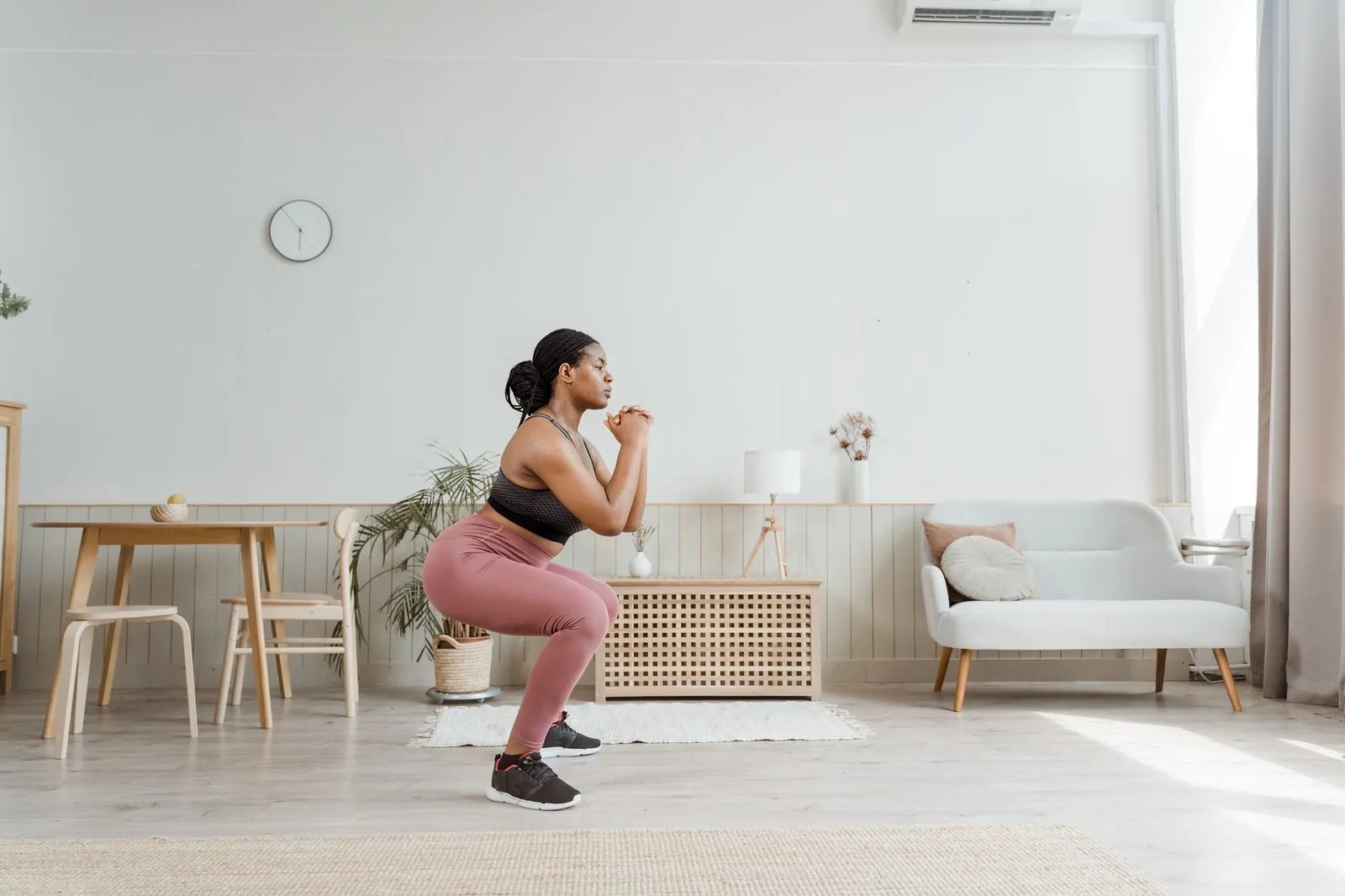
| Bodyweight squat | 30 sec | 2 | 30 sec | 10 to 15 | Chest up, knees track over toes, sit back as if onto a chair |
| Step-out jacks | 30 sec | 2 | 30 sec | 20 to 30 steps | Step, do not jump; keep shoulders relaxed and arms moving |
| Slow mountain climbers (hands on a sofa or table) | 30 sec | 2 | 30 sec | 16 to 20 knee drives | Straight line from head to heels, hips level |
| Standing punches | 30 sec | 2 | 30 sec | Steady pace | Soft knees, rotate from the hips, do not lock elbows |
| Glute bridge | 30 sec | 2 | 30 sec | 12 to 15 | Press through heels, squeeze at the top, ribs down |
| Between rounds | – | – | 60 sec | – | Sip water, shake out your legs |
That is roughly 11 minutes of timed work plus warm-up and cool-down. If two rounds feel easy by week three, add a third round before you shorten the rest. Add volume first and intensity second.
How Do You Run Your First Session, Step by Step?
Run your first session by warming up for 3 minutes, setting a phone timer for 30 seconds on and 30 seconds off, doing the five moves in order for two rounds, then walking and stretching for 2 minutes. Stop any move early if form breaks or pain appears. Finishing tired but intact is the goal.
- Clear the space. About 2 metres by 1 metre is plenty. Move the chappals, wear proper sports shoes on tile or marble, and keep a small towel nearby.
- Set the timer. Use any free interval timer app, or just a stopwatch and the clock on your wall.
- Warm up. Three minutes of marching, arm circles and half-squats until you feel slightly warm.
- Work at 6 out of 10. In round one, hold back. You should finish round two feeling you could do one more.
- Cool down. Walk slowly for a minute, then stretch calves, quads and chest for 20 to 30 seconds each.
- Note it down. Write the date and how it felt. This is the data you will use to progress.
What Does a Four-Week Beginner HIIT Plan Look Like?
A four-week beginner plan starts with 20 seconds of work and 40 seconds of rest, then slowly lengthens the work interval to 40 seconds by week four. Keep three sessions a week, and add one extra round only after every session in the current week feels manageable. Progress should feel boringly gradual.
| Week | Work : rest | Rounds | Sessions per week | Session length | Focus |
|---|---|---|---|---|---|
| 1 | 20 sec : 40 sec | 2 | 2 | About 14 min | Learn the five moves with clean form |
| 2 | 30 sec : 30 sec | 2 | 3 | About 17 min | Build a steady rhythm |
| 3 | 30 sec : 30 sec | 3 | 3 | About 20 min | Add the third round |
| 4 | 40 sec : 20 sec | 2 to 3 | 3 | About 18 to 20 min | Raise the effort, keep the form |
If a week feels too hard, repeat it. Nobody has ever failed a plan by staying in week two for an extra week.
Myth: If You Are Not Exhausted, It Did Not Work
This is the most damaging belief in beginner fitness. Being flat on the floor is not a quality marker; it is often a sign the session was too hard to repeat. A workout you can repeat three times a week beats one brutal session followed by a week of aches.
A related myth is that HIIT burns fat by itself. It does burn calories, and you may burn a small extra amount for a while afterwards, but that bump is modest. Fat loss still comes mainly from your overall food intake, daily movement and sleep. For a food side that fits Indian meals, our online nutritionist consultation helps you build it around your own routine.
Spot reduction is a myth too. Squats do not burn thigh fat specifically, and mountain climbers do not melt belly fat. Your body decides where fat comes off, and we would be misleading you to promise otherwise. No workout can guarantee a particular amount of weight loss in a set number of weeks.
Troubleshooting: What If It Feels Wrong?
Most early problems have simple fixes. Use the table below before you decide HIIT is not for you.
| Problem | Likely cause | Fix |
|---|---|---|
| Dizzy or nauseous mid-session | Too hard, too fast, or a heavy meal within the last 90 minutes | Stop, sit, sip water. Next time drop to 20 sec work and eat 1.5 to 2 hours earlier |
| Knee pain on squats or jacks | Knees collapsing inward, impact on hard floor | Reduce depth, sit back more, use step-outs, wear shoes. If pain persists, stop and get it checked |
| Lower back aches during mountain climbers | Hips sagging, core switched off | Raise your hands on a sofa or table and slow down |
| Wrists hurt | Weight too far forward on flat palms | Use fists on the floor or an elevated surface, or swap to high knees |
| Sore for 3 days | Normal muscle soreness from a new load | Walk gently, sleep well, repeat the same session at lower effort |
| Skipping sessions | Plan too long or too hard | Cut it to 10 minutes and protect the habit first |
Who Needs to Adjust HIIT the Most in Indian Homes?
People who are overweight, returning after a long break, over 40, or living in small flats with neighbours below should adjust most. They should choose low-impact versions: step-outs instead of jumps, half-squats, and fast marching in place. These still lift your heart rate while protecting knees, ankles and the downstairs neighbour’s ceiling.
- Heat and humidity. In summer, train early morning or late evening, switch the fan on, and drink water before and after. Do not train in a closed room in peak afternoon heat.
- Tile and marble floors. They are slippery and hard. Wear shoes with grip, and put a mat or folded dari down if possible.
- Timing around food. Avoid training right after a full lunch or dinner. A light snack such as a banana or a handful of roasted chana an hour before is usually enough.
- Women. Add a supportive sports bra, and ease off or choose lower impact on heavy period days if you feel drained. There is no rule that you must skip training, but there is no rule that you must push either.
- Desk workers. Your hips and upper back are likely tight, so spend an extra minute on bridges and arm circles in the warm-up.
- Weight loss goal. HIIT is one piece; a structured plan with a coach, such as online weight loss training, keeps food, movement and recovery aligned.
When Should You See a Doctor Before Starting?
See your doctor before starting HIIT if you have a heart condition, high blood pressure, diabetes, are pregnant, have had recent surgery, or have ongoing joint, back or chest problems. High-effort intervals raise your heart rate sharply, and a quick check can tell you what intensity is safe for you.
Stop immediately and seek medical care if you feel chest pain or pressure, severe breathlessness, fainting, or pain that is sharp rather than muscular. If a joint injury lingers past a few days or worsens with each session, see a doctor or physiotherapist before returning. This article is general guidance, not medical advice, and no workout is guaranteed to be safe for every body.
How Does HIIT Fit with Other Training?
HIIT works best as one part of a week, not the whole week. A sensible beginner split is two HIIT sessions, one or two easy strength or mobility sessions, and daily walking. If you also enjoy music-led cardio, a dance session counts as a second style of conditioning, and our guide to Zumba at home for beginners is a good low-pressure alternative on a lighter day.
For a wider starting point with strength and mobility, see our at-home workouts for beginners, and for recovery days try yoga for beginners at home. You can also join guided sessions through our online yoga classes and online Zumba classes.
If you would rather have someone watch your form and set your intervals each week, 1-on-1 personal training builds sessions around your actual starting point rather than a generic template.
Frequently Asked Questions
What are good HIIT workouts for beginners at home?
Good beginner HIIT workouts use five or six bodyweight moves such as squats, step-out jacks, slow mountain climbers, standing punches and glute bridges. Work for 20 to 30 seconds, rest 30 to 40 seconds, repeat for two rounds, and keep the total near 15 minutes. Prioritise clean form over speed.
How many days a week should a beginner do HIIT?
Two to three days a week is enough, with at least one rest or light-activity day between sessions. Start with two in week one if you have been inactive. Fitness improves during recovery, so more days do not automatically bring faster results.
Can I do HIIT every day as a beginner?
We do not recommend it. Daily HIIT in the first month tends to cause fatigue, sloppy form and sore joints, which leads many beginners to quit. Three well-spaced sessions with walking or yoga on other days is a safer and more sustainable approach.
Do I need any equipment for HIIT at home?
No equipment is required. A phone timer, a small clear space, sports shoes with grip and a bottle of water are enough. A mat or folded dari helps on slippery floors, and a sturdy sofa or table lets you do easier incline versions of floor moves.
Is HIIT safe if I am overweight or have never exercised?
It can be, if you choose low-impact versions, keep intervals short, rest longer and build up slowly. Swap jumps for steps and use half-depth squats. If you have a heart condition, high blood pressure, diabetes or joint problems, check with your doctor before you begin.
Start small this week: ask a Fitstrot coach to set your first beginner HIIT circuit to your fitness level through 1-on-1 personal training.


