

HIIT workouts at home work because intensity, not equipment, does the job: hard efforts of 20 to 45 seconds, separated by short rests, repeated for 15 to 25 minutes on a mat in your bedroom or hall. This guide gives you four interval formats to choose from, a move-by-move 20-minute circuit, a weekly plan, and fixes for the problems Indian flats create, such as noisy floors, heat and humidity.
One honest note first: HIIT builds stamina and supports fat loss, but it does not build muscle like progressive strength work, and it cannot burn fat from one body part.
What counts as HIIT, and how long should a home session last?
A HIIT session alternates near-maximal effort for 20 to 45 seconds with 10 to 60 seconds of rest or easy movement. At home, a full session runs 15 to 25 minutes including a 3 to 5 minute warm-up. If you can chat comfortably during the hard interval, you are working at moderate effort, not HIIT.
HIIT is a method, not a list of exercises. Squats, skipping, shadow boxing or stair climbing all qualify if you push hard enough during the work window. A simple gauge is effort out of 10: the work intervals should feel like an 8 or 9, and the rests should drop you back to about a 3.
Longer is not better. Past 25 minutes most people cannot hold true intensity, and the session becomes a long moderate circuit.
Which interval format suits you best?
For most beginners the best HIIT interval is 20 seconds of work and 40 seconds of rest for 8 rounds. Intermediate trainees usually move to 30 seconds on and 30 seconds off for 10 rounds. Tabata (20 seconds on, 10 off, 8 rounds) lasts only 4 minutes per block, so you chain two or three blocks into one session.
| Format | Work : rest | Rounds | Time per block | Best for |
|---|---|---|---|---|
| Beginner pacing | 20 sec : 40 sec | 8 | 8 min | First 2 to 3 weeks, or returning after a long break |
| Classic 30/30 | 30 sec : 30 sec | 10 | 10 min | General fitness, most people after week 3 |
| Tabata | 20 sec : 10 sec | 8 | 4 min | Very short on time, one exercise per block |
| 40/20 | 40 sec : 20 sec | 10 | 10 min | Fitter trainees who want more volume per session |
Stay with one format for four weeks before changing it. For a different structure and move list, our HIIT workout routine guide is the place to go.
How do you run a 20 minute HIIT workout without equipment?
Warm up for 3 minutes, then run five bodyweight moves at 30 seconds of work and 20 seconds of rest, and repeat that circuit three times with 45 seconds of rest between rounds. Add a 3 minute cooldown and the whole 20 minute HIIT workout needs only a mat, a phone timer and about two metres of floor.
For the warm-up, spend 3 minutes on marching in place, arm circles, hip circles, bodyweight squats and a few easy jumping jacks so your joints are moving before the hard work starts.
| Move | Work / rest | Form cue | Low-impact swap |
|---|---|---|---|
| 1. Squat jumps | 30 / 20 sec | Sit back, chest up, land softly on the balls of your feet and roll into your heels | Fast bodyweight squats with a heel raise at the top |
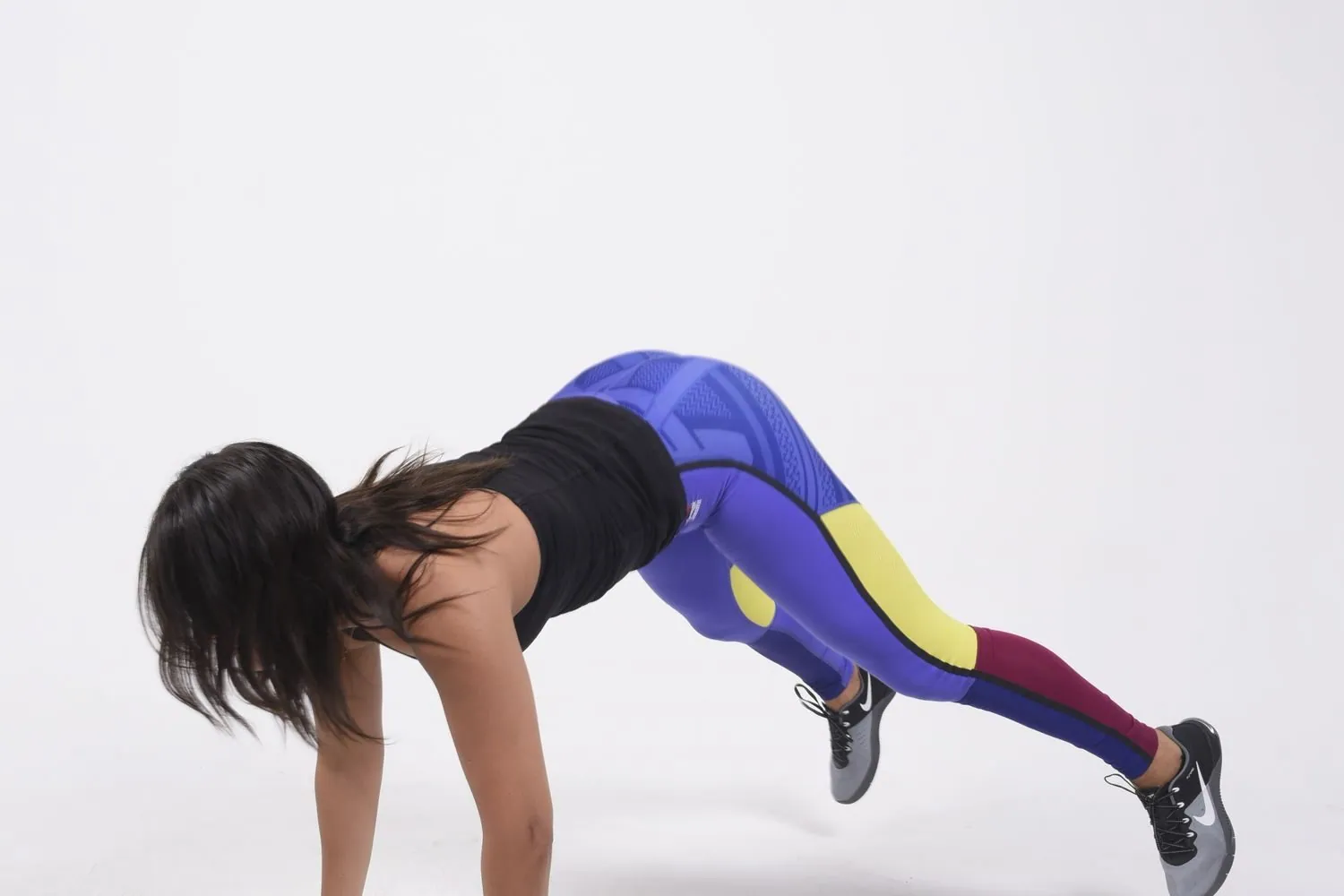
| 2. Mountain climbers | 30 / 20 sec | Hands under shoulders, hips level with your back, drive knees towards your chest | Slow plank knee taps, hands on a sturdy table edge |
| 3. Reverse lunges | 30 / 20 sec | Step back, drop the back knee close to the floor, push through the front heel | Shorter steps with a hand on a wall |
| 4. Push-ups | 30 / 20 sec | Body in one line, elbows about 45 degrees from your sides, chest towards the floor | Knee push-ups or hands on a sofa arm |
| 5. Skater hops | 30 / 20 sec | Bound sideways, softly bent landing knee, reach across with the opposite arm | Side steps with a deep reach, no hop |
Do all five moves in order, rest 45 seconds, and go again. After round three, walk slowly for 2 minutes and stretch your quads, hamstrings, calves and chest for another minute.
Pace yourself across the three rounds. Start round one at around 80 per cent so round three is not a collapse. Progress in one direction at a time, either a fourth round or 5 seconds less rest, never both in the same week. Complete beginners should use the 20 : 40 format and our HIIT workouts for beginners at home post.
Where does HIIT fit in a training week?
Two to three HIIT sessions a week is enough for most people, with at least one easier day between them. A balanced week adds two strength sessions and one low-intensity day such as a walk, yoga or Zumba. Daily HIIT adds fatigue and injury risk faster than it adds fitness.
| Day | Session | Duration | Effort (out of 10) |
|---|---|---|---|
| Monday | 20 minute HIIT circuit | 20 min | 8 to 9 |
| Tuesday | Strength: squats, push-ups, rows, glute bridges | 30 to 40 min | 6 to 7 |
| Wednesday | Brisk walk or gentle yoga | 30 min | 3 to 4 |
| Thursday | Tabata blocks, 2 to 3 blocks | 15 to 20 min | 8 to 9 |
| Friday | Strength, a different set of exercises | 30 to 40 min | 6 to 7 |
| Saturday | Dance cardio or a long walk | 40 to 45 min | 5 to 6 |
| Sunday | Full rest, light stretching only | 10 min | 2 |
Beginners should drop Thursday and keep one HIIT day plus two easy sessions for the first month. If you enjoy music and company, our online Zumba classes make a good Saturday, and the online yoga classes suit Wednesday. For a wider view of how sessions like these compare, see our guide to the types of workouts.
Does more sweat mean more fat loss?
No. Sweat is your body cooling itself, not a measure of fat burned. A 20 minute HIIT session burns roughly 150 to 300 kcal depending on your body weight and effort, while one kilo of body fat holds about 7,700 kcal, so fat loss comes from repeating sessions and eating in a modest deficit.
Two other myths come up constantly.
- “HIIT melts belly fat.” You cannot choose where fat leaves. Belly fat reduces as overall body fat falls, and that depends on weeks of consistent training and food.
- “The afterburn does the real work.” Extra calorie burn after a hard session is real but modest. Treat it as a small bonus, not a licence for a large dinner.
If fat loss is your main goal, the biggest lever is still food. A dietitian-guided plan and a coach who adjusts your training each month usually beat any single workout style. Our online weight loss trainer program combines both.
How do you keep HIIT quiet and cool in a small flat?
Swap jumps for low-impact versions, train on a thick mat or folded carpet with shoes on, and pick a time when neighbours are awake, such as 6:30 to 8 am or 6 to 8 pm. In summer, run a fan, avoid noon to 4 pm, and sip 150 to 250 ml of water every 15 to 20 minutes.
- Noise: Land on the balls of your feet and keep jumps small. Replace burpees with a step-back burpee (no jump) and skater hops with side steps.
- Floor: Bare feet on tile slide and jar your joints. Wear cushioned shoes and use a mat of about 6 to 10 mm.
- Heat and humidity: Indian summers and monsoons make 20 minutes feel like 40. Wear light cotton and keep water within reach.
What should you do if HIIT leaves you dizzy, sore or stuck?
Stop immediately if you feel dizzy, nauseous or have chest pain, then sit, sip water and rest. Muscle soreness that peaks within 24 to 72 hours is normal; sharp joint pain is not. For plateaus after 4 to 6 weeks, change one variable: add a round, shorten rests by 5 seconds, or swap a move.
Dizziness or nausea. Usually from training on an empty stomach, standing up too fast or overheating. Eat a light snack 45 to 90 minutes before, and slow down for a minute rather than pushing through.
Knee or ankle pain. Jumping loads your joints several times your body weight. Switch to the low-impact swaps in the table, check your landing, and see a physiotherapist if pain lingers beyond a few days.
Form falling apart in the last 10 seconds. Shorten work to 20 seconds and keep the rest. Clean reps at 20 seconds beat sloppy reps at 30.
No progress after a month. Check sleep (7 to 8 hours), food portions and whether your hard intervals are truly hard.
Who should adjust or avoid home HIIT?
Anyone with heart disease, high blood pressure, diabetes on medication, a recent injury or surgery, or who is pregnant should speak to a doctor before starting HIIT. Everyone else should begin with lower intensity and build up over 3 to 4 weeks rather than starting at full effort.
Beginners should use the 20 : 40 format and low-impact swaps, and do only one or two sessions a week. Adults over 40 benefit from a longer warm-up of 5 minutes and extra rest between rounds. Women may want to adjust intensity during heavy period days or in the postpartum months; our guide to workouts for women covers that planning.
If you are unsure whether your heart or joints can handle hard intervals, check with a doctor first. A coach can then scale every move to your body, which is what our 1-on-1 personal training sessions do.
What should you eat around a HIIT session?
Eat a light snack 45 to 90 minutes before, such as one banana with 6 to 8 almonds, and a protein-plus-carb meal within about 2 hours after, such as 2 rotis with 1 cup dal and curd. Aim for roughly 20 to 30 grams of protein in that post-workout meal.
- Before: 1 banana, or 2 dates with a small handful of nuts, or half a bowl of poha if you train an hour later.
- After: 2 eggs with 1 roti, or 100 g paneer bhurji with a roti, or a bowl of sprouts chaat with a glass of chaas.
- Hydration: Water first. Coconut water or a pinch of salt and lemon in water is useful on very hot days, but plain water is enough for a 20 minute session.
Frequently asked questions
How many times a week should you do HIIT workouts at home?
Two to three times a week is enough for most people, with at least one lighter day between sessions. Beginners should start with one or two sessions a week for the first month. More days rarely add results and often add soreness and joint stress.
Can you do a HIIT workout every day?
It is not recommended. HIIT is hard on muscles, tendons and your nervous system, and recovery is where fitness is actually built. Doing it daily usually leads to tiredness, stalled progress and overuse injuries. Alternate HIIT with strength work, walking, yoga or complete rest days.
Does HIIT burn belly fat?
HIIT helps reduce total body fat when combined with a modest calorie deficit and enough protein, and belly fat usually falls along with it. It cannot target the stomach specifically. Expect gradual change over 8 to 12 weeks, and track waist measurement alongside the scale.
Is a 10 minute HIIT workout worth doing?
Yes, if the intervals are truly hard. A 10 minute session of 30 seconds on and 30 seconds off, plus a short warm-up, still lifts your heart rate and builds stamina. It is a useful fallback on busy days, but it should not replace your longer sessions every time.
Can HIIT workouts at home replace the gym?
For stamina and general fitness, yes. For building noticeable muscle or getting much stronger, not fully, because bodyweight moves lack progressive load. Add dumbbells, resistance bands or a structured strength plan once bodyweight work starts to feel easy.
Want your HIIT, strength and food planned around your actual week? Book a trial with a Fitstrot coach through 1-on-1 personal training and get a plan scaled to your fitness level.


