
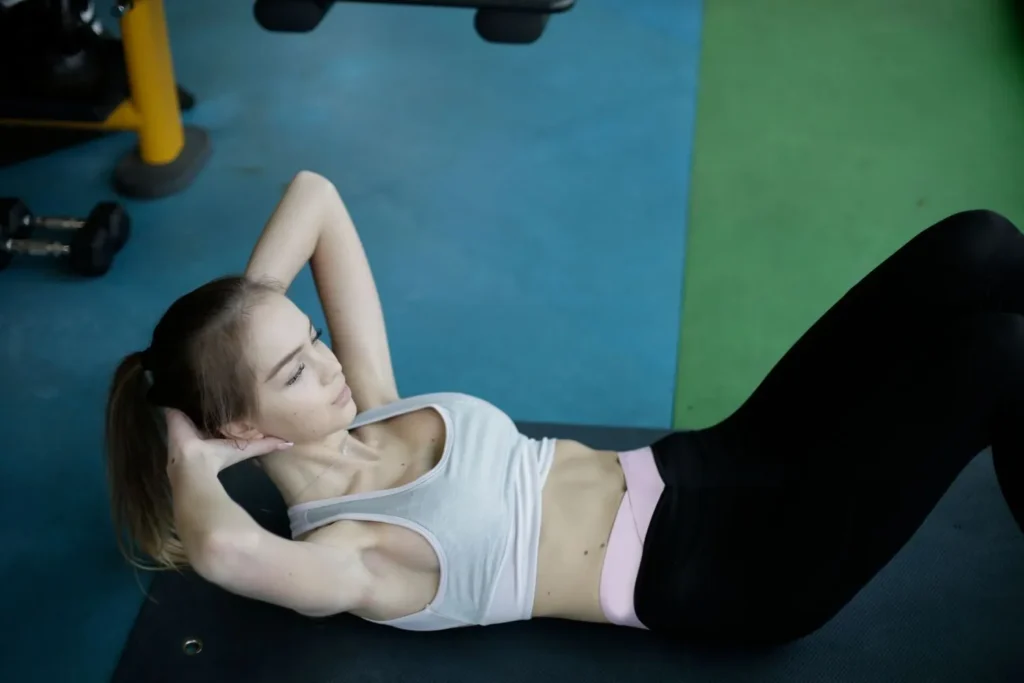
If you are new to the gym, an abs workout gym for beginners should be short, slow and boring in the best way: three or four exercises, 10 to 15 controlled reps, and about 15 to 20 minutes including rest. The aim in the first month is not a burning core. It is learning to brace your trunk, breathe properly and move your ribs towards your hips without yanking on your neck. Everything harder gets built on that.
This guide gives you the exact exercises, a sets-and-reps table with form cues, a four-week progression, and fixes for the problems most first-timers run into. It stays narrow on purpose. If you have trained for a while and want longer sessions, jump to our abs workout gym guide instead.
What Should an Abs Workout Gym for Beginners Include?
A beginner abs session needs one exercise that curls the ribs towards the hips (flexion), one that stops your lower back from arching (anti-extension, like a plank), and one that works the hips and lower abs (a leg raise or knee raise). Three to four exercises, 2 to 3 sets each, done twice or thrice a week, is enough.
Most beginners do the opposite. They copy a random reel, do 100 crunches on the floor, and leave without knowing whether any of it worked. A better rule is control first, load second: a plank before a weighted crunch, and a slow knee raise before anything hanging or explosive.
For the bigger picture of how core training fits into a full week, our ab workouts guide covers the principles. If you are still deciding how many days to train overall, start with the workout schedule for beginners and slot abs into it.
Which Gym Equipment Is Best for Beginner Abs?
For the first two months you need only a mat, a cable stack with a rope attachment, and a captain’s chair (the padded station with armrests where you lift your knees). The cable gives guided resistance, the mat covers floor work, and the captain’s chair teaches hip and lower-ab control. Skip the ab wheel and hanging leg raises until week five or later.
The cable crunch is usually the friendliest starting point. The cable controls the path of the resistance, so you cannot cheat the range as easily as on a floor crunch. You kneel, hold the rope beside your ears, and curl down using your abs, not your arms.
The captain’s chair is worth learning early because it trains the lower abs and hip flexors together and teaches you to stay still while your legs move. That skill carries over to nearly every other core exercise.
| Equipment | Best for | Beginner difficulty | Watch out for |
|---|---|---|---|
| Floor mat | Planks, dead bugs, bicycle crunches | Easy | Pulling on the neck during crunches |
| Cable with rope | Cable crunch, loaded flexion | Easy to medium | Starting too heavy and using the hips instead of the abs |
| Captain’s chair | Knee raises, lower abs | Medium | Swinging the legs and arching the lower back |
| Swiss ball | Ball crunch, stability work | Medium | Rolling off the ball; keep feet wide |
| Ab wheel / hanging leg raise | Advanced anti-extension | Hard | Overloading the lower back; leave for later |
Your First Session: Exercises, Sets, Reps and Form Cues
This is a session we would hand a first-time client. It takes roughly 15 to 20 minutes, and every move on it is hard to get badly wrong. Do it at the end of a bigger workout, or after a short warm-up if it is your only task for the day.
| Exercise | Sets | Reps or time | Rest | Form cue |
|---|---|---|---|---|
| Plank (forearms) | 3 | 20-30 sec hold | 45 sec | Ribs down, glutes tight, one straight line from head to heels |
| Cable crunch (rope) | 3 | 12-15 reps | 60 sec | Hips stay still, curl ribs towards pelvis, exhale on the way down |
| Captain’s chair knee raise | 3 | 10-12 reps | 45-60 sec | Press forearms into pads, lift knees slowly, no swinging |
| Dead bug | 2 | 8-10 per side | 45 sec | Lower back stays flat on the mat as opposite arm and leg extend |
Do this two to three times a week, always as part of a bigger session rather than an ab-only day. If you already follow a general routine, our gym workout guide shows where core work sits among the big lifts.
Walkthrough: How to Do Each Move Properly
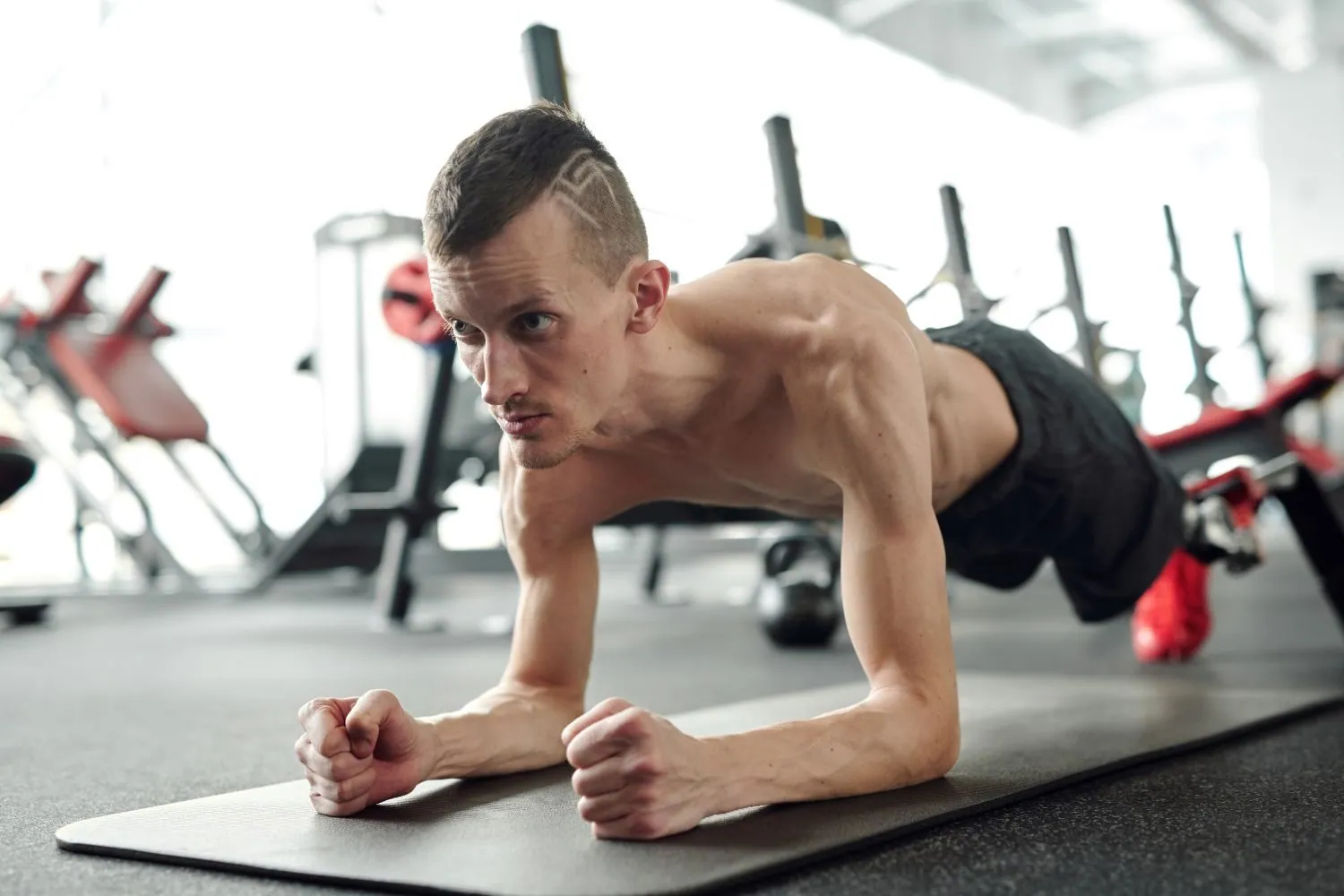
Plank. Place your forearms on the mat with elbows under shoulders. Squeeze your glutes, pull your ribs down towards your hips, and keep your neck long by looking at the floor just ahead of your hands. If your hips sag or pike up, shorten the hold. A 20-second clean plank beats a 60-second sagging one.
Cable crunch. Set the rope at the top of the stack and kneel about an arm’s length away. Hold the rope beside your ears, brace, and curl your ribs towards your hips while your hips stay still. Start with a light weight you can control for 12 to 15 reps. If your hips are sitting back and forth, the weight is too heavy.
Captain’s chair knee raise. Stand on the footrests, rest your forearms on the pads, and press your lower back lightly into the backrest. Lift your knees to about hip height, tilt your pelvis up slightly at the top, then lower for a slow count of three. The slow lowering is where most of the work happens.
Dead bug. Lie on your back with arms pointing to the ceiling and knees bent at 90 degrees. Extend the opposite arm and leg while keeping your lower back pressed down. Return and switch. If your back arches, make the movement smaller.
Myth Check: Will Crunches Give You a Six-Pack or Burn Belly Fat?
No. Ab exercises strengthen the muscle underneath, but whether you can see it depends mainly on your overall body fat, which is driven by food, daily activity and consistent training across the whole body. You cannot spot-reduce belly fat with crunches. Strong abs hidden under a layer of fat simply stay hidden.
For most people, visible abs need a slow fat-loss phase, often a deficit of roughly 300 to 500 kcal a day below maintenance, which tends to mean losing around 0.25 to 0.5 kg a week. That can take months, and results vary a lot between bodies. There is no guaranteed timeline, and anyone promising a six-pack in 30 days is selling something.
On the plate, think dal, curd, paneer, eggs, sprouts and roti portions that fit your day, with protein at each meal. Many active adults aim for roughly 1.2 to 1.6 g of protein per kg of body weight, though your needs depend on your health and goals. For a plan built around your own food habits, an online nutritionist consultation is the practical route, and our six-pack workout article covers the visible-abs side in more detail.
How Many Times a Week Should Beginners Train Abs?
Two to three sessions a week, with at least one rest day between them, is the sweet spot for beginners. Your abs recover like any other muscle group. Daily training adds fatigue that tends to wreck form, and it does not speed up results. Two or three focused sessions of 15 to 20 minutes beat seven rushed ones.
Your abs also work during squats, deadlifts and rows, so they are not idle on other days. Beginners on three full-body days a week can add the four-move session to two of them, and pair it with our back workout at gym for beginners.
A Four-Week Progression Plan
Progress by adding small amounts, one variable at a time: first more time or reps, then a harder variation, then a little more load. Do not change everything in the same week. If a week feels too hard, repeat it. There is no prize for rushing.
| Week | Plank | Cable crunch | Knee raise | Dead bug |
|---|---|---|---|---|
| 1 | 3 x 20 sec | 3 x 12, light | 2 x 8 | 2 x 8 per side |
| 2 | 3 x 25 sec | 3 x 12-15, same weight | 3 x 8-10 | 2 x 10 per side |
| 3 | 3 x 30 sec | 3 x 15, then add a small plate | 3 x 10-12 | 3 x 8 per side |
| 4 | 3 x 30-40 sec | 3 x 12 at the heavier weight | 3 x 12 | 3 x 10 per side |
After week four, add a harder variation such as a feet-elevated plank or a slow reverse crunch, then move on to the longer routine in our abs workout gym guide. If you train at home on some days, the equipment-light ideas in our home gym workout article keep the habit going.
Troubleshooting: Neck Pain, Back Pain, or Feeling Nothing in the Abs
Neck pain after crunches. You are pulling with your arms. Keep your chin slightly tucked, hands light at your temples or on the rope, and let your ribs curl towards your hips. Look at a point on the ceiling rather than your knees.
Lower back ache during planks or knee raises. Your ribs are flaring and your back is arching. Squeeze your glutes, pull your ribs down, and shorten the set. If the ache is sharp rather than a muscular burn, stop the exercise.
Feeling nothing in your abs. Usually the reps are too fast or the weight pulls through the hips. Slow the lowering phase to three seconds, exhale fully at the hardest point, and reduce the load until you feel the abs, not the hip flexors.
Beginner Abs Training for Women, Men over 35 and Desk Workers
Women. The same exercises apply. If you are pregnant, within roughly the first few months after delivery, or have a known abdominal separation, check with your doctor or a qualified physio before starting crunches or planks. Our online weight loss trainer programme can adapt the plan to your stage.
Men over 35. Joints and recovery matter more. Favour planks, dead bugs and cable crunches over fast, jerky moves, warm up for 5 minutes, and keep the weight modest. Add a rest day between sessions if you feel stiff.
Desk workers. Long sitting tightens the hip flexors and weakens the trunk. Take a short walk every hour or so, and consider a gentle stretch or breathing session on rest days, such as the classes in our online yoga classes, which help with core control and flexibility.
When to See Your Doctor Before or During Ab Training
See your doctor or a physiotherapist before starting, or stop and get checked, if you have a hernia or a bulge in the abdomen, recent abdominal surgery, a back or disc problem, high blood pressure, or heart or breathing conditions. The same goes for sharp pain, numbness, tingling down a leg, dizziness, or chest discomfort during exercise. Mild muscle burn is normal; pain that feels sharp or lingers is not.
If you are injured, do not train through it. A professional can tell you which moves are safe and which to skip. This article is general information and not medical advice.
Frequently Asked Questions
What is a good abs workout for gym beginners?
A good beginner abs workout uses 3 to 4 exercises covering flexion, anti-extension and the lower abs, such as cable crunches, planks and knee raises. Keep reps controlled at 10 to 15, hold planks for 20 to 30 seconds, rest 45 to 60 seconds between sets, and put form ahead of weight.
How many ab exercises should a beginner do?
Three to four exercises per session is enough for most beginners. Doing more usually means rushed reps and fatigue-driven mistakes by the end. Two to three sets of each, with proper breathing and control, will challenge a new trainee more than a long list of exercises done on autopilot.
Can beginners get abs without a gym?
Yes. Planks, dead bugs, bicycle crunches and leg raises build the same core strength as most gym equivalents. Visible abs depend far more on body fat, which food and overall activity control, than on where you train. A gym simply gives you more resistance options as you progress.
How often should beginners train abs?
Two to three times a week with a rest day in between is ideal. Abs recover like any other muscle group, and training them daily does not speed up progress. It mainly adds fatigue, which makes your form worse just when technique needs the most attention.
Do I need special gym equipment to start training abs?
No. A mat and a cable machine cover most of what a beginner needs, and bodyweight versions work well while you learn to brace and control your spine. A captain’s chair is a useful addition once you are comfortable, but none of it is mandatory.
Next step: if you want a core plan matched to your schedule, body and injuries, book a session with our coaches for 1-on-1 personal training and start with a form check on these four moves.


