

A home gym workout is a strength session built around a few pieces of equipment you own, usually adjustable dumbbells, a bench, bands and a pull-up bar, rather than a commercial gym’s full floor. It works because muscle responds to progressively heavier effort, not to the building you train in. Here is the setup, the weekly plan and the fixes for when progress stalls.
What is a home gym workout, and how is it different from a home workout?
A home gym workout is a weights-based session using owned equipment such as a bench and adjustable dumbbells, so you can add load week after week. A plain home workout is mostly bodyweight movements like push-ups and squats. The first scales strength steadily; the second tends to plateau sooner once bodyweight stops feeling hard.
Both are valid starting points. If you have no equipment yet and want to begin this week, our home workout guide covers bodyweight sessions. This article is for people ready to set up a small equipment corner and train the way they would in a gym, just closer to the bedroom.
What equipment do you need for a home gym setup?
You need five basics: adjustable dumbbells, a flat-to-incline bench, resistance bands, a doorframe pull-up bar and a yoga mat. Together they cover pushing, pulling, legs and core. Roughly Rs 12,000 to Rs 25,000 covers the lot in most Indian cities, and you can buy in stages instead of all at once.
Prices below are rough ballparks and move with brand, city and online sales. Treat them as planning ranges, not quotes.
| Item | Rough cost (Rs) | What it unlocks | Buy it when |
|---|---|---|---|
| Yoga mat | 500 to 1,500 | Floor presses, planks, stretching, protects the floor | Day one |
| Adjustable dumbbells (about 2 to 20 kg each) | 4,000 to 9,000 | Squats, presses, rows, lunges, curls | Day one |
| Resistance bands | 500 to 1,500 | Face pulls, shoulder warm-ups, assisted pull-ups | Week one |
| Adjustable bench | 5,000 to 10,000 | Incline press, supported rows, step-ups, split squats | After 3 to 4 consistent weeks |
| Doorframe pull-up bar | 800 to 2,000 | Pull-ups, chin-ups, hanging knee raises | When rows feel easy |
Skip all-in-one multi-gym machines unless you have both the budget and a dedicated room. Simple, adjustable and compact beats impressive and unused. Choose dumbbells with a secure collar or locking system, and check that your pull-up bar suits your door frame before hanging your full weight from it.
Home gym workout plan: a 4-day weekly chart
This home gym workout chart uses an upper/lower split, so every muscle is trained twice a week with at least a day between similar sessions. Pick weights where the last two reps of each set feel hard but your form stays clean. It suits beginners with a few weeks of basics behind them.
| Day | Focus | Exercises | Sets x reps | Rest |
|---|---|---|---|---|
| Monday | Upper A (push-led) | Dumbbell bench press, seated shoulder press, one-arm dumbbell row, band face pull, plank | 3 x 8-12 (plank 3 x 30-45 sec) | 60-90 sec |
| Tuesday | Lower A (squat-led) | Goblet squat, dumbbell Romanian deadlift, reverse lunge, standing calf raise | 3 x 10-12 (calves 3 x 15) | 60-90 sec |
| Wednesday | Rest or walk | 20-30 minute walk, light stretching | – | – |
| Thursday | Upper B (pull-led) | Pull-ups or band-assisted pull-ups, incline dumbbell press, bent-over row, dumbbell curl, overhead triceps extension | 3 x 6-12 | 60-90 sec |
| Friday | Lower B (hinge-led) | Bulgarian split squat, dumbbell hip thrust on bench, step-up, hanging knee raise | 3 x 8-12 per leg where applicable | 60-90 sec |
| Saturday | Optional light day | Brisk walk, cycling or an easy yoga session | 20-40 min | – |
| Sunday | Rest | Full rest, sleep and food on point | – | – |
Run this for four to six weeks before changing anything. If you prefer to hit everything in each session, a three-day full-body layout works just as well, and our full body workout guide shows how to structure it. For dumbbell-specific exercise choices, see the home dumbbell workout breakdown.
How do you run a home gym workout session step by step?
Warm up for 5 to 10 minutes, do compound lifts first, then smaller isolation work, resting 60 to 90 seconds between sets. A session takes about 45 to 60 minutes. Write down every weight and rep count so you can add a little load or one extra rep each week.
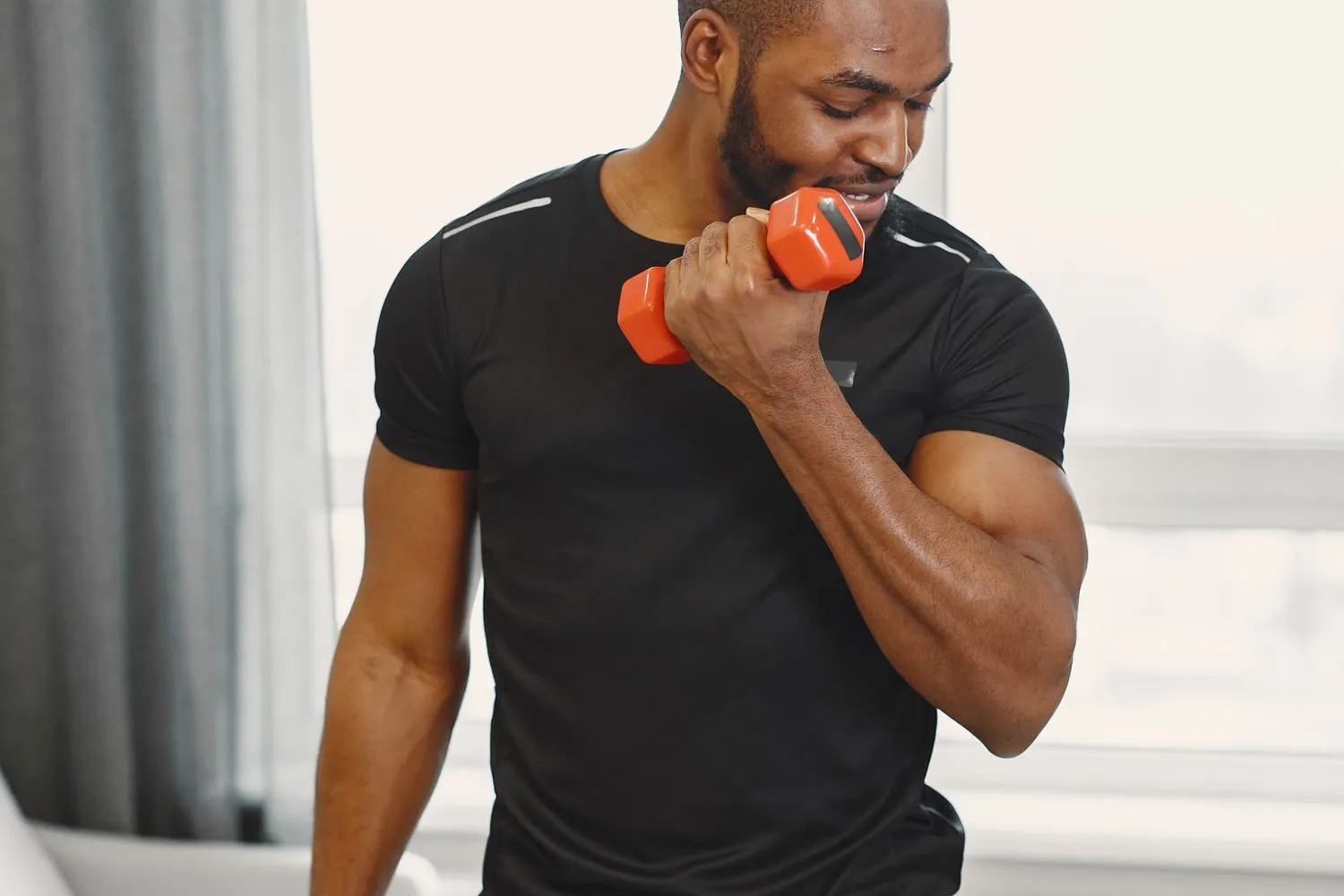
- Warm up (5 to 10 minutes). Brisk marching or skipping for two minutes, then arm circles, hip circles, bodyweight squats and a few light reps of your first exercise.
- Do the big lift first. Squats, presses, rows and deadlift variations use the most muscle, so do them while you are fresh.
- Add accessories. Curls, triceps work, calf raises and core finish the session without draining you early.
- Use the double progression rule. When you hit the top of the rep range on every set (say 12 reps) with clean form, add a small amount of weight and drop back to the bottom of the range.
- Cool down for 3 to 5 minutes. Easy walking and gentle stretches. Then eat a proper meal with protein.
Fixed training slots beat motivation. Keep the gear visible, not buried in a cupboard, and pin a simple home workout time table near your mat so you are never deciding what to do. Even a 30 minute fixed window works if it is protected like a meeting.
Three myths about home gym workouts, corrected
Myth 1: You cannot build real muscle without a barbell and rack. You can build solid muscle with dumbbells, a bench and bands for a long time, because muscle responds to hard sets taken close to failure, not to a particular machine. What a home setup cannot do forever is load a squat or deadlift past what your heaviest dumbbells allow, and that ceiling is the honest limit.
Myth 2: Home gym workouts will make you taller. Once growth plates close in the late teens or early twenties, training does not change skeletal height. What it can do is improve posture. Stronger upper back, shoulders and core stop the slouch that makes people look shorter than they are, and that is a realistic goal worth training for.
Myth 3: Crunches or arm curls will burn fat from one area. Your body decides where fat comes off, not the exercise you pick. Training builds muscle; a modest calorie deficit and consistent walking handle fat loss. If fat loss is your main goal, a coach-built plan from our online weight loss trainer programme pairs the training with the food side.
Troubleshooting: why is your home gym progress stuck?
Most stalls trace back to a few fixable problems: weights that no longer challenge you, too little protein or sleep, no written log, or plain boredom. Check this table first, usually within three to four weeks of stalling, before changing your whole programme or buying more equipment.
| Problem | Likely cause | Fix |
|---|---|---|
| Dumbbells feel too light | Top-end weight reached on adjustable pair | Slow the lowering phase to 3 seconds, add a pause at the bottom, move to single-leg or single-arm versions, or add a band for extra tension |
| No strength gain for 3+ weeks | No logging, random weights, or poor recovery | Write down every set, repeat the same plan, sleep 7 to 9 hours, then add a small load increase |
| Shoulders ache on presses or dips | Elbows flared wide, bench dips too deep | Tuck elbows about 45 degrees, stop dips at a comfortable depth or swap for floor press and push-ups |
| Back is lagging | No pull-up bar, too few pulling sets | Do as many row sets as press sets, add band pull-aparts and a doorframe pull-up bar |
| Skipping sessions | Gear stored away, no fixed time | Leave equipment out, pick fixed days and aim for a minimum 20 minute session on bad days |
| Legs not improving | Weights too light for lower body | Use single-leg work like Bulgarian split squats, which make light dumbbells feel much heavier |
Pain is different from effort. Sharp or joint pain means stop and reduce the load or swap the exercise. Persistent pain, numbness or swelling deserves a doctor’s opinion before you train through it.
Is a home gym workout right for beginners, women and busy professionals?
Yes, for all three, with small adjustments. Beginners should start with two or three full-body days and light weights. Women can use the same plan and weights as men, scaled to ability. Busy professionals benefit most from home training because there is no commute to skip a session for.
- Home gym workout for beginners: start with three days of full-body work, use a weight you can lift for 12 clean reps, and spend the first two weeks learning movements, not chasing heavy loads. Move to the four-day split after about a month.
- Women: lifting weights will not make you bulky by accident; building large muscle takes years of focused effort and heavy eating. Hip thrusts, split squats, rows and presses build strength and shape together.
- Busy professionals: two 30 minute sessions beat zero 60 minute ones. Start with a compact version of the plan and grow it as your schedule allows.
Home gym vs commercial gym: which should you choose?
A commercial gym wins on variety, heavier barbells and racks. A home gym wins on convenience, privacy and consistency, since traffic or a late meeting cannot cancel a session when your equipment is ten steps away. The gym vs home workout choice is not permanent, and many people use home most weeks and a gym for heavier lifting.
If you do have gym access and want a structured weekly layout, the gym workout schedule and gym workout plan pages lay out options you can borrow from at home.
Can you do a home bulking workout, and what should you eat?
Yes, for beginners and intermediates. Do compound lifts for 6 to 12 reps, add load every one to two weeks, and eat roughly 1.6 to 2 grams of protein per kg of body weight daily with a small calorie surplus. Expect slow gains, not dramatic jumps.
In Indian terms, protein can come from eggs (about 6 g each), paneer (about 18 g per 100 g), dal, curd, chicken or fish, and soya chunks. Spread it over three to four meals, not one big dinner. If you struggle to hit your numbers or have a medical condition, a plan from an online nutritionist consultation is safer than guessing.
Know the limit: once your heaviest dumbbells stop being hard even for 12 to 15 slow reps, you have two choices. Make exercises harder with tempo, single-limb work and bands, or add a barbell and rack, or a gym membership, to keep progressing.
Frequently asked questions
What is a home gym workout?
A home gym workout is a strength session done at home with basic equipment such as adjustable dumbbells, a bench, resistance bands and a pull-up bar. Unlike a bodyweight-only routine, it lets you add weight gradually, which keeps building strength and muscle. A typical session takes 45 to 60 minutes, three to four days a week.
How much space and money do I need for a home gym setup?
A clear area of about 6 by 6 feet is enough for the basics: dumbbells, bench, mat and bands. A budget of roughly Rs 12,000 to Rs 25,000 covers a starter kit in most Indian cities, though prices vary. You can start with only a mat and dumbbells, then add the bench and pull-up bar later.
How many days a week should I do a home gym workout?
Most people do well with three to four strength days a week, with at least one rest day between sessions that train the same muscles. Beginners can start with three full-body days. Add walking on other days if you like, but keep one or two full rest days weekly so your muscles and joints can recover.
Can I lose weight with a home gym workout?
Yes, though weight loss mainly depends on eating slightly fewer calories than you burn. Strength training helps you keep muscle while losing fat, and walking adds extra movement. A realistic pace is roughly 0.25 to 0.5 kg per week. You cannot reduce fat from one body part by training only that area.
Is a home gym workout enough to build muscle?
Yes, for a long time. Adjustable dumbbells, a bench and bands let you train every major muscle with hard sets and steady progression. Over years, very strong lifters may outgrow what dumbbells can load, especially for legs, and then barbells or a gym help. For most people, home training is enough to see a clear change.
Want a home gym workout plan built around your exact equipment, space and goal? Our coaches build it into 1-on-1 personal training, with form checks and progress reviews instead of a PDF you forget in a week.


